Start with the access boundary, not the provider label
Treat the first external commitment as a gate on uncertainty and access, not as a choice between provider labels. Before a fund asks an outside party to enter its systems or take on broader responsibility, record four things: the unresolved decision, the information and systems involved, the internal decision owner, and the output that will be reviewed.
Use this commitment record:
Unresolved decision: What must the fund decide about architecture, integration, modernization, implementation, or controls?
Information boundary: What information is collected, processed, or stored, where it resides, and which systems use it?
Decision rights: Which choices remain with the fund, and who approves access, scope changes, and acceptance?
Reviewable output: What requirements, options, assessment, implementation, documentation, or support activity will exist for review?
The record determines the next commitment. When technical direction remains unsettled, ask for a bounded analysis of requirements, options, or risks. When the direction and development plan are clear but internal capacity is limited, consider additional engineering capacity. When the outcome, responsibilities, and acceptance conditions are defined, a project proposal can be evaluated. When the information boundary is unclear, keep the work at assessment until the fund can describe what access is needed and why.
This is a decision sequence rather than a permanent classification. A fund may move from analysis to implementation, or from a defined project to added capacity, but each move should have a stated reason, a new access decision, and a review point. U.S. technology consulting commonly uses project-based, retainer, and staff-augmentation structures; the structure affects contract terms, risks, and deliverables, but it does not answer the fund’s unresolved question by itself.
The first gate is passed when the fund can state the question, the permitted information boundary, the accountable internal owner, and the output that will support the next decision. If one of those items is missing, narrow the request rather than asking for a broad commitment.
Assign authority to artifacts and decisions
A software development consultant is useful when the fund needs an external party to connect a technology need with an examined approach, an implementation activity, or a managed technical task. The role should be bounded by decisions and artifacts rather than by a general promise of expertise.
The supplied role description supports activities such as:
Turn those activities into an authority map before work begins. For each requested activity, record the question being addressed, the artifact or action expected, the person who reviews it, and the decision that remains with the fund. For example, a requirements assessment can produce documented requirements; an architecture review can produce options and trade-offs; implementation can produce an agreed component; and support can produce a defined response activity. The agreement should state which of these is included.
This map also prevents responsibility from expanding by implication. A consultant may analyze requirements without owning the fund’s investment process. A provider may review a technology environment without determining whether the fund satisfies every applicable legal or regulatory obligation. The fund should identify who approves access, accepts technical work, handles incidents, administers permissions, and decides what happens after handoff.
Ask the provider to connect each proposed activity to four points:
What information or system context is needed?
What work will be performed or produced?
What decision can the resulting output support?
Which responsibility remains with the fund?
A scope that names only “technical expertise” leaves the commitment gate open. A scope that names an examined requirement, documented option, implemented component, support activity, or training task gives the fund something to review and a clear boundary for the next access decision.
Make the first commitment reversible
Choose the first commitment by asking how much uncertainty the fund is willing to carry forward and how easily the work can be narrowed if the answer changes. Advisory work, staff augmentation, recruiting, and software delivery are not interchangeable ways to obtain software help.
Advisory or discovery work is the narrower starting point when important choices remain unresolved. Its possible outputs include analyzed requirements, technical options, documented specifications, risk questions, or a plan for a later phase. The fund should define the question to be examined and the decision that the output will inform.
Staff augmentation addresses additional engineering capacity when the development plan is already clear. The fund must state who directs priorities, reviews work, approves access, and makes technical decisions. Adding engineers does not by itself settle an unresolved architecture or information boundary.
Recruiting addresses adding a person or candidate to the fund’s own organization. It follows a different decision path from engaging an external party to assess a system, implement a component, or provide technical support.
Software development delivery addresses an agreed implementation outcome. The scope should state the component or result, responsibilities, acceptance conditions, dependencies, and handoff. A delivery proposal is difficult to compare when the fund is still deciding what should be built or which constraints apply.
Use an exit condition for the first phase. An advisory phase can end with a documented decision and a recommendation about whether to proceed. A capacity phase can end when the agreed work or period is complete. A delivery phase can end at acceptance and handoff. A recruiting process can end with a hiring decision. These endpoints make it possible to narrow or stop the commitment without treating every engagement as a route to a larger one.
A staged path can combine these forms, but each stage should retain its own purpose and decision rights. The useful question is not which label sounds broader. It is whether the proposed first step produces the information or work needed for the next gate without granting more access or responsibility than the current decision justifies.
Classifying the organizational problem first helps keep the engagement aligned with the work required.
Run the four-part commitment gate
Use a four-part commitment gate to decide whether an external engagement should remain narrow or move toward implementation, broader access, or continuing responsibility. The gate is a record of questions and evidence, not a ranking of providers.
1. Direction. State whether the fund is asking for expert input before committing to an approach or is executing a development plan that has already been established. If the direction is unsettled, define the analysis or discovery output first. If the plan is clear, state the engineering work that remains and the internal decisions that govern it.
2. Information. Describe the nature, sensitivity, and location of information the fund collects, processes, or stores, together with the systems that use it. SEC staff guidance says funds and advisers may wish, where relevant, to periodically assess these matters. Use that assessment to define the minimum information and environment access needed for the proposed work.
3. Controls. Identify the regulatory obligations, cybersecurity questions, technical constraints, review responsibilities, and operating dependencies relevant to the scope. A cybersecurity engagement may include assessment of security architecture, identification of gaps, risk assessment, policy and procedure review, and work on controls suited to the organization’s environment and risk profile. Those activities should not be expressed as a promise of a particular compliance or security result.
4. Accountability. Name the people who approve access, set priorities, make technical decisions, review work, accept outputs, and handle handoff. Record the provider’s responsibilities separately from the fund’s responsibilities. If a proposal describes tasks but not decision rights or acceptance conditions, the gate is incomplete.
For supplier diligence, request information that helps define the boundary: traceable company information, relevant supply-chain tiers, foreign influence or ownership, provenance, resilience, and foundational cyber practices. These questions help the fund determine what must be examined before a supplier receives broader access; they do not replace the fund’s own review.
Apply the gate in sequence. First, write the unresolved question. Next, define the least access and smallest output that could answer it. Then request evidence tied to that question. Finally, decide whether the result supports a broader scope, a different engagement structure, a narrower phase, or no further commitment.
For an undocumented or poorly understood system, do not use added capacity as a substitute for understanding the system. For a defined project, do not leave acceptance or handoff implicit. For a retainer, state its purpose, decision set, review cadence, response expectation, and limits. For augmentation, state team interfaces, repository and environment access, review responsibilities, and decision rights.
A project-quote inquiry is ready when the fund can state its business objective, systems context, constraints, required expertise, responsibilities, and evaluation criteria. If the direction or information boundary remains open, ask for the bounded work that will answer those questions instead of requesting a fixed delivery commitment. Expand only when the next responsibility, access request, evidence review, and acceptance path are recorded.
Sequence discovery before augmentation when systems are undocumented
An undocumented legacy system creates a knowledge problem before it creates a staffing problem. If you add engineers before the system, dependencies, and migration constraints are understood, you may increase activity without resolving the uncertainty that governs the work.
Discovery consulting followed by augmentation is a suitable pattern for an undocumented legacy system that must be migrated. The sequence matters because discovery can establish what the system does, where information moves, which dependencies exist, and what decisions must precede implementation.
Treat the discovery phase as a bounded investigation. Ask for outputs such as:
a description of the system boundary and major dependencies;
a record of known interfaces, data movements, and operational assumptions;
documented requirements for the intended migration or modernization;
a list of unresolved technical and ownership decisions;
options with stated trade-offs; and
a proposed implementation boundary for any later engineering phase.
These outputs do not prove that a migration will succeed or that every dependency has been found. They give you material to examine before expanding access, scope, or team size. The acceptance test should therefore focus on whether the agreed questions were investigated and whether the resulting decisions are documented, not on a promise of a particular migration outcome.
Ask the provider to separate known facts, working assumptions, open questions, and recommendations. Request an explanation of how the provider will work with people who understand the existing system and how knowledge will be transferred into your organization. Identify who approves a migration decision and who owns the resulting system.
Move to augmentation only after the discovery output supports a sufficiently clear plan. If major system boundaries, dependencies, or ownership questions remain unresolved, keep the next phase narrow and investigative. If the plan is clear and capacity is the primary gap, an augmentation structure becomes easier to assess against defined work.
Set the financial-services control boundary before modernization
Define the engagement’s access boundary before modernization work reaches sensitive information or important operating systems.
Start with the information and systems involved. Record whether the proposed work touches portfolio information, client information, internal research, credentials, production services, development environments, or third-party platforms. Then identify what access is necessary for the stated task and what access is unnecessary. The boundary should cover people, environments, repositories, interfaces, data, credentials, and the period for which access is granted.
SEC staff cybersecurity guidance says funds and advisers may wish, where relevant, to periodically assess the nature, sensitivity, and location of information they collect, process, or store, together with the technology systems they use. The guidance presents this as a measure to consider, not as a conclusion about your fund’s individual obligations.
Use that principle to make the provider discussion concrete:
Which information categories will the work require?
Where are those categories stored and processed?
Which environments may the provider access?
What controls already apply to those environments?
Who authorizes access, reviews activity, and ends access?
Which responsibilities remain with your fund’s security, technology, and compliance teams?
Modernization should also have an operational boundary. Define whether the provider is advising, coding, testing, deploying, monitoring, or supporting a system. Do not treat a proposal to improve software as permission to change production controls or operational responsibilities.
A provider can contribute technical work within a defined boundary, but your fund remains responsible for deciding how the engagement fits its governance and obligations. Put that decision before the commercial commitment, and make the conditions visible in the inquiry and proposed statement of work.
Evaluate security work through observable evidence
Security capability should be evaluated through observable work, defined responsibilities, and relevant evidence rather than through a broad assurance statement. A cybersecurity consultant may assess existing security architecture, identify gaps, evaluate risks, review policies and procedures, and help establish controls suited to the organization’s technology environment and risk profile.
Translate those activities into questions about the proposed engagement:
What architecture or environment will be assessed?
Which risks and gaps are within scope?
What method will the provider use to record findings and prioritize them?
Which policies or procedures will be reviewed?
What control recommendations will be produced?
Who decides whether a recommendation is accepted, deferred, or rejected?
What evidence will show that an agreed action was completed?
Ask for anonymized examples of deliverables where permitted, such as an assessment structure, findings format, risk register, control-mapping approach, or remediation plan. The request is not for confidential client information. It is a way to see whether the provider can make its work inspectable.
These categories are evaluation prompts, not proof that a provider satisfies your requirements.
Separate security assessment from security ownership. An assessment can identify a gap; it does not by itself close the gap. A control recommendation can inform a decision; it does not establish that your fund has met every applicable obligation. Your scope should state who implements changes, who tests them, who approves residual risk, and who maintains the control afterward.
Use a decision gate before access expands: proceed only when the provider can explain the work, the evidence it will produce, the information it needs, and the responsibilities that remain with your organization. If those answers are vague, keep the engagement at a narrower assessment boundary.
Examine the information and supplier boundary
The information and supplier boundary includes more than the provider’s technical skills. It includes the organization you would contract with, the people and systems involved, the origin and handling of information, and the conditions under which the relationship can continue.
Use those categories to structure your inquiry:
Traceability: Can you identify the contracting entity, operating locations, relevant contacts, and responsibilities?
Supply-chain tier: Is the provider direct, or will subcontractors or other suppliers touch the work, information, or environment?
Ownership and influence: What organizational relationships could affect control, access, or continuity?
Provenance: Where do the provider’s services, tools, personnel, and relevant components originate?
Resilience: How would the provider sustain the agreed work if staffing, systems, or operating conditions changed?
Foundational cyber practices: What practices apply to the provider’s public-facing technology and development activity?
The questions should be proportionate to the work. A provider with no access to sensitive systems presents a different information boundary from a provider implementing code in a production-adjacent environment. State the difference rather than applying one undifferentiated checklist.
That gives you a reason to revisit the boundary when scope changes, not only when the relationship begins.
Request evidence that can be examined and retained: organizational details, relevant supplier disclosures, access responsibilities, subcontractor information where applicable, continuity arrangements, and descriptions of security practices. Do not treat a completed questionnaire as a substitute for deciding whether the proposed access and responsibilities fit your fund. Use the evidence to define the contract, the access model, and the review points.
Turn each open risk into an evidence request
Turn each open risk into an evidence request that can be reviewed at the commitment gate. A provider’s presentation is not a substitute for a record showing what the proposed team can examine, produce, access, and hand over.
Create an evidence register with one row for each material question. Record the question, the requested evidence, the person who will review it, the decision it informs, and the condition that remains open if the response is incomplete.
Use these evidence categories:
Technical work: Ask how the proposed team analyzes requirements, documents specifications, develops or implements solutions, and handles support or handoff. Request an anonymized artifact or a walkthrough tied to the proposed type of work where appropriate.
Financial-services context: Ask the team to explain how it would account for the operating realities, control expectations, and dependencies relevant to a financial organization.
Information and access: Ask what environments, repositories, interfaces, and information categories are required, for what purpose, and for how long.
Delivery responsibility: Ask how requirements, design decisions, review points, acceptance, changes, documentation, and handoff would be recorded.
Communication and integration: Ask who communicates findings, who works with internal decision owners, and how unresolved questions are surfaced.
Engagement boundaries: Ask why the proposed structure matches the current decision and what would cause the provider to narrow, pause, or change the scope.
For each response, distinguish among an answer about the proposed work, a relevant example or anonymized artifact, a named responsibility in the team and agreement, and a stated limitation. These are different forms of evidence. A response should not be treated as proof of a capability that it does not address.
The register should remain live after selection. When the proposed scope changes, add the new question before approving broader access or responsibility. When an item cannot be answered, make that limitation visible in the proposal or keep the work at the narrower gate. This turns evaluation into a sequence of decisions rather than a general impression of fit.
Record how responsibility changes when access expands
Record how responsibility changes when the fund moves from a bounded question to a larger commitment. U.S. technology consulting commonly uses project-based, retainer, and staff-augmentation structures, and each affects contract terms, risks, and deliverables. The useful comparison is how each structure assigns decisions, access, review, and handoff.
Structure
Record before approval
Primary boundary
Project-based
The outcome, deliverables, acceptance conditions, change process, dependencies, and handoff
Do not treat an unsettled technical direction as a fixed delivery scope.
Retainer
The recurring purpose, decision set, review cadence, response expectation, and limit on work
Do not allow continuing access without a stated reason and review point.
Staff augmentation
The internal direction of work, team interfaces, repository and environment access, review responsibilities, and technical decision rights
Do not use additional capacity to conceal unresolved questions.
Use the same responsibility chain for every structure: who defines the work, who performs it, who reviews it, who accepts it, who operates the result, and who decides on a change after handoff. Write those answers into the proposed scope rather than inferring them from the label.
The structure can change as the evidence changes. A fund may begin with a bounded analysis, then request a project proposal if the outcome becomes clear. It may instead request additional capacity when the plan is settled but execution resources are limited. A continuing advisory arrangement requires its own purpose and review cadence. Each transition should reopen the access boundary and identify the new decision owner.
Compare proposals by the responsibility record, not by the apparent flexibility of the model. A workable proposal shows what the fund controls, what the provider performs, what evidence will be reviewed, and what ends the current commitment.
Escalate evidence in proportion to requested access
Escalate evidence in proportion to the access and responsibility the fund is considering. The first request should test whether the proposed work fits the unresolved question. A later request should examine the people, systems, supplier boundary, and operating conditions involved before the commitment expands.
Use four checkpoints:
Checkpoint 1: written scope. Request the proposed objective, assumptions, activities, outputs, dependencies, responsibilities, access needs, review points, acceptance conditions, and circumstances that would narrow or pause the work.
Checkpoint 2: technical explanation. Ask the people proposed for the work to explain how they would analyze requirements, document specifications, develop or implement the relevant solution, manage the activity, or support the result. Request an anonymized example or decision record where it helps the fund assess the proposed work.
Checkpoint 3: access and supplier boundary. Ask which environments, repositories, interfaces, and information categories are needed; how access is approved and reviewed; which legal entity will contract; and whether subcontractors or other suppliers will participate. For a supplier, examine traceable company information, relevant tiers, ownership or influence, provenance, resilience, and foundational cyber practices as applicable to the fund’s diligence.
Checkpoint 4: expanded commitment. Before adding systems, information, people, or time, record the evidence that supports the change, the new responsibilities, the acceptance or review point, and the person who approves it. If the response is incomplete, retain the narrower scope or request the missing diligence rather than treating the gap as resolved.
Include questions about security architecture, gaps, risks, policies, procedures, and controls when cybersecurity work is in scope. Include the operational dependencies and control expectations relevant to the financial organization. Keep those questions tied to the proposed work; they do not establish a particular regulatory or security outcome.
A provider does not need to supply every item in one document. The important distinction is between evidence available now, evidence that requires a later diligence step, and a limitation that the provider cannot support. Keep that distinction in the decision record before approving the next level of access.
Write the quote brief as the gate’s decision record
Write the quote brief as the commitment gate’s decision record rather than as a general request for software help. The brief should show what is known, what remains uncertain, what the provider may access, and what the fund will use to decide whether to proceed.
Include these sections:
Decision to support: State the operating or technology question the work should answer.
Current evidence: Describe the relevant systems, workflow, technical debt, known constraints, and internal capabilities without sharing unnecessary sensitive information.
Requested output: Identify the assessment, options, component, modernization activity, integration, or other work under consideration.
Information boundary: List the information categories, environments, repositories, interfaces, and access levels that may be involved.
Control context: Identify operational dependencies, control expectations, review participants, and the consequences of an unsuitable change that the provider must understand.
Responsibilities: Separate provider activities from fund decisions, approvals, access administration, testing, deployment, support, and handoff.
Evidence request: State which technical explanations, artifacts, responsibility assignments, supplier details, and access responses are required before the commitment expands.
Engagement boundary: Explain whether the fund is considering bounded analysis, a project, a retainer, augmentation, or a staged path, and identify what remains open.
Acceptance and exit: State how the output will be reviewed, what ends the phase, and what decision follows.
Unknowns: List assumptions that must be tested rather than silently embedded in the proposal.
If the architecture, system condition, or information boundary is not sufficiently understood, request a bounded assessment or discovery output instead of forcing a fixed delivery quote. If the plan and acceptance conditions are clear, the brief can support a project proposal. If the plan is clear but capacity is the constraint, state the internal direction and review model needed for added engineers.
Keep the brief suitable for controlled sharing. Use abstractions or redacted examples where possible, and identify what a provider must know before receiving more detailed information. A quote request is ready when its decision, access boundary, evidence request, responsibility record, and next review point are visible.
Choose a bounded provider conversation
A bounded provider conversation should test whether the proposed work, people, controls, and engagement structure fit the decision your fund has already defined. Keep the conversation narrow enough that you can distinguish a relevant response from a generic capability presentation.
Neutech offers custom software development services. Neutech also provides senior software designers and developers to augment product and development teams. Those are separate service facts: one concerns custom development, while the other concerns additional design and development capacity.
Neutech uses Scrum and agile planning for project management. If that approach is relevant to your proposed work, ask how planning, review, documentation, decision ownership, and acceptance would operate within your fund’s processes. A named method does not settle the scope or control boundary; the conversation should connect the method to the assignment you described.
Bring these questions to the discussion:
What does Neutech understand the decision and business objective to be?
Which parts of the work are discovery, implementation, support, or added capacity?
What information and system access would the proposed team require?
Which people would perform the work, and who would own technical decisions?
What would be produced at the end of the first bounded phase?
Which assumptions could change the proposed structure or scope?
How would your fund review, accept, document, and maintain the resulting work?
What evidence should be available before any increase in access or commitment?
Use the answers to test fit, not to invite a broader promise. If the provider recommends a different structure from the one you expected, ask which unresolved decision led to that recommendation. If the recommendation depends on information you have not yet shared, identify the smallest safe discovery step that would resolve the dependency.
The services and planning approach described above do not by themselves establish suitability for your specific systems, information boundary, controls, or project outcome. Keep those questions in the evaluation record and require the proposed scope to answer them directly.
Use the decision’s limits to set the next step
The next step should be limited by what you know, what you still need to decide, and what access the work would require. Use advisory or discovery work when the technical direction or system boundary remains uncertain; use augmentation when the plan is clear and capacity is the main gap; use a project structure when deliverables and acceptance conditions are defined.
Before you proceed, confirm that your brief names the business objective, current systems context, information boundary, required expertise, responsibilities, engagement preference, and evaluation criteria. Ask for evidence that fits the proposed access and supplier relationship. NIST’s due-diligence categories provide a practical prompt for examining traceable company information, supply-chain tiers, ownership or influence, provenance, resilience, and foundational cyber practices.
A qualified professional inside your organization should decide whether a proposed engagement fits your fund’s legal, regulatory, investment, cybersecurity, and operational requirements. External technical input can inform that decision, but it does not replace your organization’s own approval and oversight.
If the assignment has a defined objective, prepared constraints, and a clear expectation for external engineering support, the inquiry can begin with a bounded question and an evidence request rather than an open-ended search.
What should a hedge fund clarify before contacting a software consultant?
What does a software development consultant do?
A software development consultant analyzes requirements, identifies strategies, develops or implements software solutions, manages projects, provides technical support, and trains clients on new systems.
When should a hedge fund consider engaging a software development consultant?
A hedge fund should consider engaging a consultant when it needs expert input on unresolved technical decisions, additional engineering capacity for a defined plan, or assistance with implementing a specific software solution.
What are the different engagement models for technology consulting?
Common engagement models include project-based, retainer, and staff augmentation. Each model has distinct contractual mechanics, risk profiles, and appropriate use cases.
How can a hedge fund evaluate a potential software development consultant?
A hedge fund can evaluate a consultant by assessing their technical capability, financial services fit, security and compliance posture, delivery approach, communication skills, team integration, and engagement flexibility.
What information should a hedge fund prepare before requesting a project quote from a consultant?
Before requesting a project quote, a hedge fund should prepare a brief that includes the business objective, current systems context, desired scope, information boundary, required expertise, responsibilities, engagement preference, evaluation criteria, and any questions or unknowns.
What is the importance of defining the control boundary in financial services technology consulting?
Defining the control boundary is crucial to ensure that the engagement aligns with regulatory obligations, cybersecurity exposure, and operational responsibilities, particularly when sensitive information or critical systems are involved.
Map accountability across the delivery roles
Software consulting helps you decide, design, and coordinate technology work; it is not automatically the same as adding developers or buying software. A consultant may analyze requirements, recommend strategies, improve or implement systems, manage projects, document requirements, provide technical support, or guide development teams. Staff augmentation has a narrower operating model: professionals join your existing team and execute defined work under your management. A software vendor provides a product and may provide a limited implementation, while a systems integrator connects a selected platform to your existing systems and data.
For a hedge fund, a useful starting point is an accountability map rather than a provider label. Record who owns requirements and technical direction, who performs defined work under client management, who supplies a product, and who connects a selected platform to existing systems and data. These roles can involve different outside parties, so write the boundaries between them before work begins. The map gives internal stakeholders a shared basis for discussing budget, access, risk, timing, and knowledge transfer.
The distinction affects accountability. Advice should produce a decision you can act on; execution should produce agreed work; a product should provide a defined function; and integration should connect that function to your operating environment. Write that expected result before comparing providers. A clear result also gives your internal stakeholders a common basis for discussing budget, access, risk, and timing.
What software consulting includes
Software consulting can span a project from planning through implementation methodology. The work may include requirements specification, use-case definition, data modeling, technical design, solution development, and implementation methodology. The scope can stay at the advisory level or extend into implementation and support, so you should not assume that every consulting team performs every activity. Ask the provider to separate recommendations, build work, implementation assistance, and ongoing support in its proposed scope.
A defined engagement can produce several kinds of deliverables, depending on the problem you bring:
A current-state assessment that describes relevant systems, dependencies, constraints, and unresolved requirements.
A requirements record that translates business and technical needs into testable statements.
Use cases, data models, process maps, or architecture materials that clarify how a proposed solution should work.
A shortlist or recommendation for software, an integration approach, or a delivery sequence.
An implementation plan with responsibilities, dependencies, acceptance conditions, and decision points.
Technical documentation, training, support guidance, or project reporting where those items are included in scope.
Treat each item as a proposed output, not as an automatic feature of the consulting label. For every deliverable, identify its intended user, the decision it should support, the information required to produce it, and the person who will accept it.
Software consultants may also evaluate current technology use, identify business needs, recommend software opportunities, and address defects, security weaknesses, or relevant upgrades. Those activities describe possible work, not a promise that a consultant will discover or resolve every issue. Ask which activities are included, which are excluded, and what information your team must provide before work begins. If implementation is included, define where the consultant’s responsibility ends and your production, operations, or security responsibilities begin.
When a hedge fund may need software consulting
Your hedge fund may need outside consulting when a technology question crosses team boundaries or carries consequences that make trial-and-error expensive. Typical triggers include:
Data or analytics work that depends on several sources, unclear ownership, or inconsistent requirements.
Architecture decisions involving application boundaries, system design, software selection, or integration.
Security work involving access control, identity design, vulnerability assessment, remediation oversight, monitoring, or security within the development lifecycle.
A proposed system change that requires a structured assessment before your team commits to implementation.
The practical test is whether you need accountable analysis and direction, not merely more hands to complete an already-defined backlog. If the main question is still what should change, why it should change, or how several systems should work together, an advisory or coordinated engagement may be more appropriate than adding execution capacity.
Data integration deserves a separate decision because it can connect operational systems, external data, analytics workflows, and downstream applications. At Neutech, we consider automated data integration fundamental for hedge fund managers navigating financial-services complexity. If integration is your concern, ask the consultant to define the systems in scope, the data movement or transformation required, ownership of data quality, monitoring responsibilities, and the decisions the resulting data must support. Do not treat the existence of a data pipeline as proof that the resulting information is fit for every analytical or operational use.
Security and compliance work can also justify a consulting assessment when you need to understand controls, identify gaps, or organize remediation. Security and compliance consulting may include control assessments, gap analysis against selected standards, risk-management processes, compliance project planning, and policy or procedure maintenance. Cloud-security responsibilities may include access-control design, vulnerability assessment, remediation oversight, monitoring, and integration of security into the software development lifecycle. Ask for a clearly bounded work product rather than accepting a general assurance that a proposed system will be compliant. Your scope should identify the control question being examined, the evidence to be reviewed, and the person responsible for the resulting decision. Use the trigger to determine the first artifact you need. A data-integration concern may call for a defined system and data boundary, ownership of data quality, and monitoring responsibilities before build work is approved. An architecture concern may call for documented alternatives, constraints, and decision rights. A security or compliance concern may call for a control assessment, gap record, and remediation ownership. A delivery concern may call for a dependency and responsibility map. These artifacts do not resolve every issue, but they expose whether the proposed engagement is still diagnosing the problem or is ready to implement a chosen approach. That distinction helps prevent implementation activity from becoming a substitute for an unresolved decision.
Match the technology problem to the outside role
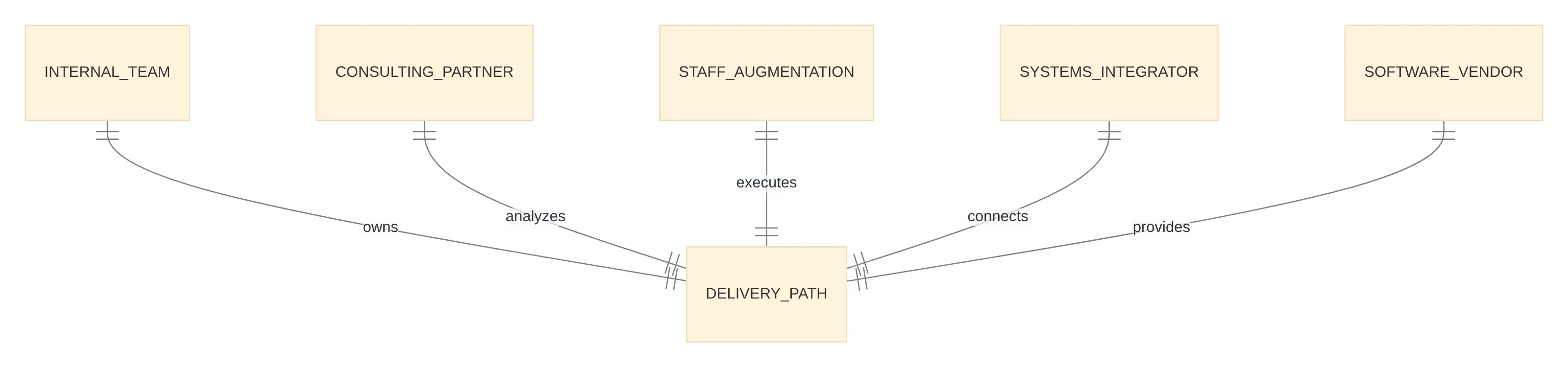
The right outside role depends on what remains unresolved after you describe the problem. Consulting, staff augmentation, systems integration, and a software product can appear in the same project, but they answer different questions. Use the comparison below to identify the first role to evaluate. A project can move from one path to another, but that transition should be explicit rather than hidden inside a broad statement of work.
Delivery path
Primary question
Expected accountability
Use this path first when
Request before selection
Internal team
Can your existing team define and deliver the work?
Your team owns the diagnosis, design, and execution.
The problem is understood and internal capacity, not direction, is the constraint.
A capacity plan, named owner, and delivery sequence.
Consulting partner
What should you build, change, or prioritize, and why?
The consultant analyzes, plans, and provides agreed direction or coordinated change.
The problem is ambiguous, cross-functional, or requires an external technical assessment.
Scope, assumptions, decision rights, and concrete deliverables.
Staff augmentation
Who can execute defined work inside your team?
Your team manages priorities and the augmented professionals execute assigned work.
The approach, backlog, tools, and internal ownership are already clear.
Skills, role boundaries, reporting model, and onboarding requirements.
Systems integrator
How will a selected platform connect to your systems and data?
The connection work is assigned within an agreed technical boundary.
You have selected or are close to selecting a platform and the integration is the main obstacle.
Integration architecture, dependencies, testing responsibilities, and handoff plan.
Software vendor
Which product provides the needed function?
The vendor provides the product and usually a defined implementation scope.
Your requirement maps to a product that you can evaluate and operate.
Product scope, implementation limits, data handling, support, and exit conditions.
Do not choose a broader engagement merely because it sounds more capable. If your team can make the key decisions and only lacks execution capacity, staff augmentation may fit. If the central uncertainty is what to build or how to structure the change, consulting deserves priority. If the product is known but the connection is difficult, evaluate integration work. If the need is a defined function that can be evaluated independently, start with the product category. Record the chosen path and the reason before you invite proposals.
The delivery path should match the unresolved technology problem and the accountability your team needs.
Define the deliverables and decision rights before selection
A consulting brief should define the work product before it defines the provider. Consulting may include requirements, data modeling, technical design, implementation guidance, project management, training, and support, but the engagement should state which of those activities apply to your problem. A broad statement such as improve our platform leaves too much room for different interpretations. A precise brief also helps your team distinguish a discovery engagement from implementation work and prevents a proposal from silently combining both.
Your brief should resolve five decisions:
Problem boundary: Identify the systems, workflows, data, users, and business decisions in scope. Name the related areas that are outside scope.
Deliverables: Specify whether you expect an assessment, requirements record, architecture recommendation, implementation plan, working software, integration, documentation, training, or another defined output.
Decision rights: State who approves requirements, architecture, security exceptions, priority changes, acceptance, and production release.
Acceptance conditions: Describe what must be present for each deliverable to be accepted, including required documentation, tests, review points, or demonstrations.
Knowledge transfer: Define what your internal team must be able to operate, maintain, review, or extend after the engagement.
These decisions turn a general request into a scope that you can compare across providers. Add the assumptions that could change the work, such as access to systems, availability of subject-matter experts, data quality, and dependencies on other teams. Make knowledge transfer observable at each decision point, not a single final meeting. During current-state work, require a record of assumptions, dependencies, and unresolved requirements. During design, identify which architecture, data-model, or integration choices require internal approval. Before implementation, record access paths, control responsibilities, review points, and acceptance evidence. At handoff, confirm that internal owners can locate documentation, understand open risks, and take responsibility for operation or further change. This sequence connects deliverables to decision rights: a document is useful only when a named stakeholder can review it and use it to approve, reject, or continue the next step. It also helps distinguish a consulting output from an implementation output. A recommendation can be accepted without authorizing a production change; working software or an integration should not be treated as accepted until the stated tests, documentation, and ownership conditions are met. Ask each provider to show where these transitions occur in its method and proposal.
Include commercial and operating boundaries as well. A software-partner audit can examine pricing and contract compliance, code quality, delivery speed, standards adherence, communication, client satisfaction, and internal risk-mitigation practices. Use those dimensions to ask how performance will be reviewed, who owns unresolved issues, how changes affect scope, and what happens when the proposed approach no longer fits. A provider should be able to describe the review mechanism without replacing the deliverable with a general promise. State how disagreements are escalated and how your fund can pause, narrow, or end work if an assumption proves wrong.
Evaluate domain and technical fit through demonstrated work
Domain fit means more than recognizing financial terminology. Evaluate whether the proposed team can understand your data flows, operating constraints, software dependencies, control questions, and delivery context well enough to make useful decisions. Technical fit should cover the relevant application layer, architecture, data work, integration boundaries, and project responsibilities rather than a generic list of programming languages. For a regulated, data-intensive environment, ask how the team will separate technical assumptions from decisions that require internal risk, compliance, or operations ownership.
Ask for demonstrated work in a form you can examine:
A comparable problem description showing the starting condition, assigned scope, decisions made, and delivered outputs.
The roles of the people who performed the work, including who would actually join your engagement.
Examples of technical documentation, architecture decisions, requirements records, or delivery reports that can be shared without exposing confidential information.
A description of how the team handled changing requirements, defects, dependencies, standards, and escalation.
References or client contacts who can discuss communication, delivery behavior, and the quality of the handoff.
Do not treat a sector logo, a tool list, or a senior title as proof that the proposed team fits your specific problem. Ask what the named team members personally delivered, what decisions they owned, and which parts of the example are comparable to your environment.
We provide senior software designers and developers to augment product and development teams. That offering fits an execution path when your team has defined the work and wants additional professionals inside the delivery effort. It does not remove the need to specify whether your engagement requires diagnosis, technical direction, implementation, or team augmentation. If you approach us, describe the work in those terms so the proposed role can be evaluated against the actual need.
Make security and compliance evidence part of the evaluation
Security and compliance should appear in the work plan, not only in the provider overview. Security and compliance consulting may include project planning, control and practice assessments, gap analysis against a selected certification standard, risk-management processes, and security-policy or procedure work. Cloud-security work may include identity and access design, vulnerability assessment, remediation oversight, monitoring, and security integration throughout the software development lifecycle. Match each activity to the systems, data, environments, and access paths in your proposed scope.
Your evaluation should ask questions that connect controls to the proposed work:
What data, environments, accounts, repositories, and operational interfaces will the team access?
Which control objectives or internal policies shape the design?
Who identifies vulnerabilities, assigns remediation ownership, and decides when a finding is closed?
How will identity, access, logging, alerts, secrets, and change records be handled within the scope?
Which security activities belong to the provider, and which remain with your team or another specialist?
What documentation will allow your team to review the decisions and operate the result?
The answers should identify responsibilities and review points. They should not be reduced to a claim that a provider can make your fund compliant. Ask for the evidence that supports each material assertion, and record the control decisions that remain with your own authorized stakeholders.
Vendor due diligence can combine a security questionnaire, objective security-rating information, and external attack-surface analysis. A questionnaire may cover incident response, breach history, governance, and security practices. Use those inputs alongside the proposed scope and access model. A questionnaire alone does not explain how the specific project will protect your systems, data, or operating processes. Compare the requested access with the provider’s stated controls, and require a clear owner for reviewing unresolved findings before access is granted. Organize this review in two passes. Before selection, use the questionnaire, rating information, and attack-surface analysis to identify questions about the provider’s general posture. After the scope is defined, map each requested access path and project activity to evidence, a control owner, and a review point. This prevents a favorable general assessment from being used as evidence for an unrelated project. For example, incident-response documentation may show how a provider addresses incidents, while it does not by itself establish how data access or logging will be handled in the proposed work. Record what each item proves, what it does not prove, and what follow-up is required. The resulting record gives internal security and operations stakeholders a basis for accepting, limiting, or rejecting the proposed boundary without treating the consulting proposal as a compliance conclusion.
Test delivery ownership and internal-team fit
Delivery ownership is the clearest boundary between consulting and staff augmentation. Staff augmentation extends an existing team with professionals who execute defined tasks under your management. Consulting focuses on analyzing, planning, and leading broader business or technology change. Before selection, decide whether you want the outside team to recommend the path, own a defined workstream, perform assigned work, or combine those roles under separate decision rights. If the engagement combines roles, mark the point at which advisory responsibility changes into delivery responsibility.
Your operating-model test should use a short scenario rather than a presentation. Ask the proposed team to explain what happens when requirements conflict, a dependency is late, a security issue appears, or an internal owner rejects a deliverable. Look for named responsibilities:
Who sets priorities and approves changes?
Who makes technical decisions when the internal team and provider disagree?
Who reviews code, architecture, controls, and documentation?
Who communicates status, risks, and decisions to investment-operations or executive stakeholders?
Who owns the result after the provider leaves?
A good fit makes those answers visible before work starts. If the provider expects your team to make every material decision, you may be buying execution rather than consulting. If your team expects the provider to make decisions that require internal authority, clarify that boundary before the engagement begins.
Communication and client relationships belong in the evaluation because delivery quality is not only a technical question. Ask how the provider records decisions, reports progress, surfaces risk, handles disagreement, and measures whether stakeholders understand the result. Match the engagement to your internal capacity: a consulting team should not create an unowned stream of recommendations, and an augmented team should not be expected to define a strategy that your organization has not approved. Set a regular decision and escalation rhythm that fits the people who must approve scope, risk, and release.
Build a verification brief before initiating the engagement
A verification brief gives you a consistent way to compare a proposed partner with the problem you actually need to solve. Prepare one before introductory calls or requests for proposals. Keep it short enough to use, but specific enough to expose assumptions. Give the brief to each serious candidate and compare answers against the same scope, access model, decision rights, and acceptance conditions.
Your verification brief should include these questions and requested materials:
Problem and scope: What decision, system, workflow, or delivery failure must the engagement address? What is outside scope?
Relevant work: Which comparable projects did the proposed team perform, and what did it actually deliver?
Team assignment: Who will do the work, what will each person own, and who provides technical or delivery oversight?
Method: How will the team move from discovery to requirements, design, implementation, review, and handoff?
Technical proof: Which architecture materials, code samples, test records, or integration plans can the provider share?
Security proof: What access will be needed, how will it be controlled, and what information can the provider provide about incident response, governance, and security practices?
Operating fit: How will communication, status, escalation, approvals, and internal-team collaboration work?
Commercial boundary: What is included, what changes the scope, how will contract compliance be reviewed, and what assumptions affect price or schedule?
Acceptance and exit: How will you accept the work, transfer knowledge, and close or extend the engagement?
The purpose is not to collect the longest questionnaire. The purpose is to expose the conditions under which the proposed work can succeed. Request enough detail to make a decision, but do not ask for confidential material that is unrelated to the proposed access or work.
Your selection record should score the answers against your own decision criteria rather than allowing a polished proposal to set them for you. Record unresolved questions, required follow-up, and the person responsible for each decision. Separate confirmed facts, provider assertions, assumptions, and open issues. If a provider cannot explain its scope, ownership, security boundary, or handoff, pause selection until those points are clear. Separate fit from proof in the record. For each criterion—domain, technical, security, operating, or commercial—capture what the engagement requires, the provider’s response, the supporting evidence, the unresolved risk, and the decision owner. A high-level assertion can be relevant but unverified; a reference can speak to communication but not architecture. Do not let strong evidence in one dimension compensate for a missing answer in another when the missing answer concerns access, decision rights, acceptance, or handoff. This preserves the distinction between provider capability, project scope, and internal authority. It also makes a later decision explainable: you can show why the selected path fits and which questions remain open.
Separate current obligations from proposed rules and provider claims
The SEC material cited here describes a proposed cybersecurity risk-management rule, not a determination of current law. The proposal would have required advisers and funds to review cybersecurity policies and procedures at least annually and prepare a written report assessing their design and effectiveness. Do not present that proposal as a current obligation for your fund. Separate enacted requirements, applicable regulatory expectations, internal policies, contractual duties, and proposed rules in your review record.
Provider claims require the same separation. A statement that a team performs gap analysis, policy work, cloud-security design, or vendor due diligence describes a possible service; it does not determine your legal duties or prove that your environment meets them. Ask the provider to identify the exact work product, assumptions, control boundary, and responsible approver. Keep legal, regulatory, investment, cybersecurity, and technology conclusions with the qualified people who have authority to make them.
Your dated decision record should label each item as an internal requirement, a provider capability, a proposed approach, an unresolved question, or a rule that needs professional interpretation. This prevents a proposal, marketing statement, or draft control plan from becoming an accidental compliance conclusion. Link each material decision to the scope, owner, and review date that apply to it.
Make the next step a bounded partner conversation
Use an accountability-and-acceptance model to make the delivery path explicit: assign who diagnoses the problem, sets technical direction, performs implementation or integration, reviews security and compliance controls, and accepts the resulting work. This separates consulting’s analysis, planning, and technical direction from staff augmentation’s execution under the client’s management, while a systems integrator connects a selected platform to existing systems and data and a software vendor provides the product and usually a narrow implementation. Record the expected deliverables, decision rights, security boundary, internal owner, and acceptance conditions in a verification brief, then ask any proposed partner to show which responsibilities it will own and what knowledge it will transfer to the internal team.
Start with the technology decision software consulting should support
Software consulting is most useful when you have a technology decision to make but cannot yet define the right solution, delivery path, or level of risk. You may be deciding whether to replace an aging platform, connect disconnected data sources, build a specialized workflow, assess an AI-enabled product idea, or address security weaknesses in an existing environment. The immediate question is not whether you need more code. It is what decision must become clearer before you commit people, budget, access, or operational risk.
For a hedge fund or another financial-services organization, that distinction matters because technology choices sit inside business processes that may involve sensitive information, third-party dependencies, uptime expectations, and compliance responsibilities. A consultant can help frame the problem, compare feasible paths, and define a bounded deliverable. You still retain responsibility for the business decision and for determining whether a proposed approach fits your environment.
Use the following test at the start:
If the problem is clear and the required build path is already settled, development capacity may be the more direct need.
If the problem is unclear, the options carry different security or operating consequences, or internal teams need an independent technical assessment, consulting may be appropriate.
If you mainly need additional people to execute an established plan, staffing support may fit better than an advisory engagement.
The right engagement begins with a defined decision, not with a generic request for technology help. A useful output should tell you what to do next, what remains uncertain, and what conditions must be met before delivery proceeds.
Define software consulting by the decisions and outputs it supports
Software consulting helps you clarify a technology problem, assess the available paths, and select an appropriate next step. The work can address requirements, feasibility, workflows, risks, and priorities, with a delivery roadmap as a typical output. That makes consulting broader than answering a narrow coding question and more bounded than assuming that a full product build is already justified.
The practical unit of value is a decision supported by a usable deliverable. Depending on your need, that deliverable may be:
A problem definition that separates business requirements from preferred features.
A feasibility assessment that identifies technical constraints and unresolved dependencies.
A current-state and target-state architecture description.
A prioritized roadmap with decision points, assumptions, and areas requiring further validation.
An evaluation of an existing application, integration, workflow, or proposed technology choice.
A risk register that makes security, third-party, data, and operational questions visible.
These outputs should be specific enough to guide a build, a procurement decision, an internal workstream, or a decision not to proceed. A presentation that leaves the same ambiguity in place is not a sufficient outcome for a bounded engagement.
Software consulting also includes interpretation. A consultant may analyze how your organization uses digital technology, determine what your operations need, and advise on opportunities to use software systems. That analysis should connect technical options to the work your teams must perform rather than treat a product label or programming language as the decision itself.
The boundary of consulting is the point where advice becomes execution. A consultant may help you choose a direction, define acceptance conditions, and reduce uncertainty before delivery. Your organization still needs an accountable owner to approve priorities, provide access to relevant people and systems, accept trade-offs, and decide whether the proposed path fits its operating responsibilities.
Ask for the following at the start of any engagement:
What decision will the work support?
Which systems, workflows, stakeholders, and constraints are in scope?
What tangible deliverable will you receive?
Which assumptions must be tested rather than accepted?
What will remain outside the engagement?
A clear answer to those questions turns a broad advisory request into a manageable piece of work.
Separate consulting from development, staffing, recruiting, and implementation
The distinction between consulting and adjacent services depends on the primary decision and deliverable, not on the label used in a proposal. Software consulting and discovery address requirements, feasibility, workflows, risks, and priorities. Custom software development addresses business-specific systems and workflows when existing tools do not support the required processes. System integration connects platforms through APIs and data exchange to reduce disconnected systems and duplicate work.
Use this comparison to identify the work you are actually buying:
Option
Main question
Typical focus
Useful when
Consulting and discovery
What should we do, and why?
Requirements, feasibility, architecture, risks, priorities, and roadmap
The problem or delivery path is not sufficiently defined
Custom development
What system must be built?
Business-specific application behavior and workflows
Existing tools do not support a required process
Staff augmentation
How do we add execution capacity?
Additional engineering or technical capacity within an existing plan
Your team owns the direction and needs more delivery support
Recruiting
How do we hire a permanent capability?
Candidate search, assessment, selection, and employment decision
The need is an enduring internal role rather than a bounded project
Implementation support
How do we configure or deploy a selected system?
Setup, migration, integration, training, and operational handoff
The product or platform decision has already been made
The categories can overlap. A consulting engagement may identify the need for custom development, integration, or added capacity. That does not make the discovery work equivalent to the later delivery work.
Choose consulting when uncertainty about the problem, architecture, risk, or priorities is the main constraint. Choose development when the required system and delivery objective are sufficiently clear. Choose added capacity when the plan is established but execution resources are limited. Choose recruiting when you need an internal long-term role. Choose implementation support when the selected platform and target process are already defined.
A short diagnostic can prevent category confusion:
If you cannot describe the required outcome without naming a product, begin with discovery.
If you can describe the workflow, acceptance conditions, and technical boundaries but lack build capacity, assess development or staffing.
If you have selected a platform and need configuration or migration, define implementation scope.
If the capability must remain inside your organization after the project ends, assess the recruiting and internal ownership requirement separately.
Do not use an implementation engagement to answer an unresolved architecture question. Do not use a staffing request to hide the absence of a product owner, decision owner, or delivery plan.
Map the consultant’s work from discovery through technical evaluation
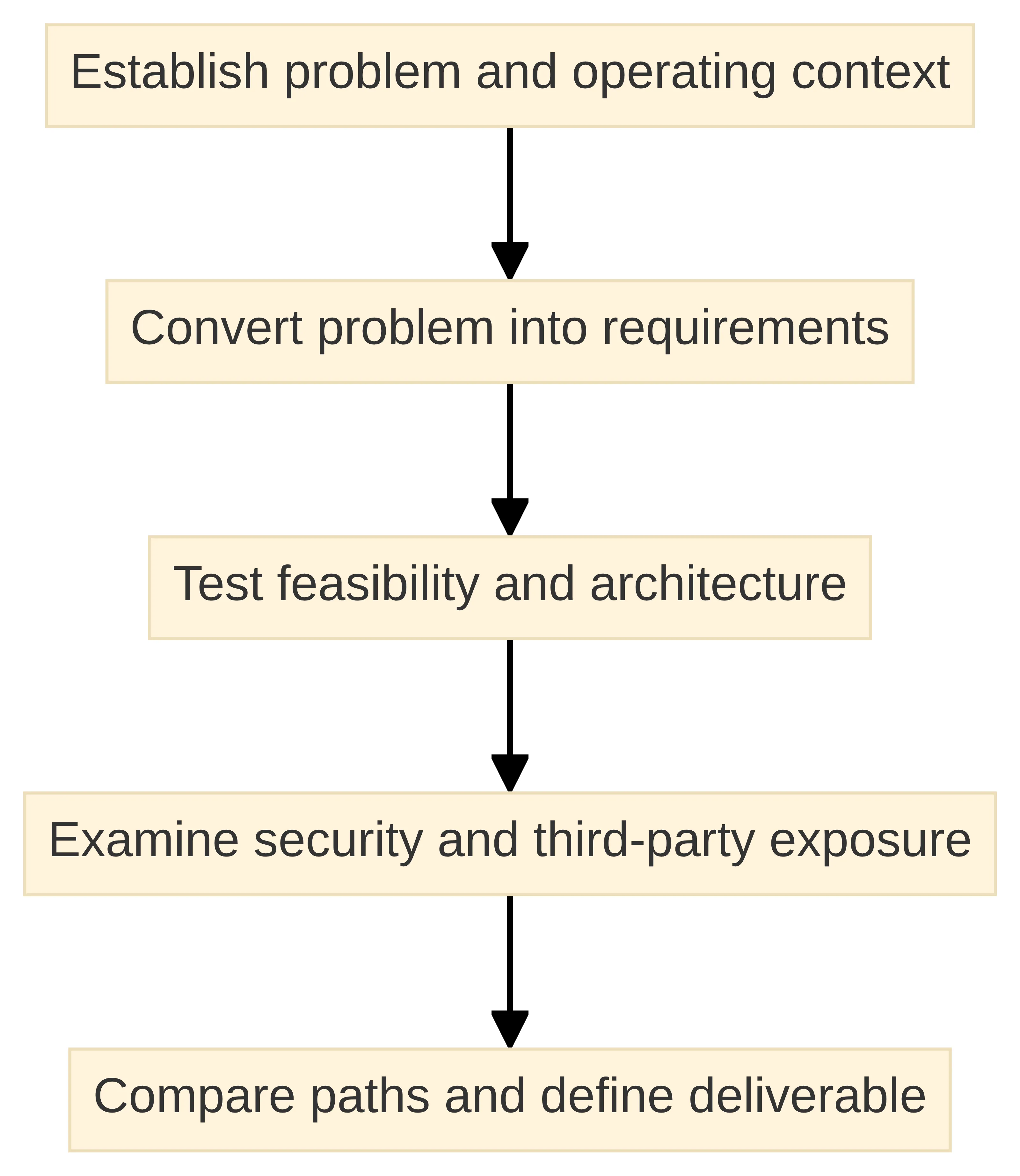
The sequence should remain adaptable, but each stage should produce a clearer basis for the next decision.
1. Establish the problem and operating context.
Start with the business process, users, systems, data flows, constraints, and decision deadline. Separate the outcome you need from the solution you currently prefer. A consultant may analyze current technology use and determine organizational needs before advising on software opportunities.
2. Convert the problem into requirements.
Describe essential workflows, users, inputs, outputs, permissions, integrations, service expectations, and acceptance conditions. Distinguish requirements from assumptions and preferences. This step gives you a basis for comparing paths rather than comparing feature lists in isolation.
3. Test feasibility and architecture.
The assessment should examine technical boundaries, dependencies, existing code, data movement, integration points, and likely delivery constraints. Development teams may assess feature feasibility, advise on technology choices, estimate effort and timelines, identify technical risks, and review existing code. Those activities are useful when you need to know whether a proposed design can fit the environment before committing to it.
4. Examine security and third-party exposure.
Discovery guidance recommends involving a security expert from the beginning so foundational security is considered before the design becomes difficult to change.
5. Compare paths and define the deliverable.
The final recommendation should state the options considered, the conditions attached to each option, the unresolved questions, and the next action. That action might be a bounded pilot, a detailed delivery plan, a platform evaluation, an integration assessment, or a decision not to proceed.
The useful sequence is not a rigid recipe. It is a way to keep discovery connected to a decision and to prevent architecture, security, and delivery constraints from appearing only after implementation has begun.
Technical evaluation should produce practical choices rather than a catalogue of technologies. Ask the consultant to explain why a proposed option fits the stated requirements, what it assumes about your systems and data, which risks it introduces, and what evidence would change the recommendation. A consultant may also identify software bugs, security weaknesses, and relevant system upgrades before proposing practical solutions.
Treat uncertainty as a deliverable. A sound assessment can say that an option remains conditional on access, data quality, vendor information, performance testing, security review, or stakeholder approval. That is more useful than a confident recommendation that conceals the conditions under which it might fail.
A structured discovery sequence keeps technical, security, and delivery constraints connected to the final decision.
Trace systems, information, and controls into a delivery roadmap
Software consulting is useful when a technology question must be made concrete across processes, systems, information, and delivery choices. A typical output is a delivery roadmap that records requirements, feasibility, workflows, risks, and priorities, so the organization can examine what should be built or changed.
Trace the question through four connected points:
Start with the process, decision, or information flow that needs to change.
Identify the platforms, APIs, data exchanges, dependencies, owners, and controls that could affect the change.
Compare feasible paths, such as custom development, system integration, use of an existing tool, or further analysis.
Record the resulting requirements, feasibility findings, workflows, risks, and priorities in the roadmap.
A consultant may analyze an organization’s current use of digital technology, determine its needs, and advise on opportunities to use software systems. This role supplies analysis for a delivery decision; it does not replace the organization’s responsibility for the decision or implementation.
This framing is relevant when systems are disconnected, an application has technical debt or security concerns, a proposed product, data platform, integration, or AI workflow needs feasibility and risk assessment, or requirements and architecture remain disputed. It is also relevant when a change touches sensitive financial information, external service providers, or several control owners. These signals call for explicit analysis of dependencies; they do not by themselves establish that an external consultant is required.
System integration shows why the map matters. Connecting platforms through APIs and data exchange can reduce disconnected systems and duplicate work, but the integration pattern depends on the systems, data, timing, ownership, and controls involved. Mapping those relationships keeps the delivery roadmap tied to the operating problem rather than to a connector selected in isolation.
Dependency questions often surface after work has begun. A development team may discover that a requested feature is not feasible within the chosen architecture, that an existing component needs review, or that a third-party dependency changes the risk profile. Discovery guidance identifies feasibility assessment, technology choices, effort estimation, technical-risk identification, and existing-code review as development-team responsibilities that inform these decisions.
For a hedge-fund technology decision, include the fund’s strategy and operational requirements in the requirements discussion, then examine how the proposed software relates to risk management, compliance, and data analytics. This keeps the analysis connected to the fund’s operating needs while leaving the organization’s own decision and implementation responsibilities clear.
When a change touches sensitive financial information, outside service providers, or several control owners, surface those dependencies in discovery and in the delivery roadmap. The roadmap can record what the organization is deciding, what information it still needs, and which delivery path the analysis supports.
Apply the concept to hedge-fund technology decisions
A focused assessment should connect the technology question to the work performed by the fund. For example, define:
Which decision or process the system must support.
Which information enters the process, where it originates, and who owns it.
Which teams need access and what different roles may do with the information.
Which existing systems must exchange data with the proposed solution.
Which operating conditions would make the solution unsuitable.
Which evidence is required before approval, deployment, or expansion.
This structure prevents a broad request for a “better platform” from becoming an unfocused product search. It also gives internal stakeholders a shared basis for discussing architecture, controls, data quality, and delivery effort.
Hedge-fund technology may touch risk management, compliance, data analytics, and operational efficiency. Neutech states that customized software solutions are needed in these areas and that managers can use technology to increase operational efficiency. Treat those statements as decision areas to investigate, not as an automatic promise that a particular system will improve results.
For data-heavy work, include an implementation-readiness review alongside the technical design. Neutech recommends evaluating the current information structure, establishing governance for standardized formats, supporting collaboration, and training staff to address implementation challenges. Translate that recommendation into concrete questions:
Where are the authoritative data sources?
Which formats, definitions, and ownership rules need to be standardized?
Who resolves conflicts or quality issues?
Which teams must coordinate during the change?
What training or operating adjustment is required after deployment?
A consultant should show how the proposed path addresses those questions. If the recommendation focuses only on software selection and ignores information structure, ownership, or adoption, the assessment is incomplete for a data-dependent workflow.
The hedge-fund context changes the questions you ask, not the basic purpose of consulting. You still need a defined problem, an accountable decision owner, a bounded scope, and a deliverable that supports a go, revise, defer, or stop decision. Avoid treating technical sophistication as a substitute for fit with the fund’s actual operating model.
Bring security, compliance awareness, and third-party risk into discovery
Third-party risk deserves its own workstream when a consultant, platform, hosting service, data provider, or integration component can access fund information or systems. NIST describes cybersecurity supply-chain risk management as a systematic process for managing exposure throughout technology supply chains and developing response strategies, policies, processes, and procedures. NIST also says effective supply-chain risk management requires stakeholders across the enterprise to collaborate, communicate, and act.
A selected passage from a 2022 SEC proposed rule asked whether advisers and funds should assess the cybersecurity compliance of certain service providers with access to adviser or fund information or related systems. That passage records a proposal-era question, not a current universal requirement. It still illustrates why provider access and oversight should be explicit topics in a U.S. financial-services technology assessment.
Ask the consultant to map:
The providers and subproviders involved.
The information and systems each party can access.
The responsibilities assigned to your organization and to each provider.
The evidence needed for procurement, security review, monitoring, and offboarding.
The response path if a provider changes, fails, or experiences a security incident.
Require the final recommendation to identify unresolved control ownership. A security label without a responsibility map does not answer the operating question.
Evaluate providers by judgment, evidence, communication, and scope
Provider evaluation should test how a consulting team thinks, communicates, and limits its conclusions. A polished proposal is not enough. Ask for evidence that the team can understand your operating context, explain trade-offs, and produce the deliverable your decision requires.
Use these criteria:
Domain fit. Can the team discuss financial-services workflows, sensitive information, operational dependencies, and the difference between a technical possibility and an acceptable operating choice? Ask which parts of your context they need to understand before recommending a path.
Technical approach. Does the proposed method cover requirements, architecture, feasibility, dependencies, existing code, integrations, and technical risks? Ask how the team will distinguish facts, assumptions, open questions, and recommendations.
Security and compliance awareness. Does the scope identify information access, third-party components, control ownership, and the people who must review the result? Ask where security expertise enters the work and what evidence will be produced.
Communication. Will you receive clear decision records, risk explanations, status updates, and escalation points? Ask who makes technical findings understandable to business, engineering, security, and compliance stakeholders.
Engagement scope. Does the proposal identify the decision, activities, inputs, deliverables, exclusions, dependencies, and completion conditions? Ask what happens when the initial assessment reveals a larger problem.
Independence of judgment. Can the team explain why it would reject a preferred technology, reduce scope, defer delivery, or recommend internal ownership? A useful advisor must be able to state a boundary, not only present an attractive path.
Use direct questions before you compare providers:
What will you need to know about our systems, workflows, data, and stakeholders before beginning?
Which decisions will the engagement support, and which decisions remain with us?
What will you deliver in writing, and how will we use it afterward?
How will you evaluate feasibility, architecture, existing code, integrations, and third-party exposure?
Which security and compliance stakeholders should participate?
How will you record assumptions, unresolved questions, and changes in scope?
What access will you request, and how will that access be limited and removed?
What would cause you to recommend a smaller scope, a different delivery path, or no engagement?
Which parts of the work require internal staff, legal review, compliance review, or security approval?
How will you define completion for this specific assessment?
Compare the answers, not only the service names. A provider that cannot make its method and boundaries clear before work begins may create avoidable ambiguity during the engagement.
Understand the limits and trade-offs before engaging a consultant
Consulting reduces uncertainty only when the engagement has access to the right context, people, systems, and decision authority. It cannot make an undefined problem precise without stakeholder participation, and it cannot turn missing data, unclear ownership, or unavailable technical access into reliable conclusions.
Account for these limits:
Advice is not execution. A roadmap or architecture assessment does not by itself build, test, deploy, operate, or govern the resulting system.
Scope creates trade-offs. A narrow engagement can produce a faster decision but may leave adjacent dependencies unresolved. A broad engagement can examine more conditions but requires more stakeholder time and coordination.
External judgment has a learning curve. A consultant must learn your systems, language, policies, and constraints. Provide a structured brief and knowledgeable internal contacts.
Recommendations depend on assumptions. A conclusion may change when data quality, access, vendor terms, performance, security findings, or ownership conditions change.
Independent advice still needs internal accountability. Your organization must decide which risks it accepts, which controls it requires, and who owns the resulting system.
State these limits in the engagement design rather than treating them as defects discovered at the end. The goal is not to remove every unknown. The goal is to identify which unknowns affect the decision and assign a next action for each material one.
Security frameworks and supply-chain practices also have limits. NIST says the Cybersecurity Framework is not a one-size-fits-all approach because organizations have different risks, risk appetites, tolerances, missions, and objectives. Apply a framework as a way to organize questions and outcomes, not as proof that a specific design is suitable.
The same discipline applies to third-party review. A supplier questionnaire can collect information, but it does not replace decisions about access, control ownership, monitoring, response, and exit. Ask what the evidence means for your actual systems and operating model.
Use a consultant when the expected decision value justifies the time, access, and coordination required. Defer or narrow the engagement when the business problem, decision owner, or available information is too unclear for a useful assessment.
Translate the consulting question into a delivery boundary
Software consulting can be understood through the question it answers and the output that supports the next delivery choice. For a hedge fund, that question may connect a software need with strategy and operational requirements, risk management, compliance, or data analytics.
Clarify the need.
Consulting and discovery can address requirements, feasibility, workflows, risks, and priorities. A consultant may analyze current technology use, determine organizational needs, and advise on opportunities to use software systems. A delivery roadmap is a typical output when the organization needs a clearer route to a technology decision.
Examine the technical boundary.
The work can include identifying bugs, security weaknesses, and relevant system upgrades. Adjacent development work may assess feasibility, advise on technology choices, estimate effort, identify technical risks, and review existing code. These activities describe the question, constraints, and options; they do not make every subsequent delivery activity part of consulting.
Name the work that follows.
When existing tools do not support a required business-specific process, custom software development addresses that system or workflow need. When disconnected platforms or duplicate work are the problem, system integration can connect platforms through APIs and data exchange. Keeping those boundaries visible distinguishes advice and evaluation from building or connecting the resulting software.
Record the result in a short internal scorecard:
Decision: What must become clearer?
Reason: Why does the question matter now?
Scope: Which systems, workflows, data, and stakeholders are included?
Risk: Which security, third-party, compliance, or operational concerns could change the path?
Deliverable: What will you receive and how will it support the decision?
Owner: Who accepts the recommendation and decides what happens next?
Boundary: What is explicitly outside the engagement?
Exit: What condition ends discovery or triggers a separate delivery phase?
A completed scorecard should produce a clear action: authorize a defined assessment, prepare the missing inputs, or decline the engagement. Keep that action visible when comparing proposals.
Prepare a focused brief before comparing providers
A focused brief should state the technology decision, the business workflow it affects, the current systems and constraints, the risks that need examination, and the deliverable required to move forward. Include the accountable owner, relevant stakeholders, access conditions, decision timing, and explicit exclusions. For a hedge fund, add the information flows, data ownership questions, third-party access, and security or compliance participants that could change the recommendation.
Use the brief to decide whether your need is consulting, development, added delivery capacity, recruiting, or implementation support. If the problem is still unclear, keep the first scope narrow and decision-oriented. If the design and acceptance conditions are already settled, direct the request toward execution rather than paying for analysis that will not change the path.
A qualified professional should determine individual suitability for your organization’s legal, regulatory, security, and operational circumstances. Treat the completed brief as the basis for a bounded conversation, with assumptions and responsibilities visible before work begins.
The next step is to submit a concise description of the defined need, the affected workflow or system, the decision you need to make, and the questions that remain open.
What should a hedge fund clarify before contacting a software consultant?
What is the role of a software consultant?
A software consultant analyzes an organization’s current use of digital technology, identifies needs, and advises on opportunities to use software systems. They help clarify technology problems, assess available paths, and select appropriate next steps.
When should a hedge fund consider engaging a software consultant?
A hedge fund may consider engaging a software consultant when facing uncertainty about technology decisions, such as when existing applications have accumulated technical debt, when there are competing options for a new system, or when internal teams disagree about architecture or priorities.
How can hedge funds evaluate potential software consulting providers?
Hedge funds can evaluate software consulting providers by assessing their domain fit, technical approach, security and compliance awareness, communication skills, engagement scope, and independence of judgment.
What are the limits and trade-offs of using software consulting?
Consulting can reduce uncertainty but has limits, such as the need for stakeholder participation, the inability to execute recommendations, and the potential for unresolved dependencies. A narrow engagement may produce faster decisions but could leave adjacent issues unaddressed.
What security considerations should be included in software consulting engagements?
Security considerations should include identifying vulnerabilities, ensuring regulatory alignment, designing controls, and evaluating third-party components. Involving a security expert from the beginning is recommended to establish foundational security.
What is the difference between software consulting and software development?
Software consulting focuses on clarifying technology problems and providing strategic advice, while software development involves building specific applications or systems based on defined requirements. Consulting is about decision-making, whereas development is about execution.