
Begin with workload needs, not a popularity ranking
AWS services are best evaluated by the workload, control objective, and operating responsibility they introduce—not by a generic list of popular products. If you are planning technology for a hedge fund, start by describing what the system must do: run an application, store records, move market or operational data, support analytics, control access, or provide evidence about system activity.
AWS identifies a set of core services that includes examples such as Amazon EC2, Amazon EBS, Amazon RDS, Amazon DynamoDB, AWS Lambda, Amazon S3, AWS Identity and Access Management (IAM), AWS Key Management Service (KMS), and Amazon CloudWatch. That list is a useful starting inventory, not a definitive ranking or an architecture. AWS also describes security and compliance as a shared responsibility, with customer responsibilities varying according to the services selected, their integration, and applicable laws and regulations.
Use a four-part path for each proposed workload:
- Define the capability and the data involved.
- Identify the service category that could support it.
- Assign security, resilience, monitoring, and operational responsibilities.
- Test the design against governance, regional placement, integration, and recovery requirements.
This approach keeps a service name from becoming a substitute for an architecture decision. It also gives you a traceable way to explain why a category was considered and what must be evaluated before adoption.
Use a capability map for AWS service categories
A capability map translates a business or technology need into an architectural question. It should describe the job a system must perform before it names a product. For hedge fund planning, the main categories are:
- Compute: Where does application or processing code run, and who manages the underlying configuration?
- Storage: Where do files, volumes, backups, or other persistent data reside?
- Databases: How does the workload organize and retrieve operational records?
- Networking: Which AWS networking services, including Amazon VPC-related services, should be evaluated for connectivity among users, applications, data sources, and environments?
- Analytics: How are streaming data, data lakes, warehouses, processing jobs, and reports handled?
- Identity and security: How are identities, permissions, keys, findings, and control objectives managed?
- Monitoring and operations: How do you detect health changes, investigate events, and assign response work?
AWS groups its analytics offerings around streaming, data lakes and warehouses, data processing, and business intelligence. These categories help you describe the movement and use of data without assuming that one service should handle every stage.
The map becomes useful when each category has a decision question attached to it. For example, compute asks what execution model the application needs; storage asks what persistence pattern and access pattern apply; analytics asks whether data arrives continuously or in prepared sets; and operations asks what signals must be observed and who acts on them. Keep those questions separate. A single proposed service may touch several categories, but its presence does not answer every question.
Place application workloads in the compute layer
Amazon EC2 is a web service for launching and managing Linux/UNIX and Windows Server instances in Amazon data centers. In a workload-first map, EC2 belongs to the compute layer: it is the place where you may run application or processing workloads when an instance-based model fits the design.
An EC2 decision carries substantial customer-side responsibility. AWS states that customers using EC2 are responsible for resiliency configuration and management, including deploying instances across multiple locations, implementing self-healing, and applying resilient workload architecture practices. The question is therefore not only whether EC2 can host the workload; it is whether your team can operate the configuration, recovery behavior, patching context, and monitoring that the design requires.
Amazon EC2 Auto Scaling can launch or terminate instances automatically based on user-defined policies. Treat that capability as an operating design choice rather than an automatic resilience result. Define the signal that should trigger a change, the limits of the policy, the effect on stateful or time-sensitive workloads, and the person or team responsible for reviewing its behavior. Before selecting an instance-based compute path, document the workload’s resource profile, deployment pattern, recovery expectations, and operating owner.
A practical compute brief should answer five questions:
- What code or processing runs there?
- What state must survive an instance change?
- Which configuration does your team own?
- What event should trigger scaling or recovery?
- What evidence shows that the workload is healthy?
If those answers are incomplete, keep the compute choice provisional rather than presenting it as settled architecture.
Separate storage and database decisions
Storage and database decisions solve different planning problems. Storage concerns how data or volumes persist and move through the system; a database decision concerns how the application organizes, retrieves, and changes operational records. Keeping the two questions separate prevents a storage product from being treated as a complete data model.
Amazon EBS provides block-level storage volumes for use with EC2 instances. That makes EBS a direct example of a storage decision attached to an instance-based compute design. For this path, record the volume’s relationship to the instance, the data that depends on it, the recovery process, and the controls required around access and encryption. The service name alone does not define those operating decisions.
AWS describes Amazon S3 and Amazon DynamoDB as examples of managed services for which AWS operates the infrastructure layer, operating system, and platforms, while customer responsibilities continue under the shared-responsibility model. That division can change the operational boundary, but it does not remove the need to evaluate data access, retention, integration, recovery, monitoring, and ownership.
For a hedge fund workload, write separate answers for:
- The data each component produces and consumes.
- The persistence role required by each dataset.
- The queries or access patterns the application needs.
- The controls governing sensitive or decision-supporting data.
- The recovery and reconciliation process after an interruption.
Use the answers to narrow the category and then evaluate the specific service. Do not infer that a managed service satisfies your governance or recovery requirements merely because AWS manages more of its infrastructure.
Trace data from ingestion through analytics
An analytics architecture should be read as a data path, not as a collection of disconnected products. Start with the source, then trace ingestion, preparation, persistence, analysis, and consumption. For a hedge fund, that path might involve market data, portfolio data, risk inputs, research data, or operational events, but the exact design depends on the workload and its controls.
For continuously arriving data, the planning brief should define the relevant flow and its operating conditions. Your evaluation should then specify ordering expectations, transformation responsibilities, failure handling, retention, downstream consumers, and the evidence needed to investigate a missed or duplicated event.
AWS lists Amazon Redshift and Amazon S3 data lake offerings for data lakehouse, data warehouse, and data lake use cases. These labels describe analytical roles, but they do not settle how your organization will define data quality, access, lineage, retention, or reconciliation. Add those requirements to the workload brief before selecting a destination.
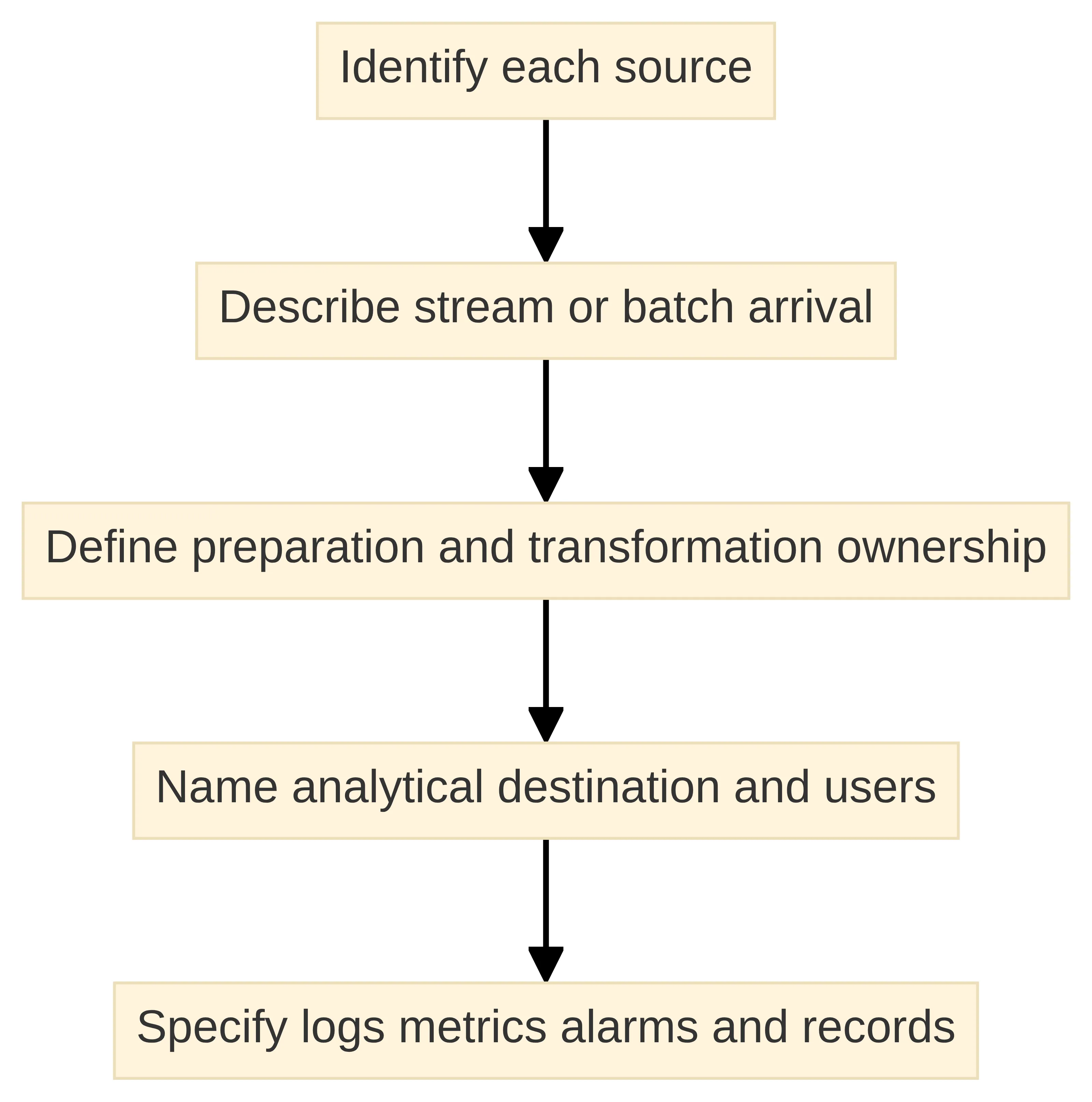
A useful pipeline review follows this sequence:
- Identify each source and the business process that produces it.
- Describe whether data arrives as a stream, a batch, or both.
- Define preparation and transformation ownership.
- Name the analytical destination and its users.
- Specify the logs, metrics, alarms, and records needed for operations.
For Amazon MWAA, AWS states that customers are responsible for reviewing CloudWatch metrics, creating dashboards and alarms, and enabling and analyzing the Airflow logs needed to diagnose workflow failures. That example illustrates the broader point: an analytics service choice includes an operating model, not only a data path.
Treat networking, identity, security, and monitoring as control layers
Networking, identity, security, and monitoring should surround the workload rather than appear as late additions. AWS identifies services such as IAM, KMS, CloudWatch, CloudTrail, Config, and related networking services among its core service examples. In your planning document, connect each control layer to a workload boundary: who can access it, how activity is recorded, how sensitive data is protected, how configuration changes are detected, and how operational signals reach the responsible team.
AWS Security Hub CSPM provides a consolidated security score, assesses AWS resources against specified security standards and frameworks, and aggregates security findings in one place. Treat those functions as inputs to a control and response process, not as proof that a workload satisfies your requirements. Define which accounts and resources are in scope, who reviews findings, what severity means for your environment, and how remediation is documented.
Monitoring must be specific enough to support action. For example, AWS documentation for Amazon MWAA assigns customers responsibility for reviewing metrics, creating dashboards and alarms, and analyzing the logs needed to diagnose workflow failures. Apply that discipline to every workload: name the health signal, threshold, notification path, investigation record, and escalation owner. A dashboard without an operating response is an observation surface, not a complete operational control.
Use a control-layer worksheet with one row for each requirement:
- Identity: who or what receives access?
- Permission: what can that identity do?
- Key and data protection: what must be protected, and under whose control?
- Network path: what must connect, and what must remain separated?
- Evidence: which event, configuration, metric, or finding demonstrates activity?
- Response: who investigates and what action follows?
This worksheet lets you compare services by responsibility instead of by feature count.
Apply the shared-responsibility test before selecting services
AWS describes security and compliance as a shared responsibility between AWS and the customer. AWS operates, manages, and controls parts of the underlying cloud infrastructure, while the customer remains responsible for elements such as the guest operating system, application software, and configuration of the AWS-provided security group firewall in the model described by AWS. Customer responsibilities vary with the services selected, their integration into the information-technology environment, and applicable laws and regulations.
Apply the model as a service-selection test. For every proposed service, ask:
- Which infrastructure and platform layers does AWS operate?
- Which application, identity, data, network, and configuration layers remain with your team?
- Which responsibilities move when the design changes services?
- Which party produces the evidence your governance process requires?
- What integration points could create an additional responsibility?
Record the answers before approval. A managed service may reduce work at one layer while leaving substantial design and operating obligations elsewhere.
The boundary is visible in AWS’s resiliency guidance. With managed services such as Amazon S3 and Amazon DynamoDB, AWS operates the infrastructure layer, operating system, and platforms, while customer responsibilities still depend on the shared-responsibility model. Use the specific service and integration—not the word managed—as the basis for your responsibility register.
Compare control and resilience obligations across service models
Service models can change where resilience and control work sits, but they do not eliminate that work. The comparison below uses Amazon EC2 and the managed-service examples Amazon S3 and Amazon DynamoDB to show the questions you should carry into an evaluation.
| Evaluation criterion | Amazon EC2 | Managed-service examples: Amazon S3 and Amazon DynamoDB |
|---|---|---|
| Infrastructure boundary | AWS operates the underlying cloud infrastructure, while your design includes instance-level and workload responsibilities. | AWS operates the infrastructure layer, operating system, and platforms. |
| Operating questions | How will you configure, monitor, recover, and update the workload running on instances? | Which data, access, integration, monitoring, and recovery responsibilities remain with your team? |
| Evidence to retain | Show the configuration and operational evidence supporting the chosen resilience design. | Show how your controls address the responsibilities that remain after AWS operates the managed layers. |
| Selection boundary | Choose it only when your team can own the required instance and workload responsibilities. | Choose it only after mapping the remaining customer responsibilities to your controls and operating processes. |
The table is not a ranking. EC2 may fit a workload that requires instance-level control; a managed service may fit a workload where reducing infrastructure-layer responsibility is useful. Neither choice establishes that a hedge fund’s requirements are met. Your decision record should state the workload, the control boundary, the recovery assumptions, and the owner for each obligation.
Evaluate regulated financial-services requirements as control objectives
AWS guidance for financial-services institutions says regulatory requirements should be translated into sustainable security control objectives that can adapt as regulations evolve. For a hedge fund, that means starting with the obligations applicable to the workload and then defining the technical, procedural, and monitoring controls that address them. Do not treat a service category or cloud deployment as a substitute for that mapping.
Build the evaluation around control objectives rather than labels such as secure, compliant, or enterprise-ready. For each objective, identify the protected data, authorized identities, permitted actions, required evidence, review interval, exception process, and accountable owner. Then map those requirements to the selected services and integrations. The shared-responsibility model matters because a control may depend on a customer-managed configuration even when AWS operates an underlying layer.
AWS financial-services guidance identifies model governance, data protection, explainability, auditability, and protection of sensitive financial data used in training and inference as considerations for generative AI in financial services. If your proposed workload includes such a system, add those concerns to the control register rather than placing them in a separate, later review. Specify what the system does, what data it uses, what decisions or outputs require review, and what records support investigation.
A control-objective brief should let you answer these questions in plain language:
- What requirement applies to this workload?
- What technical or procedural outcome must be maintained?
- Which AWS and customer responsibilities contribute to that outcome?
- What evidence demonstrates that the control operated?
- What changes would require reassessment?
This structure keeps the evaluation tied to the workload and avoids making a broad compliance conclusion from a service name.
Test Region and data-placement assumptions
Region selection is part of architecture, data governance, and operations. AWS recommends evaluating sustainability goals, data location, user location, cost, and compliance constraints when selecting Regions. AWS also advises placing data-heavy application code close to the data and user-facing workloads close to users. Treat those factors as explicit inputs rather than assuming that the nearest or most familiar Region is appropriate.
For each workload, document:
- Where the source data is created and where it must remain.
- Where users, dependent systems, and operational teams are located.
- Which network paths the workload requires.
- Which cost and compliance constraints affect placement.
- Whether data-heavy processing should run near the data.
- Whether user-facing components should run near their users.
This record should cover primary and recovery environments, cross-Region movement, and the operational effect of each placement choice. Keep the assumptions dated because service availability, regional offerings, and requirements can change.
AWS’s regional product-services list retrieved on October 27, 2026 identifies core services included in all Region launches, including examples such as EC2, EBS, RDS, DynamoDB, Lambda, S3, IAM, KMS, and CloudWatch. Use that list as a point-in-time availability reference, not as a permanent guarantee. Before implementation, check the current regional service list for every service your design depends on.
Do not collapse data placement into a single location question. A workload may have separate locations for source data, processing, user access, backups, logs, and recovery. The evaluation is complete only when each location has an owner, a reason, a permitted data flow, and a control record.
Turn the category map into an evaluation brief
A useful AWS evaluation brief should leave you with a workload-specific decision record, not a long catalog of product names. Assemble the brief in this order:
- Workload statement: describe the application, data flow, users, dependencies, and required outcome.
- Capability map: assign the workload’s compute, storage, database, networking, analytics, identity, security, and monitoring needs to categories.
- Responsibility register: record which tasks remain with your team under the selected service model.
- Control objectives: map applicable financial-services requirements to access, data protection, auditability, monitoring, and response controls.
- Resilience design: document failure assumptions, recovery responsibilities, multi-location choices, and evidence.
- Region assessment: record data, user, network, cost, and compliance constraints for each environment.
- Open decisions: list the technical questions that require further validation before implementation.
AWS guidance makes the responsibility boundary, control objectives, resilience configuration, and Region factors explicit. Use those dimensions to keep the decision reviewable as the workload or service selection changes.
The practical conclusion is narrow: select an AWS service category because it fits a defined workload and an owned control boundary, then test the choice against governance, placement, resilience, monitoring, and operating capacity. A qualified professional should determine individual suitability for your environment and obligations. When the brief identifies unresolved architecture or delivery questions, use the next step to request a project quote.
What should a hedge fund verify before choosing AWS services?
What are the core AWS services relevant for hedge fund technology planning?
Core AWS services include Amazon EC2, Amazon EBS, Amazon RDS, Amazon DynamoDB, AWS Lambda, Amazon S3, IAM, and AWS KMS. These services support various workloads and should be evaluated based on specific operational needs.
How should I approach AWS service selection for a hedge fund?
Begin by defining the workload requirements, then map those needs to AWS service categories such as compute, storage, databases, and analytics. Consider the shared responsibility model and ensure that your team can manage the necessary configurations and operational responsibilities.
What considerations should I keep in mind regarding security and compliance when using AWS?
Security and compliance are shared responsibilities between AWS and the customer. It’s essential to translate regulatory requirements into sustainable security control objectives and ensure that your architecture meets these obligations.
What factors should I consider when selecting AWS regions for my workloads?
When selecting AWS regions, consider sustainability goals, data location, user proximity, cost, and compliance constraints. Ensure that data-heavy applications run close to their data sources and user-facing components are near their users.
What is the importance of monitoring and operational controls in AWS?
Monitoring and operational controls are crucial for maintaining system health and compliance.
How can I ensure my AWS architecture meets regulatory requirements?
To meet regulatory requirements, start by identifying applicable obligations for your workload, then define the necessary technical and procedural controls. Map these controls to the selected AWS services and ensure ongoing compliance through regular reviews.