
Start with the workload the warehouse must serve
A cloud-based data warehouse stores data in cloud infrastructure rather than on local servers. Data warehouses are designed for analytical and reporting workloads, whereas databases are designed for transaction processing. For a fund, define the decisions, reports, and analysis the environment must support before comparing platforms or architectures.
For a hedge fund, the workload might bring together trading-platform records, market information, internal databases, portfolio data, and reporting inputs. The warehouse is relevant when those sources must be organized into a form that supports repeatable analysis. It is not automatically the right home for every data type, every application, or every latency requirement.
A hedge-fund data-warehouse evaluation should answer four questions before it addresses product features:
- Which analytical and reporting decisions must the environment support?
- Which source systems provide the required information?
- How frequently must the information be refreshed?
- Which controls, ownership boundaries, and operating requirements apply to the data?
Hedge funds must align software with their specific strategies and operational requirements, including the data needed from trading platforms, market information feeds, and internal databases. Those premises make workload definition more than a technical exercise. Write down the decision workflow first, then test whether a warehouse is an appropriate analytical layer for it.
Classify the fund’s data and decision workflows
A practical workflow inventory can use the following categories:
- Operational transactions: records that an application must create, update, or retrieve as part of ongoing operations.
- Recurring reporting: scheduled views of positions, exposures, performance, reconciliations, or other defined business measures.
- Analytical investigation: queries that compare periods, instruments, strategies, entities, or other dimensions.
- Source-data exploration: examination of raw or less-structured information before its analytical meaning is settled.
- Decision support: analysis prepared for portfolio, risk, operations, technology, or management decisions.
The distinction between a transaction and an analytical query is more useful than the label attached to the data. Map each workflow to its users, refresh expectation, required history, output, and control boundary. That map becomes the first version of the warehouse fit test.
For a hypothetical daily exposure report, the transactional system might record operational events, source feeds might provide market information, an integration process might reconcile identifiers and timestamps, and the warehouse might hold the curated history used for comparisons across dates. A portfolio or risk user could then consume the resulting report. This example does not assign a particular system to any fund. It exposes the boundaries between recording an event, moving and preparing data, storing analytical history, and querying it. If an evaluation names only the final report, it can hide dependencies that affect refresh timing, ownership, controls, and cost.
Follow the path from source data to analytical output
A cloud-based data warehouse workflow begins with source data and ends with an analytical output. ETL extracts data from source systems, transforms it into a suitable format, and loads it into the warehouse for analysis. The warehouse then provides a centralized location for structured and semi-structured information from several sources.
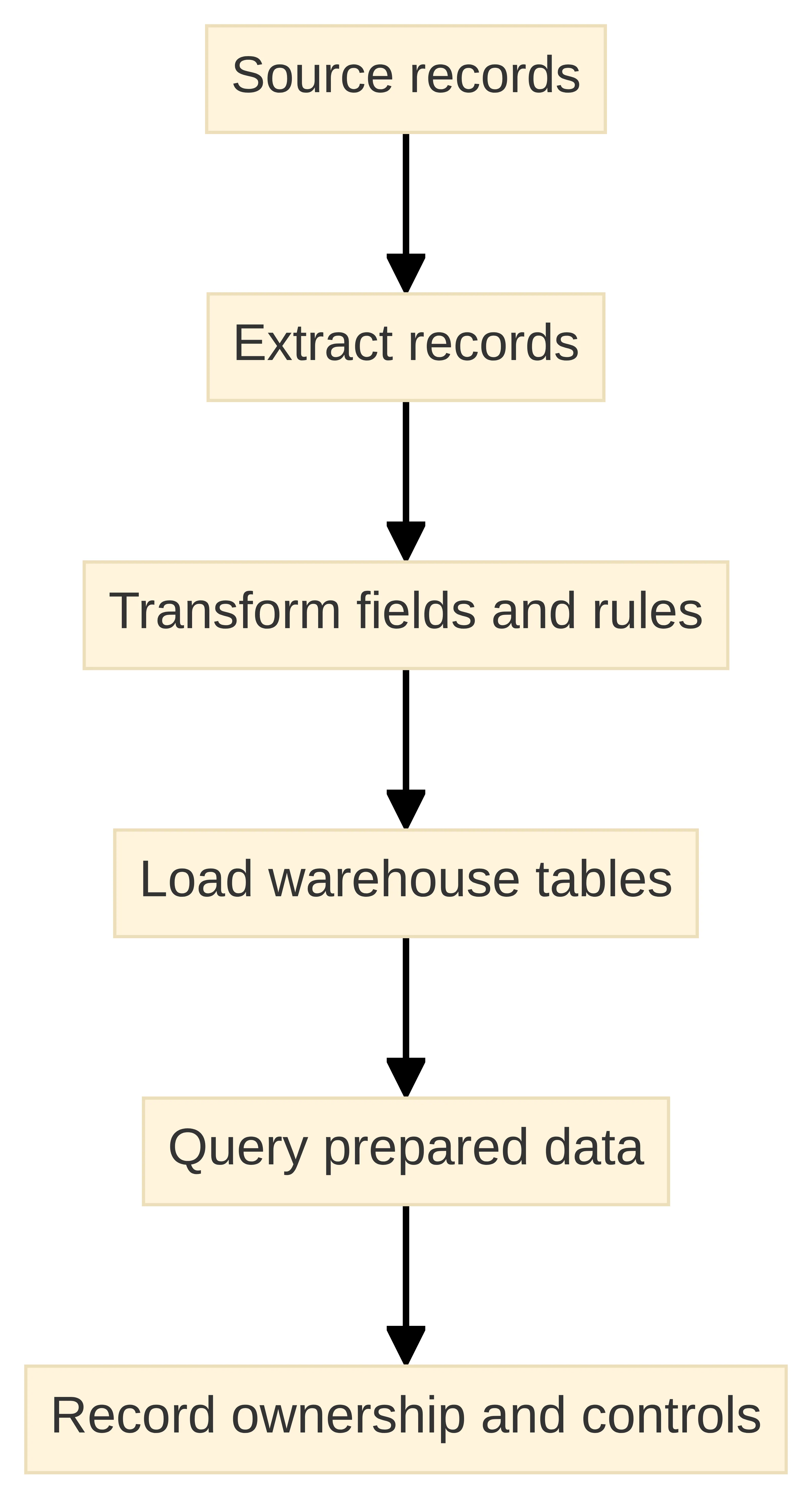
For a fund, the path might look like this:
- Identify the source records required for a defined report or analysis.
- Extract those records from trading platforms, market-information feeds, internal databases, or other approved systems.
- Transform fields, formats, identifiers, and business rules into a consistent analytical structure.
- Load the transformed data into warehouse tables or other analytical structures.
- Query the prepared data for reporting, investigation, or decision support.
- Record ownership and controls for the source, transformation, output, and access path.
The final report is only as dependable as the path that produces it. A warehouse does not remove the need to understand source meaning, transformation rules, or data ownership.
In the Snowflake architecture example, virtual warehouses provide independent massively parallel processing compute clusters, so each virtual warehouse operates independently of the others in that example. Treat that description as a product-specific architecture example rather than a universal property of every platform.
For your evaluation, ask where each stage occurs and which team or service owns it. A useful architecture description should show the source systems, ingestion or transformation path, warehouse storage, analytical compute, access controls, and user outputs. If the diagram skips a transformation step or treats the warehouse as the entire data estate, the evaluation is not yet complete.
Separate the warehouse from adjacent data platforms
A data warehouse is one part of a data architecture, not a replacement for every adjacent platform. The distinctions below help you assign each workload to the right type of system:
| Platform or layer | Primary purpose | Typical data orientation | Fit question |
|---|---|---|---|
| Transactional database | Transaction processing | Structured operational records | Does an application need to record and retrieve operational events? |
| Cloud-based data warehouse | Analytical queries and reporting | Curated structured and semi-structured data | Do users need repeatable analysis across data from several sources? |
| Data lake | Data integration, exploration, and broader data storage | Structured, semi-structured, and unstructured data | Must the organization retain raw or varied data before its analytical structure is fixed? |
| ETL or integration process | Extracting, transforming, and loading data | Data moving between sources and analytical destinations | What transformation and movement must occur before analysis? |
The platform boundary is a design decision, not a vocabulary test. A data warehouse generally benefits from a defined schema and curated analytical data. A data lake can preserve data in its raw format and apply structure at analysis time, while the selected comparison associates lakes with exploration, machine learning, streaming, operational analytics, and data discovery.
Those categories can coexist. You might retain a broad source dataset in a lake-oriented layer, transform a governed subset into a warehouse, and keep a transactional database for the application that records operational events. The fit test should identify which layer answers which question instead of asking one platform to perform every role.
Test whether the workload matches analytical processing
A cloud-based data warehouse fits most clearly when the central workload is analytical: combining prepared data, applying defined business logic, comparing time periods, and producing reports or decision-support views. Data warehouses are described as optimized for complex analytical queries, while databases are optimized for transaction processing. That distinction should guide the first pass over your requirements.
Test the fit against the actual questions your users ask. If the questions involve historical comparisons, multiple dimensions, recurring measures, or consolidated reporting, a warehouse-oriented design deserves consideration. If the primary requirement is recording an operational event with transactional consistency, keep that requirement anchored to the system designed for transaction processing rather than moving it into the analytical layer.
Analytical suitability does not guarantee a particular response time or cost profile. A cloud-data-warehouse analysis reports that some users experience query responses measured in tens of seconds or minutes and that some workloads may cost three to five times more than alternatives. Those are broad, non-universal observations, so use them as reasons to test your own workload rather than as a prediction about any specific platform.
Run representative queries against representative data volumes. Include joins, historical ranges, concurrent users, scheduled reports, and the slowest business-critical analysis. Record the required response range and the resources consumed. A warehouse should pass on the workload you intend to operate, not on a generic demonstration query.
Examine scale, compute separation, and workload isolation
Cloud-based data warehouses can dynamically adjust storage and compute resources to changing operational needs, according to a cloud-data-warehouse overview. That capability can matter when a fund has uneven analytical demand, such as a mix of scheduled reporting, research queries, and periodic review activity. It does not remove the need to define workload patterns, resource boundaries, or cost controls.
Describe scale in terms of work rather than vague volume. Document the number and size of source datasets, the historical period required, the expected refresh pattern, the number of concurrent users, the heaviest queries, and the periods of concentrated demand. Then ask how the candidate architecture responds to each condition. The relevant question is not whether the platform can scale in the abstract; it is whether its scaling behavior matches your workload and operating controls.
Workload isolation should be evaluated as an architectural behavior. In the Snowflake example, storage, cloud services, and query processing are separate layers, and virtual warehouses operate as independent compute clusters. That separation may provide a useful model for asking whether reporting, research, transformation, and other workloads can be kept from interfering with one another, but the example does not establish that every cloud warehouse behaves the same way.
Ask four concrete questions:
- Can scheduled reporting and exploratory analysis use separate compute arrangements?
- What happens when several heavy queries run at the same time?
- Which resources expand, and which remain fixed, during a demand increase?
- How will the team observe resource use and assign it to workloads?
Capture the answers in the architecture and operating plan. Do not infer isolation from the word “cloud.”
Make governance and security part of the fit test
Cloud data security covers data at rest, in transit, and in use through measures that include encryption, customer-managed keys, least-privilege identity and access management, and continuous monitoring, according to a cloud-security guidance source. Google Cloud guidance published April 6, 2022 identified centralized audit logs, customer-managed encryption keys, monitoring, and access-insight controls as security measures for a cloud environment.
Use those measures as evaluation topics, not as an automatic compliance conclusion. Ask how the proposed design protects stored data, moving data, active analytical workloads, credentials, service accounts, and administrative activity. Ask who can grant access, who can approve it, how access is removed, and how activity is reviewed. A feature list is not a control design until ownership and operating procedures are clear.
A hedge-fund governance review should connect data access to the organization’s operating and regulatory responsibilities.
Build the review around the information and decisions involved:
- Identify sensitive datasets and the roles that need access.
- Define who owns source data, transformed data, and analytical outputs.
- Record which transformations affect a report or decision-support metric.
- Establish an audit approach for access, changes, and administrative activity.
- Map the design to the fund’s applicable obligations through qualified internal or external advice.
A warehouse can organize data for analysis, but it cannot by itself establish that the fund meets a legal, regulatory, or internal requirement.
Treat integration and data quality as operating requirements
Data integration is the operating path that makes a warehouse useful. ETL extracts source data, transforms it into a suitable format, and loads it into the warehouse for analysis.
Start with a source-to-output inventory. For every analytical product, record:
- the source system and responsible owner;
- the fields, identifiers, and time period required;
- the transformation or reconciliation rules;
- the refresh schedule and acceptable delay;
- the person responsible for resolving an exception;
- the report, query, or decision-support output produced.
This inventory separates a warehouse problem from a source or integration problem. If a required field is missing, ambiguous, delayed, or transformed inconsistently, adding warehouse compute does not resolve the underlying issue.
Data quality should be evaluated at the point where business meaning is assigned. A warehouse generally uses a predefined schema and curated data, while a data lake may retain raw data before structure is applied. That difference means you should decide which transformations belong before loading, which belong during analysis, and which must remain traceable to the source.
For a hedge-fund report, define how you will handle missing records, duplicate records, inconsistent identifiers, late arrivals, restatements, and changes in source definitions. Require the design to show how an analyst can distinguish a valid value from a value that is present but not yet reconciled.
Compare financial flexibility with total workload cost
Cloud-based data warehouses are associated by one cloud-data-warehouse source with pay-as-you-go pricing, dynamic resource adjustment, reduced upfront capital investment, and lower maintenance requirements compared with traditional on-premises solutions. Those characteristics can change the financial shape of an initiative, particularly when demand is variable or when avoiding local infrastructure investment matters.
Treat that description as a pricing-model consideration, not as a promise of lower total cost. Build a workload-based model that includes:
- storage over the historical period you intend to retain;
- compute for ingestion, transformation, scheduled reporting, and investigation;
- concurrency during concentrated demand;
- data movement and integration services;
- monitoring, governance, security, and administration;
- development, testing, and recovery environments;
- the people and processes required to operate the design.
The model should connect each cost category to a workload and an owner. Without that connection, a pay-as-you-go structure can be flexible without being predictable.
A cloud-data-warehouse analysis reports that some users encounter query responses measured in tens of seconds or minutes and may pay three to five times more than alternatives for some workloads. The source presents broad claims without supplied methodology, so the figures should not be applied to your fund as an expected result. They do, however, justify testing performance and cost together.
Compare at least three workload states: normal operation, concentrated reporting or review, and an unusually heavy analytical period. For each state, record query response, concurrency, resource consumption, and total cost. A low nominal price with unacceptable analysis time is not a successful fit; a fast result whose operating cost cannot be governed is not a complete fit either.
Decide where the warehouse fits—and where it does not
A cloud-based data warehouse is a plausible fit when the fund needs curated, structured or semi-structured data from several sources for recurring analytical queries, reporting, or decision support. The workload should have a defined analytical purpose, a workable transformation path, and governance requirements that the proposed design can address.
Proceed to a detailed evaluation when these conditions are visible:
- the important questions are analytical rather than transactional;
- users need consolidated information from several sources;
- the data can be organized into a useful analytical schema;
- reporting or analysis must be repeatable;
- the organization can assign ownership for integration, access, and controls.
These conditions describe fit criteria, not a recommendation for a specific platform.
A cloud-based data warehouse may not be the primary fit when the workload is chiefly transaction processing, when raw and unstructured data must remain flexible before its use is known, or when the core challenge is moving and transforming data rather than querying prepared data. A conventional database is designed for transaction processing, while a data lake can support structured, semi-structured, and unstructured data in a raw format with structure applied at analysis time.
Do not force every requirement into one destination. Keep transactional operations in the system designed for that purpose, preserve raw-data requirements in the appropriate storage layer, and define integration work separately from analytical storage. If the workload crosses these boundaries, document the handoffs instead of treating the warehouse as the entire answer.
Record the evaluation criteria before selecting a platform
A platform evaluation should record criteria before product demonstrations influence the decision. Use the following checklist and attach a workload example to every answer:
- Workload: Which analytical, reporting, and decision-support queries must run?
- Data shape: Which inputs are structured or semi-structured, and where must raw or unstructured data remain?
- Scalability: How do storage and compute respond to changing demand?
- Security: How are data at rest, in transit, and in use protected?
- Access: How are least-privilege permissions, credentials, and administrative actions controlled?
- Governance: Who owns the data, transformations, definitions, and outputs?
- Integration: How are source systems extracted, transformed, loaded, reconciled, and monitored?
- Performance: What response range is required for representative queries and concurrent users?
- Reliability: What operating behavior, ownership, and recovery expectations apply to each critical workflow?
- Cost: What storage, compute, integration, administration, and workload-concentration costs must be governed?
The security measures and integration requirements above reflect the cited cloud-security and hedge-fund guidance. The remaining criteria turn the reader’s workload-first evaluation into a record that can be challenged, revised, and compared.
A useful scorecard should distinguish an answer from an assumption. For each criterion, record the requirement, the evidence supplied by the proposed design, the workload tested, the owner, and the unresolved question. Mark whether the requirement is mandatory, negotiable, or outside the platform’s role.
Test architecture claims directly. A Snowflake example separates storage, cloud services, and query processing, but that example does not establish the architecture of another product. Likewise, broad reports about slow queries or higher costs should prompt workload testing rather than determine the result in advance. Select only after the scorecard connects platform behavior to the fund’s actual data and decision workflows.
State what the available evidence cannot establish
A definition of a cloud-based data warehouse cannot establish that a particular platform will meet your fund’s performance, cost, security, reliability, or governance requirements. General descriptions of dynamic scaling do not establish the response or spending pattern of your workload. One product’s architecture does not establish how every platform separates storage and compute. Security controls alone do not establish a regulatory outcome.
The boundary is practical. You need representative data, representative queries, defined users, identified owners, and an operating model before drawing a platform conclusion. You also need qualified advice for individual architecture, compliance, and security decisions. Keep those decisions separate from the general educational distinction between analytical warehouses, transactional databases, data lakes, and integration processes.
Some claims require particular caution. Broad performance and cost concerns do not include enough detail about the conditions measured, while a statistic about the location of data involved in cloud breaches does not establish how the figure was derived. Neither premise should become a universal expectation for your environment.
Use uncertainty to improve the evaluation rather than to stop it. Ask which workload was measured, under what conditions, with what data, and against which alternative. For security, identify the data locations, access paths, controls, monitoring responsibilities, and review process that apply to your design. State the remaining uncertainty in the decision record.
Turn the fit test into a bounded next step
A cloud-based data warehouse deserves further consideration when a hedge fund has a defined analytical workload, multiple source systems, a workable transformation path, and clear expectations for governance, security, performance, reliability, and cost. The next decision is not whether cloud storage is modern; it is whether the proposed analytical layer fits the fund’s actual questions and operating responsibilities.
Prepare a bounded brief with the source systems, target reports or analyses, data classifications, refresh expectations, representative queries, control requirements, evaluation criteria, and unresolved constraints. A qualified professional should determine individual architecture, compliance, and security suitability for the fund. Keep the first engagement focused on the defined data and analytics work rather than an undefined platform search.
Use the completed brief to frame a focused conversation about the workload, integration boundary, governance needs, and analytical outputs you need to evaluate.
What should a hedge fund clarify about cloud-based data warehouses?
What is a cloud-based data warehouse?
A cloud-based data warehouse is a centralized repository that stores structured and semi-structured data in cloud infrastructure rather than on local servers, primarily designed for analytical processing and reporting.
How do cloud-based data warehouses differ from traditional databases?
Cloud-based data warehouses are optimized for analytical workloads and reporting, while traditional databases are designed for transaction processing.
What are the main benefits of using a cloud-based data warehouse for hedge funds?
The main benefits include scalability, flexibility, reduced upfront capital investment, and lower maintenance costs compared to traditional on-premises solutions, allowing hedge funds to optimize resource allocation based on fluctuating demands.
What evaluation criteria should hedge funds consider when assessing cloud-based data warehouses?
Hedge funds should evaluate criteria such as data workloads, scalability, security, governance, integration, performance, reliability, and cost considerations to determine the suitability of a cloud-based data warehouse for their needs.
When might a cloud-based data warehouse not be the right fit for a hedge fund?
A cloud-based data warehouse may not be suitable when the primary workload involves transaction processing, when raw and unstructured data needs to remain flexible, or when the main challenge is data movement and transformation rather than querying prepared data.
How can hedge funds ensure data quality in a cloud-based data warehouse?
Hedge funds should define how to handle missing records, duplicate entries, and late arrivals, and establish transformation rules to ensure that data quality is maintained throughout the integration and analysis processes.