
Cloud data warehousing is a control-ownership question for regulated teams
Cloud data warehousing is an analytical architecture decision, not a referendum on cloud adoption. HHS describes cloud computing as on-demand internet access to shared resources such as networks, servers, storage, applications, platforms, and infrastructure, with functionality varying by need. A cloud data warehouse applies that resource model to the organized storage, transformation, and analysis of data.
For a fintech or healthcare team, the planning question is where regulated-data responsibilities sit across the cloud arrangement. Map the boundaries around access, auditability, retention, and organizational accountability rather than treating the word “cloud” as the decision.
For regulated teams, a sound cloud-warehouse plan makes control ownership explicit as regulated data moves through the system. You need to understand where data originates, how it moves, which users and systems consume it, how access is controlled, how activity is observed, and which responsibilities remain with your organization.
Turn those boundaries into decisions: assign ownership for each data handoff and access decision, define how activity will be observed and retention handled, and identify which obligations remain with your organization before comparing architectures.
Define the warehouse as an analytical system
The warehouse is not the same thing as every storage service in your cloud environment. It is the analytical layer within a broader data arrangement.
Modern cloud warehouse architectures commonly separate storage from compute. Older fixed-size architectures coupled storage capacity and compute power, so retaining more data could require provisioning more compute even when query demand did not increase. Separating those concerns gives you a distinct question for evaluation: how does the platform store data, and how does it allocate resources to process your workloads?
The warehouse boundary becomes clearer when you separate four concepts:
- Operational systems run application workflows such as account servicing, claims handling, payments, or clinical operations. They are designed around transactions and business actions.
- Analytical storage holds data arranged for repeated investigation, reporting, aggregation, and comparison.
- Object or raw-data storage can hold source files and other data before you decide how to structure or transform it. A cloud data platform may support a data lake for large volumes of raw, structured, semi-structured, or unstructured data.
- Analytics tools provide dashboards, notebooks, models, or reports that query prepared data. They are consumers of the analytical system, not automatically the system itself.
Modern-data-warehouse comparisons characterize newer warehouse patterns as supporting structured, semi-structured, and unstructured data, while traditional warehouses are characterized as primarily structured-data systems. Treat that distinction as a capability to test against your own data types rather than as a reason to assume that every platform handles every format in the same way.
Trace data from source systems to analytics
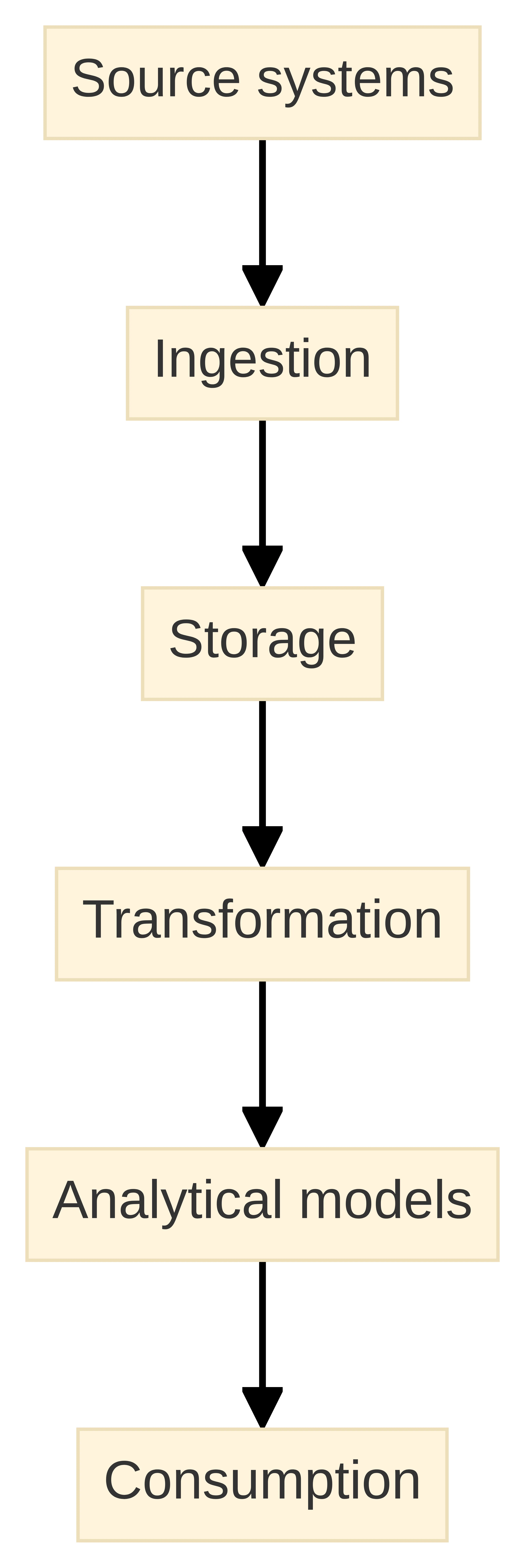
A cloud warehouse data flow begins with source systems and ends with a query, report, model, or operational decision. The architecture can vary, but the planning sequence remains useful:
- Source systems produce records from applications, payment processes, care workflows, partner feeds, files, or event streams.
- Ingestion moves those records into the analytical environment. The movement may be scheduled, event-driven, or a combination of both.
- Storage retains the incoming data in raw, staged, or curated form according to the design.
- Transformation cleans, joins, standardizes, validates, and reshapes data for defined analytical uses.
- Analytical models give recurring questions a stable structure, such as consistent measures, dimensions, or business definitions.
- Consumption exposes the resulting data to dashboards, reports, notebooks, applications, or machine-learning work.
This sequence is a map, not a mandatory implementation recipe. Your design may transform data before loading it, after loading it, or at several points.
Batch and near-real-time processing represent different timing requirements within that flow. A batch path collects and processes data on a schedule or after a defined volume accumulates. A near-real-time path moves and processes data with shorter delay when the use case needs fresher information.
Your target delay should come from the decision that consumes the data. A daily risk report, a monthly financial close, an exploratory model, and a fraud-monitoring workflow do not necessarily need the same path. Warehouse models are often built around known reporting requirements, while machine-learning analysis may require iterative exploration of raw datasets when desired outputs are initially unknown.
A practical source-to-insight map should answer these questions for each important data product:
- Which system creates the data, and who owns its meaning?
- What event or schedule moves the data?
- Where is the original record retained?
- Which transformations change the record, and who approves those changes?
- How do you identify late, duplicate, incomplete, or rejected data?
- Which report, model, application, or decision consumes the result?
- What delay can that consumer tolerate?
The answers reveal architecture needs more clearly than a list of platform features. They also show where ownership changes between application, data, security, and analytics teams.
Compare warehouse, lake, lakehouse, and real-time patterns by purpose
A platform-neutral comparison should focus on purpose, data shape, timing, and governance rather than on labels alone.
| Pattern | Primary purpose | Data and timing emphasis | Planning question |
|---|---|---|---|
| Cloud data warehouse | Curated, repeatable analysis and reporting | Structured analytical models; the design may also accommodate semi-structured and unstructured data | Which recurring measures, reports, and analytical queries need a governed home? |
| Data lake | Retain and explore large volumes of raw or varied data | Structured, semi-structured, unstructured, and raw data; timing depends on the surrounding ingestion and processing design | Which source data must remain available before its future use is known? |
| Lakehouse pattern | Combine broad data retention with more structured analytical use | A design that brings raw-data flexibility and analytical organization into one planning model | Which responsibilities, formats, and consumers must share a data environment? |
| Real-time analytical pattern | Support decisions that depend on fresher data | Shorter movement and processing delay, with additional attention to event flow and operational handling | What decision changes when data arrives minutes later rather than hours or days later? |
Cloud data platform material describes data lakes as places to store large volumes of data for analysis across curated, structured, semi-structured, unstructured, and raw forms. Those descriptions help frame the options, but they do not select an architecture for your organization.
The purpose of each pattern matters more than the label attached to it. A warehouse may be the right analytical home for governed recurring reporting while a lake supports source retention and exploration. A real-time path may be necessary for one decision but unnecessary for another. A lakehouse pattern may reduce the number of conceptual boundaries you manage, or it may combine responsibilities that your teams would rather keep distinct.
Use the pattern comparison to expose trade-offs. Do not treat “modern” as a performance guarantee, “real-time” as a business requirement, or “lakehouse” as a complete description of governance, ownership, or cost.
Match the architecture to the workload
Workload fit depends on the questions your systems must answer, the data those questions use, and the delay those answers can tolerate. A reporting workload with stable definitions has different design needs from exploratory machine-learning work or event-driven operational analysis.
Traditional warehouse models are often built around known reporting requirements. Microsoft’s comparison describes machine-learning analysis differently: when the desired outputs are initially unknown, data scientists may need iterative exploration of raw datasets to discover useful relationships. That distinction affects how much structure you impose before analysis and how easily you can revisit source data.
Common workload categories give you a practical starting point:
- Recurring reporting: Financial, operational, management, or regulatory reports with defined measures and recurring schedules. Prioritize consistent definitions, repeatable transformations, and controlled access.
- Exploratory analysis: Investigation where questions and outputs change as you learn. Prioritize access to appropriately governed source data and the ability to test different structures.
- Machine-learning preparation: Work that may require repeated feature creation, comparison, and review. Separate experimentation from approved production outputs.
- Operational analytics: Decisions that depend on fresher data than a scheduled report. Define the acceptable delay and the consequence of stale or missing data before choosing a processing path.
- Cross-domain analysis: Questions that combine financial, healthcare, customer, product, or operational records. Define shared identifiers, permitted joins, and ownership before combining datasets.
A warehouse may not be the only or immediate answer when your main need is transaction execution, long-term raw-data retention, unstructured-data exploration, or a decision with a strict freshness requirement. That does not make the warehouse irrelevant; it means you should define its role beside the other systems.
Write the workload in concrete terms: the source data, the users, the query or model, the expected refresh interval, the peak period, the access boundary, and the consequence of an incorrect or delayed result. If you cannot describe those items, keep the architecture decision open and improve the workload definition first.
Evaluate scale and economics through workload behavior
Storage-compute separation changes how you should examine scale. Modern cloud warehouse architectures commonly separate storage from compute, unlike older fixed-size designs that coupled retained data capacity to processing capacity. The comparison characterizes modern warehouses as supporting dynamic, on-demand scaling rather than scalability limited by physical hardware.
The relevant question is not whether a platform can scale in the abstract. Ask how resources respond to your workload: concurrent queries, scheduled jobs, exploratory sessions, data refreshes, peak reporting periods, and recovery or backfill work. Ask what happens when several of those activities occur together.
Cloud warehouse economics depend on behavior as well as volume. The comparison characterizes modern warehouses as using pay-as-you-go pricing rather than the high upfront investment associated with traditional warehouses. Another cloud-data-platform source states that separating storage and computing power and using pay-as-you-use pricing can make handling large data volumes easier and less expensive, while also stating that actual economics depend on workload and design.
Treat those statements as evaluation hypotheses, not financial outcomes. A flexible resource model may help when demand varies, but poorly bounded queries, unnecessary data movement, repeated transformations, retained copies, idle resources, or unexpected concurrency can change the cost profile.
A workload-based cost review should document:
- Data retained by source, format, age, and access frequency.
- Typical and peak query volume, concurrency, and processing duration.
- Scheduled transformations, refresh frequency, and backfill behavior.
- Data movement between the warehouse, source systems, analytics tools, and other storage.
- Development, test, disaster-recovery, and archival environments.
- Controls for monitoring usage, setting ownership, investigating spikes, and retiring unnecessary work.
Use the same workload description for capacity and cost discussions. A generic estimate has little value if it does not identify the data, timing, concurrency, and operating assumptions behind it.
Turn regulated data into control questions
Regulated-data planning begins by identifying the data, the people and systems that can access it, and the responsibilities that apply to each part of the environment. HHS cloud-computing guidance explains that a cloud service provider may be legally separate from the covered entity or business associate using its services. The cloud boundary therefore does not by itself transfer your organizational responsibilities.
HHS also states that regulated entities must limit physical access to electronic information systems and facilities while allowing properly authorized access. It separately states that regulated entities must govern the use and physical safeguards of workstations that can access electronic protected health information. Those points make access, facilities, devices, and organizational procedures part of the planning discussion, not merely platform-selection details.
PCI DSS guidance describes PCI DSS as a set of comprehensive requirements for enhancing the security of payment card account data. The guide includes requirements for firewall protection, avoiding vendor-supplied defaults for system passwords and other security parameters, protecting stored cardholder data, encrypting its transmission across open public networks, maintaining secure systems and applications, and limiting cardholder-data access by business need to know.
Those requirements should become architecture questions. Ask where cardholder data enters the environment, where it is stored, which paths transmit it, which systems can reach it, how access is limited, and which team owns each control. Do not treat a warehouse label or cloud deployment model as an answer to those questions.
A regulated-data question set should cover at least these areas:
- Data classification: Which records contain payment-card data, electronic protected health information, or other restricted information? Which fields can be removed, masked, tokenized, or kept separate?
- Access control: Which roles need access, for which purpose, and for how long? How do you handle administrative access, service identities, and access removal?
- Transmission and storage: Where is data encrypted in transit or protected while stored? Which paths cross public networks or external boundaries?
- Retention and disposal: What retention period applies to each data class, who approves it, and how is data removed from storage, copies, exports, and media when the period ends?
- Auditability: Which access, change, transfer, and administrative events must be recorded? Who reviews them and how are exceptions handled?
- Responsibility: Which duties remain with your organization, which are performed by a service provider, and which require coordinated procedures?
Use these as planning questions, not as an individualized compliance conclusion. A control can be described in a policy and still require technical, operational, and organizational evidence.
Make observability and accountability explicit
Observability connects warehouse activity to operational accountability. PCI log-monitoring guidance states that effective log monitoring can help track the status and effectiveness of security controls and provide metrics about their operational effectiveness. For a cloud warehouse, that principle means you should decide what activity matters before choosing how to collect or review it.
Your observability plan should connect events to decisions. A login event, permission change, data export, failed pipeline, unusual query, transformation change, or access to a restricted dataset may require different owners and responses. Define the event, the expected signal, the responsible team, and the action that follows.
Accountability becomes clearer when you assign owners to the data path rather than to the platform name. For each important dataset or workload, identify:
- The business owner who defines acceptable use and meaning.
- The engineering owner who maintains ingestion and transformation.
- The security or privacy owner who sets access and monitoring expectations.
- The analyst, application, or model owner who consumes the result.
- The person or team responsible for investigating failures, exceptions, and unauthorized activity.
A responsibility matrix should distinguish approval, execution, review, and escalation. Do not leave those roles implied by job titles or assume that the party operating the cloud environment owns every control.
Availability is also an operating question. Document which reports, models, and downstream systems depend on the warehouse, what delay each can tolerate, how a failed load is detected, and how a stale result is labeled or withheld. Then ask which dependencies sit outside the warehouse, including source systems, ingestion services, identity systems, analytics tools, and network paths.
This approach gives you a practical operations discussion without assuming a particular uptime result. It also shows whether a proposed design has a clear response when data is late, incomplete, duplicated, or unavailable.
Use an evaluation worksheet instead of a feature list
An evaluation worksheet turns an abstract platform discussion into a record of requirements, assumptions, open questions, and owners. Use one row for each material workload or data domain, then complete the same fields before comparing architectures or providers.
A useful worksheet contains these fields:
- Workload name and decision: State the report, model, operational analysis, or other result the data must support.
- Source systems and data classes: List the systems, formats, restricted data types, owners, and permitted joins.
- Freshness and volume: Record the acceptable delay, expected data growth, peak periods, query concurrency, and backfill needs.
- Processing path: Describe ingestion, storage, transformation, validation, and consumption without assuming a particular product.
- Performance behavior: Define the queries, transformations, or model jobs that matter and the conditions under which they run together.
- Governance and access: Identify roles, purpose-based access, administrative access, retention, disposal, and approval points.
- Security and monitoring: State the protections, events, logs, reviews, and escalation paths that require evidence.
- Availability and recovery: Identify dependencies, acceptable delay, failure handling, recovery assumptions, and data-reconciliation needs.
- Economics: Record retained data, processing behavior, data movement, environments, usage monitoring, and cost ownership.
- Open decisions: Capture unresolved architecture, policy, responsibility, and implementation questions with an owner and next action.
A completed worksheet should let you compare alternatives by the same criteria. If one option handles a workload only by adding an assumption, record the assumption instead of treating the option as equivalent. If a control depends on a process outside the warehouse, assign that process to its owner. If a cost discussion lacks workload details, mark the estimate as unresolved.
Use the worksheet in three passes:
- Describe: Record the current data path and the intended analytical result.
- Challenge: Test timing, access, governance, operations, and economic assumptions.
- Decide what remains open: Separate questions you can answer internally from questions that require architecture, security, compliance, or implementation expertise.
The immediate use of this tool is clarity.
Keep unsupported decisions outside the evidence boundary
A cloud warehouse evaluation can determine whether the category is relevant to your workloads and which questions need answers. It cannot, by itself, determine that a particular architecture satisfies every obligation, that a particular platform meets your performance needs, or that a projected cost will hold under actual use.
Keep these decisions open until their conditions are documented:
- Selecting a vendor or product based on a general capability label.
- Treating a compliance-related term as proof that your implementation satisfies a requirement.
- Estimating performance without representative data, queries, concurrency, and timing conditions.
- Estimating cost without retention, processing, movement, environment, and usage assumptions.
- Choosing a migration sequence without understanding source dependencies, data quality, rollback needs, and ownership.
- Treating a real-time design as necessary without identifying the decision that requires fresher data.
A sound decision boundary does not delay every decision. It separates what you can establish now from what requires further investigation. You can document the workload, map the data path, classify the data, assign control owners, define evaluation criteria, and list unresolved questions before selecting a platform or implementation path.
That separation keeps a planning conversation precise. It also prevents a broad category description from becoming an unsupported architecture, compliance, performance, or commercial conclusion.
Document the planning case before requesting implementation help
A planning brief should connect your data warehouse decision to a defined workload and operating responsibility. Include the source systems, data classes, processing path, analytical consumers, freshness needs, scale assumptions, access model, retention questions, monitoring expectations, availability dependencies, cost drivers, and unresolved decisions.
The brief is ready for the next conversation when your team can explain what the system must do, which data it handles, who owns each responsibility, and which questions still require investigation. Keep platform and implementation choices tied to those facts rather than to cloud preference or product terminology.
A qualified security, privacy, compliance, or engineering professional should determine how your specific obligations and technical conditions apply to the proposed design. Your documented brief gives that professional a concrete scope to assess and gives your team a clear basis for discussing implementation work.
A documented scope lets you move from category research to a focused planning conversation. Bring the worksheet, data-flow map, control questions, workload assumptions, and open decisions so the next step addresses defined work rather than a vague platform request.