
Answer the IaaS question in one decision
Infrastructure as a service in cloud computing is a way to obtain foundational computing resources through a cloud model while retaining responsibility for important decisions about the workload that runs on them. Cloud computing provides on-demand access to shared, configurable resources such as networks, servers, storage, applications, and services. IaaS applies that model to fundamental infrastructure services such as computing and storage.
For a hedge fund, the decision is not simply whether to replace owned hardware with rented capacity. The practical question is where you want responsibility to sit. A provider may operate parts of the underlying cloud environment, while your organization still has to decide how workloads are configured, how data is handled, which identities receive access, and what operating evidence is required.
A hedge fund should consider IaaS when the organization needs infrastructure-level control and is prepared to operate the security, data, access, and governance responsibilities that remain on the customer side. The model can support an infrastructure strategy, but the label does not settle whether a particular workload belongs there.
Use this guide to make that decision in sequence: define the service boundary, identify the resources involved, assign each responsibility, test the workload, and set the documentation threshold before adoption. The result should be a bounded architecture question rather than a broad preference for or against cloud infrastructure.
Place IaaS among the cloud service models
The three major cloud service models are infrastructure as a service, platform as a service, and software as a service. Organizations may use several models together, so choosing IaaS does not require treating the other models as irrelevant. The useful distinction is the level at which the service begins and the amount of environment management that remains with you.
IaaS begins with foundational infrastructure. PaaS moves the service boundary upward toward a managed platform for application work. SaaS moves it further upward toward an application that you use rather than build and operate from the underlying infrastructure. These descriptions are planning distinctions, not mutually exclusive deployment choices.
| Service model | What you are deciding | Responsibility question |
|---|---|---|
| IaaS | Which computing, storage, network, and environment choices you need to control | Which infrastructure, operating-system, workload, data, and access tasks remain with your team? |
| PaaS | Which application platform operations you want handled above the infrastructure layer | Which platform controls, deployment decisions, and application responsibilities remain with you? |
| SaaS | Which finished application capability you want to consume | Which data, identity, configuration, and governance responsibilities remain with your organization? |
For an IaaS assessment, avoid treating the model name as a complete architecture description. Two services may both be described as IaaS while creating different customer duties, depending on the selected services and configuration. Start with the actual service boundary and document the tasks that cross it.
The service model should therefore be read as a responsibility map. IaaS may give you more infrastructure-level choice than a more abstract service, but that choice carries operating work with it. If your team wants to control the guest environment, installed software, and network access configuration, those duties need named owners rather than an assumption that the provider handles them.
Identify the resources IaaS provides
IaaS provides a foundation for computing and storage through a cloud model. Cloud computing also describes configurable resources such as servers and networks, so your infrastructure plan should map those resource categories before it discusses products or providers.
Use a simple resource map:
- Compute: Identify the processing environments that applications, research workflows, data services, or other workloads require.
- Storage: Identify the data that must be retained, accessed, protected, classified, or moved between environments.
- Networking: Identify the connections between users, applications, storage, control systems, and external services.
- Virtual infrastructure: Identify the virtual environments, isolation boundaries, and management controls that sit beneath the workload.
- Access and configuration: Identify the identities, permissions, firewall settings, operating-system settings, and application components that your team must manage.
The resource map matters because IaaS is not a single undifferentiated capacity pool. Computing and storage may be the visible requirement, but the surrounding network and virtual-infrastructure controls determine how the workload is configured and governed. FFIEC guidance identifies management of virtual infrastructure, including controls over the hypervisor, as a cloud-control area for financial institutions.
For each resource, record four facts: what the workload needs, who configures it, who monitors it, and what evidence shows that the control operated. That record gives you a concrete way to discuss infrastructure instead of using IaaS as a broad substitute for architecture.
The selected service determines how much of the resource map your team must operate. In the cited AWS EC2 example, the customer manages the guest operating system, patches, installed software, and instance firewall configuration. That example is provider-specific, so use it to illustrate the type of task that must be assigned, not as a universal description of every IaaS service.
Separate infrastructure access from customer responsibility
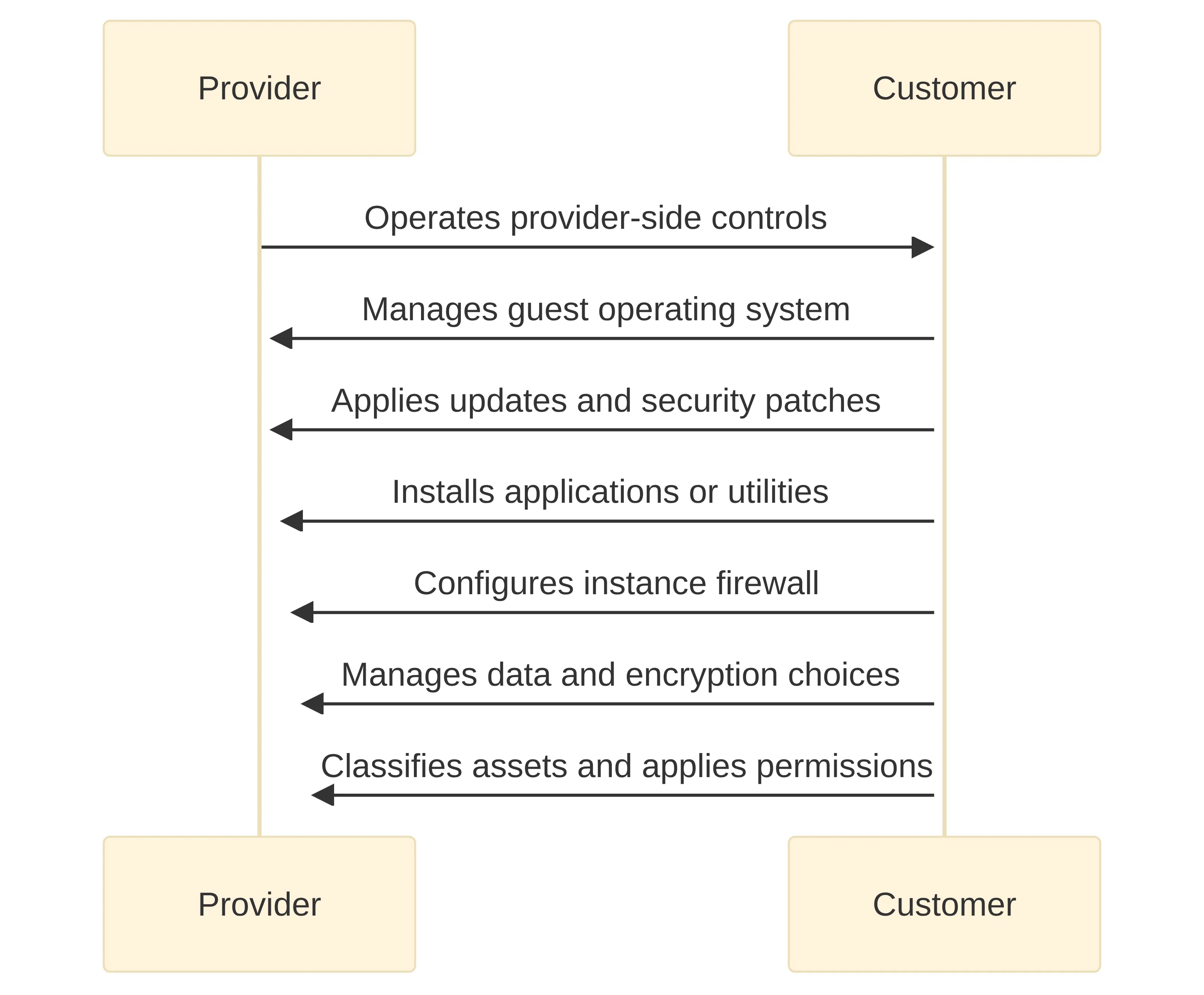
The cited AWS EC2 example makes the customer side concrete. In that example, the customer manages the guest operating system, updates and security patches, customer-installed applications or utilities, and the provider instance firewall configuration. In the same cited AWS model, customers manage their data, encryption choices, asset classification, and access permissions through identity-and-access-management tools.
Treat those items as responsibility categories. Assign an owner for operating-system maintenance, software installation, firewall configuration, data handling, encryption decisions, classification, and permissions. If the chosen service changes the boundary, update the assignment rather than carrying forward an assumption from another service.
A usable responsibility register should answer these questions for every IaaS workload:
- Which part of the infrastructure does the provider operate?
- Which guest environment and installed components does your team operate?
- Who applies patches and records the result?
- Who controls identities, permissions, and firewall settings?
- Who classifies the data and decides how encryption is used?
- Who detects a control failure and decides what happens next?
Use the register before adoption so those challenges become assigned work rather than an unexamined handoff.
Assess the flexibility and operating trade-off
IaaS trades infrastructure control for operating responsibility. The cited IBM cloud architecture material characterizes private cloud as combining capabilities associated with public cloud, including standardization, self-service automation, scalability, and metering, with greater customization and control associated with on-premises environments. That characterization shows why infrastructure planning cannot evaluate flexibility without also evaluating the work needed to use it consistently.
Flexibility can help when workloads have different configuration, storage, or access requirements. The same flexibility can create more variation to document, secure, monitor, and maintain. Your decision should therefore ask whether the organization can govern the choices it wants to retain.
The operating trade-off appears in several places:
- Configuration: More infrastructure-level choices require clearer standards and ownership.
- Automation: Self-service can support repeatable provisioning, but your organization still needs rules for who can provision and change resources.
- Scalability: The ability to adjust resources is useful only when capacity decisions, monitoring, and cost controls are defined.
- Metering: Usage information can inform management decisions, but it does not replace a budget owner or workload-level cost attribution.
- Customization: Tailoring the environment may fit a specialized workload, while each deviation creates another item to document and review.
These are decision criteria, not promised outcomes. Test them against the workload and operating model you actually have.
IaaS fits an organization that wants infrastructure-level choices and can sustain the controls those choices require. If your team cannot assign the customer-side tasks, more control may produce more unmanaged variation rather than a better operating position. Set the ownership threshold before selecting the service.
Test candidate workloads for IaaS fit
A candidate workload fits IaaS only when its infrastructure needs and customer responsibilities can be described clearly. Begin with the workload, not the cloud label. A data-intensive hedge-fund environment may contain research systems, analytical services, application components, and operational tools with different control and data requirements; treat each workload boundary separately rather than assuming that one placement decision covers all of them.
Ask five questions:
- What computing and storage resources does the workload require?
- Which operating-system, application, network, and access settings must your team control?
- What data classifications and encryption decisions apply?
- Which tasks must happen on a defined operating schedule?
- What records would demonstrate that the controls were performed?
Common candidate shapes can be evaluated without assuming that every workload needs the same environment. A computing-heavy workload may require a clear compute boundary. A storage-centered workload may require a precise data and access model. A service with several dependent components may require network and identity decisions that are more significant than its raw compute requirement.
Use these shapes to organize discovery, not to predict an implementation result. The resource map should lead to a responsibility register, and the responsibility register should lead to an operating and governance review.
A workload should not advance merely because it can run on virtual infrastructure. Advance it to the next evaluation stage only when you can identify the customer-side owners for its operating system, installed software, access controls, data decisions, and monitoring responsibilities. If those owners or records are undefined, pause the placement decision and resolve the operating boundary first.
Make virtual-infrastructure oversight part of the decision
Virtual-infrastructure oversight is a distinct diligence question for a financial-services environment. FFIEC guidance identifies management of the virtual infrastructure as a cloud-specific control area and points to the hypervisor, or other virtual-infrastructure controls, as an area where management should seek assurance about the provider’s controls.
That guidance does not decide whether a particular hedge fund must use a specific architecture. It does establish a useful question: what controls govern the virtual layer beneath your workload, and how can you assess those controls? Keep that question separate from application security and from the customer-side configuration duties.
The FFIEC statement identifies third-party assurance reports as one possible way for management to assess whether a provider has appropriate controls over the hypervisor or other virtual-infrastructure controls. Treat such reports as an input to diligence, not as a complete answer to every workload question.
For each proposed service, record the virtual-infrastructure control area being assessed, the assurance material available, the period or scope it covers, and the remaining customer-side controls. Ask whether the material addresses the environment you intend to use and whether your own operating records still need to cover the workload above it.
A practical oversight sequence is:
- Define the virtual layer that supports the workload.
- Identify the provider controls that affect that layer.
- Review the available assurance material and its scope.
- Map the provider-side controls to your responsibility register.
- Record unresolved questions before authorizing the workload.
This sequence keeps virtual-infrastructure oversight attached to the architecture decision instead of leaving it as a general procurement question.
Define security and data-governance ownership before adoption
Security and data governance remain customer decisions wherever the selected service leaves those duties with your organization. In the cited AWS model, customers manage their data, encryption choices, asset classification, and access permissions. The shared-responsibility boundary means that provider security controls cannot substitute for customer decisions about the workload and its information.
Define those decisions before adoption. Identify the data owner, classification approach, encryption decision-maker, identity owner, permission review process, and recordkeeping requirement. Then connect each item to the specific IaaS service and configuration that will carry it.
The Cloud Security Alliance notes that customers may find it challenging to design, deploy, and operate a secure cloud service, including IaaS. That observation gives your planning process a useful boundary: security is not complete when the infrastructure is provisioned. The design, deployment, and operating stages each need an owner and a record of the relevant controls.
Build the review around the workload’s actual data and access pattern:
- Identify which information enters the environment and where it is stored.
- Define who may access it and how permissions are managed.
- Record the encryption choices that apply to the data.
- Assign responsibility for patches, installed components, and firewall configuration where the selected service leaves those tasks with you.
- Define the operating record that shows each control was performed.
Do not convert a provider’s responsibility for part of the environment into a conclusion about the whole workload. The customer-side boundary still governs your data, access, configuration, and operational decisions where the selected service assigns them to you. Resolve that boundary in writing before treating the workload as ready.
Compare public and private cloud context without choosing a provider
Public and private cloud describe deployment context, while IaaS describes a service model. They answer different questions. A public cloud is operated by a provider, with servers, storage, and networking resources shared among multiple customers and accessed over the internet. The cited IBM material characterizes private cloud as combining public-cloud capabilities such as scalability and automation with greater customization and control associated with on-premises environments.
Do not treat public or private as an automatic security, compliance, or workload decision. Use the deployment context to frame ownership, access, customization, and operating questions, then assess the selected service and workload together.
| Criterion | Public-cloud context | Private-cloud context |
|---|---|---|
| Environment | Provider operates the cloud environment | The cited IBM characterization associates the environment with greater customization and control linked to on-premises settings |
| Resource arrangement | Servers, storage, and networking are shared among multiple customers and accessed over the internet | The cited IBM characterization emphasizes combining cloud capabilities with greater control and customization |
| Planning emphasis | Examine shared-environment controls, access, service boundaries, and customer responsibilities | Examine how the chosen environment delivers standardization, automation, scalability, metering, customization, and control |
| IaaS question | Identify which infrastructure duties remain with your organization | Identify which infrastructure duties are retained, delegated, or automated within the private environment |
The table compares planning questions rather than declaring one context suitable for every hedge fund. The right comparison depends on the workload, the control boundary, and the evidence your governance process requires.
Use public and private cloud context to narrow the decision, not to skip the responsibility review. For either context, document who controls the infrastructure, who controls the workload, how data and access are managed, and how you will assess the virtual layer. Those questions remain relevant after the deployment label changes.
Turn resilience, observability, portability, and cost into diligence questions
Resilience, observability, portability, and cost should be treated as questions to answer for each workload, not as automatic properties of IaaS.
Turn each concern into a decision record:
- Resilience: Which components must continue operating, what failure conditions matter, and who owns the response?
- Observability: Which signals, logs, and control records must be available to operate the workload and investigate a problem?
- Portability: Which configurations, data structures, dependencies, and operating procedures would need to move if the environment changed?
- Cost: Which team owns usage decisions, what resource activity must be attributed, and what review process addresses unexpected consumption?
- Change: Who approves infrastructure changes, and how are changes connected to workload and control records?
The customer responsibility boundary gives these questions operational force. If your organization controls the guest operating system, installed software, firewall configuration, data, encryption choices, asset classification, or permissions in the selected service, your operating model must cover those areas. The exact tasks depend on the service, so write the answer against the selected configuration.
A useful diligence record should connect each requirement to an owner, a control activity, a signal or document, and a review frequency. That record helps you distinguish a stated capability from an operating process your organization can actually maintain.
Do not accept scalability, metering, or automation as substitutes for resilience planning, monitoring ownership, portability analysis, or cost governance. Ask what the capability changes in your operating process and what evidence will show that the process works for the workload under review.
Set the evidence threshold for a regulated environment
A regulated financial-services environment needs a defined threshold for accepting provider and customer control information. The threshold should match the workload, the service boundary, and the governance decisions you need to support. It should not be reduced to a general statement that a provider operates cloud infrastructure.
FFIEC guidance identifies virtual-infrastructure management as a cloud-specific control area and cites third-party assurance reports as one possible way to assess provider controls over the hypervisor or other virtual-infrastructure controls. Use that material to frame the provider-side review, then preserve the customer-side responsibilities in your own control record.
The passage concerns a proposal and does not establish a universal contractual requirement. It does show why provider diligence may involve more than a product description.
For a candidate IaaS service, define what you need to assess:
- Control documentation for the virtual infrastructure and selected services.
- Information about the scope and period of available assurance material.
- The customer responsibilities that remain after provider controls are considered.
- The records your organization must maintain for data, access, configuration, and operations.
- Contractual questions that require review by the appropriate internal functions.
The evidence threshold is met only when the material supports the decision you are making. A general provider document may help you understand the environment, while a workload decision may require a narrower mapping of controls, responsibilities, and records. Record unresolved items explicitly and assign them before authorization.
Recognize what the IaaS label cannot establish
The IaaS label cannot establish that a workload is secure, compliant, resilient, portable, economical, or suitable for your organization. It identifies a service category, not the complete operating result. Security responsibility is shared and depends on the selected services, while public-cloud resources may be shared among multiple customers and accessed over the internet.
The label also cannot tell you who patches the guest environment, manages installed software, configures a firewall, classifies data, chooses encryption, or applies access permissions. Those answers come from the service boundary and your responsibility register.
Use the label as the beginning of a question set:
- What infrastructure resources are included?
- Which virtual-infrastructure controls affect the workload?
- Which customer-side security and data duties remain?
- What assurance material addresses the provider-side controls?
- What operating records will your organization maintain?
- Which workload requirements still need architecture, security, or governance review?
A negative answer to any of these questions does not automatically reject IaaS. It does mean that the architecture decision is not ready to close.
Make the recommendation conditional on accountable ownership
The recommendation should be conditional: consider IaaS for a workload when the organization needs infrastructure-level control, can assign the customer responsibilities, and can produce the governance evidence required for that workload. Do not proceed on the assumption that provider operation removes the need for customer security, data, access, or configuration ownership.
The shared-responsibility model supplies the decision logic. First identify the provider-side boundary. Then assign the customer-side tasks. Finally, test whether the organization has the people, processes, records, and review paths needed to operate those tasks.
Use these gates before making a workload recommendation:
- Resource gate: The required computing, storage, network, and virtual-infrastructure resources are defined.
- Responsibility gate: Provider and customer duties are mapped to named owners.
- Security gate: Data, encryption, classification, identity, permissions, patching, software, and firewall duties are assigned where applicable.
- Oversight gate: Virtual-infrastructure controls and available assurance material have been reviewed for the intended service.
- Operations gate: Resilience, observability, portability, cost, and change questions have owners and review processes.
- Evidence gate: The organization knows which records support the decision and ongoing operation.
Advance only when each gate has an answer appropriate to the workload. If a gate remains open, make the next action a scoped investigation rather than a general adoption decision.
This conditional approach preserves the value of infrastructure flexibility without treating flexibility as a result. IaaS can be a reasonable architectural option where control needs, operating capacity, and governance expectations align. Where accountable ownership is missing, the responsible decision is to resolve that gap before selecting the service.
Prepare the next infrastructure decision
The next infrastructure decision should be a bounded workload assessment, not a decision about cloud in the abstract. Write down the workload, map its computing and storage needs, identify the virtual-infrastructure boundary, assign provider and customer responsibilities, and define the records needed for security, data governance, operations, and oversight.
IaaS merits consideration when your organization wants infrastructure-level control and can own the customer-side work that accompanies it. A qualified professional should determine individual architectural, security, compliance, and legal suitability for your organization and workload. Request a project quote.
What should a hedge fund clarify before requesting a project quote?
What is infrastructure as a service in cloud computing?
Infrastructure as a service (IaaS) is a cloud computing model that provides foundational computing resources such as networks, servers, storage, and applications on-demand.
How does responsibility divide between the provider and the customer in an IaaS model?
In an IaaS model, responsibility is shared between the provider and the customer.
What should organizations consider when evaluating IaaS for a regulated environment?
Organizations should assess the shared responsibility model, security controls, compliance requirements, and the ability to manage data governance and access permissions. It’s important to document responsibilities and ensure that the IaaS solution aligns with regulatory standards.
What factors should be documented when adopting IaaS?
When adopting IaaS, organizations should document the service boundary, the resources involved, the division of responsibilities, security measures, and compliance requirements. This documentation helps ensure clarity in operational roles and governance.