
Multi-tenancy is a shared system with separate tenant boundaries
Multi-tenant architecture serves multiple tenants from a shared application and resource set. A tenant is usually a customer organization, business unit, or other defined group whose users and records must remain within its own boundary. The shared system may include the application, databases, and supporting infrastructure; the boundary determines which tenant can access which resources.
That distinction separates multi-tenant architecture from a single-tenant model. In a single-tenant arrangement, each tenant receives a dedicated application instance and resources. In a multi-tenant arrangement, multiple tenants use the same application and shared resources, so separation depends on controls at the application or database layer rather than on a completely separate environment for every customer.
The central planning question is therefore not simply whether infrastructure can be shared. You need to decide how tenant identity travels through the system, where data separation is enforced, how shared resources are controlled, and how operations behave when many tenants depend on the same platform. A design can be efficient to operate and still require careful boundaries. It can also provide strong separation in one layer while leaving another layer exposed to cross-tenant mistakes.
Use multi-tenancy as an end-to-end design problem. The isolation shape, data model, access controls, resource policies, maintenance process, and governance model need to support the same tenant boundary.
A SaaS example makes the model concrete
A business-to-business SaaS application provides a practical example of multi-tenancy. Imagine one software product used by several companies for their own projects, users, and records. The application is shared, but each company represents a separate tenant with its own logical space inside that application.
When a user signs in, the system needs a reliable way to associate the user and each request with the correct tenant. A request to view a project should be evaluated in the context of that tenant, not only in the context of the user’s general identity. The same principle applies when the application creates, changes, or deletes a record. Tenant identifiers are one conceptual way to represent this boundary, while schemas or other database-layer separation can provide another layer of separation.
The example is shared in one sense and separate in another. The companies may use the same application code and underlying resource pool, but company A must not receive company B’s records merely because both companies use the same software instance. Strong identity and access controls are part of the design because each tenant needs access only to its own resources.
This example also shows why “shared application” is not a complete architecture description. You still need to document the tenant boundary, the path from identity to data access, and the resources that remain shared. Those details turn a broad product model into an architecture that can be assessed.
Choose the isolation shape before choosing implementation details
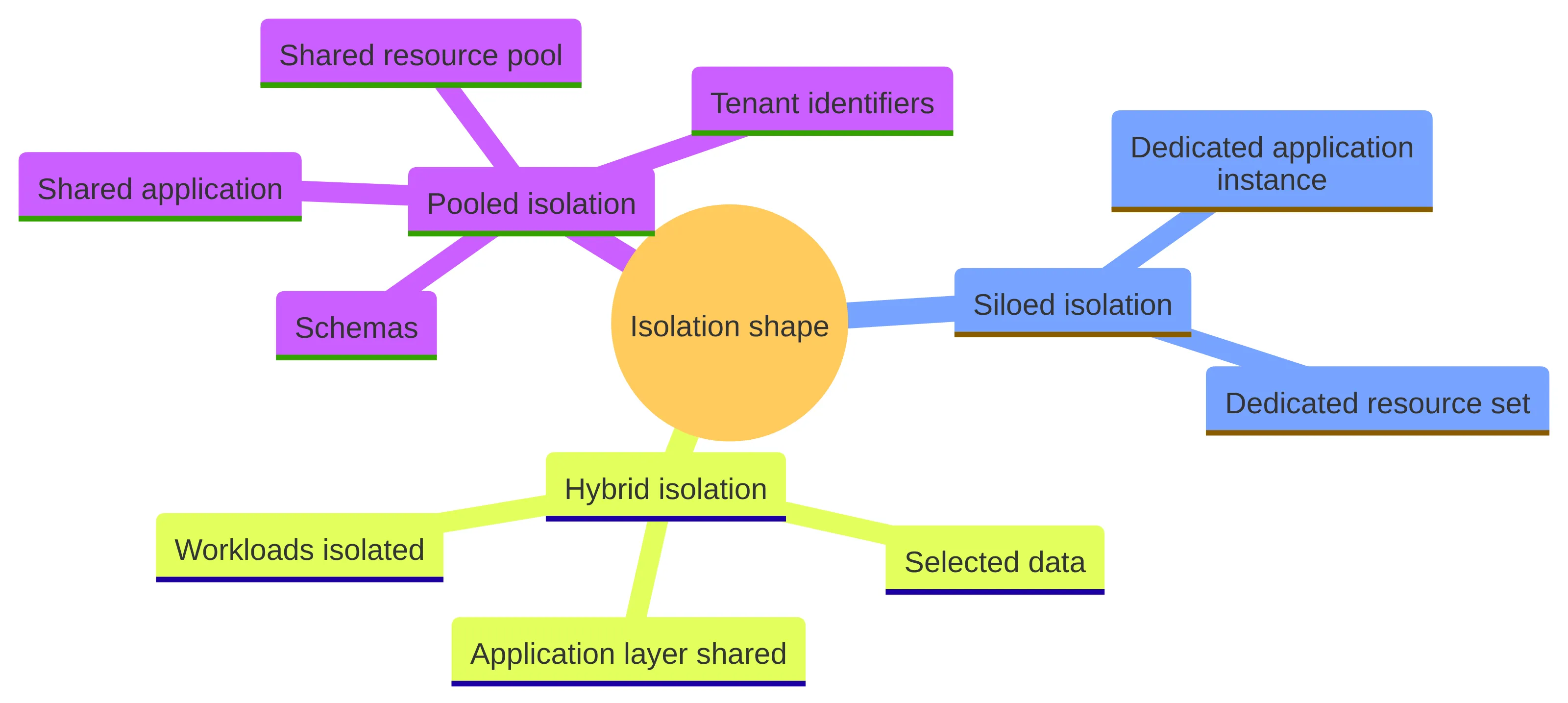
Isolation shape describes how much of the system tenants share. Choose that shape before selecting particular databases, deployment services, or framework features.
- Pooled isolation: Tenants share the application and much of the resource pool. Tenant identifiers or schemas distinguish data within the shared system. This shape puts more responsibility on consistent application and database controls.
- Siloed isolation: Each tenant receives a dedicated application instance and resource set. The model gives you a clearer physical boundary, but each additional tenant brings another environment to provision, maintain, and update.
- Hybrid isolation: Some layers are pooled while others are separated. For example, an application layer may be shared while selected data or workloads receive a more isolated arrangement. The boundary must be written down for each layer rather than described only as “hybrid.”
Pooled isolation can fit a product that expects common behavior and centralized operations. Siloed isolation can fit a requirement for tenant-specific environments or independent infrastructure.
Compare the shapes using concrete criteria:
- Which resources are shared, and which resources are dedicated?
- Where is tenant data separated: in the application, in database schemas, through tenant identifiers, or through separate systems?
- Can the operating model apply maintenance and policy changes consistently?
- What tenant-specific customization is required, and can configuration provide it without independent code or infrastructure?
- How will you identify and respond when one tenant’s activity affects shared performance?
Start with those boundaries. Implementation details should answer them, not replace them.
Treat data separation as an end-to-end boundary
Tenant data separation is an end-to-end boundary, not a single database setting. A tenant identifier or separate schema can help distinguish records, but the architecture still needs to preserve the correct tenant context from sign-in through application logic, queries, background work, and administrative paths.
Map the boundary across the main data path:
- Identity: Define how the system establishes which tenant the user belongs to and how that relationship is represented during a request.
- Application access: Ensure that application operations use the tenant context when selecting, creating, or changing records.
- Database separation: Decide whether schemas, tenant identifiers, or another supported separation approach carries the boundary at the database layer.
- Non-interactive work: Include jobs, imports, exports, integrations, and service-to-service operations in the same analysis. A background process still needs a tenant context when it handles tenant data.
- Administrative access: Specify which administrative actions can cross tenant boundaries, under what authority, and how those actions are distinguished from ordinary tenant access.
Strong identity and access controls are intended to ensure that each tenant accesses only its own resources. Centralized governance can apply consistent security, resource, and operational policies across tenants, but policy consistency does not remove the need to enforce the boundary at the points where data is selected or changed.
An ORM helper that adds tenant criteria to queries is defense in depth, not complete enforcement of tenant isolation. Treat it as one control in a wider design. Test the boundary at every path that can read, write, export, or administer tenant data, and record what happens when tenant context is missing, malformed, or inconsistent.
Shared resources create operational leverage
Shared resources change the operating model as well as the deployment model. Infrastructure costs or overhead can be lower when resources are used across multiple tenants instead of being dedicated to each tenant. A shared system can also accommodate additional tenants without creating a separate application instance for every one.
Centralized maintenance is another consequence. Multi-tenant systems can apply maintenance and updates across tenants from a common operating point, while individual tenant environments require separate maintenance and upgrades. Automation and repeatable processes can support tenant onboarding and ongoing tenant management, especially when the same lifecycle steps recur for each tenant.
The practical benefit is consistency of the platform’s operating path. You can define a common approach for provisioning, configuration, maintenance, and resource policy rather than creating an entirely separate process for every tenant. That benefit depends on keeping tenant-specific behavior within the configuration and separation model you have chosen.
Use shared operation as a planning input, not as a conclusion. Ask which activities can be centralized, which require tenant-specific treatment, and how you will show that a change reached the intended tenants without crossing their data boundaries.
The same sharing model creates material trade-offs
The advantages of sharing come with obligations that need explicit design decisions. Multi-tenant systems typically provide less tenant-specific customization than dedicated environments because changes to shared application behavior can affect multiple tenants. Configuration, feature settings, or similar mechanisms may provide tenant-specific variation without giving each tenant an independent codebase or infrastructure.
Shared resources also create the noisy-neighbor problem. One tenant’s activity can affect performance experienced by other tenants, so the design needs a way to identify shared-resource pressure and decide how it should be handled. The important planning question is not whether the system will always behave identically for every tenant; it is how you will observe and manage variation when workloads compete for shared resources.
Security presents a related trade-off. Shared infrastructure means that logical data isolation and controls preventing unauthorized cross-tenant access carry substantial responsibility. Strong identity and access controls, consistent policy enforcement, and separation at the application or database layer belong in the architecture rather than being treated as later configuration work.
Central maintenance is efficient to repeat, but a common update path also means that you need a clear approach to tenant configuration, testing, and change handling. A shared change should be evaluated against the tenant boundary and the supported customization model. If a requirement depends on independent code changes, dedicated resources may be a closer fit than a pooled arrangement.
Treat each trade-off as a condition to investigate. Shared infrastructure may suit common operating requirements, while a tenant with distinct isolation or customization needs may require a different shape.
Compare multi-tenant and single-tenant consequences
Multi-tenant and single-tenant architectures make different trade-offs across the same planning criteria. The comparison below is conceptual: it describes the consequences of shared or dedicated resources, not a universal result for every implementation.
| Criterion | Multi-tenant architecture | Single-tenant architecture |
|---|---|---|
| Resource model | Multiple tenants share an application and resource set. | Each tenant receives a dedicated application instance and resources. |
| Data separation | Separation is handled at the application or database layer, using approaches such as tenant identifiers or schemas. | The dedicated environment provides a separate system boundary for each tenant. |
| Adding tenants | A shared system can accommodate additional tenants without provisioning a separate application instance for each one. | Each additional tenant requires another individual instance to provision and manage. |
| Maintenance | Maintenance and updates can be centralized across tenants. | Maintenance and upgrades are performed for individual tenant instances. |
| Customization | Tenant-specific behavior generally relies on configuration rather than independent infrastructure or code changes. | A dedicated environment allows more tenant-specific infrastructure and software changes. |
| Performance considerations | Shared-resource activity can make performance vary between tenants, including through the noisy-neighbor problem. | A tenant’s resources are dedicated to that environment, so the shared-resource comparison changes. |
| Operating responsibility | You must define and enforce logical boundaries while managing common resources and policies. | You must manage more individual environments and their separate maintenance paths. |
Use the table to expose a requirement rather than to select a model by label. If common operation and configuration fit the product, multi-tenancy may be relevant. If independent environments or extensive tenant-specific changes dominate the requirements, single-tenancy may be more appropriate to investigate. If the requirements differ by layer, evaluate a hybrid shape and document every boundary.
Turn the architecture choice into planning questions
Planning questions make the architecture choice concrete before implementation begins. Use the following set to structure an early design discussion and record the answer, owner, and unresolved test for each question.
Architecture
- What exactly counts as a tenant: a customer organization, business unit, account, or another boundary?
- Which application, database, and infrastructure resources are pooled, siloed, or hybrid?
- Does the required customization fit configuration, or does it require independent code or infrastructure?
- How does a new tenant enter the system, and which resources are created or shared at that point?
Security and data separation
- How is tenant identity established, and how does tenant context accompany each request?
- Where does the system prevent one tenant from accessing another tenant’s resources?
- Which application and database controls enforce the boundary, and which controls provide defense in depth?
- Have you included background jobs, integrations, exports, imports, and administrative paths in the same boundary review?
Strong identity and access controls are intended to limit each tenant to its own resources. Tenant criteria applied by an ORM can add protection, but ORM-level filtering is defense in depth rather than complete enforcement. Use that distinction when deciding what must be enforced elsewhere.
Scalability and shared resources
- Can additional tenants be added without a separate application instance, and what does onboarding require?
- Which shared resources could allow one tenant’s activity to affect another tenant’s performance?
- What signal would show that a tenant or workload is putting pressure on a shared resource?
- Which resource and operational policies need to apply consistently across tenants?
Operations
- How will you provision, configure, update, and retire a tenant?
- Which maintenance actions affect all tenants, and which can be scoped to one tenant?
- How will you test a common update against tenant-specific configuration?
- Which recurring lifecycle tasks should use automation and repeatable processes?
Governance
- Who owns the tenant-boundary rules and approves changes to them?
- Which security, resource, and operational policies need centralized management?
- How will you record exceptions without turning them into undocumented special cases?
- What evidence will show that the design still follows the intended boundary after a change?
Finish by turning unanswered questions into bounded work. A decision record that names the boundary, isolation shape, controls, shared resources, and open tests is more useful than a model name without conditions.
Make governance and operating controls part of the design
Governance gives the tenant boundary an owner and a repeatable operating rule. In a multi-tenant design, centralized governance can manage security, resource, and operational policies across tenants, while consistent policy enforcement helps keep those rules from diverging between environments.
Separate governance into three questions:
- What is the rule? Define the tenant boundary, permitted access, resource expectations, and supported customization model.
- Where is the rule enforced? Identify the application, database, identity, and operational points that apply it.
- How is the rule maintained? Assign ownership for onboarding, changes, updates, exceptions, and tenant retirement.
This separation prevents a policy statement from being mistaken for a technical control. For example, a rule that tenants may access only their own resources needs enforcement along the data path. An ORM helper may strengthen that enforcement, but it is not complete tenant-isolation enforcement by itself. The operating model should identify the other controls and the tests that exercise them.
Repeatability matters for tenant lifecycle work. Automation can support onboarding and ongoing management, but automation should follow an explicit boundary and ownership model. Decide which steps are common, which are tenant-specific, and how an operator can tell that the correct tenant context was used.
For systems handling sensitive or regulated information, include the relevant organizational control requirements in this governance record before committing to an isolation shape. Keep those requirements tied to observable design decisions rather than treating a general architecture label as proof of suitability.
Use a bounded next step before committing to a model
A bounded architecture review can turn multi-tenancy from a broad platform preference into a decision with explicit conditions. Start with one representative SaaS workflow and document four things:
- the tenant boundary and the resources that remain shared;
- the pooled, siloed, or hybrid isolation shape for each relevant layer;
- the controls that carry tenant context from identity through data access; and
- the operational and governance questions that still require testing or ownership.
Then compare that record with the consequences of a dedicated environment. If the requirements depend on independent customization, separate resources, or a different operating boundary, keep single-tenancy or a hybrid design in scope rather than forcing every requirement into a pooled model. If the requirements favor common operation, configuration-based variation, and repeatable onboarding, examine whether the shared design can enforce its tenant boundary at every data path.
This first review does not need to settle every implementation detail. It needs to make the boundary, trade-offs, assumptions, and next tests visible. For a production decision involving regulated data or material access controls, have a qualified architecture or security professional assess the specific environment before you commit.
When you have that decision context, you can move from an architecture discussion to a defined software planning engagement.
What should leaders clarify before selecting a multi-tenant design?
What is multi-tenancy architecture?
Multi-tenancy architecture allows multiple tenants to share a single application instance and its resources while keeping each tenant’s data and operations separate. This model contrasts with single-tenant architecture, where each tenant has a dedicated application instance.
How do tenants share resources in a multi-tenant system?
In a multi-tenant system, tenants share a common application and infrastructure, with data separation achieved through mechanisms like tenant identifiers or schemas.
What are the common tenant-isolation approaches in multi-tenancy?
Common tenant-isolation approaches include using separate schemas for each tenant, applying tenant identifiers within a shared database, or utilizing dedicated instances for each tenant in a hybrid model.
What are the key benefits and trade-offs of multi-tenancy?
Benefits of multi-tenancy include reduced infrastructure costs, centralized maintenance, and easier scalability.
What planning questions should be considered when designing a multi-tenant architecture?
Key planning questions include defining what constitutes a tenant, determining which resources are shared or dedicated, establishing how tenant identity is managed, and identifying security measures to prevent unauthorized access between tenants.
What is the 'noisy-neighbor' problem in multi-tenant systems?
The ‘noisy-neighbor’ problem refers to performance issues that arise when one tenant’s resource usage negatively impacts the performance experienced by other tenants sharing the same infrastructure.