
Answer the risk question before choosing a test
The useful question is not simply which tool or test name to select. It is what security risk you need to examine, where that risk could appear, when it can be detected, and how you will validate the result after remediation.
For financial-services software, that distinction changes the planning conversation. A source-code review, a test of an implemented application, and an assessment of operational controls answer different questions. Application security assessment can include methods ranging from source-code review to penetration testing of an implemented application. Treat the approach as a map of risk questions rather than as a single pass or a label.
A risk-question map uses four questions to establish coverage:
- What could fail or be exploited, such as information leakage, authentication, session management, command injection, or denial of service?
- Where could the weakness exist: in source code, application behavior, an integration, a database interaction, a cloud dependency, or a control?
- At what stage can you test it, and what conditions must exist for the result to mean something?
- What evidence will show the finding, the response, and the result of retesting?
This approach gives you a defensible starting point without treating a test result as proof of complete security or compliance.
Place security testing inside the broader testing lifecycle
Security testing is one part of software testing and software development, not a replacement for the wider testing lifecycle. A testing lifecycle commonly moves through requirement analysis, test planning, test-case development, environment setup, execution, defect reporting, retesting, and cycle closure. Security questions belong inside those activities because the scope, expected behavior, environment, and remediation record determine what a result means.
Start during requirement analysis by identifying the security properties that need examination. Then put those properties into the test plan, define the conditions under which they will be tested, and specify what counts as an expected or unacceptable result. This turns a general concern such as protecting account data into testable questions about behavior, access, interaction, and handling.
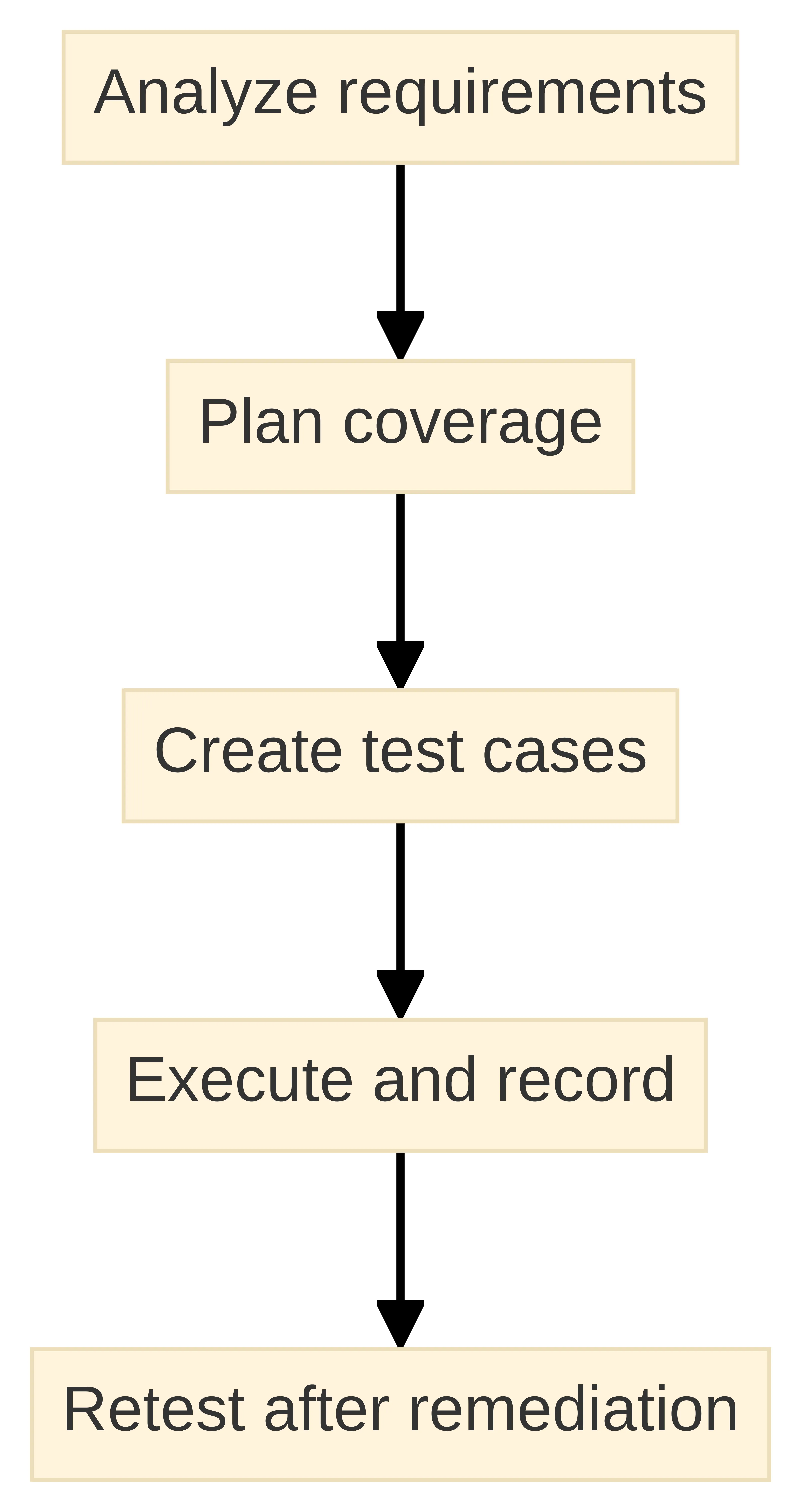
A security-aware testing cycle can be organized as follows:
- Analyze requirements. Identify the software functions, information, users, integrations, and security expectations within scope.
- Plan coverage. Define the testing scope, strategy, resources, schedule, tools, environment, and required effort.
- Create test cases. Translate the security questions into conditions and expected results that can be recorded.
- Execute and record. Compare actual results with expected results and report defects with enough context to act on them.
- Retest after remediation. Run the relevant check again and verify whether the corrected condition behaves as expected.
This sequence does not require every security activity to happen at one point. The application-security methods described here address different parts of the development and deployment lifecycle, from code commits through live production environments.
That timing creates a handoff requirement. An early code-focused result can identify an implementation condition for later runtime examination; a runtime result can identify a behavior that needs a code or configuration owner; and a control result can identify an operational question that application execution alone cannot settle. Record the handoff explicitly rather than treating each stage as an independent pass. The record should say whether the next activity is confirmation, broader coverage, remediation, or retesting. This makes a finding useful even when the first test cannot answer the entire risk question, because the unresolved part is visible and assigned to the appropriate kind of evidence.
Map the system boundary before mapping test coverage
Your system boundary should include more than the application repository. Application security testing can examine how software behaves and interacts with users, other applications, databases, and its execution environment.
For a financial-services application, write the boundary before you choose coverage. Record which application functions matter, which information they handle, which services they call, where databases sit, and which operational or cloud dependencies could affect the result. Include the business process supported by the software, not only the code that implements it.
A boundary review can use these questions:
- Which assets and application components are in scope, and which are outside it?
- Which users, services, databases, and execution environments interact with the application?
- Which business process depends on the software, and what risk tolerance applies to that process?
- Which security policies, legal or regulatory requirements, and internal requirements shape the test questions?
- Which external or cloud providers influence the system’s security, availability, or data handling?
- Who owns each boundary component and the evidence needed to assess it?
That means a boundary review should include provider dependencies where cloud services form part of the system.
Use code-focused checks to find weaknesses early
Source-code review gives you a code-focused way to examine an application before relying only on its running behavior. NIST describes application security assessment as ranging from source-code review to penetration testing of an implemented application. Application security testing also examines coding errors and potential threat vectors before attackers can exploit them.
Use the code-focused stage to ask whether the implementation creates conditions that later tests should expose. The questions can cover how the application handles authentication and sessions, whether it could leak information, and whether implementation choices create paths associated with spoofing, impersonation, command injection, or other attack patterns. These are coverage questions, not a conclusion that a code review alone has found every defect.
A useful code-focused review brief states:
- the source or component under review;
- the security behavior or requirement being examined;
- the conditions that would count as a defect;
- the dependencies that cannot be evaluated from code alone; and
- the retest condition after a correction.
Keep those boundaries visible. A source review can examine implementation, but it does not by itself demonstrate how the deployed application behaves under interaction with users, databases, other services, or its execution environment.
Test the running application and its interactions
A running application answers questions that source-code review cannot answer on its own. NIST describes application security testing as examining whether implemented software behaves and interacts securely with users, other applications such as databases, and its execution environment. The same guidance places penetration testing among the methods that can assess an implemented application.
Define the runtime conditions before interpreting a result. State which build, interfaces, accounts, data conditions, external services, and environment are included. Then connect each test to a behavior you expect to observe. This keeps a runtime finding tied to a concrete application interaction instead of treating a generic scan result as a complete description of software risk.
The interaction surface should be reviewed through separate questions:
- Does the application behave securely when a permitted user performs an in-scope function?
- Does it handle interaction with databases and other applications as expected?
- Does the execution environment introduce a condition that changes the security result?
- Can you reproduce and record the conditions that produced a finding?
- After a fix, can you execute the relevant test again and compare the result with the original expectation?
The testing lifecycle treats execution, defect reporting, retesting, and verification as connected activities. Preserve that connection in your security record.
Treat attack patterns as coverage questions
Attack patterns give your test plan a concrete vocabulary. NIST lists information leakage, authentication exploits, session-management exploits, spoofing, impersonation, command injection, and denial-of-service attacks as examples of patterns that application security testing may examine. The value of the list is not that it creates a universal checklist. It helps you ask which patterns are relevant to your application, where they could arise, and which test stage can examine them.
Each attack pattern can become a bounded coverage question:
- Information leakage: Which application responses, interactions, or environments could expose information that should remain protected?
- Authentication and session management: Which user and session behaviors require examination, and under what permitted test conditions?
- Spoofing and impersonation: Which identities, services, or trust relationships need to be distinguished during testing?
- Command injection: Which application inputs or integrations create a question about unintended commands or execution?
- Denial of service: Which availability-relevant behavior belongs within the authorized test scope and environment?
Then record the asset, requirement, test condition, expected result, and risk response for each question. The NIST Identify function connects vulnerabilities and threats with risk responses and risk tolerances, so the pattern should lead to a decision about coverage and follow-up rather than remain as an isolated label.
Resolve the IAST classification without losing the practical distinction
IAST can be described in two compatible but differently framed ways. One application-security taxonomy lists SAST, DAST, IAST, and RASP as four primary methodologies that address different phases of the development and deployment lifecycle. Another description presents IAST as combining elements of SAST and DAST, interacting with the running program, and using sensors integrated into the application to identify potential issues during operation.
Do not let the classification dispute decide your coverage. Treat IAST as a distinct practical question about instrumented observation of a running program, while recognizing that its method combines elements associated with code-focused and runtime testing. The evidence you receive should state what was instrumented, what ran, what was observed, and which limitations applied.
The following comparison separates the practical questions each approach can help you examine:
| Approach | Primary question | Main scope | Typical point in the lifecycle |
|---|---|---|---|
| Source-code review | What weaknesses or coding errors appear in the implementation? | Source and implementation | Before or alongside execution |
| Implemented-application testing | How does the application behave and interact under defined conditions? | Running application, users, integrations, databases, and environment | During execution of the implemented system |
| IAST | What potential issues appear while the program operates with integrated sensors? | Running program plus application instrumentation | During operation |
Use the table as a planning distinction, not as a promise that one approach covers every risk. If a provider uses SAST, DAST, IAST, or RASP terminology, ask for the objective, scope, stage, evidence, and excluded conditions behind the label.
A negative result must be read at the same level. A code-focused result with no finding does not describe interactions that were never exercised; a runtime result with no finding is bounded by the accounts, data, interfaces, and execution paths included; and an instrumented result is bounded by what actually ran with the sensors in place. These are not failures of the methods. They are reasons to record the conditions behind each result and compare the uncovered questions before concluding that coverage is sufficient. The useful comparison is therefore not which label sounds broadest, but which unanswered risk question remains after each method contributes its evidence.
Separate application tests from control assessment
An application test and a security control assessment answer different questions. NIST defines a security control assessment as testing or evaluating management, operational, and technical security controls to determine whether they are implemented correctly, operate as intended, and produce the desired outcome for system security requirements. Application testing focuses more narrowly on software vulnerabilities, behavior, interactions, and attack patterns.
Keep the two evidence streams separate. A test of an authentication behavior may reveal an application weakness. A control assessment may examine whether the relevant management, operational, and technical controls are implemented and operating as intended. The application result can inform the control conversation, but it does not automatically answer the broader control question.
A review record should label each item as one of the following:
- an application behavior or vulnerability test;
- a management, operational, or technical control assessment;
- evidence about a requirement or risk response; or
- a remediation and retest record.
This labeling prevents a narrow application result from being presented as a complete assessment of the surrounding security program. FFIEC guidance says that a comprehensive information security program should incorporate cybersecurity and that management should identify, measure, mitigate, monitor, and report cybersecurity-related risks. Your evidence should show where each test result fits within that wider responsibility.
Review financial-services coverage beyond the application
Financial-services software sits inside a risk-management setting that extends beyond application behavior.
Use this boundary context to widen your review without turning it into a compliance conclusion. Ask how the application boundary relates to the provider boundary, how identified risks are recorded, and how management receives information about their status. The answers help you decide whether application testing is connected to the wider operating process.
Your financial-services coverage review can include these areas:
- Assets and business environment: Identify the systems, information, business functions, and external relationships that the application supports.
- Requirements and risk tolerance: Record the cybersecurity policies, legal or regulatory requirements, internal requirements, and risk tolerances that shape test priorities.
- Threats and vulnerabilities: Connect relevant attack patterns and application findings to the assets and business process they affect.
- Cloud and third-party dependencies: Identify provider responsibilities, due diligence questions, oversight activities, and monitoring expectations.
- Risk response and reporting: Show how findings move into mitigation, monitoring, reporting, or an explicit decision to accept a defined risk.
This is a coverage frame. It does not determine which requirements apply to your institution or whether your current controls satisfy them.
Judge a testing approach by evidence and remediation
A testing approach is useful when its evidence lets you connect a security question to a decision. Judge the approach by what it can show, not by how many test names it includes. Use the following review criteria:
- Risk connection: Does each test identify the asset, business process, vulnerability, threat, or requirement it addresses?
- Scope clarity: Does the record state the application, build, environment, interfaces, data conditions, and dependencies included?
- Objective: Does it explain what behavior, implementation condition, or control operation is being evaluated?
- Expected result: Does it define what should happen and what would count as a finding?
- Evidence quality: Can you understand the observed result and the conditions that produced it?
- Exclusions: Does it identify relevant components or conditions that were not tested?
- Risk response: Does the finding move into mitigation, monitoring, reporting, or a documented decision?
- Retest path: Can you verify the result after a fix using the relevant test condition again?
The NIST Identify function includes assets, requirements, vulnerabilities, threats, risk responses, and risk tolerances. The testing lifecycle connects expected results with execution, defect reporting, retesting, and verification. Together, these premises support a review based on traceability rather than a simple test count.
A compact evidence packet for each material finding should contain:
- The question or requirement being tested.
- The component, environment, and conditions in scope.
- The observed behavior or control result.
- The risk interpretation and responsible owner.
- The remediation status and any conditions that remain.
- The retest result after the correction.
This format helps you distinguish a discovered defect from a completed risk response. It also prevents a report from presenting a finding without enough context to decide what happens next.
For example, consider a financial-services feature in an application supporting a Brazil or broader LATAM operation, where an authorized user interacts with application data stored in a database. A review brief should not record only that the feature was “security tested.” It should identify the implementation question, the user and data conditions, the application-to-database interaction, the expected behavior, and any excluded environment or provider dependency. A code-focused review may contribute evidence about implementation; testing the implemented application may examine the interaction under defined conditions; IAST may add observations from an instrumented run; and a control assessment may address whether the responsible management, operational, or technical control is implemented and operating as intended. The packet can then show which question each result answered, which question remains open, and whether remediation was retested. This prevents method names from being mistaken for coverage and turns the review into a decision about evidence gaps.
Build security responsibility into delivery
Security testing depends on delivery responsibilities, not only on test execution. OWASP says development teams need ongoing security training and describes security champions within development teams as a foundation for building security into applications and systems. FFIEC guidance places cybersecurity risk identification, measurement, mitigation, monitoring, and reporting within management’s information security responsibilities.
Translate those premises into ownership questions. Who defines the security question? Who prepares the environment? Who reviews the finding? Who decides the response? Who performs and records the retest? Who reports unresolved risk to the people responsible for the business process? If those roles are unclear, the test may produce information without a controlled path to action.
A delivery workflow can make responsibility visible:
- assign a security contact for each relevant development or product area;
- connect test planning to requirements and risk questions;
- give findings an owner and a response status;
- record the conditions needed for retesting; and
- include unresolved findings in the appropriate monitoring or reporting path.
The purpose is operational clarity. A security test becomes more useful when you can identify the person responsible for interpreting the result and the next decision it requires.
State what testing cannot prove
Security testing cannot prove complete security by itself. Different methods examine different stages, scopes, conditions, and objects. Source-code review, testing of an implemented application, runtime instrumentation, attack-pattern checks, and control assessment each provide a bounded view. A result with no finding means that the defined conditions produced no recorded finding; it does not establish that every relevant condition, component, threat, or control has been examined.
The same boundary applies to compliance. A security test can provide evidence about an application behavior, vulnerability, requirement, or control condition, but the test result alone is not a compliance determination. NIST’s control-assessment definition focuses on whether controls are implemented correctly, operate as intended, and produce the desired outcome against system security requirements. That is broader than a single application test.
A conclusion should carry these limitations:
- A method may cover only the source, running application, instrumented runtime, or defined control conditions.
- A test may exclude dependencies, environments, users, data states, or attack patterns that change the risk question.
- A finding may require remediation and retesting before its original condition can be considered addressed.
- A tested application still sits within a wider information security program and third-party environment.
Write the conclusion at the same scope as the evidence. Do not convert a bounded result into a universal assurance.
Turn the framework into a bounded review brief
A review brief for financial-services software should define:
- the business process, assets, users, applications, databases, environments, and providers in scope;
- the security questions and attack patterns that matter to those boundaries;
- code-focused, implemented-application, runtime, or control-assessment activities according to the question each one can answer;
- requirements, expected results, test conditions, exclusions, and evidence owners;
- findings connected to risk response, monitoring, reporting, remediation, and retesting; and
- exactly what the completed testing does and does not establish.
This produces a bounded decision record rather than a test-name inventory. It gives you a practical basis for reviewing whether the approach addresses your software risks, while preserving the distinction between application evidence, control evidence, and broader security or compliance decisions. A qualified security or compliance professional should determine how these questions apply to your specific institution, system, and obligations.
The next planning conversation should include the boundary, risk questions, expected evidence, remediation ownership, and unresolved decisions. That preparation makes the scope reviewable before testing begins and keeps the final conclusion proportional to what was actually examined.
What should a financial-services team clarify before selecting security tests?
How does security testing relate to the broader software testing lifecycle?
Security testing is one part of the software testing lifecycle, which includes requirement analysis, test planning, test-case development, execution, defect reporting, and retesting. Security considerations should be integrated into each of these activities.
What are the main areas of focus in security testing for financial services software?
Key areas of focus in security testing for financial services software include examining authentication and session management, information leakage, command injection, and ensuring secure interactions with users, databases, and other applications.
What criteria should be used to evaluate a security testing approach?
When evaluating a security testing approach, consider criteria such as risk connection, scope clarity, objective definition, expected results, evidence quality, exclusions, risk response, and the ability to retest after remediation.
What limitations should be acknowledged regarding security testing?
Security testing cannot prove complete security or compliance by itself. Different methods examine various aspects, and a lack of findings does not imply that all relevant conditions have been tested.
How can financial services organizations ensure comprehensive security coverage?
Organizations should map their system boundaries, identify relevant assets and dependencies, and integrate security testing into their overall risk management practices, including oversight of third-party services.