
Fintech development begins with the financial purpose
Fintech software development covers the product, infrastructure, compliance, and operational systems that support financial services. That scope can include user-facing applications, transaction-processing backends, customer-data management, compliance rules, and integrations with banking or payment networks. It can also support lending, payments and money transfer, digital banking, wealth platforms, insurance technology, and related back-office systems.
The financial purpose gives the project its first boundary. General software development may begin with a feature, workflow, or technical platform. A fintech initiative must also explain which financial transaction or decision the software supports, which records it creates, which external systems it depends on, and what happens when the normal path fails.
A fintech product should therefore be evaluated as a workflow rather than as a collection of screens or services. A payment product, for example, may involve payment APIs, orchestration, gateways or processors, transaction data, ledger services, risk and compliance functions, operations tooling, and reconciliation. Those parts create responsibilities that ordinary feature planning can leave unstated.
Your first planning question is direct: what financial purpose must the system perform, support, record, or control? The answer becomes the basis for scope, architecture, partner evaluation, and the quote brief.
Turn the product idea into a workflow boundary
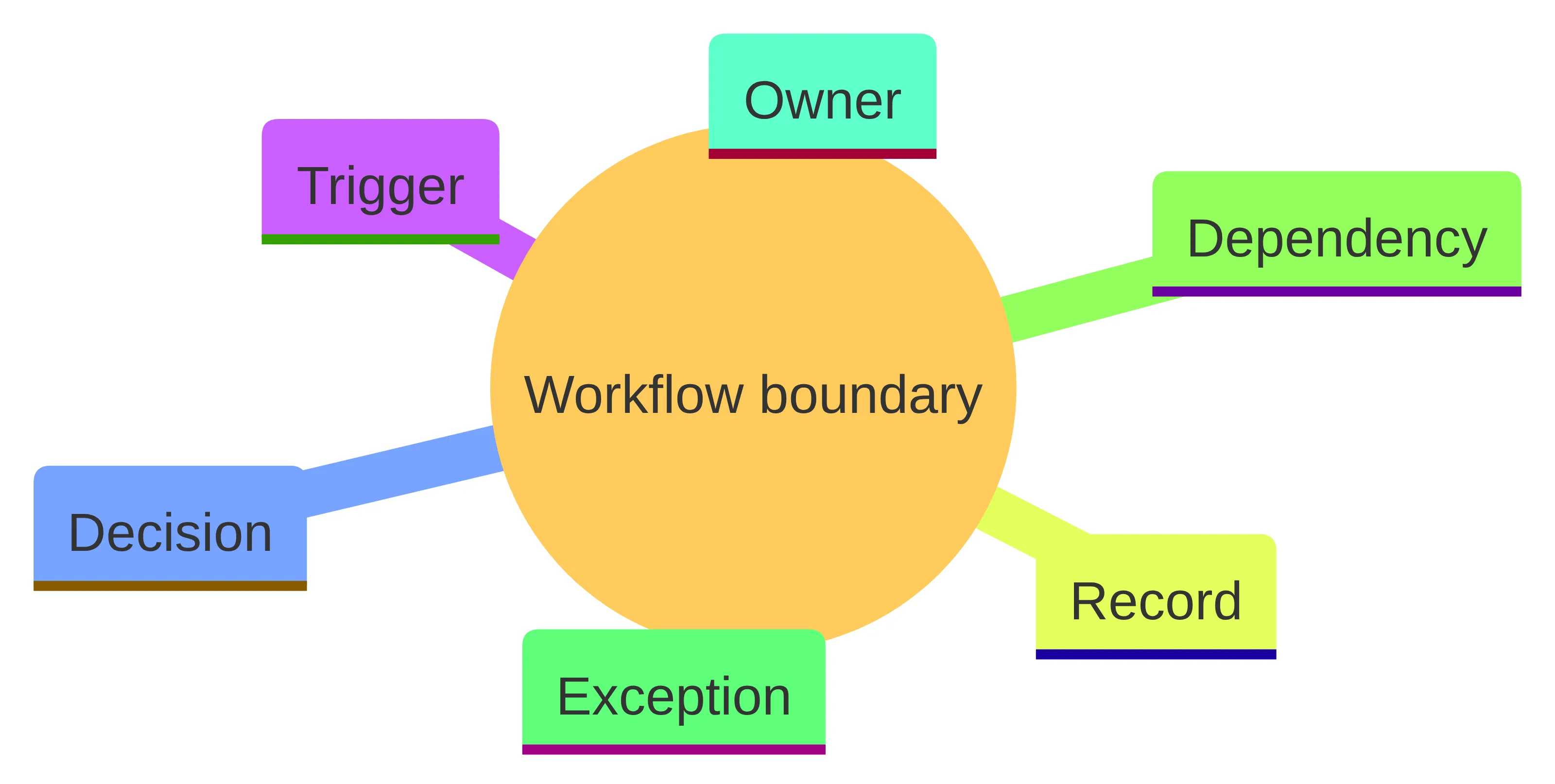
A fintech workflow boundary describes where the system starts, what it changes, what it records, and where responsibility moves to another system or team. Fintech project planning should gather stakeholder requirements, identify applicable regulatory constraints, and define project scope before architecture and implementation decisions harden.
Use a short workflow statement that names the financial purpose and the system boundary. Then break the statement into these parts:
- Trigger: Identify the customer, employee, partner, or system event that starts the flow.
- Decision: Describe the approval, rejection, calculation, routing, or other financial decision the product supports.
- Record: List the data and financial status that must be created or changed.
- Dependency: Name the banking, payment, identity, data, or internal system that the flow calls.
- Exception: Describe what happens when a request is delayed, rejected, duplicated, interrupted, or requires investigation.
- Owner: Assign responsibility for the workflow, its records, its exceptions, and its continued operation.
A defined boundary also clarifies what kind of delivery support you need. You may need a complete custom software engagement, additional senior designers and developers for an existing product team, or a combination of discovery and implementation. The scope should state which decisions belong to your organization and which deliverables belong to the delivery team.
Do not treat a feature list as a complete scope. Tie every feature to a financial workflow, a system dependency, a record, an acceptance condition, or an operational responsibility.
Separate confirmed requirements from questions that still need discovery. For example, an identified external dependency may be in scope while its interface limits, status model, or failure handling remain open. Marking that distinction lets a proposal show which work is implementation and which work is analysis. It also gives your team a clearer basis for comparing estimates: two proposals should not be treated as equivalent if one assumes the boundary is settled and the other includes work to resolve it. Keep the unresolved item visible, name the decision owner, and state what artifact will close it, such as an agreed workflow map, interface definition, or acceptance condition.
Trace transaction, data, and integration dependencies
A payment architecture may need APIs, orchestration, gateways or processors, ledger services, risk controls, operations tooling, and reconciliation capabilities. The same dependency pattern appears in other fintech products: a customer action can pass through several services before the product can show a final status or create a reliable record.
Map the transaction path from initiation to the point at which your organization considers the financial event complete. For each handoff, record the system involved, the data exchanged, the status returned, the failure path, and the team responsible for follow-up. This map gives you a concrete way to discuss integration compatibility instead of relying on a general statement that a proposed solution can connect to your systems.
Transaction data and operational data should be mapped separately even when they travel through the same integration. Transaction data can describe the financial event and its status. Operational data can describe retries, exceptions, investigation notes, reconciliation work, or support activity. Your brief should state which system is authoritative for each record and how teams will identify a mismatch.
Use this dependency checklist:
- Entry point: Which application, API, partner, or internal process creates the request?
- External connection: Which payment provider, banking system, data source, or partner receives or returns information?
- Status model: Which states can the transaction occupy, and which system assigns each state?
- Record model: Where are the transaction record, ledger entry, reconciliation data, and audit information kept?
- Failure path: How is an error surfaced, investigated, retried, corrected, or handed to an operator?
- Operational view: Which tools show pending, failed, disputed, or unmatched activity?
Transaction consistency, scalability, testing, and recovery mechanisms belong in partner evaluation because they affect how the system behaves beyond a successful demonstration. Ask the delivery team to explain how the proposed design handles the transaction states and exceptions in your map. A useful answer should connect the architecture to observable behavior, test conditions, and operational ownership.
Do not use a single successful response as the definition of completion. In the map, distinguish the external transaction status, the internal financial record, the reconciliation state, and the operational view shown to staff. These may require different evidence and different owners. For each transition, state what confirms that the next system has accepted the event, what happens if confirmation is delayed, and how an operator identifies an item that needs review. This makes the partner discussion more precise: the team must explain not only how systems connect, but how the product preserves a usable record when a dependency is pending or an exception requires intervention.
Make jurisdiction and control assumptions explicit
Jurisdiction mapping determines which regulatory constraints, contractual expectations, data-handling conditions, and operating responsibilities belong in the project discussion. Fintech architecture may need to meet the requirements of every market in which the product operates, while the applicable constraints remain dependent on the product and its jurisdiction.
For a United States project, document the markets served, the financial activity supported, the data involved, the external parties in the workflow, and the control expectations already identified by your organization. Keep confirmed obligations separate from assumptions that still require review. That distinction prevents a project brief from presenting a general control idea as a universal legal requirement.
NIST CSF 2.0, published on February 26, 2024, groups cybersecurity risk governance and management into Govern, Identify, Protect, Detect, Respond, and Recover. The framework also uses tiers to describe the rigor of governance and risk-management practices. You can use those functions as an organizing model for questions about ownership and operating practice, not as a substitute for product-specific obligations.
FFIEC guidance from 2015 described financial institutions as dependent on information and technology assets and connected protection of confidential information with operational continuity and customer trust. That longstanding perspective supports a practical boundary: include information protection and operational responsibility in the design discussion, then have the appropriate specialists determine which requirements apply to your situation.
Build security into product and delivery decisions
Security should be treated as an ongoing product and engineering discipline, not only as a post-development checklist. The decision affects requirements, architecture, code, testing, deployment, monitoring, incident handling, and changes made after launch.
NIST CSF 2.0 provides a useful structure for keeping those activities connected. Govern and Identify questions clarify responsibility and risk context. Protect and Detect questions address safeguards and visibility. Respond and Recover questions address what teams do after an event. Your project brief should assign an owner and an expected artifact or decision to each relevant area.
Access control is one concrete area where a general security promise needs to become an engineering discussion. Review authentication, role-based authorization, least privilege, protected administrator accounts, and session handling. Ask how those controls apply to users, service accounts, support personnel, administrators, and external integrations when those roles exist in your workflow.
Security and compliance evaluation should also cover the practices used to build and maintain the system. Ask how prospective suppliers handle:
- Code review and approval boundaries
- Dependency checks and updates
- Secrets handling
- Vulnerability identification and fixes
- Audit logging and access review
- Testing of security controls
- Monitoring and incident responsibilities
Operational continuity depends on more than the application code. Define who can investigate an abnormal transaction, who can access relevant records, who can change a configuration, and who owns communication when an integration or service fails. Include those responsibilities in the delivery and support discussion so that security decisions remain connected to day-to-day operation.
Convert controls into verifiable engineering requirements
A verifiable engineering requirement connects a control objective to observable behavior, an owner, a test or review method, and an artifact that demonstrates the result. This format turns broad expectations such as secure development or auditability into questions that a delivery team can answer.
Write each material requirement in five parts:
- Objective: State what the control or behavior must accomplish.
- System behavior: Describe what the product, service, or integration must do.
- Condition: Identify the user role, transaction state, data type, or failure condition in which the behavior applies.
- Evidence: Name the test result, log, configuration, design record, or other artifact you expect to inspect.
- Responsibility: Assign ownership for implementation, approval, operation, and correction.
NIST’s Secure Software Development Framework can provide a common vocabulary for discussing supplier practices, but it is not itself a vendor certification requirement. Use it to ask how a proposed team handles code review, dependency checks, secrets, and vulnerability fixes. The answer should identify the practice, its point in the delivery process, and the evidence available for review.
OWASP’s Application Security Verification Standard provides requirements for testing web-application security controls. Agree on an appropriate verification level based on the application’s risk, and ask how the results will be shared. Treat the level as a project decision rather than an automatic default.
Acceptance criteria should cover the financial workflow and the control behavior together. A successful test may need to show not only that a transaction reaches its expected status, but also that the related record, exception path, access boundary, audit trail, or reconciliation output behaves as specified. Define those conditions before proposals are compared so that delivery estimates refer to the same target.
Use a traceability chain from requirement to evidence. The workflow map identifies the event or state; the requirement states expected behavior; the test exercises the relevant normal or exception condition; and the resulting artifact is assigned to an owner. This chain helps distinguish an untested design assumption from a demonstrated control. It also prevents acceptance from ending at a user-interface result when the required outcome includes a ledger record, audit information, reconciliation state, or support action. Ask proposals to show which acceptance items are included, which depend on client systems or decisions, and which remain discovery work.
Separate software capability from fintech readiness
Software capability describes what a team can design, build, integrate, test, or maintain. Fintech readiness describes whether that capability has been connected to your financial workflow, data boundary, control expectations, operating model, and handover conditions.
A team may demonstrate technical skill without yet showing how it will handle your transaction states, external dependencies, access model, audit needs, recovery conditions, or ownership boundary. That difference does not determine the team’s suitability by itself. It tells you which questions the evaluation must answer before a delivery commitment is made.
Evaluate readiness through evidence tied to your workflow. Review relevant financial-workflow experience, API and payment-provider integrations, transaction handling, scalability, testing, recovery mechanisms, security and compliance controls, delivery accountability, support, commercial transparency, and handover. Ask how the team’s secure-development practices map to the requirements you wrote.
Use demonstrations and written responses to test the fit of the proposed approach. Keep a separate record for demonstrated capability, proposed design, unresolved assumption, and required artifact. That separation makes it easier to see where a proposal is specific to your system and where it remains a general statement.
Inspect the operating, commercial, and ownership boundary
The operating boundary defines what happens after development work enters a live environment. A fintech evaluation should cover delivery accountability, commercial transparency, post-launch support, and ownership handover alongside technical capability.
Ask for clear answers to these boundary questions:
- Delivery: Which milestones, responsibilities, acceptance criteria, and escalation procedures govern the work?
- Commercial scope: Which assumptions, exclusions, change requests, ongoing costs, and dependencies affect the proposal?
- Support: Who handles monitoring, incident response, maintenance, security updates, and service commitments after launch?
- Ownership: Which party controls the source code, infrastructure, documentation, credentials, and deployment processes?
- Internal participation: Which decisions, approvals, access, and operational duties remain with your team?
Ownership handover is a delivery requirement, not an administrative detail to resolve at the end. Confirm how source code, infrastructure, documentation, credentials, and deployment processes will be transferred or made accessible. Your scope should also state when access is provided, who maintains each artifact during delivery, and what acceptance condition confirms that the handover is complete.
Legacy integration deserves its own line in the operating boundary when existing systems are part of the workflow. We recognize integration challenges with legacy technologies as a concern for B2B operations. Record the affected systems, available interfaces, data ownership, technical constraints, and fallback responsibilities before a delivery team estimates the work.
Prepare the quote brief before requesting proposals
A quote brief should give each prospective delivery team the same description of the work, the same boundary conditions, and the same unresolved questions. Fintech planning should define requirements, applicable constraints, and scope before architecture and implementation are estimated.
Prepare these sections before you request a project quote:
- Financial purpose: State the product’s financial activity, target users, business outcome, and decision or transaction it supports.
- Workflow map: Describe the trigger, decision, records, dependencies, exceptions, and operational owner.
- Product scope: Separate the first release from later work and identify explicit exclusions.
- Integration inventory: List APIs, payment or banking systems, data sources, legacy systems, credentials, and known interface limits.
- Data and control brief: Describe sensitive data, access roles, audit expectations, security practices, control questions, and applicable constraints that have already been identified.
- Quality and acceptance: Define transaction behavior, error handling, testing expectations, monitoring, reconciliation, and evidence required for acceptance.
- Delivery model: State the work your internal team will own, the work you expect from the delivery team, decision rights, milestones, and escalation path.
- Commercial assumptions: Identify scope assumptions, exclusions, change handling, ongoing support, and costs that the proposal should address.
- Handover and support: Specify source-code access, infrastructure, documentation, credentials, deployment processes, monitoring, maintenance, and incident responsibilities.
Architecture trade-offs should be made intentionally during the Concept Phase rather than reactively later. Include the decisions that still need analysis, such as integration boundaries, data ownership, transaction status, operational responsibility, or control verification. A proposal can then distinguish confirmed scope from discovery work instead of hiding unresolved architecture decisions inside an implementation estimate.
The finished brief should let you compare responses against the same workflow and evidence requirements. Ask each team to identify assumptions, proposed controls, delivery artifacts, open dependencies, and ownership conditions. Keep the brief concise enough to use in a working discussion, but specific enough that a proposal cannot avoid the transaction, data, security, and handover questions.
Use evidence gaps as the next evaluation questions
An evidence gap is a question your brief has raised but a proposal has not answered with a specific design, responsibility, condition, or artifact. Treating the gap as a question keeps the evaluation practical and prevents general capability statements from carrying more weight than they support.
Use questions such as these:
- Which comparable financial workflows has the team delivered, and which parts of the work are relevant to your transaction path?
- How will the proposed design connect to each API, payment provider, banking system, data source, or legacy system in your inventory?
- How will the system represent transaction status, handle exceptions, support reconciliation, and recover from integration failure?
- Which authentication, authorization, least-privilege, administrator, session, and audit controls apply to each role and service?
- How will code review, dependency checks, secrets handling, vulnerability fixes, and security testing appear in the delivery process?
- Which acceptance tests and artifacts will demonstrate the required behavior?
- Who owns monitoring, incident response, maintenance, security updates, and service commitments after launch?
- How will source code, infrastructure, documentation, credentials, and deployment processes be transferred or made accessible?
Record each answer beside the requirement it addresses. Mark the answer as demonstrated, proposed, conditional, unresolved, or outside scope. This record gives your product and engineering teams a shared basis for follow-up and shows which issues must be resolved before the delivery boundary is accepted.
Know what this assessment cannot decide
A planning assessment cannot determine every regulatory obligation, approve an architecture for your organization, or establish that a product will satisfy a particular control environment. Applicable constraints depend on the product, data, markets, external parties, and operating model. NIST CSF 2.0 can organize cybersecurity governance and risk-management questions, but it does not replace decisions specific to your situation.
A checklist also cannot select a delivery partner without evidence connected to your workflow. Use the criteria to structure demonstrations, proposal responses, testing expectations, ownership terms, and unresolved questions. Keep legal, regulatory, financial, and security determinations with the qualified professionals responsible for those decisions.
The useful boundary is practical: this guide helps you define the work, expose dependencies, make control assumptions visible, and request evidence about delivery and ownership. It does not promise compliance, security, uptime, or a particular project result. Those outcomes depend on decisions, implementation, operation, and review within your specific environment.
Move from a prepared brief to a bounded quote
A prepared fintech brief gives you a clear path from financial purpose to workflow, dependencies, controls, delivery responsibilities, and ownership. Use it to separate known scope from open architecture decisions, then ask prospective teams to answer the same evidence questions against the same boundary. A qualified professional should decide individual legal, regulatory, financial, and security suitability for your organization.
We provide senior software designers and developers to augment product and development teams. We also offer custom software development services. Our recommendation is to make product-architecture trade-offs intentionally during the Concept Phase rather than reactively later.
The next useful artifact is a concise brief that names your financial workflow, transaction and data dependencies, control expectations, acceptance evidence, delivery responsibilities, support boundary, and handover conditions. That brief gives a scoped discussion a concrete starting point.