
Cards and payments are related but not interchangeable concepts
Cards and payments answer related but different questions. A card is the customer-facing instrument used to initiate a transaction, while a payment is the broader movement and handling of transaction information and funds between the customer, merchant, financial institutions, and payment networks. In the United States, merchant processing settles merchants’ credit- and debit-card transactions through banks and card associations, while card issuance is a separate banking activity.
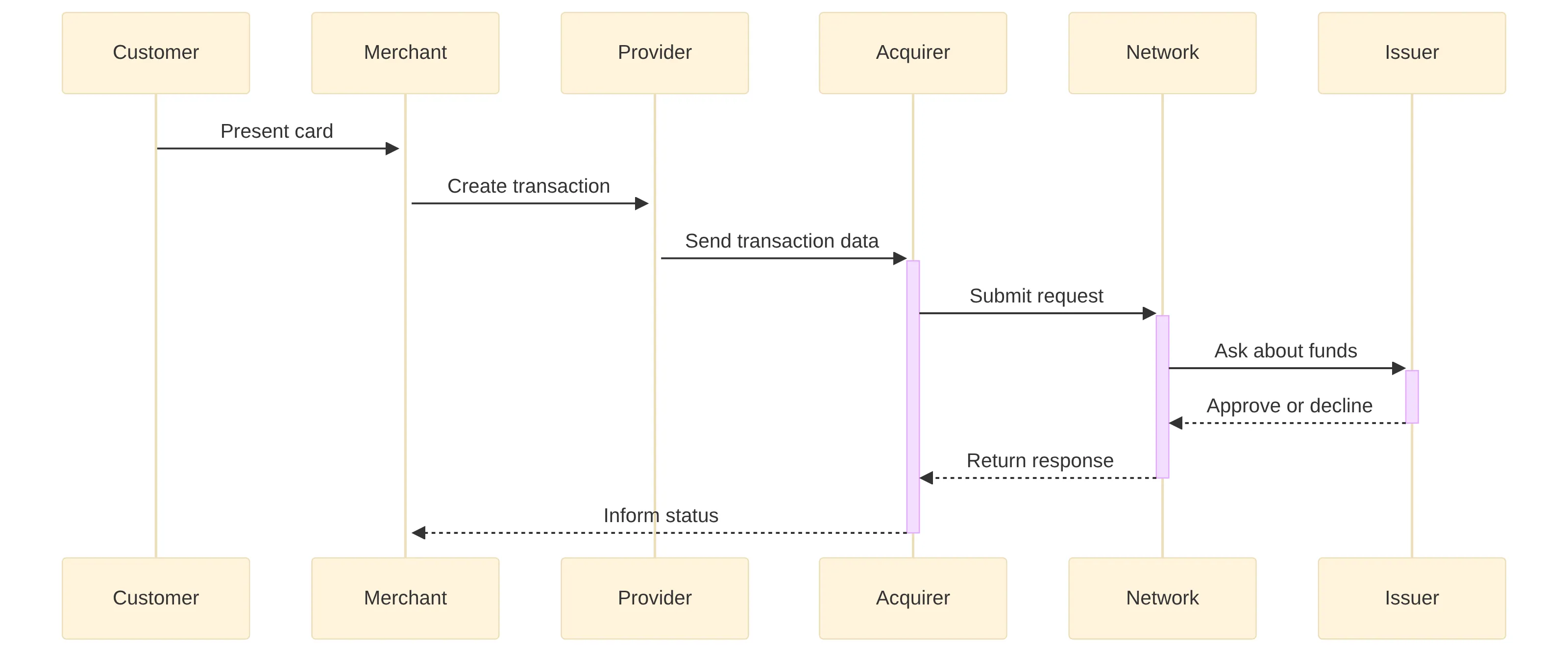
The transaction lifecycle is the useful organizing model for evaluating payment-related software. A customer presents a card, transaction data travels through the provider, acquirer, and network to the issuer, the issuer returns an approval or decline, and a later clearing and settlement stage moves funds toward the merchant. That sequence separates the visible checkout moment from the operational work that follows. It also gives you a practical way to discuss responsibilities, data handling, timing, and failure boundaries without starting with a provider name.
The transaction lifecycle is the organizing model
The card transaction lifecycle has four connected stages: initiation, authorization, clearing, and settlement. The stages answer different operational questions:
- Initiation: What payment is the customer asking the merchant to process?
- Authorization: Will the issuer approve or decline that request?
- Clearing: How will approved transaction information be exchanged and prepared for funds movement?
- Settlement: How will funds move through the relevant institutions and reach the merchant?
Authorization determines whether a transaction may proceed; settlement later moves the funds from the issuer through the acquirer for deposit to the merchant. Treating those stages as separate prevents an approved checkout from being mistaken for completed funding.
A payment system should map each lifecycle stage to a responsible component and an observable status. The gateway may submit electronic transactions to payment networks and may provide transaction management, reporting, and billing services. The processor may move transaction information among the merchant, network, and issuer to support authorization and settlement. The acquirer may receive the transaction and participate in the later movement of funds. Your system discussion should therefore ask which component owns each handoff, what record confirms the handoff, and who acts when the next stage does not complete.
This model also keeps requirements from collapsing into a single checkout requirement. An interface can show that a request was submitted, while a separate operational record may be needed to show authorization, clearing, or funding. Define those states before you decide which systems must exchange data.
Initiation begins the request for payment
Card payment initiation begins when a customer presents a card at a merchant. The customer may swipe or tap the card at a merchant terminal, after which the business’s payment processing provider sends transaction information onward to the acquirer. The initiation event creates the request; it does not by itself establish approval, clearing, or funding.
The payment entry point determines which transaction data and workflow states your software must handle. A physical terminal, an electronic checkout, and a broader payment system can connect to different surrounding components, but each path still needs a clear transition from customer action to transaction submission. Define the initiation boundary by recording:
- the customer action that starts the request;
- the merchant system that creates or receives the transaction data;
- the provider that sends the data onward; and
- the status exposed to the merchant before an authorization decision returns.
This map keeps the interface event separate from the downstream decision. It also gives operations teams a way to distinguish a customer action that never reached the provider from a request that reached the issuer and received a decline.
Authorization determines whether the transaction may proceed
Authorization determines whether the issuer will approve or decline the transaction. After the provider sends transaction data to the acquirer, the acquirer submits it to the card network, and the network asks the issuer whether funds are available. The issuer examines the cardholder’s account and returns an approval or decline through the network and acquirer to the merchant.
An authorization status is a decision about whether the transaction may proceed, not a statement that the merchant has already received funds. Your application should preserve that distinction in its user messages, internal statuses, and operational reporting. A useful review asks whether the system can identify the request, record the issuer’s response, pass the response back to the merchant, and hand approved transactions into the later clearing and settlement process. Keep those states distinct when you define interfaces or reconcile records.
The distinction matters when teams investigate an apparently successful payment. An approved request still has to enter the later transaction path, and the merchant may need a separate record to establish whether the transaction was submitted for clearing and whether funding was recorded.
Clearing and settlement complete the money movement
Clearing and settlement follow authorization and complete the money movement. After authorization, transactions may be stored in a batch and sent to the acquirer later—often at the end of the day—for clearing and settlement. The batch provides an operational handoff between the immediate authorization response and the later funding process.
Merchant funding occurs after the acquirer has been paid through the relevant payment path. A transaction-lifecycle description places authorization to funding at usually about three days and says the merchant receives the transaction amount less the acquirer’s processing discount rate; timing can vary by arrangement. Use that timing as a lifecycle reference rather than a universal service promise.
Settlement timing affects more than a merchant’s cash position. Settlement records shape reconciliation, finance reporting, customer-service responses, transaction management, and the operational interpretation of an approved transaction. Your internal model should therefore keep authorization time, batch submission time, clearing status, and funding time as separate fields when those distinctions matter to the workflow. Do not collapse them into a single completed status.
Assign each participant a role before evaluating a payment system
The card payment participants are the cardholder, merchant, issuer, card network, acquirer, processor, and gateway. Their responsibilities overlap in some arrangements, so a role map is more useful than relying on a product label alone.
- Cardholder: The customer whose card is submitted and whose account is the source of the transaction funds.
- Merchant: The business whose goods or services are purchased and whose bank account receives the funds after settlement.
- Issuer: The bank or financial institution that examines the cardholder’s account and approves or declines the transaction.
- Card network: The network that routes the authorization request between the acquirer and issuer and carries the response back.
- Acquirer: The merchant-side bank or financial institution that processes payments for the business and routes them through card networks.
- Processor: The intermediary that moves transaction information among the merchant, network, and issuer to support authorization and settlement.
- Gateway: The technology-and-process layer that lets the merchant submit electronic transactions to payment networks and may also provide transaction management, reporting, and billing services.
The processor and acquirer may be separate or combined by a payment provider. That arrangement changes where an operational responsibility sits, but it does not remove the responsibility from the lifecycle. Record the actual boundary for each system under review:
- Identify the party that accepts the merchant’s transaction data.
- Identify the party that submits the request through the card network.
- Identify the party that receives the issuer’s response.
- Identify the party responsible for clearing, settlement, reporting, and merchant funding records.
A clear role map gives you a basis for ownership discussions before you compare architecture or implementation options. It also prevents a general provider label from hiding which party controls a particular status, record, or handoff.
Use card categories to scope the payment workflow
Within the supported distinctions, credit- and debit-card transactions are separate merchant-processing categories, while the Federal Reserve study distinguishes general-purpose prepaid debit, private-label prepaid debit, and EBT cards as distinct prepaid categories. The category label identifies the program or transaction class to trace, but it does not by itself specify funding, acceptance, servicing, or use requirements. Those labels are useful starting points for scope, but the label alone does not define every funding, acceptance, or servicing requirement.
For each category in your system, document:
- how the product is funded for the transaction;
- which institution or program issues it;
- where the card can be used;
- which transaction states the merchant must support; and
- which reporting and settlement records the business needs.
Network structure adds another distinction to card classification. Open networks such as Visa and Mastercard generally let other financial institutions issue cards within their networks. Closed networks such as Discover and American Express combine network and issuer roles. This difference matters when you map participants because the same organization may occupy more than one position in the transaction flow. Use the network arrangement to identify the relevant issuer, acquirer, processor, and routing responsibilities rather than assuming that every card program uses the same institutional structure.
A category comparison becomes useful when it changes a concrete system question. A general-purpose prepaid program, a private-label prepaid program, and an EBT program should not be treated as interchangeable simply because each is described as prepaid. An open network and a closed network should not be mapped identically when you assign issuer and routing roles. Start with the category, then trace the actual acceptance, issuance, and settlement requirements for the workflow you are evaluating.
For an enterprise payment discussion, category is therefore a scoping input rather than a complete architecture decision. It tells you which participants and records need closer examination; it does not, by itself, establish the implementation or operating arrangement.
Place cards beside adjacent payment concepts
Payment gateways and payment processors are adjacent concepts, not interchangeable names for the entire payment system. A gateway lets merchants submit electronic transactions to payment networks and may add transaction management, reporting, and billing services. A processor moves transaction information among the merchant, network, and issuer to support authorization and settlement. A provider may perform acquiring services without itself being the acquirer, so your architecture document should state the function being performed rather than relying on a broad label.
Instant payments use a different concept of completion from the card lifecycle described above. The cited Federal Reserve material defines an instant payment as one in which the end user receives funds near real time and immediate interbank settlement has occurred. The same material identifies FedNow, operated by the Federal Reserve since July 2023, and RTP, operated by The Clearing House since 2017, as the two major U.S. instant-payment systems it discusses.
When comparing card payments with instant payments, begin with the outcome your workflow must observe. Ask whether the business needs a card authorization and later funding lifecycle, or whether it needs the near-real-time receipt and immediate interbank settlement described for instant payments. Keep those concepts separate in requirements, status names, reconciliation rules, and operational ownership. A shared checkout experience does not make the underlying payment rails identical.
Treat payment security as a system property
Payment tokenization replaces primary account numbers with randomly generated values so merchants can store tokens instead of PANs, reducing the exposure of stored card data if systems are compromised. Tokenization changes what the merchant system retains, which makes it a design decision about data boundaries rather than a cosmetic feature in a checkout interface.
Stored payment tokens can support recurring or one-click payments without requiring customers to re-enter payment information for every transaction. That use case creates a direct connection between security design and product behavior: the system must identify which component stores the token, which component can use it, and which workflow authorizes a later transaction. Keep the token’s permitted use distinct from the original card-entry event.
A secure payment-system review should trace sensitive data through collection, transmission, storage, reporting, and later use. Tokenization addresses the stored representation of the primary account number, but your review still needs to assign responsibility for the surrounding data path. Ask where primary account numbers can appear, where tokens are retained, which records expose payment details, and how access is represented in operational workflows. Treat those answers as part of the system boundary before selecting an implementation approach.
Evaluate the operating model, not only the checkout path
Payment operations continue after the customer sees an approval message. A checkout demonstration may show initiation and authorization while leaving the later operational record unclear. Evaluate the full path by asking:
- Which system records each lifecycle state?
- Who owns the batch and settlement handoff?
- How does the merchant reconcile transaction amounts with funding records?
- Which reports support finance, operations, and customer-service work?
- What happens when the timing of authorization and funding differs?
- Which controls and owners address card-data protection and applicable compliance requirements?
- How are fraud or dispute cases recorded, routed, and reviewed?
- How does the system surface failed or delayed state transitions, and what recovery path is documented?
- Which logs and reports make authorization, clearing, settlement, and funding states observable?
Settlement timing should be treated as an operating requirement rather than a promise inferred from authorization. Your workflow should therefore distinguish expected timing from a confirmed funding event and identify which party supplies the record used for reconciliation.
Operational ownership should follow the role map. The processor may support authorization and settlement information, the acquirer may handle merchant-side processing and funding relationships, and the gateway may provide transaction management or reporting. Assign each responsibility to a named system or organization in your requirements document. That step makes uptime, data access, reporting, and incident-handling discussions concrete without assuming that one provider performs every function.
The resulting requirements should describe observable responsibilities rather than only product names. For example, state which component exposes an authorization result, which record supports settlement reconciliation, and which party owns the relevant reporting path.
Keep the evidence boundary visible
U.S. payment terminology and system examples should not be treated as universal rules. The U.S. merchant-processing definition separates merchant settlement from card issuance, and the cited Federal Reserve material identifies U.S. instant-payment systems in a specific national context. Payment rules, institutional arrangements, and operating practices can vary by jurisdiction. Mark the jurisdiction whenever you carry this model into a Brazil, LATAM, European, or other regional workflow.
Payment regulation and data-sharing requirements can change after a general model has been written. The cited Federal Reserve material says the CFPB finalized a Section 1033 data-rights rule in October 2024 requiring specified data sharing at a customer’s direction and subject to security standards, while also noting that potential effects depend on the rule standing. Treat that example as a reason to obtain current jurisdiction-specific legal and compliance input before relying on a regulatory conclusion.
A transaction-flow explanation can frame an internal discussion, but the actual workflow still determines its participants, data boundaries, timing, controls, and jurisdiction. Use the lifecycle to identify questions, then document the particular institutional and contractual arrangements that govern the system under consideration. Keep general terminology separate from requirements that depend on a particular institution, contract, or operating arrangement.
Use the model to frame the next internal discussion
The transaction lifecycle gives you a disciplined starting point for payment-related technology decisions. Begin with the customer’s initiation event, separate issuer authorization from later clearing and settlement, map the roles of the merchant, issuer, network, acquirer, processor, and gateway, then classify the card program and data boundary. Finish by recording operational ownership, settlement timing, reporting needs, and jurisdiction. A qualified professional should determine individual legal, regulatory, security, financial, or implementation suitability before you commit to a particular design.
An effective internal brief can stay concise while still covering the decisions that matter:
- the payment method and card category in scope;
- the lifecycle states the business must observe;
- the institution or system responsible for each role;
- the data that enters, moves through, and remains in the workflow;
- the settlement and reconciliation records the operation requires; and
- the jurisdiction-specific questions that need specialist review.
That brief turns a general explanation into a structured agenda for technical and operational discussion. It gives your teams a common vocabulary without deciding the provider, architecture, or implementation in advance.
What should a technology leader verify before evaluating a payment workflow?
What are the main stages of a card payment transaction?
The main stages of a card payment transaction are initiation, authorization, clearing, and settlement. Initiation begins when a customer presents a card, authorization determines if the transaction can proceed, clearing prepares the transaction information for funds movement, and settlement transfers the funds to the merchant.
Who are the key participants in a card payment transaction?
The key participants in a card payment transaction include the cardholder, merchant, issuer, acquirer, payment processor, card network, and payment gateway. Each has distinct roles in processing the transaction.
What is the difference between a payment gateway and a payment processor?
A payment gateway is a technology layer that allows merchants to submit electronic transactions to payment networks and may provide transaction management services. A payment processor, on the other hand, moves transaction information among the merchant, network, and issuer to support authorization and settlement.
How does tokenization enhance payment security?
Tokenization enhances payment security by replacing primary account numbers with randomly generated tokens, which reduces the risk of exposing sensitive card data if merchant systems are compromised. This allows merchants to store tokens instead of actual card numbers.
What is the typical timeline for the authorization to funding process in card payments?
The typical timeline for the authorization to funding process in card payments usually takes about three days, during which the merchant receives the transaction amount minus the acquirer’s processing discount rate.
What are instant payments and how do they differ from traditional card payments?
Instant payments are transactions where the end user receives funds in near real time with immediate interbank settlement.