
Agile is a delivery approach, not a product or tool
Agile software development is an iterative, incremental way to manage design and build work while gathering feedback from users and stakeholders. Instead of treating the full product as a single handoff, you organize delivery into smaller pieces, inspect what those pieces reveal, and adjust the next part of the work.
That definition describes a delivery approach, not a software product, vendor, certification, or tool. Tools can help you plan, communicate, test, or document work, but a tool does not make the delivery approach agile. The defining question is how your team makes progress, receives feedback, and changes direction.
Regulated software delivery adds a governing condition: adaptability must operate inside requirements for security, quality, review, documentation, and evidence. Agile does not automatically satisfy SOC 2, HIPAA, PCI, or another obligation. Your team has to identify the applicable requirements and place them into the delivery system at the points where they matter.
A useful test is therefore not whether agile sounds flexible. Ask whether each increment can produce controlled, testable, reviewable, and auditable progress without leaving material obligations until the end.
The governing loop is small work, working feedback, and adaptation
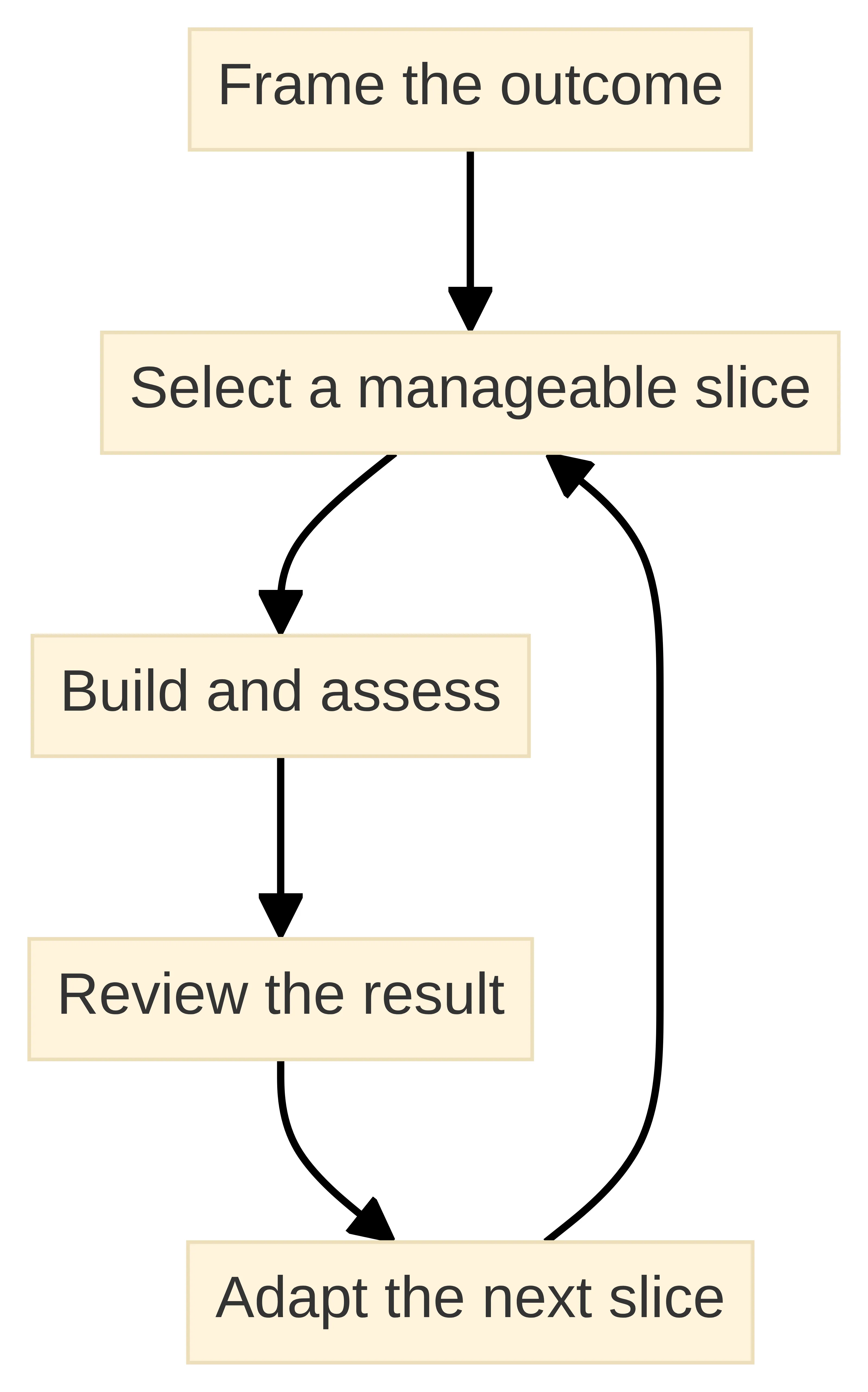
The agile delivery loop connects a limited piece of work with feedback and a decision about what happens next. Agile software development uses iteration and continuous feedback from users and stakeholders, while agile project management applies an iterative and incremental approach to design and build activities.
A practical loop looks like this:
- Frame the outcome. State the user, business, technical, security, and control conditions that the work must satisfy.
- Select a manageable slice. Choose a part of the outcome that the team can build and evaluate without pretending that the entire solution is finished.
- Build and assess. Produce the slice and apply the appropriate engineering, quality, and security activities.
- Review the result. Use stakeholder or user feedback, observed behavior, and unresolved risks to examine what the increment means.
- Adapt the next slice. Continue, revise, reorder, or stop work based on what the review established.
Feedback is useful only when it can change a decision. If your review produces comments that never affect requirements, priorities, risk treatment, or acceptance, the team is collecting information without completing the governing loop.
Requirement volatility means that software requirements are uncertain or change during development. A qualitative study of 12 people with agile-project experience identified six primary causes of requirement volatility and three agile practices that helped mitigate it. The study provides a useful warning, not a universal prediction: iteration can expose change earlier, but it does not remove the need to control and communicate that change.
Frameworks implement agile; they do not define it
Agile frameworks and methods provide ways to organize the broader approach. Scrum, extreme programming, lean, and Kanban are examples used within agile processes. Scrum is one agile framework for maintaining and continuously developing projects; agile itself is broader than Scrum.
That distinction matters during evaluation. If a proposal says that a team uses Scrum, you still need to understand how the team handles product decisions, engineering quality, security, stakeholder feedback, documentation, and acceptance. A framework name does not answer those questions.
A framework gives your team a working structure, but the structure still needs a defined responsibility boundary. In the USDS agile example, the government retains responsibility for the product vision, contractual requirements, acceptance criteria, iteration plans, and revisions to the overall plan. The example illustrates a broader operating principle: the team performing delivery does not automatically own every product or acceptance decision.
Before selecting a framework, write down who can define the outcome, prioritize work, approve an increment, accept a result, and revise the plan. Then choose the practices that make those responsibilities visible.
Agile and predictive delivery answer different planning questions
Agile and predictive delivery organize planning around different assumptions. Neither label settles the fit for your project. The relevant question is which planning pattern can handle your uncertainty, controls, dependencies, and decision rights.
| Planning criterion | Agile delivery | Predictive delivery |
|---|---|---|
| Primary planning question | What useful, reviewable increment should you develop and assess next? | What defined sequence and target should the plan execute? |
| Response to changing requirements | Revisit priorities and adapt later increments as new information appears. | Assess the effect of a change against an established plan, scope, and dependency structure. |
| Feedback timing | Invite feedback throughout incremental delivery. | Concentrate more feedback at planned review or acceptance points. |
| Main operating demand | Maintain disciplined prioritization, dedicated participation, and repeated review. | Maintain a reliable baseline, controlled change process, and dependency coordination. |
This distinction prevents two common misreadings. Agile still requires planning: the plan is revisited as evidence and feedback change what the team knows. Predictive delivery still requires change control: a baseline does not make new information disappear. The difference is where the process places the decision. Agile expects more decisions about the next increment and its acceptance; predictive delivery expects more decisions about whether a requested change should alter an established sequence, scope, or dependency. For a regulated initiative, compare both patterns against the consequences of late discovery and uncontrolled change. If late discovery could affect controls or system boundaries, earlier review may be valuable. If a dependency or approval must remain stable, that part of the work may need a more fixed plan. Compare the approaches at the level of a workstream or control boundary rather than assigning one label to the entire initiative.
The trade-off is not simply speed versus caution. Iteration can help you expose uncertain requirements and gather feedback earlier, but it creates a recurring planning and coordination burden. Work must be selected, completed, reviewed, and documented repeatedly.
Small tasks do not solve a resourcing problem by themselves. Evidence from iterative audit work shows that scheduled activities can be delayed when the organization does not dedicate resources, and incomplete work can affect the schedule. For your software initiative, ask whether product, engineering, security, compliance, and operational participants can give the work attention at the required points. If they cannot, a nominally agile process may create unfinished increments rather than useful control.
Regulated delivery puts governance inside each increment
Regulated software delivery needs compliance and risk decisions to appear during the lifecycle, not only during a final review. A regulated development process should ensure that organizational and procedural compliance requirements are fulfilled by the required point in the product or service lifecycle.
For each increment, connect the work to the conditions that govern it:
- Requirement: Which business, security, privacy, contractual, or regulatory condition applies?
- Risk: What could fail, and what product-specific quality risk does that create?
- Control activity: What review, test, approval, restriction, or operating step addresses the risk?
- Acceptance: What observable result allows the increment to be accepted or sent back for further work?
- Evidence: What record demonstrates the decision and the result?
Agile does not turn a delivery process into a compliance program by itself. Your team must map the obligations that apply to the product and decide when each one has to be satisfied. Some requirements may be addressed early; others may depend on a later system boundary, operational condition, or formal approval.
Product-specific quality risks can be handled through structured identification, transparent risk management, and defined mitigation actions. That gives your team a way to adapt without treating every change as harmless. A changed requirement should trigger a review of affected controls, tests, documentation, dependencies, and acceptance conditions.
Secure-development practices need shared ownership
NIST’s Secure Software Development Framework provides common language for describing fundamental secure software practices and is intended for use with modern development models such as agile and DevOps.
Use that shared language to make security part of ordinary delivery decisions. A business owner can clarify the protected outcome and acceptable conditions. Product and engineering roles can turn those conditions into work and acceptance criteria. Cybersecurity and operations roles can identify relevant risks and operating expectations. Acquisition roles can express required supplier practices when outside delivery capacity is involved.
A secure delivery arrangement needs explicit participation rather than a late security checkpoint. Define who contributes to risk identification, who reviews proposed controls, who evaluates evidence, and who can accept unresolved risk. Keep those decisions visible as the work changes.
This approach does not prescribe a particular tool or framework. It establishes a working boundary: every increment should have the security and quality questions needed for its scope, along with a clear route for resolving issues that the increment exposes.
Documentation and evidence are part of delivery
Documentation and audit evidence need deliberate planning when work is delivered incrementally. In iterative audit work, activities and findings are produced in stages, so teams must plan for evidence collection and documentation while the work is performed.
The same operational concern applies to your software delivery records: if you postpone all explanation until the end, the people who performed, reviewed, or approved earlier work may no longer have the necessary context. Iteration therefore requires a small, repeatable record for each meaningful increment rather than a large documentation exercise after delivery.
An increment record can contain the following items:
- the requirement, risk, or decision the increment addresses;
- the change that was made and the relevant system or data boundary;
- the tests, reviews, or other control activities performed;
- the result, approval, exception, or unresolved issue; and
- the evidence location and the owner of the next action.
This is a practical record structure, not a universal compliance checklist. Your applicable obligations determine what must be retained, who must approve it, and how long it must remain available. The record is useful when it lets you reconstruct what changed, why it changed, what was assessed, and what still requires action.
Use change, risk, and control demands to test fit
Project fit depends on whether your organization can support the governing loop, not on whether agile is fashionable or familiar. Test the initiative against five questions:
- How uncertain are the requirements? If user needs or system behavior are likely to change, incremental feedback may help you learn before the full solution is fixed. You still need a method for assessing the effect of each change.
- How specific are the control deadlines? Identify when compliance, security, quality, or approval requirements must be fulfilled. An iterative approach needs enough planning to meet those points.
- Who can participate repeatedly? Product, engineering, security, compliance, operations, and stakeholder roles need time to perform their assigned activities. Undedicated resources can leave scheduled work incomplete.
- Can you make progress observable? Each increment should have a defined result, appropriate evaluation, and an evidence record that supports the relevant decision.
- What happens when a risk remains open? Establish who can accept, mitigate, defer, or reject the risk before the team encounters it.
Use an iterative approach when you can provide recurring stakeholder feedback, dedicate the roles needed for each increment, and place control work inside the delivery cycle. Begin with a bounded slice and define its acceptance and evidence conditions before expanding the scope.
Use a predictive or mixed delivery pattern when fixed dependencies, formal approvals, or control deadlines require a stable sequence for part of the initiative. You can still use feedback and incremental work inside that boundary, but do not describe the whole initiative as adaptable if a material portion cannot change without a formal decision.
The decision should be recorded as a set of conditions rather than a permanent label. Revisit it when requirements, system boundaries, risks, resources, or applicable obligations change.
Choose the delivery approach your controls can support
The delivery approach for regulated software should connect adaptability with governance. Agile can help you work incrementally and use stakeholder feedback, but its fit depends on whether your team can make each increment controlled, testable, reviewable, and supported by appropriate evidence.
Before you commit, capture four decisions:
- the outcome and system boundary;
- the requirements, risks, and control deadlines that apply;
- the roles responsible for building, reviewing, accepting, and documenting each increment; and
- the conditions that would cause you to change the delivery pattern.
A qualified professional must decide whether a particular approach fits your initiative, obligations, and operating environment. This guide gives you a structure for that discussion; it does not determine individual compliance or legal suitability.
For a regulated fintech or healthcare initiative, prepare the project scope, delivery constraints, security and compliance expectations, stakeholder responsibilities, and evidence requirements before discussing capacity. A bounded brief makes the delivery question concrete and gives you a basis for evaluating whether the proposed team can support the controls your initiative requires.