
Build a Verification Record for One Transaction Workflow
Start with one representative transaction workflow rather than a general provider profile. Create one record for each requirement or question, with fields for the requirement, requested artifact or demonstration, provider response, scope and date, accountable owner, unresolved dependency, and decision state. This record makes follow-up visible and keeps a general capability statement separate from evidence tied to the proposed financial software.
Use four decision gates against the register:
- Scope gate. Mark the product workflows, data, integrations, required financial-domain areas, and delivery responsibilities that each response must address.
- Technical gate. The technical gate covers transaction handling, integration design, and failure-recovery mechanisms for a representative workflow and its exception paths.
- Control gate. Link security and compliance responses to the systems, data, applicable requirements, and evidence scope they actually address.
- Operating and quote gate. Record team responsibilities, milestones, acceptance criteria, ownership, handover, support, and the cost categories that belong in a comparable request.
Set each row to advance, hold, or escalate. Advance when the response addresses the stated condition and its scope is clear; hold when an artifact, owner, or dependency is missing; escalate when an unresolved item affects security, compliance, access, or contractual responsibility. Request a quote only from candidates whose open rows are understood well enough to state the remaining assumptions.
This approach is a non-ranking decision guide. It does not treat a logo, a broad industry label, or an untested compliance statement as evidence. It gives you a repeatable path from product definition to a qualified shortlist, while keeping provider-specific certifications, prices, results, and rankings outside the decision until a candidate substantiates them.
Define the evidence fields for the engagement
Start the register with the work the engagement must cover. A fintech software engagement may include strategy, architecture, engineering, system integration, compliance-related documentation, or complete product delivery. Record whether the candidate is being reviewed for custom development, integration work, end-to-end delivery, or staff augmentation. This scope field prevents similar proposal language from hiding different responsibilities and gives each later evidence request a defined subject.
Your scope should identify the financial capabilities that matter to the product. Relevant areas can include:
- Digital banking or account-related workflows
- Payments and payment-rail integrations
- Lending workflows
- Wealth or capital-markets functions
- Fraud-detection tools
- Compliance technology and regulatory reporting
- Connections between legacy banking systems and newer financial infrastructure
Do not ask a provider to demonstrate every area. Mark each item as required, adjacent, or out of scope, then request evidence only for the areas your product will use.
Turn the scope into concrete outputs. Your initial brief can specify:
- The product decision or workflow the software must support
- The systems that must connect to it
- The technical and security requirements already known
- The expected architecture or discovery decisions
- The code, infrastructure, documentation, and testing artifacts you expect
- The internal decisions your team will retain
- The provider decisions your partner will own
- The milestones and acceptance conditions for each deliverable
Document business workflows, technical requirements, and integration dependencies before comparing providers. That brief becomes the reference point for technical questions and later commercial review.
Ask each candidate to map its proposed work to your scope rather than sending a general capability deck. Request a description of the work it would perform, the work it would expect from your team, and the evidence it can provide for the relevant financial systems. A candidate that cannot make those boundaries explicit should not advance to pricing discussions.
Log the product, data, and applicability boundary
Use the product-and-data boundary as a reference field in the register. For each relevant system or flow that stores, processes, or transmits customer financial data, record the data category, the proposed activity, and the provider responsibility under review. When the customer or contract identifies applicable Trust Services Criteria, record that applicability decision with the row; if the decision is unresolved, leave the row open rather than infer it. This keeps a provider response tied to a defined technical boundary.
Describe the business workflow before describing the feature list. For each important workflow, record:
- The event that starts it
- The information required at each step
- The system that receives, changes, or forwards that information
- The external service or internal platform involved
- The decision, record, or output produced
- The failure or exception condition that needs a defined response
- The team responsible for deciding whether the result is acceptable
This is not a request for a finished architecture. It is a shared boundary that lets you test whether a proposal addresses the actual work rather than a generic version of a fintech product.
Separate data categories that may be handled differently. Mark customer financial data, authentication data, operational records, reporting data, and any data supplied by an external partner. For each category, identify where it enters the environment, where it is stored, which systems process it, and where it leaves. Include environments used for development, testing, and production when those environments are part of the project boundary.
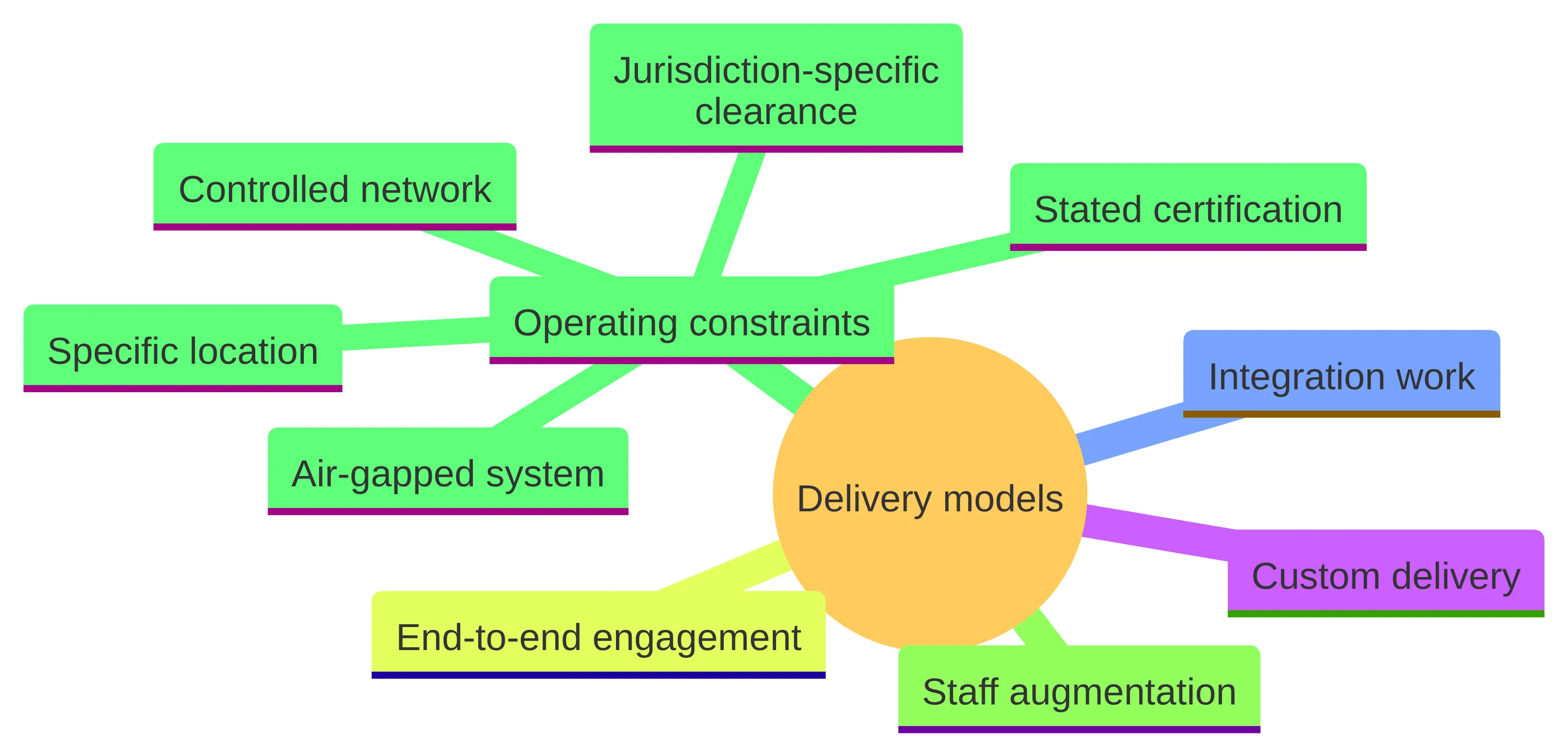
Add constraints that can change the delivery design. These may include a controlled network, a required location, a certification condition, an air-gapped system, or a jurisdiction-specific clearance. A highly regulated project may be unable to use a delivery model that assumes unrestricted remote access. Ask each candidate to identify which stated constraints it can meet, which require a change in approach, and which need a decision from your organization.
The output of this step should be a product-and-data brief with explicit assumptions and unresolved questions. Give the same brief to every candidate. If a provider proposes a different boundary, record the difference instead of silently comparing unlike scopes.
Create a verification record for the transaction path
Make the technical gate produce a verification record for one representative financial workflow. Record the systems involved, information exchanged, normal processing, exception paths, monitoring responsibility, and dependencies outside the candidate’s control. A normal-path demonstration is only one entry in the record; unresolved behavior at an incomplete, rejected, delayed, or duplicated step remains an open row for follow-up.
Use a consistent walkthrough for every candidate:
- Identify the systems involved and the information exchanged between them.
- Show where the provider expects to integrate with legacy banking systems, modern fintech infrastructure, or both.
- Explain how the proposed design handles an incomplete, rejected, delayed, or duplicated step.
- Identify which team monitors the workflow and which team investigates a failure.
- State what records, logs, or documentation the engagement will produce for later review.
- Mark any dependency that remains the responsibility of your organization or another supplier.
Match the questions to your actual financial infrastructure. Depending on your product, ask about experience with the relevant KYC or AML provider, payment rail, banking core, fraud-detection tool, or regulatory-reporting system. Do not treat experience with an adjacent system as equivalent. Ask for the candidate’s actual contribution, the integration boundary, and the artifact or demonstration that supports the answer.
Record the answer in three parts: what the candidate has done, what it would do for your project, and what remains an assumption. This separation prevents a provider’s general experience from becoming an unsupported promise about your product. Advance the candidate only when the transaction and integration discussion gives you a workable basis for further technical review.
Grade security responses by evidence scope
Make each security response a scoped evidence row. The row should identify the sensitive or customer information involved, the proposed activity, the provider environment and personnel boundary, and the artifact being reviewed. Relevant artifacts can include an information-security program, control assessments, policies, and workforce practices. Mark the row incomplete when the response does not show how the artifact relates to the services, systems, personnel, or subcontractors that would touch the project.
Build the request around specific evidence categories:
- The security framework or control structure used for the relevant work
- Penetration-test and vulnerability-assessment practices
- Policies governing information security and privacy
- How findings are identified, mitigated, corrected, and tracked
- Training and testing practices for employees and subcontractors
- The boundary between the provider’s environment and your systems
- The roles responsible for approving access, responding to findings, and producing documentation
Ask the candidate to identify the scope, date, environment, and owner for each artifact. A document is more useful when you know what it covers and how it relates to the proposed engagement.
Separate a control description from evidence that the control operates. A policy describes an expected practice; an assessment or test can show how the practice is examined. For a project with customer financial data, connect each requested artifact to the systems and data flows in your boundary map. If a candidate provides a broad security statement without that connection, record the answer as incomplete and ask what evidence applies to your proposed activity.
Use follow-up questions that expose responsibility rather than asking whether the provider is secure. Who owns remediation? How are subcontractors included? Which findings would change the delivery plan? What information would your team receive when a relevant assessment identifies a weakness? These questions turn a general assertion into an operating discussion without treating any single artifact as a substitute for your own diligence.
Separate compliance evidence from an audit conclusion
Use a compliance gate that records applicability instead of treating SOC 2, HIPAA, or PCI as a generic badge request. For each row, name the product activity, affected data and systems, requirement identified by your organization, supporting engineering activity, evidence owner, and unresolved governance question. Ask the provider to connect its proposed work to those defined rows. Keep the register focused on engineering evidence; it does not replace a legal, regulatory, audit, or contractual conclusion.
For a SOC 2 preparation effort, the supplied process is practical and sequential:
- Map every system that stores, processes, or transmits customer financial data.
- Identify the applicable Trust Services Criteria based on customer and contractual requirements.
- Compare current controls with the selected criteria and document gaps, including missing policies or unconfigured logging.
- Prioritize high-risk, low-effort gaps, such as multifactor authentication, before larger infrastructure changes.
- Assign a named owner to each control family so evidence responsibility is visible.
- Run internal testing before the audit to identify evidence gaps early.
Use this sequence to question a provider’s proposed contribution. Do not ask a vendor to take ownership of a requirement that your organization has not assigned or defined.
Ask compliance questions at the boundary between engineering and governance:
- Which systems and data does the provider’s work affect?
- Which control or requirement does each proposed activity support?
- What policy, configuration, test result, log, or other artifact will be produced?
- Who owns the artifact and who approves it?
- What remains with your internal compliance, security, legal, or operational teams?
- How will a change in scope alter the evidence request?
The answers should distinguish engineering work from an audit conclusion. A provider may help document or implement controls without determining whether your organization satisfies every legal, contractual, or regulatory obligation.
Compliance requirements can also affect where and how work is performed. Check location, certification, controlled-network, air-gapped-system, and jurisdiction-specific clearance requirements before selecting a delivery model. If one of these conditions applies, require the candidate to explain the access path, personnel boundary, and operating assumption in its response.
Turn delivery constraints into decision gates
Use the operating-fit gate to record the delivery path, decision rights, and constraints for each candidate. The engagement may involve custom delivery, integration work, end-to-end delivery, or staff augmentation. For each option, identify the authority retained by your team, the responsibilities assigned to the provider, the artifacts used for acceptance, and the conditions that could prevent the proposed work from operating as described. The comparison is a set of documented conditions, not a universal preference.
| Delivery path | Conditions to examine | Questions before proceeding |
|---|---|---|
| Fixed-scope project | Requirements are defined and the work has a firm timeline, including a project expected to last under two to three months | Does the onboarding and integration effort fit the project duration? Are milestones, deliverables, and acceptance criteria precise? |
| Dedicated team | Your organization can provide product ownership, technical direction, and ongoing decisions | Who directs the team? How will engineers join your working practices? Which decisions remain internal? |
| Staff augmentation | You need engineers to operate as an extension of an internal team | Who owns architecture, prioritization, review, acceptance, and incident decisions? What documentation and handover will your team require? |
| End-to-end delivery | You want the provider to carry a broader responsibility from architecture through deployment | Which interfaces, dependencies, and acceptance decisions remain outside the provider’s control? What evidence will show that the delivered work meets the agreed boundary? |
A dedicated team requires clear direction, product ownership, and ongoing decision-making from the client side. A short, fixed-scope project may justify comparing that integration investment with a fixed-scope alternative. Staff augmentation likewise requires you to define internal authority instead of assuming that added engineers will supply product or technical leadership. Put the decision rights in writing before you compare daily or project rates.
Then test the model against operational constraints. Ask whether personnel must work from a particular location, use a controlled network, hold a stated certification, access an air-gapped system, or possess a jurisdiction-specific clearance. If the answer is yes, ask the candidate to describe the delivery model that meets the condition. Do not approve a model whose access assumptions conflict with the project boundary.
Close ownership, handover, and support rows
Close the register with accountability rows before requesting a quote. Record team responsibilities, milestones, deliverables, acceptance criteria, the artifact or decision that marks completion, the person who accepts it, and dependencies that could delay it. Add ownership, documentation, handover, and support rows so the commercial request carries the same conditions as the technical and control review. An estimate is comparable only when its assumptions can be matched to those recorded rows.
Make quality review specific to the work. Ask:
- What technical artifacts will be reviewed at each milestone?
- Which transaction, integration, failure-recovery, security, and vulnerability checks are included?
- Who performs the review and who resolves an open finding?
- What evidence will your team receive for the checks that matter to the project?
- Which acceptance condition applies if an external dependency prevents a complete demonstration?
These questions connect delivery acceptance to the technical and security boundary instead of leaving quality as a general promise.
Agree on post-launch support, source-code ownership, documentation, and handover terms. Clarify what happens to repositories, deployment information, architecture records, operational instructions, test artifacts, credentials, and unresolved issues at the end of the engagement. Keep ownership and access language separate from support scope so that a change in support does not create ambiguity about the software or documentation your organization needs.
Ask how ongoing support connects to evidence duties. If the provider maintains a system that stores, processes, or transmits customer financial data, identify who keeps relevant logs, assessment records, vulnerability findings, and control documentation available. Assign a named owner for each recurring evidence or support task. A handover is incomplete when your team receives code but cannot determine who owns the records needed to operate and review it.
Compare the full commercial exposure
Compare total cost rather than the initial development fee alone. Relevant categories can include development, infrastructure, third-party services, maintenance, and ongoing support. Ask every candidate to separate those categories and state the assumptions behind each one. A low initial figure may represent a narrower boundary, deferred infrastructure work, or support that sits outside the proposal; record the difference instead of treating the figures as equivalent.
Include these commercial questions in the same request:
- What work is included, excluded, or dependent on your team?
- Which infrastructure and third-party charges are paid directly by your organization?
- What maintenance and support activities are recurring?
- How are changes to requirements, integrations, or compliance scope handled?
- Which milestones trigger acceptance or payment?
- What documentation, source-code ownership, and handover rights are included?
- What assumptions would cause the estimate to change?
The purpose is not to force every provider into identical contract terms. It is to expose the conditions behind the estimate so you can compare like with like.
Commercial diligence also includes the provider’s operational and financial condition. U.S. banking due-diligence guidance identifies business experience and operational history, financial condition, and legal and regulatory compliance as areas for review in a fintech relationship. Apply the level of review that fits your proposed activity, access, dependency, and contract exposure, and document any unresolved supplier risk before approval.
A commercially suitable candidate is not simply the provider with the smallest visible number. It is the candidate whose scope, assumptions, responsibilities, ownership, support, and unresolved risks are clear enough for your organization to make a controlled commitment.
Use one verification matrix for every candidate
Apply the same weighted evaluation criteria to every qualified provider. A shared matrix keeps one candidate from being judged on a polished presentation while another is judged on detailed evidence. Keep the matrix attached to the product-and-data brief and update it as answers, artifacts, and open risks arrive.
| Evaluation area | Evidence or answer to request | Record before advancing |
|---|---|---|
| Engagement scope | Mapping of workflows, technical requirements, integrations, deliverables, and exclusions | Which responsibilities belong to the provider and which remain internal |
| Financial domain fit | Relevant work with the financial systems, workflows, or reporting functions in your brief | The candidate’s actual contribution and its similarity to your proposed activity |
| Transaction and integration design | Walkthrough of transaction handling, integration design, and failure recovery | Unresolved dependencies, failure conditions, and ownership |
| Security practice | Security framework, penetration and vulnerability assessments, policies, and workforce or subcontractor training evidence | Scope, applicability, owner, and open findings |
| Compliance boundary | Explanation of the requirements relevant to your data, contracts, systems, and jurisdiction | Which controls, artifacts, and decisions remain with your organization |
| Delivery model | Team structure, technical direction, communication, location, network, certification, and clearance conditions | Decision rights and operating constraints |
| Quality and handover | Milestones, acceptance criteria, testing evidence, documentation, source-code ownership, and handover terms | Acceptance owner, artifact list, and post-launch responsibilities |
| Commercial exposure | Development, infrastructure, third-party, maintenance, support, and change assumptions | Total cost categories and conditions that could change the estimate |
Use a simple status for each row: supported, partly supported, or unresolved. Add the artifact or meeting reference that supports the status, then write the practical consequence of an unresolved item. Do not convert an unanswered question into a favorable score. If you use weights, set them before reviewing the candidates and apply the same criteria to every provider.
The shortlist should contain only candidates whose evidence fits the engagement boundary and whose remaining risks are understood. Record why each candidate advances, which condition must appear in the commercial response, and what evidence is still required. Also record why a candidate does not advance. This decision record gives your team a common basis for the next discussion instead of relying on memory or presentation quality.
Advance only providers that can support a quote
A provider is ready for a quote request when it can respond to the same documented brief with specific scope, technical reasoning, security and compliance evidence, delivery responsibilities, commercial assumptions, and ownership terms. Your final request should carry the product and data boundary, the representative transaction or integration path, the applicable operating constraints, the verification matrix, and the unresolved questions that the proposal must address.
Before sending it, separate confirmed requirements from open assumptions. Attach the product-and-data brief, identify the systems and dependencies in the representative path, and list the artifacts expected at each milestone. For every unresolved item, record its owner, affected scope, evidence still required, and possible effect on delivery responsibilities or cost categories. Ask candidates to return their assumptions in the same format. One proposal may exclude an integration, another may assign an acceptance task to your team, and another may place support or infrastructure outside its estimate. Record these differences explicitly instead of averaging them into a single score. Keep the quote request aligned with the same boundary used for technical and control review, so pricing does not conceal a change in scope or responsibility.
Before you move forward, confirm that you can answer these questions:
- What does the provider need to build, integrate, document, test, and support?
- Which systems and data are inside the proposed boundary?
- What evidence supports the provider’s financial, technical, security, and compliance answers?
- Who owns each decision, artifact, acceptance condition, and unresolved risk?
- What delivery and access constraints shape the team model?
- What costs and assumptions extend beyond initial development?
- Have you included legal and regulatory compliance in the fintech due-diligence review?
A qualified legal, compliance, or security professional should determine how requirements apply to your product and jurisdiction. This guide helps structure provider diligence; it does not replace that judgment.
The result is a defensible shortlist built from documented boundaries and testable answers. When the open risks, evidence requests, responsibilities, and commercial assumptions are recorded, your next provider discussion can focus on the work rather than broad promises.
What evidence should a fintech app development company provide before a quote?
What services do fintech app development companies typically provide?
Fintech app development companies generally offer services such as strategy, architecture, engineering, integrations, regulatory scoping, payments and ledger design, and compliance documentation.
How can I assess a fintech provider's experience with regulated financial software?
To evaluate a fintech provider’s experience, review their relevant projects, confirm their contributions, and assess their familiarity with compliance requirements and security controls.
What should I include in my evaluation of a fintech app development company?
Your evaluation should include documenting business workflows, technical requirements, integration dependencies, transaction handling, integration design, and security controls.
What factors should I consider when comparing delivery models from fintech providers?
Consider whether the provider offers fixed-scope projects, dedicated teams, staff augmentation, or end-to-end delivery, and how these models fit your operational constraints.
What are the key commercial aspects to review when selecting a fintech app development company?
Review total costs, including development fees, infrastructure, third-party services, maintenance, and ongoing support, along with the assumptions behind each cost category.
What questions should I ask a fintech provider during the due diligence process?
Ask about their experience with relevant financial systems, how they handle compliance requirements, their approach to security, and the specifics of their proposed engagement.