
Start with the automation decision, not the tool
For hedge-fund software, the first automation decision is which behaviors and requirements need repeatable evidence, not which tool should run the tests. Software testing helps identify defects, verify intended behavior and stakeholder requirements, and mitigate risks before deployment. Automated testing uses separate software to control test execution and compare actual results with predicted results. Those definitions point to a practical boundary: automation is a way to execute and assess selected tests, while testing is the broader discipline of evaluating whether software behaves as required.
Your evaluation should begin with the system’s highest-consequence behaviors. Identify the functions that support investment workflows, data movement, access decisions, reporting, or other operational activities within your scope. Then ask what evidence each function requires:
- A repeatable check that a defined result is produced.
- A test of how components interact.
- A review of security-related behavior.
- A human examination of usability, ambiguity, or an unfamiliar path.
- A record that connects the test to a stated requirement.
This approach avoids treating automation as a replacement for judgment. The balance between automated and manual testing depends on context and approach, and applying automation in the wrong context can cause the effort to fail. Start by defining the decision the test evidence must support. Select automation only after that decision, the expected behavior, and the required review are clear.
A risk-based test portfolio gives you a better planning question than “How much should we automate?” Ask instead: which tests produce useful, maintainable evidence for the software behaviors that matter most, and where does human judgment still add coverage? That question keeps testing connected to requirements, operational risk, data security, and the limits of what an automated result can establish.
Define software testing, automation, and manual testing
Software testing evaluates whether a software system behaves as intended, meets stakeholder requirements, and avoids defects that could create risk before deployment. Requirements define the system’s intended behavior and scope, so testing activities need a clear connection to those requirements. Without that connection, a passing test may show that one observed behavior occurred without showing that the software satisfies the behavior the business actually specified.
Automated software testing automates testing activities. More specifically, test automation uses separate software to control test execution and compare actual results with predicted results. The useful output is not automation by itself; it is a repeatable comparison that answers a defined question about the system.
Manual testing uses a human tester to execute software features as an end user and assess whether behavior matches expectations, often with a written test plan. Manual work can involve following a known scenario, exploring an unfamiliar path, examining usability, or making a judgment that is difficult to express as a fixed expected result. Automation and manual testing therefore describe different execution approaches, not two mutually exclusive testing programs.
For your planning document, define each test with four fields:
- The behavior or requirement under examination.
- The expected result and the evidence that would demonstrate it.
- The execution approach: automated, manual, or both.
- The person or role responsible for interpreting the result.
This vocabulary prevents a common category error. A test level describes where testing occurs in the software development life cycle; automation describes how selected testing activity is executed. A system-level test may be automated, manual, or supported by both approaches.
Map requirements before selecting tests
Requirements mapping gives your automation and testing plan its decision structure. Requirements define intended behavior and scope, while effective testing aligns test cases, plans, and scenarios with those requirements. For software used in a hedge-fund environment, the map should make the connection between a stated expectation, the system behavior that implements it, and the evidence needed to evaluate that behavior.
Build the map before choosing execution methods. A practical version can include:
- Requirement: what the software must do or preserve.
- Risk question: what could go wrong if the behavior is incorrect, incomplete, or inconsistent.
- Test condition: the input, state, permission, integration, or workflow that exercises the requirement.
- Expected result: the observable outcome against which the actual result will be compared.
- Review path: the person or role that interprets failures, exceptions, and ambiguous outcomes.
- Evidence record: the result, environment context, and requirement reference retained for evaluation.
The map also exposes gaps that automation cannot solve. A requirement may be unclear, an expected result may not be defined, or a workflow may depend on a human judgment that has not been expressed as a rule. Those gaps belong in requirements analysis before they become test-maintenance problems.
Use the map to choose the first test paths. Prioritize behaviors where an incorrect result would affect a significant operational decision, expose sensitive data, or make later investigation difficult. That is a planning preference, not a claim that every such test must be automated. The execution method should follow the evidence question.
Build the test portfolio across levels and quality dimensions
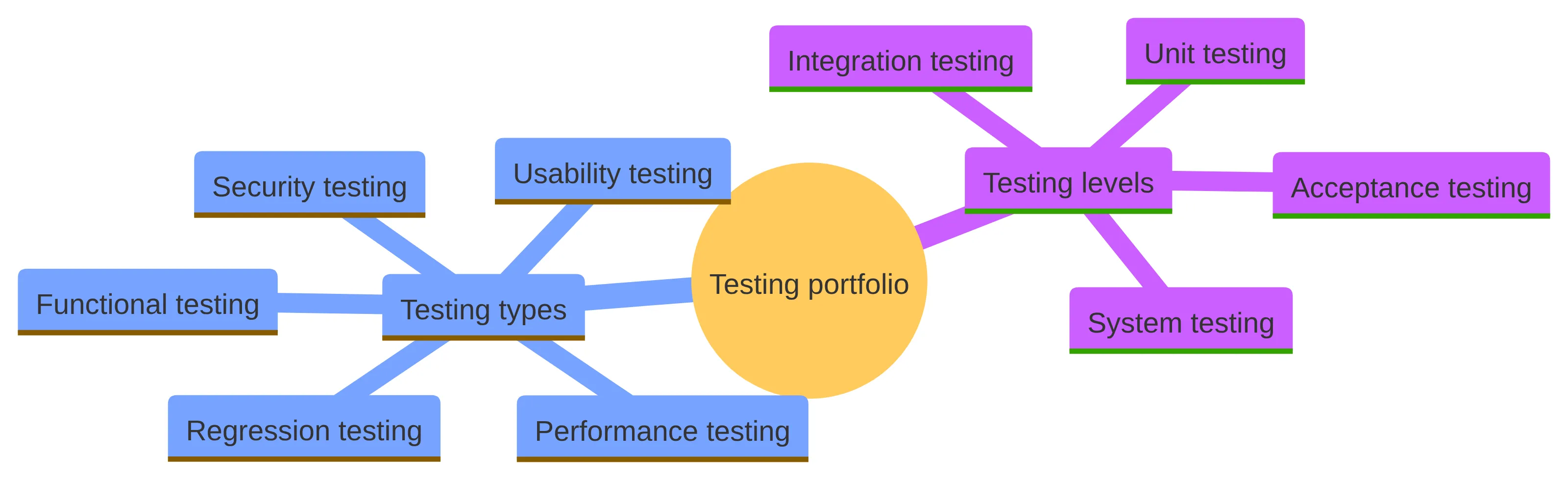
A complete test portfolio separates testing levels from testing types. Testing levels describe stages in the software development life cycle, including unit, integration, system, and acceptance testing. Testing types evaluate particular functional or non-functional aspects of software, including function, performance, security, usability, and regression behavior.
Use the two dimensions as a planning grid rather than as competing categories:
| Testing level | Questions for your evaluation |
|---|---|
| Unit testing | Does an individual unit behave as specified under the selected conditions? |
| Integration testing | Do connected components exchange and handle information as required? |
| System testing | Does the complete application or workflow behave as expected? |
| Acceptance testing | Does the delivered system meet the stated acceptance conditions? |
Then apply the quality dimensions to each relevant level. Functional testing examines specified behavior. Performance testing examines the application’s speed or other defined performance characteristics. Security testing examines security-related behavior. Usability testing examines how people interact with the system. Regression testing checks whether a change affects behavior that previously worked.
This grid helps you avoid a narrow automation plan that checks only isolated code paths. It also prevents a broad list of test labels from hiding the absence of a requirement, expected result, or responsible reviewer. You do not need every cell to contain a test. You do need a stated reason when a cell matters to your system and a clear boundary when it does not.
For a compliance-sensitive environment, preserve the distinction between testing evidence and a compliance conclusion. Testing can evaluate defined behavior and requirements; it does not, by itself, determine whether your organization satisfies every external obligation. Keep that determination with the appropriate governance and professional review.
Choose automation where repetition earns its cost
Automation earns consideration when a defined test must be executed repeatedly and the expected result can be expressed clearly enough for software to compare actual and predicted outcomes. The decision should account for the value of repeatable evidence and the work required to keep the test aligned with changing requirements.
Select candidate tests by asking:
- Will the same requirement be evaluated more than once across changes, environments, or releases?
- Can the expected result be stated without relying on an unresolved human interpretation?
- Can the test use controlled data and conditions that you can explain and reproduce?
- Will a failure identify a meaningful question, rather than create an ambiguous alert?
- Can your team maintain the test when the requirement or implementation changes?
These questions turn “automate this” into a bounded decision. A test that is repeated often may justify the effort of automation. A test that runs only once or twice may be more efficiently handled manually; manual testing is particularly suited to low-volume tests, as well as exploratory, usability, and compatibility testing. The choice still depends on your system and the purpose of the test.
Automation does not completely replace manual testing or eliminate personnel costs. Your plan therefore needs an owner for reviewing results, investigating failures, updating expected outcomes, and deciding whether a failed test reflects a defect, a changed requirement, a test-data problem, or an invalid assumption. If that ownership is missing, automation can produce more output without producing more usable evidence.
Keep human testing where judgment adds coverage
Human testing adds coverage when the test question depends on exploration, interpretation, or an experience that has not been reduced to a fixed expected result. Manual testing uses a human tester as an end user to execute features and assess whether behavior matches expectations. That approach remains relevant beside automated checks.
Keep manual testing in the portfolio when you need to:
- Explore an unfamiliar workflow or investigate behavior outside predefined scenarios.
- Assess usability through direct interaction with the application.
- Examine compatibility across platforms or operating systems in real-world conditions.
- Run a low-volume test that will occur only once or twice.
- Interpret an outcome where the correct response depends on context that the test specification does not yet capture.
Manual testing is not a substitute for clear requirements. If a human tester cannot explain what behavior was expected or why an outcome matters, record that uncertainty and resolve it before treating the result as evidence.
Your evaluation should also define how manual findings enter the wider portfolio. A manual observation can reveal a missing requirement, a new regression scenario, or a candidate for automation. It can also remain a manual check when judgment is the reason it exists. Preserve the reason for the choice so future changes do not turn a deliberate boundary into an accidental gap.
Treat coverage as a question, not a conclusion
Coverage metrics answer different questions, so your evaluation should name the question before interpreting the number. Code coverage indicates how much code is exercised. Test coverage focuses on whether specified functional requirements are tested. A high value in one measure does not, by itself, establish that the other objective has been met.
For complex systems, code coverage can help identify untested paths and branches. Test coverage becomes especially important when all specified requirements must be verified, including in regulatory or safety-critical domains. These measures should therefore sit beside the requirements map rather than replace it.
Use separate review questions:
- Code coverage: which parts of the implementation did the selected tests exercise?
- Test coverage: which specified requirements and behaviors did the portfolio test?
- Risk coverage: which high-consequence failure questions have a defined test or explicit review boundary?
- Evidence coverage: which results have enough context for someone to interpret them later?
The third and fourth questions are decision criteria for your portfolio, not additional claims about what a coverage metric measures. They help you avoid treating a single percentage as a conclusion about reliability, security, or compliance.
Coverage also requires context. A test may execute a line of code without checking the meaningful business condition associated with that line. Conversely, a requirement may be tested through a path that does not exercise every implementation branch. Record both the metric and the purpose behind it. When the metrics point in different directions, return to the requirement, the risk question, and the evidence needed for the decision.
Connect testing to secure and reliable delivery
Secure and reliable delivery requires your testing plan to include security-related requirements and evidence, not treat security as a separate label added at the end. NIST’s Secure Software Development Framework provides a common language for describing secure software development practices and communicating about them with internal stakeholders and suppliers. NIST guidance also states that software should ideally be secure by design and that the security of its design and implementation should be demonstrated, documented, and maintained.
Translate those principles into evaluation questions:
- Which security expectations belong in the requirements map?
- Which design decisions need documented security reasoning?
- Which implementation behaviors require repeatable checks?
- Which results need human review because the expected security outcome is contextual?
- How will you maintain the evidence as the system and its security practices change?
Data security deserves a specific place in the test plan. Define the data conditions a test may use, the expected handling of sensitive information, and the evidence that demonstrates the intended behavior. Keep test data decisions connected to the system boundary and the requirement being evaluated; do not treat a passing functional result as proof of secure data handling.
Reliability and operational risk also need explicit questions. Identify what happens when an integration returns an unexpected result, a required input is incomplete, or a workflow reaches an untested branch. Select automated or manual checks according to the question. Record the boundary when your plan does not assess a condition, and route any broader governance or regulatory determination to the appropriate professional review.
Define the evidence the portfolio must produce
Test evidence should let you connect an observed result to a requirement, a defined condition, and a decision about what happens next. Software testing seeks to identify and address defects, verify intended behavior and stakeholder requirements, and mitigate risks before deployment. Automated testing compares actual results with predicted results, while manual testing records a human assessment of expected behavior. Your evidence model should preserve those distinctions.
Define the minimum record for each meaningful test:
- Requirement or risk question under examination.
- Testing level and quality dimension.
- Preconditions, inputs, and test data description.
- Expected result and observed result.
- Execution method and date of execution.
- Status, including any uncertainty or exception.
- Reviewer responsible for interpretation.
- Link to a defect, decision, or follow-up action when necessary.
The exact fields should fit your system and governance process. The principle is stable: a result without its question and conditions is difficult to interpret. Security-related evidence also needs a maintenance path because NIST guidance describes secure design and implementation as something to demonstrate, document, and maintain.
Do not measure evidence volume as a substitute for evidence quality. A large set of automated results may still leave a requirement unmapped, a data condition unexplained, or a human judgment unrecorded. Review the portfolio for traceability and meaningful boundaries, then decide which gaps require another test, a manual review, a clarified requirement, or a documented acceptance decision.
Pilot the highest-value test paths first
A focused pilot gives your team a way to evaluate the test approach before expanding it across the system. Choose a small set of paths that represent different evidence questions rather than selecting only the easiest functions to automate.
A useful pilot can include:
- One requirement with a clear expected result and repeated execution value.
- One integration or system workflow where component interaction matters.
- One security-related behavior that requires defined data handling and review.
- One exploratory, usability, compatibility, or low-volume scenario that remains manual.
- One coverage review comparing exercised code with tested functional requirements.
The pilot should produce more than pass or fail statuses. Record whether the requirement was clear, whether the expected result was testable, whether the data and conditions were controlled, and whether a reviewer could interpret a failure. These observations help you assess maintainability before committing to a larger automation portfolio.
Use the pilot to test the decision process itself. If the same failure requires repeated manual interpretation, clarify the requirement or expected result. If a test changes often because its assumptions are unstable, review whether automation is appropriate in that context. If a manual scenario consistently produces a defined, repeatable comparison, evaluate it as a candidate for automation. Keep the action tied to the evidence question rather than to a target automation percentage.
State what automation cannot establish
Automation cannot establish that a software system is fully tested, fully secure, or compliant merely because selected tests pass. Automated testing controls execution and compares actual results with predicted results; it does not decide whether the selected requirements were complete, whether the expected results were correct, or whether an untested condition matters.
Coverage metrics have the same boundary. Code coverage shows how much code is exercised, while test coverage addresses whether specified functional requirements are tested. Neither metric alone answers every risk question. Manual testing also remains necessary where exploration, usability, compatibility, low-volume execution, or human judgment adds coverage.
Your evaluation should record these boundaries explicitly:
- What the test portfolio assesses.
- What it does not assess.
- Which results require human interpretation.
- Which security, governance, or regulatory questions require separate review.
NIST’s secure-development guidance supports a common language for discussing secure practices and describes security as something to demonstrate, document, and maintain. Use that guidance to structure communication, not to treat a test result as a universal assurance. A clear boundary is useful evidence because it prevents a narrow result from being applied to a broader conclusion.
Prepare the next technical evaluation
Your next technical evaluation should begin with a bounded test portfolio, not a general request to automate more. Bring the requirements map, the highest-consequence behaviors, the proposed testing levels and quality dimensions, the manual-versus-automated rationale, the coverage questions, and the evidence fields together in one working brief.
Use that brief to decide whether the proposed approach can produce interpretable, maintainable evidence for the software you operate. Confirm that each selected test has an expected result, an owner, a review path, and a stated boundary. Keep human testing where exploration or judgment adds coverage, and use automation where repeatable comparison earns the cost of maintaining it. Individual suitability, security decisions, and regulatory conclusions should be determined by the qualified professionals responsible for those areas.
A technical partner can then evaluate a defined problem rather than infer your needs from a broad automation goal. Request a project quote.
What should a hedge-fund technology leader clarify before evaluating test automation?
What is the difference between automated testing and manual testing?
Automated testing uses separate software to control test execution and compare actual results with predicted outcomes, while manual testing involves a human tester executing software features to assess whether behavior matches expectations.
What are the main purposes and benefits of automated testing?
Automated testing helps identify defects, verify intended behavior, and mitigate risks before deployment.
What considerations should be taken into account when evaluating automation for software testing?
When evaluating automation, consider factors such as the frequency of test execution, clarity of expected results, maintainability of tests, and the need for human judgment in interpreting outcomes.
How do testing levels and testing types differ in software testing?
Testing levels describe stages in the software development life cycle, such as unit, integration, system, and acceptance testing. Testing types evaluate specific functional or non-functional aspects, including performance, security, and usability.
How can coverage metrics be interpreted in the context of software testing?
Coverage metrics, such as code coverage and test coverage, answer different questions. Code coverage indicates how much code is exercised, while test coverage focuses on whether specified functional requirements are tested.
What is the significance of the NIST Secure Software Development Framework in testing?
The NIST Secure Software Development Framework provides guidelines for secure software practices, emphasizing that security should be integrated into the software development process and documented throughout.