
A digital financial platform is an interconnected operating environment
A digital financial platform is best evaluated as an interconnected operating environment that delivers, moves, or supports financial information and services across digital systems. The phrase can describe more than a single application. It may cover the applications that perform financial work, the data flows connecting them, the controls governing access and use, and the external providers that support critical functions.
Digital financial services are described as services and products delivered through digital platforms directly to devices such as mobile phones or payment cards, rather than primarily through physical branches or field officers. That definition emphasizes how a service reaches its users. For a hedge fund, the evaluation question is broader: how do the fund’s trading, portfolio, risk, data, and oversight activities connect, and what has to remain controlled when information crosses system or provider boundaries?
The platform label does not answer that question. A feature list may show what a product is designed to do, but it does not by itself show which systems exchange data, who owns each control, how access is limited, how incidents are handled, or how critical work would continue after a disruption. A useful assessment therefore follows the operating path rather than accepting the label as proof of suitability.
Start with five questions:
- Which business decision or operating activity must the environment support?
- Which systems create, transform, store, or consume the relevant information?
- Which person or function owns each required capability and control?
- What evidence shows that access, data quality, monitoring, and recovery expectations are defined?
- Which dependencies could interrupt a critical function or make an exit difficult?
Those questions turn a broad technology term into an assessment that can be scoped, assigned, and documented.
Separate platform scope from assumed capabilities
Platform scope describes the connected boundary; assumed capabilities describe what you expect that boundary to do. Keeping those ideas separate prevents a product category from being mistaken for a confirmed operating function.
A financial platform may include several connected elements, depending on its design and the organization’s requirements:
- Trading or order workflows that create transaction information.
- Portfolio records and processes that organize positions and related data.
- Risk processes that consume information from trading, portfolio, and market sources.
- Market-information feeds, internal databases, and other data sources.
- Interfaces, transfer mechanisms, and storage locations that move or retain information.
- Access, security, governance, monitoring, and reporting controls around those components.
These are possible parts of an operating environment, not a universal capability list. A platform can connect applications without replacing them. It can provide an integration layer without owning the underlying data. It can expose analytics without establishing that the underlying information is complete, timely, or suitable for a particular decision.
The distinction matters because the same label may describe different architectures. In one organization, the boundary may be concentrated around portfolio and risk workflows. In another, it may include a wider set of trading connections, data services, oversight records, and provider relationships. The organization’s strategy and operating requirements determine which functions belong in scope.
Write the boundary in plain language before reviewing products or implementation options. Identify what is inside the proposed environment, what remains outside it, and which interfaces connect the two. Then list each expected capability separately. For every item, record the system that supplies it, the system that consumes it, the accountable owner, and the evidence required to accept it. That sequence keeps a requested function from becoming an unsupported assumption.
Overview
A practical platform evaluation connects five questions: purpose, information flow, control, resilience, and accountability. Each question narrows a different type of uncertainty.
Purpose: What financial activity or decision does the environment support? A hedge fund should relate the proposed scope to its own strategy and operating requirements rather than treating a broad platform category as sufficient justification. Technology can support operational efficiency, but relevance depends on the work the organization actually needs to perform.
Information flow: Where does information originate, how is it transformed, and where is it used? Automated integration can connect trading platforms, market-information feeds, and internal databases, but the connection still needs a defined format, owner, timing expectation, and exception path.
Control: How are confidentiality, integrity, and availability protected? Third-party due diligence can examine information-security programs, access restrictions, multifactor authentication, encryption, secure source-code management, and the handling of known and emerging threats.
Resilience: What happens if a system, provider, connection, or data process is unavailable? Cloud services may strengthen security, yet dependence on providers can increase the potential impact of a disruption when critical functions rely on them. The assessment must therefore include monitoring, incident handling, recovery expectations, concentration risk, and exit planning.
Accountability: Who makes decisions, maintains controls, reviews evidence, and accepts residual risk? Cybersecurity and data compliance work crosses organizational boundaries. Clear responsibility is needed across technology, data management, compliance, legal, security, suppliers, customers, and partners.
Use these questions as a common structure for discovery. They do not establish that any particular product is suitable. They create a disciplined way to compare the proposed operating model with the fund’s actual requirements and control expectations.
Anchor relevance in the hedge fund operating model
A hedge fund operating model gives the platform question its practical meaning. Hedge funds work across interconnected order-management, portfolio-management, and risk systems, and those systems need to integrate reliably for daily use in a complex and regulated environment.
Begin with the decisions and activities that cannot be evaluated in isolation. A fund may need to understand how a trade moves into portfolio records, how market information reaches an analytical process, how risk information is generated, and how exceptions reach the person responsible for resolving them. The point is not to assume that every platform must perform each activity. The point is to identify the chain that the proposed environment must support.
Use a capability map with four columns:
- Operating activity: State the work in business terms, such as order handling, portfolio information, risk analysis, reconciliation, or management reporting.
- Required information: Identify the data needed for the activity, its origin, its expected format, and the conditions under which it can be used.
- Connected system: Record the application, feed, database, service, or manual handoff involved in the information path.
- Decision consequence: Describe what becomes harder to assess or execute if the information is late, incomplete, inconsistent, inaccessible, or unavailable.
This map helps you distinguish an actual operating requirement from a preferred feature. It also makes integration gaps visible before a procurement or implementation decision is made. Automated data integration is described as important for information flows from trading platforms, market-information feeds, and internal databases, but automation does not remove the need to define ownership, standards, exceptions, and review.
A capability belongs in the platform scope when its connections and controls affect the required operating activity. A capability belongs in a separate workstream when it is useful but does not change the decision path under review. Make that boundary explicit before asking whether a proposed environment is relevant.
Test information flow before reviewing the feature list
Information flow is the first operational test because a platform cannot support a decision more reliably than the information path behind it. Automated integration may connect trading platforms, market-information feeds, and internal databases, but the value of that connection depends on how the data is defined, transferred, checked, and used.
Trace each important information path in sequence:
- Origin: Which system or external feed creates the information?
- Transfer: How does the information move, and which interface or process carries it?
- Transformation: Does a process change its structure, meaning, units, or classification?
- Storage: Where is the information retained, and how is its version or status identified?
- Consumption: Which application, report, model, or person uses it?
- Exception: What happens when the information is late, missing, duplicated, rejected, or inconsistent?
- Ownership: Which team decides whether the information is fit for the intended use?
A useful map should expose handoffs that a feature list hides. For example, an environment may advertise analytics, while the more consequential questions concern whether the necessary source data arrives on time, whether transformations are documented, and whether an exception reaches an accountable person. The same principle applies to integration: a connection exists technically only when the sending and receiving sides agree on the information, timing, error handling, and security conditions.
Ask for evidence that matches the map. That evidence may include interface specifications, data standards, lineage records, access decisions, exception logs, monitoring arrangements, and ownership documentation. The exact evidence will depend on the organization and use case. The evaluation should not treat a diagram or feature description as proof that the information path works under operating conditions.
Finish the flow test by identifying the smallest unresolved handoff that could change the decision. Resolve that handoff, narrow the intended capability, or record it as a condition of further planning.
Attach an accountable control to every required capability
A required capability is not ready for approval until its control and accountable owner are clear. The control should address what the capability does, what could go wrong, how the organization detects the problem, and who decides the response.
Use the following control record for each capability:
- Capability: State the function in operational terms.
- Information involved: Identify the data, transactions, credentials, or reports affected.
- Risk condition: Describe the failure, misuse, unauthorized access, or loss of availability that matters.
- Control activity: State how access, confidentiality, integrity, availability, change, or monitoring is handled.
- Owner: Name the role responsible for maintaining the control and making related decisions.
- Evidence: Specify what demonstrates that the control exists and operates as intended.
- Escalation: Define where an exception, incident, or unresolved gap goes.
NIST’s cybersecurity framework activities include identifying assets, the business environment, policies, legal and regulatory requirements, vulnerabilities, threats, risk responses, risk tolerances, and supply-chain priorities. Use those areas to test whether the control record covers the environment rather than only the application.
Third-party due diligence adds a second level of scrutiny. A financial organization can compare a provider’s information-security program with its own requirements and identify gaps that may create risk to the organization or its customers. Relevant review areas can include confidentiality, integrity, availability, multifactor authentication, encryption, secure source-code management, and the provider’s approach to known and emerging threats.
Do not accept a generic control statement such as “the platform is secure” as the control record. Replace it with a condition you can assign and examine. If no owner can explain the control, its evidence, and its response to failure, mark the capability as unresolved rather than treating it as complete.
Coordinate cybersecurity and compliance responsibilities
Cybersecurity and compliance responsibilities should be coordinated across the organization and its external relationships. A platform assessment becomes incomplete when technical ownership is documented but legal, data, supplier, or compliance ownership is left implicit.
NIST CSF 2.0 calls for cybersecurity supply-chain risk-management processes to be established, managed, monitored, and improved by relevant organizational stakeholders. It also calls for cybersecurity roles and responsibilities for suppliers, customers, and partners to be established, communicated, and coordinated internally and externally. Apply that principle to the proposed environment by documenting who owns each relationship, decision, control, and escalation path.
A data-compliance assessment may involve several functions:
- Compliance: Oversees the compliance framework and related strategy.
- Data protection: Coordinates protection of personal or sensitive information where applicable.
- Legal: Reviews the legal implications of data management, contracts, and applicable obligations.
- IT and data management: Maintains secure storage, transfer protocols, access permissions, and technical foundations.
- Data governance: Defines standards, manages data assets, maintains metadata, and documents data lineage.
- Technology and security leadership: Assesses architecture, threats, vulnerabilities, monitoring, and response.
- Supplier and business owners: Define the service requirement, accept operating responsibilities, and manage the relationship.
The list is a coordination aid, not a universal organizational chart. Your fund may combine or separate these responsibilities. What matters is that every material decision has a named role, a communication route, and an escalation point.
Use a responsibility matrix to test four moments: design approval, access approval, incident response, and periodic review. Include external providers where they affect the information path or a critical function. A platform can be technically connected while its responsibilities remain fragmented; the evaluation should treat that fragmentation as a planning issue that requires resolution.
Treat cloud and providers as part of the risk perimeter
Cloud and other technology providers belong inside the platform risk assessment when they support a critical function or hold a meaningful position in an information path. Treating them as background infrastructure can hide concentration, continuity, access, and exit concerns.
Cloud use has a conditional risk profile. The Bank for International Settlements notes that cloud services may enhance a financial firm’s IT security beyond what the firm could accomplish alone. The same source points to concentration among a small number of global providers and the potentially severe impact of a disruption when critical functions depend on cloud services. The appropriate conclusion is neither that cloud is automatically unsuitable nor that provider security removes the firm’s responsibility. Assess the dependency in relation to the function it supports.
Ask provider-focused questions in five areas:
- Criticality: Which business or technology functions depend on the provider, and what would be affected by an interruption?
- Security alignment: How does the provider’s information-security program compare with your organization’s requirements?
- Visibility: What information is available about incidents, access, changes, vulnerabilities, and service performance?
- Concentration: Would several important functions fail through the same provider, region, connection, or subcontractor?
- Exit: What strategy, information, interfaces, and responsibilities would support a transition or controlled shutdown?
Third-party oversight guidance identifies incident reporting, exit strategies, and the identification, monitoring, and management of service-provider concentration as relevant tools. Approaches can vary by jurisdiction and organization, so treat these as evaluation areas rather than a universal compliance checklist.
Document the material dependency before deciding whether it is acceptable. If a provider supports a critical function, assign an owner for ongoing oversight, define the information needed for review, and record the conditions that would trigger escalation or contingency planning.
Use an evidence-based relevance test
Relevance means that the proposed environment addresses a defined organizational need with an acceptable operating and control model. It does not mean that the environment has the longest feature list or the broadest label.
Use this relevance test:
- Decision fit: Can you state which hedge fund activity, decision, or control problem the environment is meant to support?
- Information fit: Can you trace the required information from its origin through transfer, transformation, storage, and use?
- Integration fit: Can the proposed connections support the fund’s existing operating requirements, including the relationship among order-management, portfolio-management, and risk systems where those systems are in scope?
- Control fit: Can you assign access, security, data governance, monitoring, incident, and change responsibilities?
- Provider fit: Can you identify third-party dependencies, concentration concerns, due-diligence requirements, and exit considerations?
- Evidence fit: Can the organization identify the documents, demonstrations, tests, records, or accountable owners needed to support each material conclusion?
A “yes” should mean that the condition is defined and supported, not that someone has offered a reassuring description. A “partial” should identify the unresolved dependency. A “no” should narrow the proposed scope or stop the evaluation until the underlying requirement is clarified.
The test should also reflect the fund’s specific strategy and operational requirements. Software selection cannot be separated from the work the organization performs, the data it relies on, and the risk it is prepared to manage. Automated integration may support more consistent information flows and decision processes, but it does not establish that every source is fit, every transformation is controlled, or every output is suitable for a particular use.
Record the result in a short decision brief. For each criterion, state the requirement, the supporting evidence, the accountable owner, the unresolved issue, and the next action. That record lets technology, security, compliance, and business teams discuss the same decision without reducing it to a feature comparison.
Distinguish platform relevance from implementation readiness
Platform relevance asks whether the proposed environment belongs in the organization’s solution space. Implementation readiness asks whether the organization has defined enough of the operating model to plan, control, and execute the work. A platform can be relevant while implementation remains premature.
Check readiness across six conditions:
- Defined outcome: The organization has stated the activity, decision, or information problem in operational terms.
- Known information structure: The important sources, destinations, formats, transformations, dependencies, and exceptions are identified.
- Governance arrangement: Roles, standards, permissions, lineage expectations, and decision rights are assigned.
- Control baseline: Security, compliance, access, monitoring, incident, change, and recovery expectations have owners.
- Operating capacity: The people responsible for data, technology, security, compliance, and business decisions can participate in design and review.
- Adoption plan: The organization has identified how existing processes, staff responsibilities, and supplier relationships will change.
Guidance on automated-data-integration implementation identifies several practical activities: evaluate the current information structure, establish governance, standardize formats, support collaboration, and train staff. Use those activities as readiness prompts rather than treating integration as a purely technical installation.
NIST’s cybersecurity activities also support a readiness check around assets, business context, policies, legal and regulatory requirements, vulnerabilities, risk tolerance, and supply-chain risk. Those questions should be answered early enough to influence scope and design.
If the environment is relevant but readiness is low, the next step is not necessarily a product decision. It may be a bounded discovery effort that documents the information paths, requirements, control owners, dependencies, and unresolved decisions. If readiness is adequate, carry those records into implementation planning and keep the conditions attached to the relevant capability.
Balance potential efficiency and scale against operational dependence
A digital operating environment can create efficiency by reducing disconnected work and supporting more direct delivery of financial services, but efficiency should be weighed against dependence on shared systems, providers, data paths, and controls. The decision is a balance between the work the environment may simplify and the consequences of making critical activity more dependent on it.
The selected financial-services source describes digital platforms as a way to deliver services directly to digital devices and, in principle, reduce the need for physical presence and lower unit transaction costs for broader service delivery. That observation does not establish a benefit for every hedge fund architecture. For a fund, the relevant question is whether the proposed connections improve a defined operating activity without creating unacceptable information, control, or continuity conditions.
Consider four trade-offs:
- Integration versus coupling: More connections can reduce manual transfer, while a tightly connected environment can make a local change affect several downstream processes.
- Central visibility versus concentration: A shared view can support coordination, while concentrating important information or functions can increase the impact of a failure.
- Provider capability versus dependency: A provider may supply security or operational resources that are difficult to reproduce internally, while reliance on that provider creates oversight and exit work.
- Automation versus exception management: Automated flows can reduce repetitive handling, while rejected, delayed, or unusual information still needs a defined human response.
Cloud services illustrate the same balance. They may strengthen security, but concentration and reliance on providers can increase the potential impact of disruption to critical functions. Evaluate the dependency by function, not by the technology label.
State the trade-off as an operating condition. For example, approval may depend on a recovery expectation, an access boundary, an exit plan, an exception owner, or evidence that information can be reconstructed. Concrete conditions produce a more useful decision than a general claim that the environment is efficient or scalable.
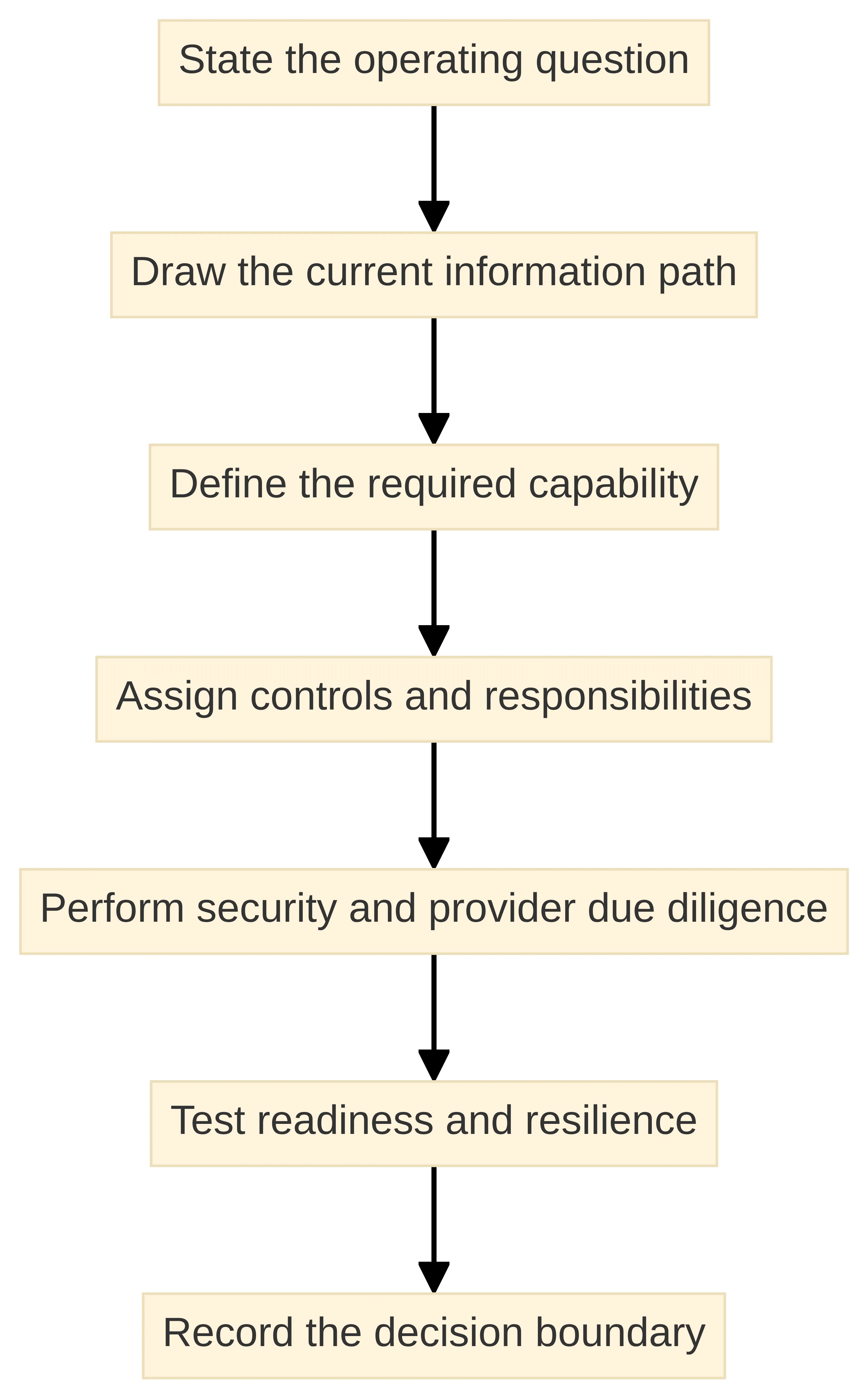
Follow a bounded evaluation sequence
A bounded evaluation sequence keeps the work tied to a decision and prevents a broad platform review from becoming an unstructured inventory. Move through the following steps.
1. State the operating question. Define the activity, decision, information problem, or control concern that requires attention. Identify the people who own the business outcome and the technology boundary.
2. Draw the current information path. Map sources, interfaces, transformations, storage, consumers, manual handoffs, exceptions, and dependencies. Mark which parts are confirmed and which still require discovery.
3. Define the required capability. Describe what the environment must support without assuming that it must replace every existing application. Separate essential functions from useful additions and record the conditions attached to each requirement.
4. Assign controls and responsibilities. For every required capability, identify the information affected, the risk condition, the control activity, the owner, the evidence, and the escalation route. Coordinate responsibilities across internal teams, suppliers, customers, and partners where the information path crosses those boundaries.
5. Perform security and provider due diligence. Compare the relevant information-security program with organizational requirements. Examine confidentiality, integrity, availability, access controls, multifactor authentication, encryption, secure source-code management, threat handling, provider concentration, incident reporting, and exit planning as applicable to the proposed scope.
6. Test readiness and resilience. Confirm that the information structure, governance, standards, staff responsibilities, monitoring, recovery expectations, and decision rights are defined. Identify what would happen if a connection, provider, application, or critical function became unavailable.
7. Record the decision boundary. State whether the environment is relevant, what remains unresolved, who owns the next action, and what evidence is required before a later decision. A bounded outcome may be to proceed, narrow the scope, conduct discovery, or stop the evaluation.
This sequence is deliberately narrower than a full implementation plan. It creates an evidence brief for the next decision while keeping unresolved technical, operational, security, and compliance questions visible.
What the assessment cannot establish
An assessment can clarify whether a proposed platform fits a defined operating need, how information moves, which controls and owners are required, and which dependencies need attention. It cannot by itself establish regulatory eligibility, legal sufficiency, investment suitability, security approval, or an acceptable level of operational risk for every organization.
Your conclusion should therefore be conditional and specific. State the intended capability, the connected systems, the accountable owners, the evidence reviewed, the unresolved conditions, and the decision that the assessment supports. A qualified legal, compliance, security, or technology professional should decide the organization-specific questions within their remit.
If the organization has a defined platform, integration, data, or control evaluation need, turn the decision boundary into a scoped next step rather than requesting a broad technology discussion.
Frequently asked questions about digital financial platforms for hedge funds
What is a digital financial platform?
A digital financial platform is an interconnected operating environment that delivers, moves, or supports financial information and services across digital systems, encompassing various applications, data flows, and controls.
How can hedge funds evaluate the relevance of a digital financial platform?
Hedge funds can evaluate relevance by assessing whether the platform addresses specific operational needs, supports required information flows, integrates with existing systems, and assigns clear responsibilities for controls and oversight.
What are the key considerations for assessing information flow in a digital financial platform?
Key considerations include tracing the origin of information, understanding how it is transferred and transformed, identifying storage locations, and determining who consumes the information and how exceptions are handled.
What role do cybersecurity and compliance responsibilities play in evaluating a digital financial platform?
Cybersecurity and compliance responsibilities should be clearly defined and coordinated across the organization and its external relationships to ensure that all material decisions have designated roles and communication routes.
What should hedge funds consider regarding third-party providers in their platform evaluation?
Hedge funds should assess the criticality of third-party providers, their security alignment with organizational requirements, visibility into their operations, concentration risks, and exit strategies.
How can hedge funds ensure that their platform implementation is ready?
Hedge funds can ensure readiness by defining operational outcomes, identifying information structures, establishing governance arrangements, and confirming that security and compliance expectations are met.
What are the potential trade-offs when adopting a digital financial platform?
Potential trade-offs include balancing integration and operational efficiency against the risks of dependency on shared systems, provider concentration, and the need for effective exception management.