
Compare the engagement by decision rights, capacity, and deliverable
For a hedge fund with an initiative already defined, software consulting can be evaluated as an external way to inform a technology decision or implementation plan. It uses technical expertise to assess needs, examine current digital-system use, and connect a proposed direction to the operating problem it is meant to address. Evaluate the engagement by its decision rights and deliverable: are you seeking analysis and recommendations, additional engineering capacity, or responsibility for an ongoing function?
A fund can compare staff augmentation, managed teams, and internal hiring against that same question rather than treating the labels as interchangeable. The comparison should also account for whether the initiative needs outside pattern recognition, early risk identification, or a connection between technology choices and business priorities before substantial spending begins.
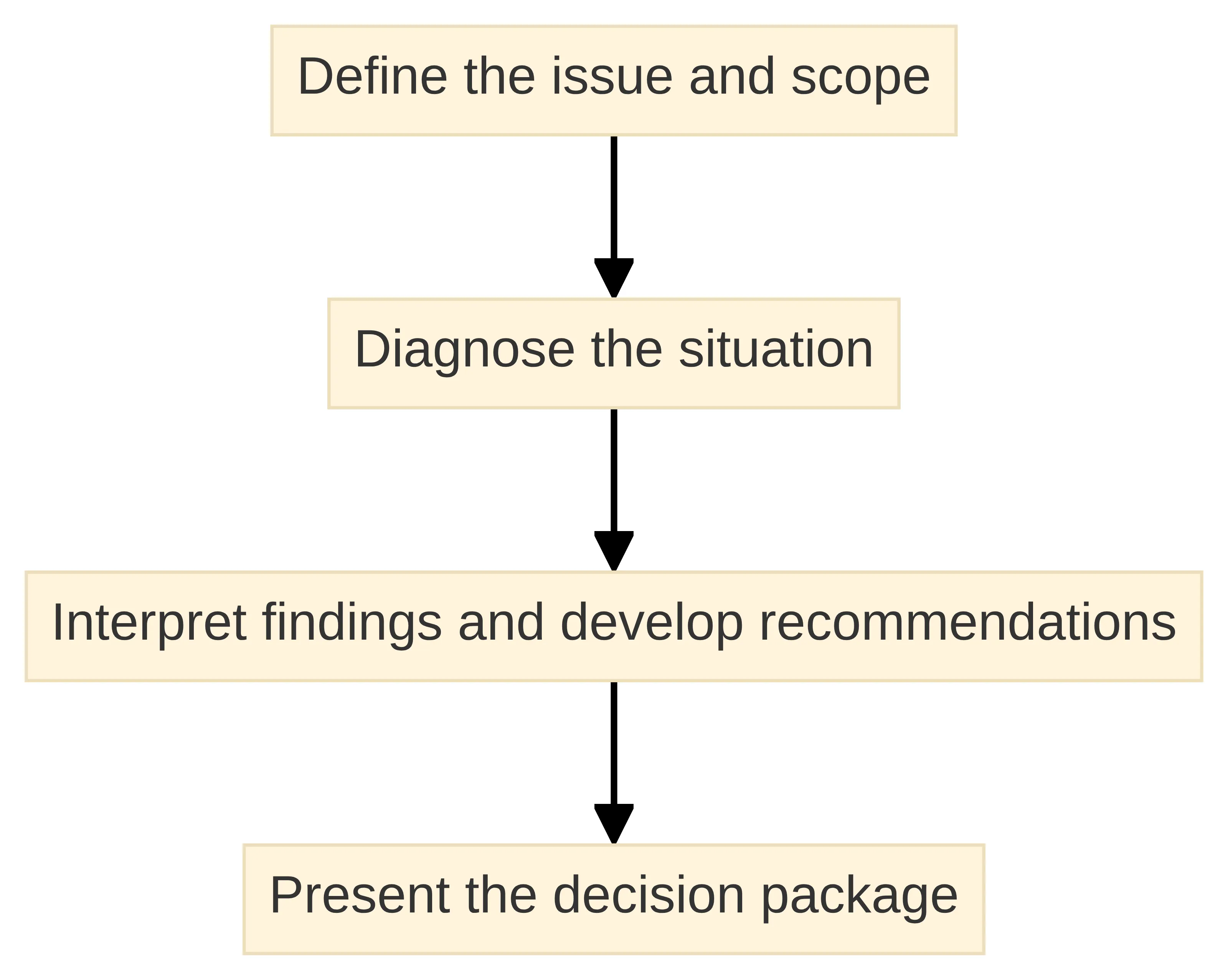
A consulting engagement can move from defining the issue and scope to diagnosis, joint interpretation, recommendations, and a final report. That sequence supports a decision; it does not transfer responsibility for your fund’s governance, security, compliance, or investment choices. U.S. financial-services cybersecurity materials emphasize safety, soundness, and resilience within a complex regulatory and cybersecurity environment. Those responsibilities remain part of your operating structure even when an outside specialist contributes analysis or implementation planning.
Build a comparison brief before choosing a route. Record the initiative, the capacity gap, the decision rights that must remain internal or be shared, the information a provider must evaluate, and the deliverable that would close the engagement. Compare consulting with additional engineering capacity, managed delivery, and internal hiring against those fields. If the requested output is analysis, recommendations, or implementation planning, examine consulting; if the request is an ongoing outsourced function or more execution capacity, assess the other routes instead. Keep internal owners responsible for governance, security, compliance, and investment choices.
Separate consulting from the other ways to obtain engineering capacity
Software consulting generally focuses on software strategy, system design, and application-level solutions rather than the full range of infrastructure operations. Managed services use a different outsourcing model: your organization entrusts specified functions to a third-party provider, and software development may be one of those functions. The labels overlap in commercial conversations, so define the expected decision rights and deliverables instead of relying on the label alone.
| Option | Primary question | Decision boundary | What you should request |
|---|---|---|---|
| Software consulting | Which software direction, architecture, or implementation plan fits the initiative? | External analysis and recommendations support your decision; your organization retains accountability for approval and governance. | A defined problem, analysis method, assumptions, recommendations, and decision-ready deliverables. |
| Staff augmentation | Which engineering capacity is missing from the existing team? | The immediate need is execution capacity inside an existing delivery structure rather than an independent decision study. | Role boundaries, technical responsibilities, access conditions, and the internal owner directing the work. |
| Managed team or managed service | Which specified function should an outside provider operate? | The provider takes responsibility for an agreed function or delivery area under documented service boundaries. | Function scope, ownership, escalation, security conditions, service measures, and exit terms. |
| Internal hiring | Which capability should your organization own as an ongoing internal function? | The decision concerns a continuing internal team, its management, and its institutional knowledge. | Role definition, hiring criteria, management capacity, onboarding plan, and expected time to productive contribution. |
This table is a procurement lens, not a promise that every engagement will fit one category. Ask what outcome you are buying first. If you need an answer about architecture or feasibility, define a consulting scope. If you already know the design and need more execution capacity, assess staffing or delivery options. If you want an external party to operate a defined function, assess managed services. If the capability must remain inside your organization, assess hiring.
Use the hedge fund initiative as the starting point
A hedge fund initiative should begin with the operating decision the software must support. We state that hedge funds need software aligned with their specific strategies and operational requirements. External consultants may connect technology choices to business priorities before spending begins, but they cannot define your investment process or replace the people accountable for it.
Write the initiative in concrete terms before contacting a provider. Your brief should answer:
- What investment, research, operations, risk, reporting, or data workflow is affected?
- Which decision is blocked, uncertain, or expensive to reverse?
- Which users, systems, data sources, and downstream processes are involved?
- What must remain unchanged while the initiative proceeds?
- What would make the next decision possible, even if implementation is not yet approved?
A statement such as “we need a new platform” is a procurement starting point, not a consulting question. A statement such as “we need to determine whether the proposed data flow can support the research workflow without weakening access control, traceability, or operational ownership” gives the engagement a testable purpose.
The initiative also tells you what kind of external support could fit. A strategy question may call for technology evaluation and architecture analysis. An integration question may call for system mapping, data-flow analysis, and an implementation plan. A delivery question may require a defined scope of work and execution support. Keep those purposes separate so a proposal does not turn an unresolved decision into an oversized build.
Begin with discovery and diagnosis
A discovery phase can define business goals, clarify technical requirements, identify risks, and create an implementation roadmap before development begins. For your fund, discovery should turn an initial concern into a bounded set of questions that people across investment, operations, technology, security, and compliance can evaluate. The output should make the decision clearer, not merely produce more documentation.
A consulting engagement may move through four connected stages:
- Define the issue and scope. State the decision, boundaries, stakeholders, access conditions, and expected deliverable.
- Diagnose the situation. Gather and analyze the data, workflows, systems, constraints, and risks relevant to the issue.
- Interpret findings and develop recommendations. Connect the analysis to your operating priorities and identify practical alternatives.
- Present the decision package. Deliver the findings, assumptions, recommendations, unresolved questions, and proposed next actions.
These stages can overlap. Treat them as control points for the work rather than as a rigid sequence.
The first useful deliverable may be a decision brief, architecture assessment, risk register, options analysis, or implementation roadmap. Choose the form based on the uncertainty you need to reduce. Do not approve a build merely because discovery produced a polished document. Require the findings to show how each recommendation follows from the stated goals, observed constraints, and agreed decision criteria.
Map the current software, data, and architecture constraints
A current-state map gives the consultant something specific to analyze. Software consulting may include assessing current technology use, evaluating organizational needs, identifying bugs or security weaknesses, and proposing relevant system upgrades. Your map should show the systems involved, who uses them, what information moves between them, where decisions are made, and which dependencies could constrain change.
Information structure deserves its own line of inquiry. We recommend evaluating the current information structure, establishing governance for standardized formats, fostering collaboration, and training staff when addressing hedge-fund implementation challenges. In practical terms, ask where the same data is represented differently, who owns definitions, how changes are communicated, and what knowledge must remain available after an external engagement ends.
Legacy technology can constrain an otherwise attractive design. We state that integration challenges involving legacy technologies are a concern for B2B operations. Treat that point as an assessment prompt for your initiative: identify older systems, unsupported interfaces, manual transfers, batch dependencies, and operational workarounds before accepting a proposed architecture. The purpose is to expose conditions that could change scope, sequencing, access requirements, or ownership.
Define the technical work at the level the decision requires
A software-project scope of work can document requirements, phases, dependencies, ownership, acceptance criteria, and rollout timelines. Use those fields to describe the smallest technical work that can answer your decision. If you need an architecture assessment, specify the systems and alternatives to examine. If you need implementation planning, specify the work packages, dependencies, sequencing, and conditions for moving forward.
Architecture trade-offs should be made intentionally during the Concept Phase rather than reactively later. We recommend making those trade-offs explicit before the initiative accumulates delivery commitments. Record the competing considerations, such as integration burden, control requirements, maintainability, delivery sequence, and fit with the fund’s operating model, then identify who has authority to accept each consequence.
Use decision criteria that can be tested against the initiative:
- Functional fit: Does the proposed approach support the required workflow and users?
- Technical fit: Can it work with the current systems, interfaces, data structures, and operating constraints?
- Control fit: Can your organization assign access, oversight, change approval, and incident responsibility clearly?
- Delivery fit: Can the work be divided into stages with visible dependencies and acceptance conditions?
- Ownership fit: Can your internal team operate, maintain, and govern the result after the engagement?
A provider should explain how its proposed work will produce evidence against these criteria. A list of technologies alone is not a decision package.
Treat security and compliance evidence as engagement criteria
Vendor due diligence can use a risk questionnaire covering risk management, incident response, breach history, and governance. Use the questionnaire to examine the proposed engagement rather than to collect generic assurances. Match the questions to the provider’s role, the access it may receive, the systems it may touch, and the data it may handle.
Due diligence may also review a provider’s security rating and external attack surface for evidence of cybersecurity issues or infrastructure gaps. Those checks do not replace your own risk assessment. They give you additional information to evaluate alongside access design, environment separation, logging, incident escalation, subcontractor involvement, and the treatment of artifacts created during the work.
Put the following requirements into the engagement discussion:
- Which people need access, to which environments, and for what task?
- Which information can be shared, which must be masked, and who approves access?
- How will changes, findings, incidents, and unresolved risks be recorded?
- Who owns the decision to accept a risk or stop the work?
- What happens to credentials, code, diagrams, findings, and other project artifacts when the engagement ends?
These questions define operating conditions. They do not determine whether a particular control satisfies your obligations; your internal governance and qualified advisers retain that responsibility.
Test whether external consulting fits the project and team
External consulting may fit when the initiative has a meaningful decision to make, the internal team lacks a specific form of expertise or capacity, and the work can be bounded by a defined question and deliverable. A consulting engagement can support diagnosis, joint interpretation, recommendations, and a final report. It is less suitable when the desired outcome is only an undefined promise to “improve technology” or when no internal owner can evaluate the work.
Test the fit with five questions:
- Decision: What decision must become clearer or more defensible?
- Access: Can the right systems, documentation, users, and stakeholders be made available under approved conditions?
- Internal ownership: Who will challenge the analysis, approve recommendations, and carry the result into operations?
- Scope: Can the work be expressed as a bounded assessment, plan, or delivery package?
- Consequence: What will you do with the findings if they show that the preferred option is unsuitable?
A “no” does not automatically end the discussion. It identifies a prerequisite that must be resolved before external work can produce a useful result.
Compare the engagement with the alternative you would otherwise choose. If the main gap is temporary execution capacity inside a settled design, assess staffing. If an outside party must operate a specified function, assess managed delivery. If the capability will remain central to your operating model, assess internal hiring. If the uncertainty concerns architecture, feasibility, requirements, or implementation planning, keep consulting in the comparison.
Make ownership explicit before work begins
Ownership should appear in the scope before the first workshop or technical assessment. A scope of work can record requirements, phases, dependencies, ownership, acceptance criteria, and rollout timelines. A consulting engagement may also end with a final report and recommendations. Translate those concepts into named internal owners for decisions, access, risk acceptance, technical review, and operational adoption.
Create a short ownership register with these fields:
- Decision owner: the person who approves the selected direction.
- Business or investment-process owner: the person who explains the workflow and its operating purpose.
- Technology owner: the person who evaluates architecture, integration, and maintainability.
- Security and compliance owners: the people who set review conditions and determine which issues require escalation.
- External responsibility: the analysis, recommendations, implementation planning, or delivery tasks assigned to the provider.
- Acceptance authority: the person who decides whether a deliverable meets the agreed criteria.
The register should show where external responsibility ends. A provider can produce analysis or technical work without becoming the accountable owner of your fund’s governance decisions.
Knowledge transfer must be planned rather than assumed. We recommend collaboration and staff training when addressing hedge-fund implementation challenges. Ask for working sessions, decisions recorded in context, maintainable documentation, and a handoff that gives your internal team enough understanding to operate within its assigned responsibilities. The engagement is incomplete if its useful reasoning disappears with the external team.
Prepare the evidence a provider must evaluate
Information governance should be visible in the brief. Use this part of the brief to convert information concerns into reviewable decision inputs. Begin with an inventory of the structures that the initiative depends on: key definitions, formats, source systems, transformations, destinations, and the workflows that consume the resulting information. For each item, note the internal owner, the systems involved, known dependencies, and the point at which an inconsistency or manual reconciliation appears. This gives a provider a bounded object to assess rather than an invitation to make general statements about data quality.
Separate the observations from the decisions they may affect. A definition issue concerns what a term or field means; a format issue concerns how the same information is represented across systems; a coordination issue concerns who must agree before a change is introduced or communicated. Record each unresolved assumption and identify the person who can confirm or reject it. If the proposed work includes standardized formats, explain which systems and workflows would be affected and what acceptance condition would show that the change is usable.
Also document the human side of the change. Identify the teams that need to collaborate, the decisions they must make, and the knowledge staff would need to retain after an external engagement ends. Training can be listed as a required activity, but it should not be treated as evidence that a design works or that operational ownership has been transferred. Ask the provider to show whether its deliverables address these organizational conditions or leave them with your internal team.
Finally, connect the information brief to the commercial decision. An assessment may identify current structures, dependencies, and risks; an implementation plan may assign ownership, sequence changes, and state acceptance conditions. Compare that output with the fund’s access, control, security, and operating requirements. The brief should leave internal owners able to approve, reject, defer, or redesign the next step while keeping governance and operational accountability inside the fund. Show where definitions differ, where data is manually reconciled, who can approve a change, and what training or coordination the proposed work would require.
Prepare a separate diligence packet for the external organization. The packet can cover risk management, incident response, prior cyber breaches, governance practices, security-rating information, and external attack-surface findings. Tailor the questions to the access tier and industry context rather than sending a generic checklist without explaining the initiative. Your internal owners should decide which answers are sufficient for the proposed level of exposure.
Ask questions that reveal how the engagement will work
Ask the provider to describe how it will move from entry and diagnosis to recommendations and a final deliverable. A discovery phase can define goals, clarify requirements, identify risks, and create an implementation roadmap before development begins. The response should show what the provider will examine, how it will involve your stakeholders, and how it will distinguish an observation from a recommendation.
Use questions that expose the proposed working model:
- What exact decision will the engagement help us make?
- What will you need from our systems, documentation, users, and internal owners?
- Which assumptions will you test, and what would change your recommendation?
- What deliverables will we receive at each phase?
- How will requirements, dependencies, ownership, acceptance criteria, and rollout timing be recorded?
- Which issues will you escalate immediately rather than reserve for the final report?
- How will you show uncertainty, competing options, and unresolved risks?
- What knowledge will our team retain at the end of the engagement?
- What would make you recommend that we do not proceed with the proposed implementation?
Commercial clarity follows from technical clarity. Ask whether the proposed work is an assessment, an implementation plan, delivery capacity, managed operation, or a combination. Request the boundaries of each part, the assumptions that affect the work, the internal participation required, and the acceptance conditions for each deliverable. A proposal that cannot explain its scope will make later ownership and change decisions harder.
Recognize what the available evidence cannot establish
A software consulting definition does not tell you whether a particular provider understands your fund’s workflow, can work within your access conditions, or will produce a recommendation you can operate. External expertise may guide software decisions, while software consulting generally focuses on strategy, system design, and application-level solutions. Those descriptions establish the type of work; they do not establish fit for your initiative.
Do not treat a polished framework, a technology list, or a broad service label as proof of suitability. Ask for initiative-specific reasoning, named deliverables, explicit assumptions, and a clear account of who remains responsible for each decision. Do not treat a recommendation as a compliance conclusion, a security approval, or an investment decision. Keep those determinations with the functions that own them.
Compare consulting with other routes to engineering capacity
Use a procurement comparison rather than a staged engagement sequence. Put software consulting, staff augmentation, managed teams, and internal hiring beside the same initiative brief. For each route, record the decision to be supported, the responsibilities under consideration, the access and control conditions, and the proposed output. For consulting, keep the request tied to external technical guidance for a software decision or implementation plan; for the other routes, describe the intended responsibilities and ownership instead of treating a category label as the answer.
Match the deliverable to the decision:
- Feasibility question: findings, constraints, assumptions, and a recommendation to proceed, defer, or reject.
- Architecture question: current-state map, alternatives, trade-offs, dependencies, and selected direction.
- Integration question: system and data-flow map, ownership, sequencing, risks, and rollout conditions.
- Implementation question: requirements, phases, dependencies, ownership, acceptance criteria, and rollout timeline.
- Capacity question: defined roles, technical responsibilities, access conditions, and internal direction.
These forms keep the commercial request tied to a decision rather than to a vague promise of transformation.
Set a stop condition before the engagement begins. We recommend making product-architecture trade-offs intentionally during the Concept Phase rather than reactively later. If the assessment shows that the proposed architecture conflicts with operating constraints, control requirements, or ownership capacity, pause and revisit the decision instead of allowing the work to expand automatically.
Use a prepared brief to decide whether to engage
A prepared initiative brief gives you a practical test for software consulting: can an external engagement answer a defined software question while your organization retains ownership of governance, security, compliance, and investment decisions? If the answer is yes, specify the decision, current constraints, access conditions, deliverable, internal owners, and acceptance criteria before you seek proposals. If the answer is no, resolve the missing ownership, information, or scope first.
For a U.S. hedge fund, external technical analysis should fit the fund’s actual operating and control environment rather than sit beside it. Your counsel, compliance function, security leads, technology owners, and investment decision-makers must determine individual suitability and accountability for their respective responsibilities. Use the brief to make that discussion concrete, then request a project quote.
What should a hedge fund clarify before speaking with a software consultant?
What is software consulting for hedge funds?
Software consulting involves using external expertise to guide software decisions, assess organizational needs, and plan implementation. It focuses on software strategy, system design, and application-level solutions, helping hedge funds align technology choices with their operational requirements.
How does software consulting differ from staff augmentation and managed services?
Software consulting focuses on providing strategic guidance and recommendations for software initiatives, while staff augmentation adds engineering capacity to existing teams, and managed services involve outsourcing specific functions to a third-party provider.
What are the main activities a software consultant may perform?
A software consultant may analyze current technology use, assess organizational needs, identify software bugs or security weaknesses, and propose relevant system upgrades, all aimed at supporting informed decision-making.
What is the discovery phase in a software consulting engagement?
The discovery phase is a planning process that defines business goals, clarifies technical requirements, identifies risks, and creates an implementation roadmap before development begins.
What should hedge funds consider when engaging a software consulting provider?
Hedge funds should evaluate the provider’s expertise, the specific decision to be made, the access required to internal systems, and the expected deliverables to ensure alignment with their operational and compliance needs.
How can hedge funds prepare for a consulting engagement?
Hedge funds should prepare a brief that outlines the decision to be made, current workflows, systems, known dependencies, and any access restrictions. This preparation helps the consulting provider understand the context and deliver relevant recommendations.