
Start with the technology decision software consulting should support
Software consulting is most useful when you have a technology decision to make but cannot yet define the right solution, delivery path, or level of risk. You may be deciding whether to replace an aging platform, connect disconnected data sources, build a specialized workflow, assess an AI-enabled product idea, or address security weaknesses in an existing environment. The immediate question is not whether you need more code. It is what decision must become clearer before you commit people, budget, access, or operational risk.
For a hedge fund or another financial-services organization, that distinction matters because technology choices sit inside business processes that may involve sensitive information, third-party dependencies, uptime expectations, and compliance responsibilities. A consultant can help frame the problem, compare feasible paths, and define a bounded deliverable. You still retain responsibility for the business decision and for determining whether a proposed approach fits your environment.
Use the following test at the start:
- If the problem is clear and the required build path is already settled, development capacity may be the more direct need.
- If the problem is unclear, the options carry different security or operating consequences, or internal teams need an independent technical assessment, consulting may be appropriate.
- If you mainly need additional people to execute an established plan, staffing support may fit better than an advisory engagement.
The right engagement begins with a defined decision, not with a generic request for technology help. A useful output should tell you what to do next, what remains uncertain, and what conditions must be met before delivery proceeds.
Define software consulting by the decisions and outputs it supports
Software consulting helps you clarify a technology problem, assess the available paths, and select an appropriate next step. The work can address requirements, feasibility, workflows, risks, and priorities, with a delivery roadmap as a typical output. That makes consulting broader than answering a narrow coding question and more bounded than assuming that a full product build is already justified.
The practical unit of value is a decision supported by a usable deliverable. Depending on your need, that deliverable may be:
- A problem definition that separates business requirements from preferred features.
- A feasibility assessment that identifies technical constraints and unresolved dependencies.
- A current-state and target-state architecture description.
- A prioritized roadmap with decision points, assumptions, and areas requiring further validation.
- An evaluation of an existing application, integration, workflow, or proposed technology choice.
- A risk register that makes security, third-party, data, and operational questions visible.
These outputs should be specific enough to guide a build, a procurement decision, an internal workstream, or a decision not to proceed. A presentation that leaves the same ambiguity in place is not a sufficient outcome for a bounded engagement.
Software consulting also includes interpretation. A consultant may analyze how your organization uses digital technology, determine what your operations need, and advise on opportunities to use software systems. That analysis should connect technical options to the work your teams must perform rather than treat a product label or programming language as the decision itself.
The boundary of consulting is the point where advice becomes execution. A consultant may help you choose a direction, define acceptance conditions, and reduce uncertainty before delivery. Your organization still needs an accountable owner to approve priorities, provide access to relevant people and systems, accept trade-offs, and decide whether the proposed path fits its operating responsibilities.
Ask for the following at the start of any engagement:
- What decision will the work support?
- Which systems, workflows, stakeholders, and constraints are in scope?
- What tangible deliverable will you receive?
- Which assumptions must be tested rather than accepted?
- What will remain outside the engagement?
A clear answer to those questions turns a broad advisory request into a manageable piece of work.
Separate consulting from development, staffing, recruiting, and implementation
The distinction between consulting and adjacent services depends on the primary decision and deliverable, not on the label used in a proposal. Software consulting and discovery address requirements, feasibility, workflows, risks, and priorities. Custom software development addresses business-specific systems and workflows when existing tools do not support the required processes. System integration connects platforms through APIs and data exchange to reduce disconnected systems and duplicate work.
Use this comparison to identify the work you are actually buying:
| Option | Main question | Typical focus | Useful when |
|---|---|---|---|
| Consulting and discovery | What should we do, and why? | Requirements, feasibility, architecture, risks, priorities, and roadmap | The problem or delivery path is not sufficiently defined |
| Custom development | What system must be built? | Business-specific application behavior and workflows | Existing tools do not support a required process |
| Staff augmentation | How do we add execution capacity? | Additional engineering or technical capacity within an existing plan | Your team owns the direction and needs more delivery support |
| Recruiting | How do we hire a permanent capability? | Candidate search, assessment, selection, and employment decision | The need is an enduring internal role rather than a bounded project |
| Implementation support | How do we configure or deploy a selected system? | Setup, migration, integration, training, and operational handoff | The product or platform decision has already been made |
The categories can overlap. A consulting engagement may identify the need for custom development, integration, or added capacity. That does not make the discovery work equivalent to the later delivery work.
Choose consulting when uncertainty about the problem, architecture, risk, or priorities is the main constraint. Choose development when the required system and delivery objective are sufficiently clear. Choose added capacity when the plan is established but execution resources are limited. Choose recruiting when you need an internal long-term role. Choose implementation support when the selected platform and target process are already defined.
A short diagnostic can prevent category confusion:
- If you cannot describe the required outcome without naming a product, begin with discovery.
- If you can describe the workflow, acceptance conditions, and technical boundaries but lack build capacity, assess development or staffing.
- If you have selected a platform and need configuration or migration, define implementation scope.
- If the capability must remain inside your organization after the project ends, assess the recruiting and internal ownership requirement separately.
Do not use an implementation engagement to answer an unresolved architecture question. Do not use a staffing request to hide the absence of a product owner, decision owner, or delivery plan.
Map the consultant’s work from discovery through technical evaluation
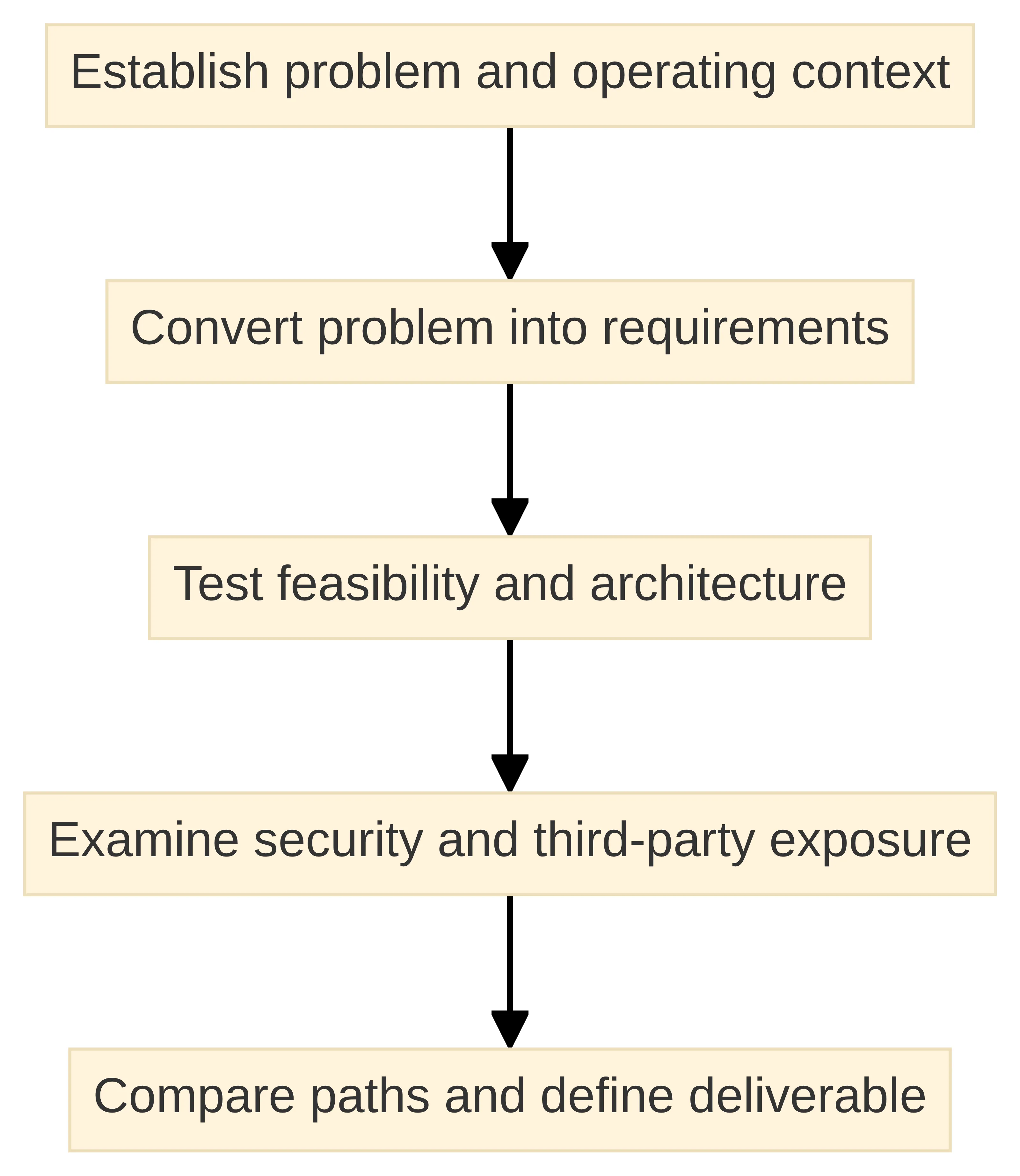
The sequence should remain adaptable, but each stage should produce a clearer basis for the next decision.
1. Establish the problem and operating context.
Start with the business process, users, systems, data flows, constraints, and decision deadline. Separate the outcome you need from the solution you currently prefer. A consultant may analyze current technology use and determine organizational needs before advising on software opportunities.
2. Convert the problem into requirements.
Describe essential workflows, users, inputs, outputs, permissions, integrations, service expectations, and acceptance conditions. Distinguish requirements from assumptions and preferences. This step gives you a basis for comparing paths rather than comparing feature lists in isolation.
3. Test feasibility and architecture.
The assessment should examine technical boundaries, dependencies, existing code, data movement, integration points, and likely delivery constraints. Development teams may assess feature feasibility, advise on technology choices, estimate effort and timelines, identify technical risks, and review existing code. Those activities are useful when you need to know whether a proposed design can fit the environment before committing to it.
4. Examine security and third-party exposure.
Discovery guidance recommends involving a security expert from the beginning so foundational security is considered before the design becomes difficult to change.
5. Compare paths and define the deliverable.
The final recommendation should state the options considered, the conditions attached to each option, the unresolved questions, and the next action. That action might be a bounded pilot, a detailed delivery plan, a platform evaluation, an integration assessment, or a decision not to proceed.
The useful sequence is not a rigid recipe. It is a way to keep discovery connected to a decision and to prevent architecture, security, and delivery constraints from appearing only after implementation has begun.
Technical evaluation should produce practical choices rather than a catalogue of technologies. Ask the consultant to explain why a proposed option fits the stated requirements, what it assumes about your systems and data, which risks it introduces, and what evidence would change the recommendation. A consultant may also identify software bugs, security weaknesses, and relevant system upgrades before proposing practical solutions.
Treat uncertainty as a deliverable. A sound assessment can say that an option remains conditional on access, data quality, vendor information, performance testing, security review, or stakeholder approval. That is more useful than a confident recommendation that conceals the conditions under which it might fail.
Trace systems, information, and controls into a delivery roadmap
Software consulting is useful when a technology question must be made concrete across processes, systems, information, and delivery choices. A typical output is a delivery roadmap that records requirements, feasibility, workflows, risks, and priorities, so the organization can examine what should be built or changed.
Trace the question through four connected points:
- Start with the process, decision, or information flow that needs to change.
- Identify the platforms, APIs, data exchanges, dependencies, owners, and controls that could affect the change.
- Compare feasible paths, such as custom development, system integration, use of an existing tool, or further analysis.
- Record the resulting requirements, feasibility findings, workflows, risks, and priorities in the roadmap.
A consultant may analyze an organization’s current use of digital technology, determine its needs, and advise on opportunities to use software systems. This role supplies analysis for a delivery decision; it does not replace the organization’s responsibility for the decision or implementation.
This framing is relevant when systems are disconnected, an application has technical debt or security concerns, a proposed product, data platform, integration, or AI workflow needs feasibility and risk assessment, or requirements and architecture remain disputed. It is also relevant when a change touches sensitive financial information, external service providers, or several control owners. These signals call for explicit analysis of dependencies; they do not by themselves establish that an external consultant is required.
System integration shows why the map matters. Connecting platforms through APIs and data exchange can reduce disconnected systems and duplicate work, but the integration pattern depends on the systems, data, timing, ownership, and controls involved. Mapping those relationships keeps the delivery roadmap tied to the operating problem rather than to a connector selected in isolation.
Dependency questions often surface after work has begun. A development team may discover that a requested feature is not feasible within the chosen architecture, that an existing component needs review, or that a third-party dependency changes the risk profile. Discovery guidance identifies feasibility assessment, technology choices, effort estimation, technical-risk identification, and existing-code review as development-team responsibilities that inform these decisions.
For a hedge-fund technology decision, include the fund’s strategy and operational requirements in the requirements discussion, then examine how the proposed software relates to risk management, compliance, and data analytics. This keeps the analysis connected to the fund’s operating needs while leaving the organization’s own decision and implementation responsibilities clear.
When a change touches sensitive financial information, outside service providers, or several control owners, surface those dependencies in discovery and in the delivery roadmap. The roadmap can record what the organization is deciding, what information it still needs, and which delivery path the analysis supports.
Apply the concept to hedge-fund technology decisions
Neutech states that hedge funds must identify software aligned with those strategies and requirements.
A focused assessment should connect the technology question to the work performed by the fund. For example, define:
- Which decision or process the system must support.
- Which information enters the process, where it originates, and who owns it.
- Which teams need access and what different roles may do with the information.
- Which existing systems must exchange data with the proposed solution.
- Which operating conditions would make the solution unsuitable.
- Which evidence is required before approval, deployment, or expansion.
This structure prevents a broad request for a “better platform” from becoming an unfocused product search. It also gives internal stakeholders a shared basis for discussing architecture, controls, data quality, and delivery effort.
Hedge-fund technology may touch risk management, compliance, data analytics, and operational efficiency. Neutech states that customized software solutions are needed in these areas and that managers can use technology to increase operational efficiency. Treat those statements as decision areas to investigate, not as an automatic promise that a particular system will improve results.
For data-heavy work, include an implementation-readiness review alongside the technical design. Neutech recommends evaluating the current information structure, establishing governance for standardized formats, supporting collaboration, and training staff to address implementation challenges. Translate that recommendation into concrete questions:
- Where are the authoritative data sources?
- Which formats, definitions, and ownership rules need to be standardized?
- Who resolves conflicts or quality issues?
- Which teams must coordinate during the change?
- What training or operating adjustment is required after deployment?
A consultant should show how the proposed path addresses those questions. If the recommendation focuses only on software selection and ignores information structure, ownership, or adoption, the assessment is incomplete for a data-dependent workflow.
The hedge-fund context changes the questions you ask, not the basic purpose of consulting. You still need a defined problem, an accountable decision owner, a bounded scope, and a deliverable that supports a go, revise, defer, or stop decision. Avoid treating technical sophistication as a substitute for fit with the fund’s actual operating model.
Bring security, compliance awareness, and third-party risk into discovery
Third-party risk deserves its own workstream when a consultant, platform, hosting service, data provider, or integration component can access fund information or systems. NIST describes cybersecurity supply-chain risk management as a systematic process for managing exposure throughout technology supply chains and developing response strategies, policies, processes, and procedures. NIST also says effective supply-chain risk management requires stakeholders across the enterprise to collaborate, communicate, and act.
A selected passage from a 2022 SEC proposed rule asked whether advisers and funds should assess the cybersecurity compliance of certain service providers with access to adviser or fund information or related systems. That passage records a proposal-era question, not a current universal requirement. It still illustrates why provider access and oversight should be explicit topics in a U.S. financial-services technology assessment.
Ask the consultant to map:
- The providers and subproviders involved.
- The information and systems each party can access.
- The responsibilities assigned to your organization and to each provider.
- The evidence needed for procurement, security review, monitoring, and offboarding.
- The response path if a provider changes, fails, or experiences a security incident.
Require the final recommendation to identify unresolved control ownership. A security label without a responsibility map does not answer the operating question.
Evaluate providers by judgment, evidence, communication, and scope
Provider evaluation should test how a consulting team thinks, communicates, and limits its conclusions. A polished proposal is not enough. Ask for evidence that the team can understand your operating context, explain trade-offs, and produce the deliverable your decision requires.
Use these criteria:
Domain fit. Can the team discuss financial-services workflows, sensitive information, operational dependencies, and the difference between a technical possibility and an acceptable operating choice? Ask which parts of your context they need to understand before recommending a path.
Technical approach. Does the proposed method cover requirements, architecture, feasibility, dependencies, existing code, integrations, and technical risks? Ask how the team will distinguish facts, assumptions, open questions, and recommendations.
Security and compliance awareness. Does the scope identify information access, third-party components, control ownership, and the people who must review the result? Ask where security expertise enters the work and what evidence will be produced.
Communication. Will you receive clear decision records, risk explanations, status updates, and escalation points? Ask who makes technical findings understandable to business, engineering, security, and compliance stakeholders.
Engagement scope. Does the proposal identify the decision, activities, inputs, deliverables, exclusions, dependencies, and completion conditions? Ask what happens when the initial assessment reveals a larger problem.
Independence of judgment. Can the team explain why it would reject a preferred technology, reduce scope, defer delivery, or recommend internal ownership? A useful advisor must be able to state a boundary, not only present an attractive path.
Use direct questions before you compare providers:
- What will you need to know about our systems, workflows, data, and stakeholders before beginning?
- Which decisions will the engagement support, and which decisions remain with us?
- What will you deliver in writing, and how will we use it afterward?
- How will you evaluate feasibility, architecture, existing code, integrations, and third-party exposure?
- Which security and compliance stakeholders should participate?
- How will you record assumptions, unresolved questions, and changes in scope?
- What access will you request, and how will that access be limited and removed?
- What would cause you to recommend a smaller scope, a different delivery path, or no engagement?
- Which parts of the work require internal staff, legal review, compliance review, or security approval?
- How will you define completion for this specific assessment?
Compare the answers, not only the service names. A provider that cannot make its method and boundaries clear before work begins may create avoidable ambiguity during the engagement.
Understand the limits and trade-offs before engaging a consultant
Consulting reduces uncertainty only when the engagement has access to the right context, people, systems, and decision authority. It cannot make an undefined problem precise without stakeholder participation, and it cannot turn missing data, unclear ownership, or unavailable technical access into reliable conclusions.
Account for these limits:
- Advice is not execution. A roadmap or architecture assessment does not by itself build, test, deploy, operate, or govern the resulting system.
- Scope creates trade-offs. A narrow engagement can produce a faster decision but may leave adjacent dependencies unresolved. A broad engagement can examine more conditions but requires more stakeholder time and coordination.
- External judgment has a learning curve. A consultant must learn your systems, language, policies, and constraints. Provide a structured brief and knowledgeable internal contacts.
- Recommendations depend on assumptions. A conclusion may change when data quality, access, vendor terms, performance, security findings, or ownership conditions change.
- Independent advice still needs internal accountability. Your organization must decide which risks it accepts, which controls it requires, and who owns the resulting system.
State these limits in the engagement design rather than treating them as defects discovered at the end. The goal is not to remove every unknown. The goal is to identify which unknowns affect the decision and assign a next action for each material one.
Security frameworks and supply-chain practices also have limits. NIST says the Cybersecurity Framework is not a one-size-fits-all approach because organizations have different risks, risk appetites, tolerances, missions, and objectives. Apply a framework as a way to organize questions and outcomes, not as proof that a specific design is suitable.
The same discipline applies to third-party review. A supplier questionnaire can collect information, but it does not replace decisions about access, control ownership, monitoring, response, and exit. Ask what the evidence means for your actual systems and operating model.
Use a consultant when the expected decision value justifies the time, access, and coordination required. Defer or narrow the engagement when the business problem, decision owner, or available information is too unclear for a useful assessment.
Translate the consulting question into a delivery boundary
Software consulting can be understood through the question it answers and the output that supports the next delivery choice. For a hedge fund, that question may connect a software need with strategy and operational requirements, risk management, compliance, or data analytics.
Clarify the need.
Consulting and discovery can address requirements, feasibility, workflows, risks, and priorities. A consultant may analyze current technology use, determine organizational needs, and advise on opportunities to use software systems. A delivery roadmap is a typical output when the organization needs a clearer route to a technology decision.
Examine the technical boundary.
The work can include identifying bugs, security weaknesses, and relevant system upgrades. Adjacent development work may assess feasibility, advise on technology choices, estimate effort, identify technical risks, and review existing code. These activities describe the question, constraints, and options; they do not make every subsequent delivery activity part of consulting.
Name the work that follows.
When existing tools do not support a required business-specific process, custom software development addresses that system or workflow need. When disconnected platforms or duplicate work are the problem, system integration can connect platforms through APIs and data exchange. Keeping those boundaries visible distinguishes advice and evaluation from building or connecting the resulting software.
Record the result in a short internal scorecard:
- Decision: What must become clearer?
- Reason: Why does the question matter now?
- Scope: Which systems, workflows, data, and stakeholders are included?
- Risk: Which security, third-party, compliance, or operational concerns could change the path?
- Deliverable: What will you receive and how will it support the decision?
- Owner: Who accepts the recommendation and decides what happens next?
- Boundary: What is explicitly outside the engagement?
- Exit: What condition ends discovery or triggers a separate delivery phase?
A completed scorecard should produce a clear action: authorize a defined assessment, prepare the missing inputs, or decline the engagement. Keep that action visible when comparing proposals.
Prepare a focused brief before comparing providers
A focused brief should state the technology decision, the business workflow it affects, the current systems and constraints, the risks that need examination, and the deliverable required to move forward. Include the accountable owner, relevant stakeholders, access conditions, decision timing, and explicit exclusions. For a hedge fund, add the information flows, data ownership questions, third-party access, and security or compliance participants that could change the recommendation.
Use the brief to decide whether your need is consulting, development, added delivery capacity, recruiting, or implementation support. If the problem is still unclear, keep the first scope narrow and decision-oriented. If the design and acceptance conditions are already settled, direct the request toward execution rather than paying for analysis that will not change the path.
A qualified professional should determine individual suitability for your organization’s legal, regulatory, security, and operational circumstances. Treat the completed brief as the basis for a bounded conversation, with assumptions and responsibilities visible before work begins.
The next step is to submit a concise description of the defined need, the affected workflow or system, the decision you need to make, and the questions that remain open.
What should a hedge fund clarify before contacting a software consultant?
What is the role of a software consultant?
A software consultant analyzes an organization’s current use of digital technology, identifies needs, and advises on opportunities to use software systems. They help clarify technology problems, assess available paths, and select appropriate next steps.
When should a hedge fund consider engaging a software consultant?
A hedge fund may consider engaging a software consultant when facing uncertainty about technology decisions, such as when existing applications have accumulated technical debt, when there are competing options for a new system, or when internal teams disagree about architecture or priorities.
How can hedge funds evaluate potential software consulting providers?
Hedge funds can evaluate software consulting providers by assessing their domain fit, technical approach, security and compliance awareness, communication skills, engagement scope, and independence of judgment.
What are the limits and trade-offs of using software consulting?
Consulting can reduce uncertainty but has limits, such as the need for stakeholder participation, the inability to execute recommendations, and the potential for unresolved dependencies. A narrow engagement may produce faster decisions but could leave adjacent issues unaddressed.
What security considerations should be included in software consulting engagements?
Security considerations should include identifying vulnerabilities, ensuring regulatory alignment, designing controls, and evaluating third-party components. Involving a security expert from the beginning is recommended to establish foundational security.
What is the difference between software consulting and software development?
Software consulting focuses on clarifying technology problems and providing strategic advice, while software development involves building specific applications or systems based on defined requirements. Consulting is about decision-making, whereas development is about execution.