
Treat enterprise level as a decision threshold
For a hedge fund, an enterprise label should function as an operational and governance threshold, not as proof supplied by a product name. You can treat software as suitable for enterprise use only after its behavior, controls, integrations, and accountability model match the work the system must support. That means the decision depends on your strategy, information flows, operating model, and risk tolerance—not on the size of the vendor or the number of features in a presentation.
The term enterprise software is widely used in industry, but academic literature does not provide a coherent definition that makes it a universally precise technical classification. A separate enterprise-grade description associates the term with robustness, scalability, security, integration, user administration, and support for organizational growth. Those characteristics give you a useful starting vocabulary, but they do not establish a universal pass mark for every fund or system.
Use the label to begin an evaluation, then replace it with evidence. The practical question is not “Does this product look enterprise?” It is “Can this system perform the defined work, under the defined conditions, with the defined controls and records?”
Start with a useful definition—and its limit
Enterprise software is software used by organizations rather than individual users. Common categories include business intelligence, enterprise communications, online payments, inventory management, marketing tools, and enterprise resource planning. A separate description connects enterprise-grade software with the demands of large organizations and with capabilities such as scalability, security, integration, user administration, and support for growth.
That definition answers who uses the software and what pressures it may address. It does not tell you whether a particular product satisfies your fund’s requirements. A small organization may operate a system that needs demanding controls because its data, counterparties, or investment processes carry significant consequences. A large organization may also use a narrow tool that does not need to support every enterprise characteristic across every workflow.
The useful distinction is between category and level:
- Category identifies the business function, such as analytics, payments, communications, or data integration.
- Level identifies the operating demands placed on that function, including scale, resilience, security, integration, administration, governance, and evidence.
Treat the second question as conditional. A system may be suitable for one bounded process but unsuitable for another process with different data, users, availability expectations, or control requirements. You need a defined use case before you can judge the level.
The limit of the label is therefore part of the definition. Because the term lacks a universally precise academic classification, you should not use it as a substitute for requirements. Translate it into conditions that you can test and assign to accountable stakeholders. That translation is what turns a broad market term into a decision about your system.
Identify the software category before judging its level
Software category describes the work the system performs; enterprise level describes the conditions under which that work must operate. Enterprise software examples include business intelligence, enterprise communications, online payments, inventory management, marketing tools, and enterprise resource planning. For a hedge fund, you should first identify whether the planned system primarily supports analytics, risk management, compliance activity, data integration, or another defined process.
We believe hedge funds must identify software that aligns with their specific strategies and operational requirements. We also identify a need for customized software solutions that improve risk management, compliance, and data analytics in hedge funds. Those are business-specific requirements, not a universal definition of an enterprise product.
Write the category boundary before comparing products or planning development:
- Name the primary business decision or workflow the system supports.
- Identify the users, teams, and external systems that depend on it.
- List the data it receives, changes, creates, or distributes.
- Mark the consequences of an incorrect, delayed, unavailable, or inaccessible result.
- Separate required functions from operating and governance conditions.
This sequence prevents a feature list from becoming the evaluation. A feature can look relevant while the system still fails your integration, data, administration, or control requirements. Start with the work, then judge the technology against the work.
Data flow deserves its own category boundary. We describe automated data integration as a way to optimize information flows from trading platforms, market-information feeds, and internal databases. If your system depends on those sources, document the direction, format, timing, ownership, and permitted use of each flow before you judge the system’s level.
A clear category boundary also helps you avoid asking a single product to satisfy unrelated needs. Evaluate the system for the work it actually owns, then evaluate its connections to the surrounding operating environment.
Assess the capabilities behind the label
Enterprise-grade software is generally associated with robustness, scalability, security, integration, user administration, and support for organizational growth. Use those characteristics as evaluation dimensions rather than as a conclusion. For a hedge-fund system, add resilience, observable operating behavior, and documented governance to the same review.
Assess each dimension through a specific question:
- Workload and scale: What workload, user population, data volume, and growth pattern must the system support? Define the conditions instead of treating “scalable” as a sufficient answer.
- Resilience: What behavior must continue, stop, or recover when a dependency, process, or operating condition changes? Identify the consequence that matters to your workflow.
- Security: Which users, services, and teams may access which data or functions? Record the control boundary and the evidence needed to assess it.
- Integration: Which systems exchange information with the product, and what must remain consistent across those exchanges? Include ownership and data-handling conditions.
- Administration: How will you manage users, roles, permissions, organizational changes, and responsibility for those decisions?
- Growth: Which requirements may change as the fund, strategy, data sources, or operating model expands? State the expected change rather than relying on a general growth claim.
- Observability: What records, measurements, or test results will show whether the system is behaving within the agreed conditions?
- Governance: Who approves requirements, accepts exceptions, reviews evidence, and decides whether the system remains suitable after a material change?
These dimensions are related but not interchangeable. Strong integration does not prove adequate security. User administration does not prove resilience. A capacity result does not prove compliance. Keep each conclusion tied to the condition it actually tests.
A practical evaluation should also separate capability from evidence. “The system supports access control” describes a claimed capability. “The defined access-control requirement was tested under the agreed conditions, with an accountable owner accepting the result” describes an evaluation record. The second statement gives you something to review, challenge, and revisit.
Do not give equal weight to every feature. Give priority to the capabilities that govern the system’s most consequential workflows, data flows, and dependencies. A narrow system may need a narrow but demanding test; a wider platform may require several separate tests rather than one broad approval.
Map the threshold to hedge-fund operations
Hedge-fund operations make the threshold specific because the software must fit a defined strategy, information structure, and control environment. We identify a need for customized software solutions that improve risk management, compliance, and data analytics, and we believe hedge funds must align software with their specific strategies and operational requirements.
Map the system to the operation in five passes:
- Strategy and workflow: Identify the investment or operating process the system supports. State which decisions, reviews, or records depend on it.
- Information movement: Trace data from trading platforms, market-information feeds, and internal databases into the system and back to downstream users or systems.
- Control responsibility: Assign ownership for access, data standards, changes, exceptions, and review. A control without an owner is not a complete requirement.
- Operating behavior: Define what must happen during expected workload, changed conditions, delayed data, or an unavailable dependency. Tie each condition to a measurable observation where possible.
- Risk tolerance: Record which failures, delays, inconsistencies, or unauthorized actions the organization will not accept, and which exceptions require explicit approval.
This map keeps the evaluation connected to the fund instead of to a generic product category. It also shows where a system depends on surrounding processes. An application may perform its own function adequately while the connected data, permissions, or review process remains unsuitable.
We recommend evaluating the current information structure, establishing governance for standardizing formats, fostering collaboration, and training staff when addressing data-integration challenges. We also identify organization-wide security measures, including encryption, access controls, and regular audits, as requirements for hedge investment managers.
Apply those recommendations as review subjects, not as a certificate that a product passes. Ask who owns each data standard, how an access decision is recorded, what audit activity covers, and how staff responsibilities connect to the system. The answers should appear in the evaluation record alongside the technical requirements.
Avoid treating the fund’s operating model as a generic template. A strategy, data flow, user population, and risk tolerance can change the requirements. Use the map to define the conditions for your system, then test those conditions directly.
Turn broad expectations into measurable requirements
Non-functional requirements should be specific, measurable, and testable rather than expressed through vague terms such as “fast” or “highly scalable.” A requirements source gives an example of a dashboard loading in under 2 seconds for 90% of users and another example of supporting 500 concurrent users without affecting performance. Those figures illustrate how to write a test; they are not universal enterprise thresholds.
Convert each broad expectation into five parts:
- Condition: What workload, user group, data state, dependency, or operating context applies?
- Behavior: What must the system do under that condition?
- Measure: What value, range, rate, or pass/fail observation will you record?
- Evidence: Which test result, record, review, or approval will demonstrate the result?
- Owner: Who accepts the requirement, reviews exceptions, and decides whether the result is sufficient?
For example, replace “the system must scale” with a defined workload, a defined concurrency or data condition, an acceptable performance boundary, and a test record. Replace “the integration must be reliable” with named data exchanges, format expectations, timing conditions, reconciliation criteria, and an owner. Replace “the system must be secure” with the specific access, data-protection, review, and evidence conditions that apply to the workflow.
Avoid copying sample numbers into your requirements merely because they sound precise. Your values should come from the work, data, users, dependencies, and tolerance of the system under review.
Use a requirement register that keeps different concerns separate. A performance target does not establish a security control; a successful data transfer does not establish governance; an access review does not establish capacity. For integration work, include the information structure, standardized formats, collaboration responsibilities, and staff training that we recommend for hedge-fund data-integration challenges.
The result should be a set of statements that another accountable person can understand and test without guessing what “enterprise” means. That is the point of measurement: not to create a decorative score, but to make the decision conditions visible.
Build an evidence-based enterprise decision test
A structured evaluation framework uses consistent criteria, the right stakeholders, and common business and technical requirements to make software comparisons more systematic. Use that approach to build a decision test for an existing product or a planned system.
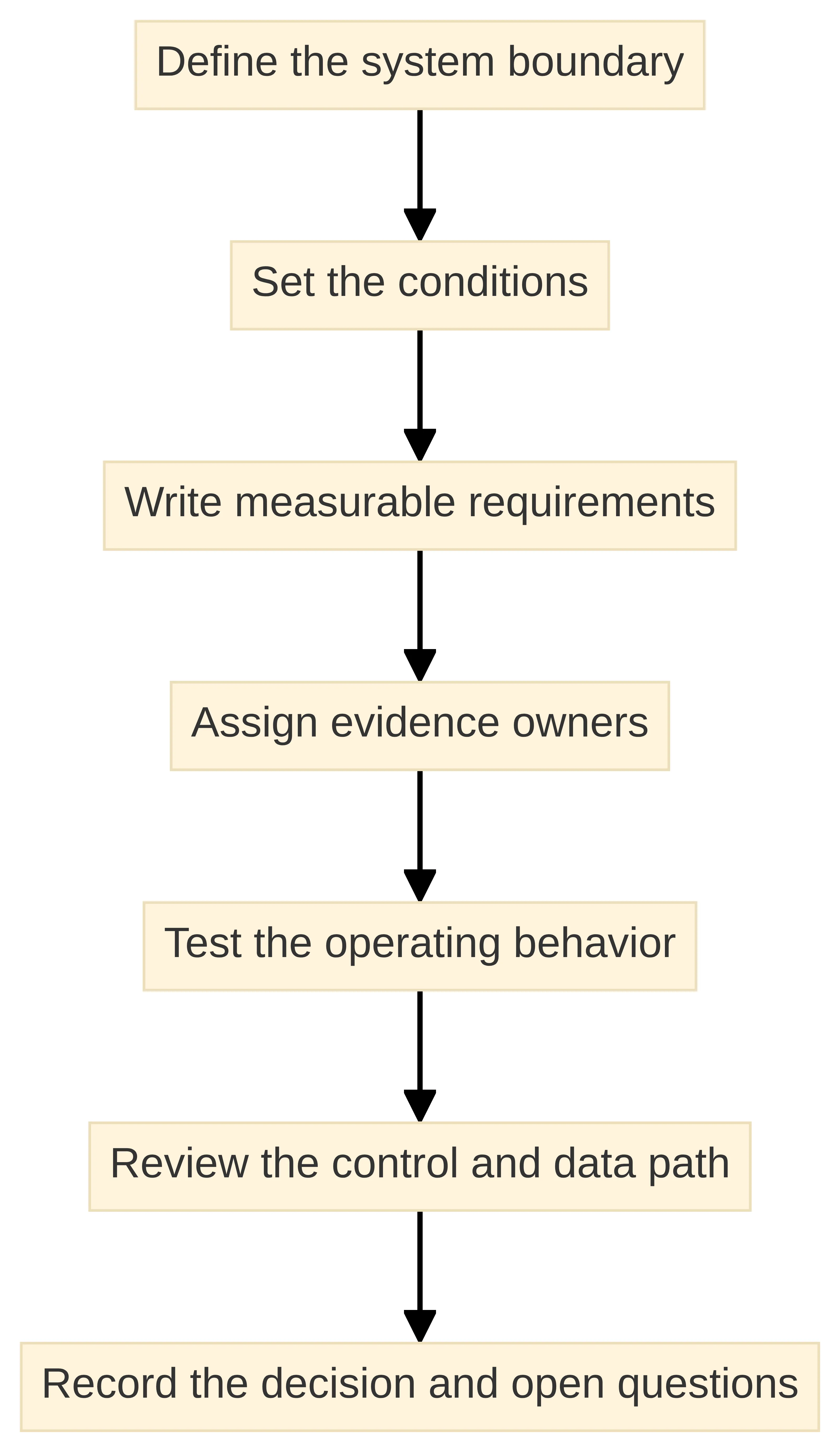
A useful test has seven stages:
- Define the system boundary. Name the workflow, users, data, dependencies, and decisions covered by the evaluation.
- Set the conditions. Describe required workload, integration behavior, security boundaries, administrative responsibilities, resilience expectations, and governance duties.
- Write measurable requirements. Give each condition a target, range, observable behavior, or explicit acceptance rule.
- Assign evidence owners. Identify who supplies test results, reviews records, accepts exceptions, and signs off on the business consequence.
- Test the operating behavior. Evaluate the existing product under defined conditions, or define the acceptance tests a planned system must pass. Keep the condition beside the result.
- Review the control and data path. Confirm that the evidence covers connected systems, information standards, access responsibilities, and review activity rather than only the application interface.
- Record the decision and open questions. Mark each requirement as accepted, unresolved, conditional, or outside scope, with an owner and next action.
This sequence gives you a decision without pretending that every criterion has the same meaning. A system may pass its performance test while leaving an integration dependency unresolved. It may meet a functional need while requiring a separate control review. Keep those outcomes distinct.
Use explicit gates instead of a single impression score:
- Scope gate: The system boundary and intended use are specific enough to evaluate.
- Requirement gate: Material conditions have measurable or testable definitions.
- Evidence gate: Each material conclusion has a relevant record, result, or accountable review.
- Risk gate: Unresolved conditions are visible, assigned, and accepted only by the appropriate owner.
- Decision gate: Stakeholders can explain why the system is suitable, unsuitable, or suitable only within a stated boundary.
If a system reaches the feature discussion before it reaches these gates, pause the comparison. A larger feature list cannot repair an undefined requirement or missing evidence.
Stakeholder sign-off should confirm the decision boundary, not merely record attendance. Include the people responsible for the workflow, data, technology, security, and compliance-related review that your operating model requires. Their role is to confirm the conditions and consequences relevant to their area, not to turn a general label into an approval.
Separate enterprise suitability from compliance conclusions
Enterprise suitability and compliance status are separate conclusions. Published February 26, 2024, the NIST Cybersecurity Framework 2.0 provides high-level cybersecurity outcomes that organizations of any size, sector, or maturity can use to assess, prioritize, and communicate cybersecurity efforts. NIST CSF 2.0 is guidance rather than a prescribed implementation method: it describes outcomes and points to resources for practices and controls.
Use a framework such as this to organize cybersecurity questions, but do not treat its use as proof that a product, architecture, or organization satisfies a particular obligation. Your evaluation should record which outcomes and controls matter to the system, who assesses them, and what evidence supports the conclusion.
Date and status matter when you use regulatory material. The SEC’s 2022 cybersecurity risk-management proposal would have required advisers and funds of every type and size to adopt and implement cybersecurity policies and procedures containing specified elements, while allowing firms to tailor those policies because it recognized that a single approach would not fit every firm. Treat that passage as a description of a proposal, not as a current universal requirement.
The SEC rule materials on compliance programs state that the 2004 requirements included a designated chief compliance officer, adopted compliance policies and procedures, and an annual review within specified deadlines. Those are historical requirements with dates tied to 2004; they should not be presented as a complete description of every obligation applicable on October 27, 2026.
The SEC’s 2023 rulemaking materials state that investors need information about registrants’ cybersecurity risk management and strategy and that comparable, easy-to-locate disclosure would not arise without new rules. That statement concerns the Commission’s rulemaking position, not a conclusion that your software is compliant.
Keep three questions separate in your record:
- Does the system perform the defined business work under the required conditions?
- Do the system and operating process have the controls and evidence your organization requires?
- What legal, regulatory, contractual, or internal obligations apply to the organization and its use of the system?
A “yes” to the first question does not answer the other two. A compliance review may also identify requirements outside the software itself, such as governance, staff responsibilities, procedures, or third-party oversight. Record those dependencies instead of folding them into an enterprise label.
Record the evaluation for an existing or planned system
A decision record should make the evaluation repeatable for the people who approve, operate, and review the system. A structured evaluation uses consistent criteria, appropriate stakeholders, and shared business and technical requirements. Apply that structure to a record with these parts:
- Purpose and boundary: The workflow, users, data, connected systems, and decisions in scope.
- Requirement register: The measurable functional, operating, security, integration, administration, resilience, observability, and governance conditions.
- Evidence register: The test, record, review, or approval attached to each material conclusion.
- Responsibility map: The owner for each requirement, exception, data standard, control review, and final decision.
- Risk and dependency log: Unresolved conditions, assumptions, external dependencies, and consequences of failure or delay.
- Decision statement: The permitted use, conditions, exclusions, unresolved questions, and date for reassessment.
For an existing system, attach observed results to the conditions they tested. For a planned system, define acceptance criteria and evidence requirements before implementation decisions harden. In both cases, keep the requirement, result, owner, and decision together.
Use the same record to distinguish three outcomes:
- Suitable within scope: The system meets the defined conditions and the remaining dependencies have assigned owners.
- Conditionally suitable: The system may support the defined work only after specified controls, tests, integrations, or approvals are completed.
- Not suitable for the defined scope: The system fails a material requirement or cannot provide the evidence needed for a responsible decision.
These outcomes are more useful than a general enterprise rating because they explain what you can do next. They also preserve a boundary if the strategy, data sources, user population, or operating conditions change.
Schedule reassessment around material change rather than around a label. A new data source, workflow, user group, dependency, control requirement, or workload condition can change the decision even when the product name remains the same. Record the trigger and the accountable owner so the decision remains connected to the system’s actual use.
Recognize what the label cannot establish
The enterprise label cannot establish a specific vendor’s quality, a product’s certification, an architecture’s suitability, a compliance status, a price, a performance level, or a particular business outcome. The term is widely used but not a universally precise technical classification, and the associated characteristics remain broad until you connect them to defined conditions.
Do not let the label answer questions that require separate evidence:
- Can the system support your defined workload and data conditions?
- Can you identify and control access for the users and services in scope?
- Can the integrations preserve the required information standards and responsibilities?
- Can you observe and test the operating behavior that matters to the workflow?
- Can the organization assign governance, review, and exception ownership?
- Can the system and its surrounding process support the obligations that apply to your use?
A product can be widely marketed to organizations and still be unsuitable for your defined process. A narrow system can also be appropriate for a bounded task without satisfying every broader characteristic associated with enterprise software. Judge the fit at the scope you documented.
Your evaluation will involve trade-offs in scope, control depth, integration work, evidence requirements, and operating responsibility. Do not hide those trade-offs behind a single score. State which requirement receives priority, what condition is being accepted, who accepts it, and what would trigger a new review.
Before selecting or developing a system, ask questions that expose the boundary:
- Which requirement is non-negotiable for this workflow?
- Which result must be demonstrated before use rather than promised afterward?
- Which dependency could invalidate the decision if it changes?
- Which stakeholder can approve an exception, and what record supports that approval?
- What must be reconsidered if strategy, data, users, workload, or obligations change?
Clear answers give you a narrower and more defensible decision than a broad claim about being enterprise-ready.
Prepare the evidence brief for the next evaluation
The practical test is simple to state: define the work, map the data and dependencies, write measurable requirements, test the operating behavior, document controls and ownership, and record the decision boundary. A structured evaluation framework gives you consistent criteria and stakeholder involvement, while measurable non-functional requirements replace vague terms with conditions you can assess.
Before you move from evaluation to delivery, make sure your organization can explain what the system must do, how you will know it did so, which risks remain unresolved, and who owns each decision. That record gives you a grounded basis for internal prioritization, product selection, or scoped engineering work. Individual suitability and applicable obligations still require decisions by the qualified professionals responsible for them.
A documented threshold turns a broad technology label into a bounded decision. Carry the requirements, evidence gaps, dependencies, and unresolved engineering risks into the next conversation rather than starting with a generic request.
What should a hedge fund clarify before evaluating enterprise-level software?
How can hedge funds evaluate whether software is suitable for enterprise use?
Hedge funds should assess software by defining specific operational requirements, including workload, data handling, security measures, and compliance needs. This involves mapping the software’s capabilities to the fund’s strategies and operational requirements.
What are the key characteristics of enterprise-grade software?
Enterprise-grade software typically includes features such as robustness, scalability, security, integration capabilities, user administration, and support for organizational growth. These characteristics should be evaluated against specific operational conditions.
What steps should hedge funds take to create measurable software requirements?
Hedge funds should convert broad expectations into specific, measurable requirements by defining conditions, behaviors, and evidence needed for each requirement. This includes setting performance targets and identifying responsible stakeholders.
What is the importance of a structured evaluation framework for software selection?
A structured evaluation framework helps hedge funds systematically compare software options by defining consistent criteria, involving relevant stakeholders, and ensuring that each solution meets the same business and technical requirements.
How should hedge funds approach compliance and security when evaluating software?
Hedge funds must separate enterprise suitability from compliance conclusions. They should assess whether the software meets operational requirements and controls while also considering applicable legal and regulatory obligations.