
Enterprise architecture answers a coordination problem
Enterprise architecture is a decision-making and coordination discipline that maps how business capabilities, processes, applications, data, and technology infrastructure work together. That map gives you a structured way to examine changes, investments, and transformations before you commit to a direction. It is useful when the question is larger than a single application or team.
A hedge fund technology leader encounters the coordination problem when a business priority crosses several boundaries at once. A change to an investment workflow may affect data ownership, application interfaces, infrastructure, security decisions, and the people who can approve or operate the result. Looking at each system separately can leave those dependencies implicit. Architecture work makes them discussable by giving different stakeholders a shared view of the decision.
The useful question is not whether your organization has produced a large blueprint. Ask whether you can connect a proposed business change to the systems, information, technical conditions, owners, and decisions that change would require. If you can, the practice is functioning as a decision aid. If you cannot, begin with the specific decision that needs clearer coordination rather than commissioning a broad documentation exercise. The scope should follow the decision.
Read the enterprise through four connected concerns
The four commonly recognized core domains are business, data, application, and technology architecture. Each domain is a partial view of the wider organization: it addresses concerns held by several stakeholders while leaving other views outside its immediate scope. No single domain explains the full effect of a major change.
The four domains can be read as follows:
- Business architecture: Connects strategic objectives, business processes, stakeholders, and the capabilities the organization needs to operate or change.
- Data architecture: Addresses how you manage and use data assets in support of business goals, including the information that must move between activities and systems.
- Application architecture: Describes individual systems, the interactions among them, their relationships with core business processes, and integration-oriented services.
- Technology architecture: Describes the hardware, software, and network infrastructure needed to operate information systems.
The descriptions are related, but they answer different questions. Business architecture asks what the organization is trying to accomplish. Data architecture asks what information supports that purpose and how it is managed. Application architecture asks which systems perform or connect the work. Technology architecture asks what infrastructure allows those systems to operate.
The four architecture domains are connected rather than four independent inventories. Business architecture gives a change its purpose and identifies relevant processes or stakeholders. Data architecture clarifies the information those processes depend on. Application architecture shows where that information is created, transformed, exchanged, or consumed. Technology architecture describes the infrastructure that allows the applications and information systems to operate. A useful view keeps the connections visible without pretending that every stakeholder needs every detail.
Trace a hedge-fund priority across the architecture
A hedge-fund data-integration initiative is a useful test case because it crosses all four concerns. We recommend evaluating the current information structure, establishing governance to standardize formats, fostering collaboration, and training staff when addressing implementation challenges. Our guidance identifies trading platforms, market-information feeds, and internal databases as information flows that an integration effort may need to address. The point is not to assume that every fund has the same sources or design; it is to make the relevant flow visible before selecting a solution.
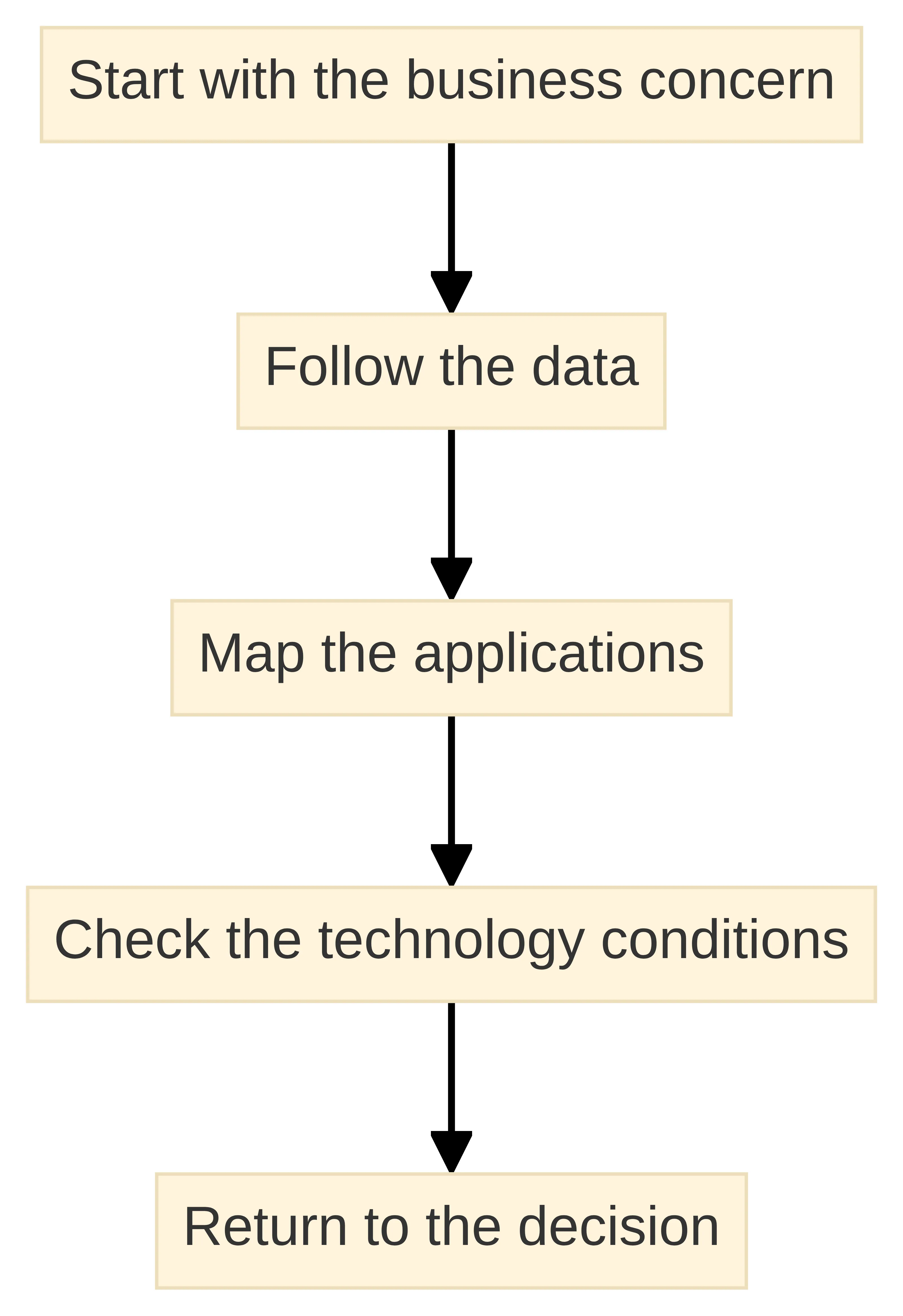
The hedge-fund data-integration initiative can be traced in this order:
- Start with the business concern. Define the decision or workflow the integration must support. Clarify whether the immediate issue is timeliness, inconsistent information, duplicated work, ownership, or another operational question. Keep the objective narrow enough to evaluate.
- Follow the data. Identify the relevant assets, formats, definitions, source systems, transformations, and owners. Record where meaning changes as information moves between activities.
- Map the applications. Identify which systems produce, receive, transform, or expose the information. Note interfaces and dependencies instead of describing each system in isolation.
- Check the technology conditions. Examine the hardware, software, and network infrastructure required for the systems to operate and exchange information.
- Return to the decision. Compare the proposed change with the business objective, information dependencies, application interactions, and technical conditions. Record what remains uncertain and who decides it.
This sequence separates the purpose of the change from the mechanisms used to deliver it. It also gives you a place to record ownership and unresolved assumptions instead of allowing them to disappear between teams.
The cross-domain trace does not prescribe a particular platform or integration design. It gives you a way to find the boundary of the decision. If the business objective cannot be connected to a defined data flow and accountable system owners, the next step is clarification, not a technology selection made in isolation. A clear boundary also makes it easier to decide which specialists need to participate.
Turn architecture into decisions and usable outputs
Architecture work becomes useful when it produces decisions that people can apply. A blueprint can show relationships, but governance must also direct and control architecture development and change, including who has decision authority. Define the decision before choosing the document, model, or notation that will support it. Otherwise, the artifact can become an inventory with no owner or action attached.
A bounded architecture workstream can follow this sequence:
- Frame the question: State the business outcome, systems or processes in scope, constraints, decision owner, and date by which a choice is needed.
- Describe the relevant current state: Map only the capabilities, processes, applications, data, technology, and dependencies that affect the question.
- Define the options: Describe the meaningful alternatives, their assumptions, affected owners, and consequences for integration, operations, security, and change.
- Clarify authority: Identify who can approve a design, accept a risk, reject an option, or authorize a transition.
- Record the path forward: Capture the decision, unresolved issues, dependencies, sequencing, and the point at which the decision should be revisited.
This sequence moves from purpose to evidence, then from alternatives to authority and action. It avoids treating current-state documentation as the final product when the organization actually needs a decision.
The resulting outputs may include a scoped architecture view, a dependency map, an option record, a target-state description, a transition sequence, and a governance decision record. You do not need every output for every question. Match the artifact to the decision: use a dependency view when sequencing is unclear, an ownership record when authority is unclear, and an option comparison when several designs remain viable. Name the intended user for each artifact and define when it should be updated.
Make risk, security, and change visible
Security risk management provides context for IT operations and support, while security risks are important inputs to operational risk management. For a U.S. hedge fund operating in a regulated financial-services environment, architecture can help you place those risks beside the business process, information asset, application dependency, and technical condition they affect. It does not, by itself, determine whether an organization satisfies a particular legal or regulatory obligation. That conclusion requires the appropriate internal or external review.
The architecture view can support concrete questions:
- Which business process or capability depends on the proposed change?
- Which data assets move through the process, and who owns their definitions and access decisions?
- Which applications exchange or transform the information?
- Which hardware, software, or network conditions could constrain operation or change?
- Which security risks become operational risks if a dependency fails or changes?
- Who has authority to accept a risk, approve a design, or require a different sequence?
- What must be tested, documented, monitored, or reassessed when the change goes live?
These questions do not replace control testing or compliance assessment. They connect those activities to the systems and decisions where conditions can change.
A cross-domain architecture view also helps with scale planning. Before adding a new workflow, data source, application, or infrastructure component, trace the new dependency through the four domains and record the control or ownership questions it creates. The result is not a promise that the change will be secure, scalable, or compliant. It is a clearer basis for deciding what must be assessed and who must make that assessment. Keep the unresolved conditions visible until the responsible owner closes them.
Choose an approach for the decision, not the label
You may encounter TOGAF, ArchiMate, BPMN, BIAN, NIST, Business Model Canvas, Business Motivation Model, and PESTLE in architecture discussions. The set includes frameworks, metamodels, and notations rather than one interchangeable method. Treat each name as a possible way to structure work, represent information, or discuss a concern—not as proof that the approach fits your organization. A method becomes relevant only when it helps people answer the decision in front of them.
Approach selection should begin with the decision you need to support:
- Do you need a repeatable process for moving from a business question to an architecture decision?
- Do you need a notation that helps different stakeholders interpret the same relationships?
- Do you need a security, business, process, data, or technology lens for a defined issue?
- Do you need a lightweight view for one initiative or a maintained model across several initiatives?
- Can your team explain who will maintain the work, use it, and decide when it is no longer reliable?
- Can the approach represent the level of detail your decision requires without creating a maintenance burden that nobody owns?
Select the smallest approach that can answer the question and support the required conversation. Expand it only when a new decision requires more structure.
A 2021 BCS comparison reported that several mechanistic planning approaches proved impractical and characterized FEAF as unsuccessful. It also quoted Steven Spewak saying that most enterprises undertaking Enterprise Architecture Planning were unsuccessful. The practical lesson is narrow: do not confuse adopting a named method with producing useful decisions. Test the approach against the scope, decision rights, maintenance effort, and outputs you actually need. The comparison is historical commentary, not a universal assessment of every framework or current implementation.
Treat AI as a scope and governance question
AI can enhance data integration in hedge funds. That possibility makes AI relevant to some architecture discussions, but it does not answer whether AI changes or replaces the enterprise-architect role. Treat the question as a design and governance problem rather than a prediction about a job title. The relevant issue is which responsibilities, decisions, and controls a proposed system would affect.
A proposed AI use should be defined before anyone discusses replacement:
- What decision, workflow, or information-flow problem is the system intended to address?
- Which data will it use, and how will you define ownership, access, quality, and permitted use?
- Which parts of the work can be automated, and which judgments remain with accountable people?
- Who can approve the design, accept operational or security risk, and stop or change the system?
- What evidence will show that the output is usable for the intended decision?
- How will you handle an incorrect output, changed data, changed requirements, or a change in the surrounding architecture?
These questions keep the proposed capability tied to an operating context. They also distinguish an experiment from a system that would influence an ongoing business process.
Architecture work still has to connect business purpose, information, applications, technology, dependencies, and authority. AI may alter the tools used to perform some of that work. It does not remove the need to define scope, assign decision rights, and make change governable. Keep those responsibilities explicit until your organization has assessed a particular use case and operating model. Avoid making a role-replacement claim from the availability of a tool alone.
Test whether enterprise architecture is relevant now
You do not need a separate architecture initiative for every technology decision. The practice is more relevant when a decision crosses business, data, application, and technology boundaries or when the dependencies are difficult to see. Use this screening list before commissioning broad work. The purpose is to match the amount of analysis to the decision rather than to create a program by default.
Architecture work deserves a defined place in the plan when:
- A business change depends on several systems, data sources, or operating teams.
- Different stakeholders use the same information with different definitions or ownership assumptions.
- You need to sequence integration, modernization, scaling, replacement, or migration decisions.
- Security risks, operational dependencies, or decision authority are unclear.
- A proposed AI or data initiative could affect more than one process or system.
- The cost of choosing the wrong direction would make later change difficult.
A lightweight architecture view may be enough when the scope is narrow, the dependencies are known, and decision rights are clear. A larger workstream needs a defined reason, owner, and output rather than a general desire for better documentation.
The screening result determines the next action. If several criteria apply, define a bounded workstream with a named decision, scope, owner, and expected output. If none apply, document the decision, assumptions, dependencies, and owner without creating a separate architecture program. Reassess when the scope expands or the assumptions change. Record why you chose the lighter or more structured path.
Evaluate outside expertise by the work it enables
Outside architecture or software expertise should be evaluated by the work it enables rather than the label attached to the engagement. Ask whether the proposed support can help you frame a decision, map the relevant domains, expose dependencies, clarify authority, and leave your team with outputs it can use. A title or framework reference does not establish that the engagement will address your actual problem.
Use these criteria in an initial discussion:
- Decision fit: Can the work be tied to a specific business or technology decision?
- Scope discipline: Will the work distinguish the systems, processes, data, and infrastructure that matter from everything outside the question?
- Domain coverage: Can the work connect business, data, application, and technology concerns rather than examining only one layer?
- Governance clarity: Will you know who approves the design, accepts risk, owns the result, and decides when to revisit it?
- Security context: Will security risks be connected to operations and the information or systems they affect?
- Usable outputs: Will you receive decision records, dependency views, options, or transition material that your team can maintain and apply?
- Handoff clarity: Will the engagement identify what your team must decide, operate, maintain, or reassess after the work ends?
External expertise can help structure analysis, but your organization still needs to identify the business objective, accountable owners, constraints, and acceptance boundary. Do not outsource the definition of your decision rights. Ask for a bounded first deliverable that lets you evaluate the quality and usefulness of the work before expanding its scope. The first deliverable should have a clear recipient and a decision attached to it.
Define the next architecture question before seeking help
The next architecture question should be specific enough to analyze without requiring a complete organizational blueprint. Write a short brief containing:
- the business decision or capability that needs attention;
- the processes, applications, data, and technology in scope;
- the known dependencies, risks, constraints, and assumptions;
- the people who own the decision and the people affected by it;
- the output you need, such as a current-state view, option analysis, dependency map, or transition sequence; and
- the point at which you will reassess the decision.
A defined question gives you a basis for deciding whether internal planning, a focused architecture workstream, or outside support fits the situation.
A focused architecture brief gives internal stakeholders or outside specialists a defined question to analyze. It also gives you a boundary for judging whether the resulting work improves coordination, clarifies governance, and supports a responsible technology decision. A focused starting point is more useful than adopting a framework name without a decision to guide it. A qualified professional should determine individual suitability for any specific architecture, compliance, legal, or technology decision.
Frequently asked questions about enterprise architecture for hedge funds
What is enterprise architecture in simple terms?
Enterprise architecture is a decision-making and coordination discipline that maps how business capabilities, processes, applications, data, and technology infrastructure work together. This structured map helps organizations evaluate changes, investments, and transformations.
How do the four architecture domains relate to each other?
The four architecture domains—business, data, application, and technology—are interconnected. Business architecture defines the organization’s objectives and processes, data architecture manages the information needed to support those objectives, application architecture identifies the systems involved, and technology architecture describes the infrastructure required for those systems to operate.
What role does security risk management play in enterprise architecture?
Security risk management provides context for IT operations and support within enterprise architecture.
How can hedge funds evaluate whether enterprise architecture is relevant to their needs?
Hedge funds should assess whether a decision crosses multiple systems, data sources, or teams, whether stakeholders have different definitions or ownership assumptions, and whether security risks or operational dependencies are unclear. If several criteria apply, a bounded workstream with a defined decision, scope, and expected output should be established.
What should hedge funds consider when selecting an enterprise architecture framework?
When selecting an enterprise architecture framework, hedge funds should consider the specific business or technology decision they need to support, the scope of the work, the level of detail required, and the governance structure for maintaining the framework. It’s important to choose an approach that aligns with their organizational context and needs.