
Enterprise architecture answers an organization-wide alignment question
An enterprise architect adds value when technology decisions affect more than one project, system, or team. The role connects organizational structure, business processes, strategy, value streams, data, information, applications, and supporting technology into an enterprise-wide view that can evolve over time. Enterprise architecture commonly connects four domains: business, data, application, and technology architecture.
That scope answers a different question from “How should this application be built?” It asks, “How should the organization arrange its capabilities and technology so that related decisions support the same direction?” The distinction matters when a new platform changes data ownership, when several teams depend on the same integration, or when a strategic initiative requires coordinated change across business and technology boundaries.
Use the organization-wide alignment test before assigning an architecture role. Ask whether the decision has any of these characteristics:
- It changes how several business areas use or exchange information.
- It creates a standard, dependency, or constraint for later technology work.
- It must support a future state that extends beyond the current delivery cycle.
- It requires agreement among stakeholders who do not share the same operational priorities.
- It needs a defensible connection between a technology investment and a business objective.
A “yes” does not automatically justify a permanent role or a large program. It does show that an isolated project decision may leave material questions unanswered. Your next step is to define the boundary, objective, and decision that need architectural attention.
Define the enterprise boundary before evaluating the role
Enterprise architecture describes how organizational structure, business processes and strategies, value streams, data and information, and supporting technologies fit together and are expected to change. That definition makes the enterprise boundary broader than an application portfolio or an infrastructure diagram.
Your boundary should include the parts of the organization that can change the decision or be affected by it. For a financial-services technology question, that may include a business capability, the teams that operate it, the information they create or consume, the applications that process it, and the technology that supports those applications. The boundary is not a claim that every system deserves equal attention. It is a way to identify which relationships must be understood before you select a direction.
Write the boundary in concrete terms before you discuss staffing or delivery. A useful boundary statement answers four questions:
- Which business capability or outcome is under consideration?
- Which teams, legal entities, operating groups, or external dependencies can affect the decision?
- Which data, applications, and technology platforms are inside the decision?
- Which adjacent areas must remain compatible even if they are not being changed?
A narrow boundary is appropriate when the assignment genuinely concerns one contained system with limited dependencies. A wider boundary is appropriate when a local choice can establish a pattern for other teams or constrain future change. This discipline prevents two opposite errors: treating a local delivery question as an enterprise program, or treating an enterprise dependency as a local implementation detail.
An enterprise boundary statement becomes useful when it changes the decision you are trying to make. Use it to distinguish facts that must be coordinated from background that can remain outside the assignment. For each item inside the boundary, record its role in the decision: capability, dependency, owner, constraint, or affected party. Then mark what is known, what is assumed, and what must be decided. This is not a demand for a complete enterprise inventory. It is a control on scope: you can explain why a system or team matters, or why it does not need detailed treatment yet.
For a hedge-fund platform change, the relevant boundary may extend from an operating requirement through the information used to meet it, the applications that process that information, and the technology relationships that support them. The boundary should widen only when those relationships affect the decision. Your action is to record inclusion and exclusion reasons before asking for architecture capacity.
Start with objectives and the desired future state
Enterprise architecture planning can begin by defining the business objectives and the desired future state. The objective gives the architecture question a purpose; the future state describes the condition your organization is trying to reach. Without both, architecture work can become an inventory exercise that produces descriptions without a decision.
State the objective in business terms before naming a technology. You might need to support a new operating model, make a capability more consistent across business units, replace a fragmented arrangement, or create a path toward a strategic change. The wording should identify what must become possible or different, not prescribe the product or platform that will deliver it.
Describe the future state at a level that supports choices without pretending to know every implementation detail. Include:
- The business capability or operating result that should exist.
- The major users, teams, or stakeholders who depend on it.
- The information that must move, remain controlled, or become available for the capability to work.
- The applications and technology relationships that must be created, changed, retired, or preserved.
- The decisions that must be made before delivery can proceed.
Then separate the target condition from the route to reach it. An architecture function can help compare routes, sequence initiatives, and expose dependencies, but the objective should not be rewritten to fit a preferred technical solution. Your immediate action is to produce a short objective-and-future-state brief that can be read by business and technology stakeholders alike.
Assess the current environment before selecting change
Enterprise architecture planning can assess the current IT infrastructure and systems, inventory technology and information, and model business capabilities where that helps identify strengths, weaknesses, and priorities. This assessment gives your future-state discussion a starting point grounded in what already operates.
A current-state view should describe relationships, not merely list assets. Record which capability each system supports, which information each system creates or uses, how responsibilities are distributed, and where a change would touch another team or platform. The purpose is not to document everything at the same level of detail. The purpose is to find the facts that can alter the sequence, scope, or feasibility of the proposed change.
Use a focused assessment sequence:
- Map the business capability or workflow connected to the objective.
- Identify the applications and technology components that support it.
- Trace the principal information exchanges and ownership points.
- Mark dependencies, duplicated responsibilities, and known constraints.
- Compare the current condition with the desired future state.
- Turn the material gaps into decisions rather than an undifferentiated backlog.
The comparison is where architecture begins to add decision value. A gap may require a new capability, a change to an existing system, a governance decision, or a staged transition. Do not select a remedy before you know which kind of gap you are addressing.
Connect business, data, application, and technology architecture
Enterprise architecture commonly connects business, data, application, and technology architecture. These domains are distinct ways of examining the same organizational change, not four unrelated inventories.
Business architecture describes the capabilities, processes, and direction that give the change its purpose. Data architecture examines the information required to support those capabilities and the relationships that allow it to be used. Application architecture considers how systems provide or consume those capabilities. Technology architecture addresses the supporting technology choices and relationships. A sound decision keeps the four views connected so that a change in one view can be considered against its effects in the others.
Trace one business objective across the four domains rather than producing four disconnected documents. For example, start with the capability your organization wants to strengthen, identify the information that capability depends on, locate the applications that handle the information, and then examine the technology relationships that support those applications.
Use the trace to ask practical questions:
- Does the proposed application change support the stated business capability?
- Does the data arrangement support the way the capability must operate?
- Does the technology choice create a dependency that affects another application or team?
- Does the future-state design leave a decision unresolved between business intent and technical delivery?
Security and control considerations should be recorded wherever they constrain a data, application, or technology decision. The four-domain view does not replace those considerations; it gives you a place to relate them to the business purpose and the wider change.
Turn the assessment into standards, governance, and a roadmap
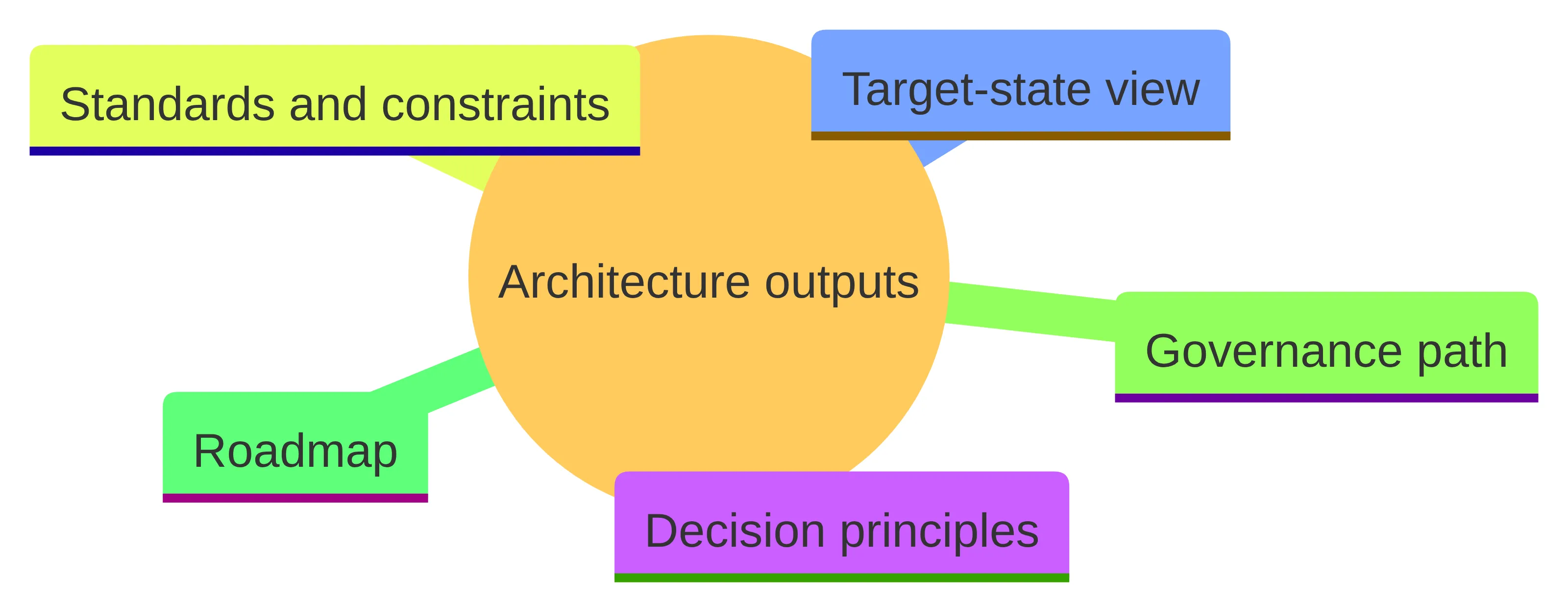
An enterprise architecture function can define organization-wide standards, roadmaps, and governance structures while solution architects design and deliver individual systems within that broader framework. Enterprise architecture planning can also translate a desired future state into an implementation roadmap after objectives, the current environment, and stakeholder input have been considered.
These outputs are useful because they turn architectural judgment into decisions that delivery teams can use. A standard clarifies a shared expectation. A governance structure clarifies who decides, when exceptions are considered, and how a decision is carried forward. A roadmap connects initiatives and sequence to the future state. None of these outputs is valuable merely because it exists; each must answer a decision that would otherwise remain ambiguous.
Build the minimum set of outputs required by the decision:
- Decision principles: the conditions that should guide related choices.
- Target-state view: the business, data, application, and technology relationships the organization is moving toward.
- Standards and constraints: the shared requirements that delivery work must respect.
- Governance path: the stakeholders, decision points, and exception route.
- Roadmap: the sequence of initiatives, dependencies, and unresolved choices.
A roadmap is not a promise that every future detail is known. It is a way to make sequencing and dependencies visible. If the roadmap cannot explain why one initiative should precede another, return to the objective and current-state assessment. If a standard cannot be connected to a business or technology decision, narrow it or leave it out.
Governance becomes operational when it assigns decisions rather than merely describing oversight. For each important choice, specify the decision owner, affected teams, evidence required, permitted exception, and point at which the choice must be revisited. This turns a standard into something delivery can apply and makes a roadmap more than a sequence of project names.
Use a simple decision record for each material dependency:
- Decision: what must be chosen or constrained.
- Rationale: which objective or current-state finding supports it.
- Consequence: which teams, systems, or later initiatives it affects.
- Owner: who has authority to approve or reject it.
- Review trigger: what change would require the decision to be reconsidered.
A record like this helps architecture and delivery stay connected while the future state changes. It also gives stakeholders a concrete object to challenge; disagreement can focus on the decision and its consequences instead of on an abstract architecture document.
Rely on technical judgment and influence across stakeholders
The architecture role combines technical knowledge, business judgment, and the ability to influence teams without relying on direct authority. That combination matters because organization-wide architecture decisions cross reporting lines and professional vocabularies.
Technical knowledge helps the architect understand the consequences of system, data, application, and technology choices. Business judgment helps connect those consequences to objectives, priorities, and operating realities. Influence helps create alignment when the architect does not own every team or budget affected by the decision. A credential or a particular career path is not a universal substitute for those capabilities.
Stakeholder involvement should be part of the planning work rather than a final presentation step. Planning guidance identifies team leaders, IT staff, and end users as relevant participants because each group sees different effects of the proposed change.
Give each stakeholder group a specific role in the decision:
- Business leaders clarify objectives, priorities, and acceptable trade-offs.
- Operational teams describe how work is performed and where a proposed state may fail in practice.
- Data and application owners explain dependencies, responsibilities, and constraints.
- Technology teams assess implementation implications and sequencing.
- End users expose workflow needs that may not appear in system documentation.
Your architecture process should make disagreement visible and resolve it at the appropriate decision level. Influence is not consensus for its own sake. It is the ability to connect competing concerns to the objective and record the decision that follows.
Separate enterprise architecture from solution architecture
Enterprise architecture and solution architecture operate at different levels of scope, even though the two roles can work closely together. The comparison below helps you identify which architectural question is in front of you.
| Decision criterion | Enterprise architecture | Solution architecture |
|---|---|---|
| Primary focus | Organization-wide alignment, standards, roadmaps, and governance | Design and delivery of a specific system or solution |
| Scope | Multiple business areas, capabilities, or shared technology relationships | A defined project, product, or delivery boundary |
| Time horizon | Longer-term technology evolution and business capability development | Immediate or near-term technical delivery |
| Main output | A framework for related decisions and change sequencing | A technical design or implementation guide |
| Relationship to delivery | Sets broader constraints and direction | Carries the direction into an individual system |
The distinction is about the decision being made, not status. A solution architect may contribute to enterprise decisions, and an enterprise architect may need detailed delivery knowledge. The question is which scope the current assignment must resolve.
Enterprise architecture addresses organization-wide coherence, while solution architecture carries strategy into individual delivered systems. Neglecting either can create a gap between strategy and implementation: broad direction may remain disconnected from delivery, or a well-built system may fit poorly with the wider organization.
Use both forms of architectural work when the organization needs a shared direction and a concrete implementation design. Use a solution-level assignment when the broader direction and constraints are already clear and the unresolved question belongs inside one delivery boundary.
Assess architecture value through capabilities and outcomes
An architecture-value assessment connects a financial-services initiative to the business outcome it is meant to support. For a hedge-fund initiative, start with the fund’s specific strategy and operational requirements, then examine the information structure and governance that shape implementation. In a broader financial-services transformation, an enterprise architect can assess business-capability maturity and help identify strategic initiatives for reaching a desired future state.
This framing makes architecture value visible through the relationship between capabilities, information, governance, and stakeholder outcomes. It keeps the discussion focused on what the initiative must achieve and how technology decisions contribute to that outcome.
Use this routing sequence when a request arrives:
- Name the unresolved decision. State what must be chosen, changed, or aligned.
- Map the affected boundary. Identify the business areas, systems, data, and technology relationships involved.
- Set the horizon. Separate an immediate delivery decision from a change that will guide later initiatives.
- Identify the required output. Choose among a solution design, a shared standard, a governance decision, a target-state view, or a roadmap.
- Assign the smallest sufficient architecture scope. Expand the assignment only when the decision requires it.
If the output is a design for one solution inside settled constraints, begin at the solution level. If the output must establish how related decisions will fit together over time, involve enterprise-level architectural work.
Apply the role to financial-services transformation
In a financial-services transformation, the architecture role can assess business-capability maturity and help identify the strategic initiatives needed to reach a desired future state. Financial institutions may also need to demonstrate how technology initiatives connect to stakeholders’ desired outcomes when seeking support for transformation.
That connection gives the role a practical function. The architect can help translate a broad transformation intention into a sequence of capability decisions, technology dependencies, and stakeholder outcomes. The work is not to label every initiative as architectural. It is to clarify which initiatives depend on a shared direction and which can proceed as contained delivery work.
Apply the transformation lens to a proposed initiative by asking:
- Which business capability is expected to change?
- What evidence shows the current capability is ready, constrained, or fragmented?
- Which data, application, and technology relationships will the initiative affect?
- Which stakeholder outcomes must be visible before support can be secured?
- Which other initiatives must precede, follow, or remain compatible with the change?
The answers should lead to a bounded architectural output. That output may be a capability assessment, a target-state decision, a roadmap, or a set of constraints for a delivery team. Your organization does not need a broad transformation label before using this method; a single cross-functional initiative can expose the need for it.
A hypothetical financial-services change illustrates why the sequence matters. Suppose an organization wants to introduce a new technology capability that depends on information held by several teams. The first question is not which platform to purchase. It is whether the current business capability, information relationships, application responsibilities, and technology dependencies can support the desired outcome. The next question is which initiative should establish the necessary conditions first.
That sequence creates a decision trail: objective, capability assessment, affected relationships, stakeholder outcome, and prioritized initiative. It also gives sponsors a clearer basis for support because the technology decision is connected to the change the organization is trying to achieve. Keep the example hypothetical; use your own current-state findings to determine the actual scope.
Test the architecture question against hedge-fund requirements
Our hedge-fund software guidance addresses the need to identify software aligned with each fund’s specific strategies and operational requirements. That requirement turns software selection into more than a feature comparison when the choice affects how information, workflows, or technology responsibilities fit together.
Start by stating the strategy or operating requirement that the software must support. Then identify the surrounding capability, information relationships, applications, and technology dependencies that can influence the choice. A tool may satisfy a local feature requirement while creating a wider architectural question if it changes an existing relationship or establishes a pattern that other parts of the organization must follow.
Use the following test for a hedge-fund technology decision:
- Local fit: Can the proposed system address the defined operational requirement inside the stated boundary?
- Cross-system effect: Does the choice alter information exchange, application responsibility, or technology dependencies elsewhere?
- Strategic fit: Does the choice support the stated direction rather than only the immediate procurement need?
- Sequencing: Must another capability or decision be established before implementation can work as intended?
- Governance: Will the choice require a shared standard, ownership decision, or exception path?
A local fit with no material cross-system effect may call for solution architecture and delivery capacity. Several cross-system or governance answers indicate that the organization should resolve the wider architecture question before committing to implementation.
Keep data governance and security within the implementation context
Our published guidance for hedge fund managers identifies four implementation actions: evaluate the current information structure, establish governance to standardize formats, support collaboration, and train staff. These actions show why an architecture decision cannot stop at selecting an application or platform. The organization also needs a workable account of information, shared conventions, participation, and operating readiness.
Use those concerns to extend the current-state assessment. Identify where information is structured differently, who owns the relevant decisions, which teams must collaborate, and what knowledge must be transferred before a change can operate. Each finding should connect to a defined decision or implementation condition rather than becoming a general process recommendation.
Treat security as an implementation context that constrains architecture choices and operating responsibilities, not as a detached checklist added after the design is complete.
For each material technology or data decision, record which security measure it affects, who owns the relevant control, and where the implementation must preserve that control. Keep the statement specific to the decision under review. An architecture document should make the relationship between the proposed change and its security responsibilities visible without turning that document into individualized compliance or legal advice.
Recognize the conditions that limit architecture governance
Enterprise architecture governance may face resistance to change, weak executive support, resource constraints, and difficulty covering large, diverse IT environments. These conditions affect whether an architecture practice can produce decisions that delivery teams can use.
Resistance can make shared processes appear slower than local work. Weak executive support can leave cross-organizational decisions without authority or resources. Limited time, money, or expertise can force a narrower boundary than the organization first proposed. A large and diverse environment can make a supposedly complete model too broad to maintain. Each condition changes the practical shape of the work; none is solved by adding more documentation.
Match the response to the limiting condition:
- If authority is unclear, identify the decision owner and the escalation path before expanding the analysis.
- If resources are limited, focus on the capability, dependency, or decision that can change the immediate sequence of work.
- If stakeholders resist a shared process, connect the process to a decision they need to make rather than presenting it as an abstract control.
- If the environment is too broad, define a boundary and a reusable rule for deciding what remains outside it.
These responses preserve the purpose of governance while keeping the assignment workable. A smaller architecture decision with a clear owner is more useful than a comprehensive model that cannot guide action.
Use an architecture-value assessment for a financial-services initiative
An architecture-value assessment gives a financial-services technology decision a concrete frame: connect the proposed change to a desired business outcome, the capability it is meant to affect, the systems and information involved, and the decisions needed to move from the current environment toward a future state. This is a different starting point from choosing an enterprise architect by title. It asks what information and decisions the initiative requires before implementation choices are made.
The approach follows the role’s supported contribution. Enterprise architecture brings organizational structure, business processes, strategy, value streams, data, information, and supporting technology into an evolving view. In a financial-services transformation, an architect can assess business-capability maturity and help identify strategic initiatives for reaching the desired future state. Stakeholders may also need to see how a technology initiative connects to their desired outcomes before supporting it.
Interpret the answers without turning them into a score. Several “yes” answers across boundary, horizon, coordination, and output indicate that an enterprise-level architecture question should be resolved before the delivery design is finalized. A “yes” only for a contained solution with settled standards and limited dependencies points toward solution architecture instead.
If the answer is uncertain, do not assume that more architecture is automatically the remedy. Define the smallest assessment that can resolve the uncertainty: a capability and dependency map, a current-state review, a stakeholder decision session, or a short comparison of target-state options. If governance cannot secure a decision owner or workable boundary, address that condition before expanding the architecture scope.
The decision is therefore conditional. Involve enterprise architecture when the organization needs coherence across related decisions and a longer-term direction. Keep the work at solution level when the wider direction is already clear and the remaining question is how to deliver one defined system.
An architecture decision test should produce a next action, not only a classification. If the boundary, horizon, and coordination questions point outward, write the enterprise-level question in one sentence and name the output needed to answer it. If they point inward, write the solution decision and list the constraints that are already settled. If the answers conflict, keep the assignment in discovery until the conflict has an owner.
This approach also separates capacity questions from architecture questions. You may need additional implementation capacity after the direction is clear, but capacity cannot substitute for an unresolved owner, objective, boundary, or governance path. Your decision record should show which of those conditions is complete and which still blocks delivery.
Define the architecture question before requesting project capacity
A useful architecture brief names the decision before it names the people or tools needed to deliver it. Your brief should state:
- the business objective and desired future state;
- the organizational and technical boundary;
- the current systems, information relationships, and material constraints;
- the business, data, application, and technology concerns involved;
- the stakeholders who must decide or operate the change;
- the required output, such as a target-state view, standard, governance path, roadmap, or solution design; and
- the implementation capacity needed after those conditions are clear.
This structure lets you distinguish an organization-wide alignment question from a contained delivery assignment. It also gives an implementation team a defined boundary instead of asking it to discover the architecture problem while building the solution. A qualified professional should determine individual suitability for a specific engagement, compliance decision, or staffing arrangement.
If your organization has a defined technology or engineering assignment and needs implementation capacity after clarifying the architecture question, keep the assignment bounded by the decisions, systems, and outcomes described in the brief.
Frequently asked questions about enterprise architecture in financial services
What is the role of an enterprise architect in financial services?
An enterprise architect is responsible for aligning technology decisions with business strategy, ensuring that changes affect the organization as a whole. They connect organizational structure, business processes, data, and technology into an evolving enterprise architecture.
How does an enterprise architect differ from a solution architect?
Enterprise architects focus on organization-wide alignment and governance, while solution architects design and deliver specific systems within defined project boundaries. The former addresses long-term technology evolution, whereas the latter is concerned with immediate technical outcomes.
What are the key responsibilities of an enterprise architect?
Key responsibilities include defining organizational standards, creating roadmaps, assessing current IT infrastructure, involving stakeholders in planning, and ensuring that technology investments align with business objectives.
What factors should be considered when determining if an enterprise architect is needed?
Consider whether the decision crosses multiple business areas, requires long-term planning, involves several stakeholders, and whether it necessitates a shared direction or governance decision.
What challenges might enterprise architecture governance face?
Challenges can include organizational resistance to change, lack of executive support, resource constraints, and the complexity of managing diverse IT environments.
How does an enterprise architect contribute to a hedge fund's technology strategy?
An enterprise architect assesses business capability maturity, identifies strategic initiatives for transformation, and ensures that technology investments align with the fund’s operational requirements and objectives.