
Choose the provider that can demonstrate fit and control
Choosing an artificial intelligence consulting company for a hedge fund is a control and delivery decision, not a popularity contest. You need to establish what the work will change, what information it will touch, how failure will be handled, and which party will own each operating responsibility before you compare proposals.
The word “AI” does not identify a single type of system. The SEC-selected material notes that the meaning of artificial intelligence remains subject to significant debate. One definition quoted in that material describes AI as a machine-based system that makes predictions, recommendations, or decisions affecting real or virtual environments for human-defined objectives. That distinction matters because an internal document assistant, a data-integration workflow, and a system that influences a trading or risk process do not present the same evaluation question.
Use a staged decision path:
- Define the business and technical work in concrete terms.
- Classify the initiative by its data, decision, operational, and third-party exposure.
- Ask each provider for comparable material about controls, delivery responsibilities, and limitations.
- Test the proposed approach against your own systems, governance expectations, and fallback needs.
- Approve only a bounded scope that identifies the work, owners, dependencies, and acceptance conditions.
This approach does not produce a universal ranking. It produces a defensible shortlist. A provider earns further attention by showing how its proposed work fits your environment and by making its boundaries visible.
Define the work before comparing companies
An AI initiative should be described by the decision or operating problem it addresses, not by a broad label such as transformation, automation, or intelligent analytics. Start with a one-page work definition that another provider could read and scope without guessing.
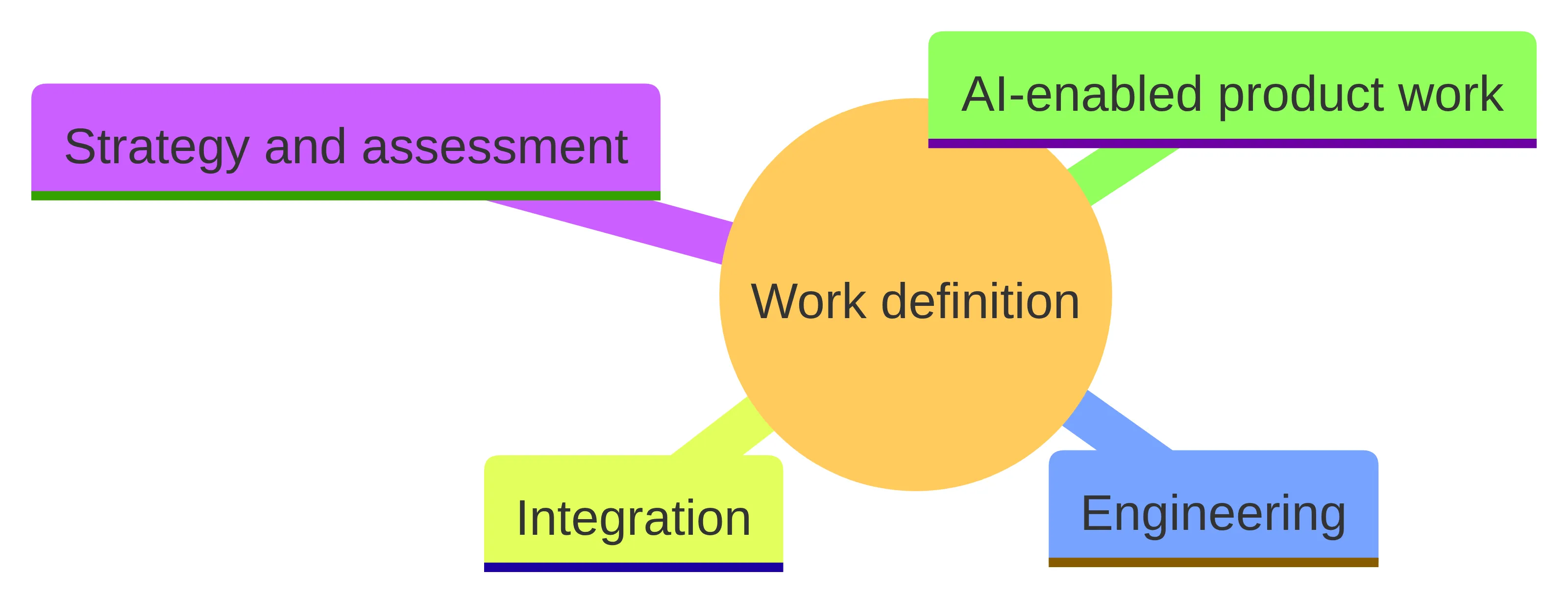
Separate the assignment into four possible work areas:
- Strategy and assessment: clarifying the use case, identifying constraints, mapping systems and data, and deciding whether AI is an appropriate approach.
- Engineering: designing, building, testing, or maintaining software that uses an AI component or supports an AI-enabled workflow.
- Integration: connecting trading platforms, market-information feeds, internal databases, applications, or control processes so information can move into and out of the proposed workflow.
- AI-enabled product work: incorporating predictions, recommendations, classification, generation, or other machine-based behavior into a product or internal operating tool.
These categories can overlap, but they should not be allowed to blur the delivery boundary. A strategy engagement may end with a decision record and technical options. An engineering engagement may end with working software. Integration work may require interface mapping and operational ownership. Product work may require a definition of acceptable behavior, review points, and a response to unexpected output.
Record the following before you invite proposals:
- The decision or process you want to support.
- The people or systems that will use the output.
- The data sources involved and the boundary around confidential, personal, market, or portfolio information.
- The systems that must connect to the work.
- The result you expect at the end of discovery, design, build, or integration.
- The internal owner who can answer business, technology, security, and compliance questions.
- The work that remains outside the engagement.
Avoid asking providers to price an undefined ambition. A vague brief encourages different companies to answer different questions, which makes a proposal comparison look precise while hiding scope differences. A useful brief lets you compare the work each provider believes it is accepting, the work it excludes, and the conditions it needs from you.
Overview
A practical comparison has three layers: exposure, control, and delivery fit. Exposure describes what the initiative can touch or influence. Control describes how you will govern the AI component, its provider, its outputs, and its failure modes. Delivery fit describes whether the proposed team can perform the defined work within your systems, operating model, and ownership structure.
The sequence matters. If you compare teams before defining exposure, a polished presentation can outweigh an unresolved data or control question. If you assess controls without defining the work, you may ask for documents that have no connection to the proposed system. If you accept a scope without delivery boundaries, responsibility can become unclear after implementation.
Use the sections that follow as a working diligence file:
- Define the assignment and its expected outputs.
- Classify the initiative before assigning a risk tier.
- Build a comparison matrix with gates, not a single promotional score.
- Examine cybersecurity accountability and third-party dependencies.
- Request AI-specific material about capabilities, limitations, training data, intended use, monitoring, and fallback controls.
- Treat records and archiving as a separate question where the workflow creates or stores regulated records.
- Compare demonstrations and documents with the same questions for every provider.
- Test the proposed delivery boundary through a bounded technical assessment.
- Set production controls and reassessment conditions before approval.
Vendor-risk guidance published December 11, 2025 recommends tiering AI vendors according to the criticality of the tool because different AI tools introduce different levels of risk. The same guidance recommends at least annual reassessment because AI systems can change faster than traditional software. Use those recommendations as operating prompts, while leaving your own legal, regulatory, and governance owners to determine the requirements that apply to your fund.
Classify the initiative before assigning providers
Risk classification should follow the proposed use, not the provider’s category or the novelty of its presentation. Begin by asking what the system will do for human-defined objectives. The SEC-selected material describes one definition of AI in terms of predictions, recommendations, or decisions that affect real or virtual environments. That gives you a useful starting point: identify the output, the person or system receiving it, and the consequence of acting on it.
Classify the initiative across four exposure questions:
- Information exposure: What data enters the workflow, where is it stored, and which provider or subcontractor can access it? Distinguish public information from confidential fund, investor, employee, client, trading, or operational information.
- Decision influence: Does the output summarize information, suggest an action, initiate a workflow, or directly affect a process? Record the human review point and what happens when the output is wrong, incomplete, delayed, or unavailable.
- Operational dependency: Would a failure interrupt an internal tool, a data flow, a reporting process, or a production service? Identify the process that continues outside the AI workflow and the owner responsible for that continuation.
- Third-party surface: Which model, hosting environment, integration, data service, or external support arrangement sits outside your direct control? List each dependency rather than treating the provider as a single black box.
Then place the initiative into a practical tier. A low-exposure internal experiment may require a narrower review than a production workflow handling sensitive information. A workflow that influences a material operating decision deserves more scrutiny than a tool used only to organize internal notes. A system that combines sensitive data, external services, and production dependencies should not receive the same treatment as a contained demonstration.
Do not confuse a tier with a regulatory conclusion. It is an internal comparison device that determines how much information, testing, ownership clarity, and follow-up you require before moving forward. Write down the reason for the tier, the assumptions behind it, and the condition that would cause the tier to change. If the provider proposes a materially different use from the one you classified, pause the comparison and classify the revised use instead.
Build a risk-tiered comparison matrix
A comparison matrix should make differences visible without pretending that every criterion has the same meaning. Use the same questions for each provider, attach the provider’s response to the relevant row, and mark unresolved items as open rather than converting them into favorable assumptions.
| Comparison area | What you need to establish | Material response to request | Boundary for moving forward |
|---|---|---|---|
| Intended use | What the AI component will do and what it will not do | A use-case description tied to your defined workflow | The proposal matches the use you classified |
| Data boundary | Which data enters, leaves, or remains within each environment | A data-flow description, access assumptions, and storage locations | Every material data movement has an owner and decision |
| Technical approach | How the proposed software, model, integration, and interfaces fit together | Architecture description, dependencies, and known limitations | The design can be reviewed against your systems |
| AI criticality | How much the tool could affect operations or decisions | A rationale for the assigned tier and review depth | The provider accepts the scrutiny associated with the tier |
| Output controls | How people will review, use, or reject outputs | Defined review points, output limitations, and exception handling | Responsibility does not end at generation |
| Continuity | What happens if the AI service, integration, or output fails | Documented fallback controls and ownership | Your process has a stated continuation path |
| Monitoring | What will be observed after deployment | Measures for model performance, output quality, and usage patterns | Monitoring has an owner and a response path |
| Provider exposure | Which external parties support the work | Subcontractor, service, hosting, and access information | Third-party dependencies are visible and governed |
| Delivery model and team | Which proposed personnel perform discovery, build, testing, deployment, and support, and how their availability and continuity fit the work | Team composition, relevant experience, availability, continuity, responsibilities, assumptions, exclusions, and demonstrated capability on comparable work | The team can cover the defined work with clear ownership and continuity |
| Records | Whether the workflow creates or stores records subject to your requirements | Contract language and retention or archiving responsibilities | Recordkeeping obligations are addressed before production |
Vendor-risk guidance published December 11, 2025 recommends tiering vendors according to AI-tool criticality, requesting model cards or system cards when possible, continuously monitoring model performance, output quality, and usage patterns, and documenting fallback controls. A financial-services vendor-risk analysis published July 15, 2026 also recommends confirming that provider contracts address recordkeeping requirements for records stored by third-party vendors. Those points support the matrix, but they do not replace your own control assessment.
Use the matrix as a gate sequence rather than a contest with a winning numerical score. A provider may have strong engineering answers and an unresolved records question. Another may explain governance well but lack a clear delivery owner. Keep both facts visible. Advance only when the unresolved item is either resolved, explicitly accepted by the appropriate owner, or removed by narrowing the scope.
Test cybersecurity accountability and third-party exposure
Cybersecurity diligence should identify responsibility, not merely collect a general security statement. Ask who assesses the relevant risks, who approves the design, who manages an incident, who controls access, and who communicates a material change in the service or dependency. The answers should connect to the actual proposed workflow.
That does not tell you which provider to select, and it does not turn a vendor response into a compliance conclusion. It does show why accountability should be legible when a third party participates in a material technology process.
Ask each provider to address:
- The systems and environments its personnel or services would access.
- The categories of information required for the proposed work.
- The external services, models, hosting arrangements, and subcontractors involved.
- How access is granted, changed, reviewed, and removed within the agreed engagement.
- What the provider considers a material service or dependency change.
- How an incident, suspected data exposure, service interruption, or material output problem is escalated.
- Which party preserves relevant records and supports your investigation or review.
- Which responsibilities remain with your fund after the provider is engaged.
Third-party service-provider breaches or failures can create unauthorized data access, business interruptions, liabilities, regulatory investigations, and significant losses. Treat that as a reason to map dependencies and ownership, not as a prediction that a particular provider will fail. A vendor that cannot describe its external surface may be difficult to evaluate even if its proposed technical design appears attractive.
Keep cybersecurity responsibility separate from marketing language. “Enterprise security,” “secure by design,” or a similar phrase is not a substitute for a data boundary, an access model, an escalation path, and a clear division of duties. Ask for the material that lets your internal technology, security, and governance owners make their own determination.
Request AI-specific operating evidence
A provider’s general software credentials do not answer every AI operating question. Request material that describes the particular model, service, workflow, or AI component proposed for your assignment. The level of detail should match the initiative’s tier and data boundary.
When possible, request a model card or system card. Vendor-risk guidance published December 11, 2025 describes these documents as a way to obtain structured information about model capabilities, limitations, training data, and intended use cases. Use the document to ask focused follow-up questions:
- Does the stated intended use match your proposed use?
- Which capabilities are relevant to the workflow, and which are outside the stated purpose?
- What limitations could affect the output you plan to use?
- What information about training data is available, and what remains unspecified?
- Which behavior requires human review before it can affect an operating process?
- What changes would require a new assessment?
Request an operating plan, not only a description of the model. The same guidance recommends continuous monitoring of model performance, output quality, and usage patterns because sudden changes can indicate security issues or model degradation. Ask what will be monitored, who will review the signals, how often review occurs, what threshold prompts action, and who can pause or change the workflow. If a provider cannot disclose a specific implementation detail, ask for a redacted example, an abstract control description, or a test that demonstrates the relevant boundary without exposing confidential information.
Require documented fallback controls. The guidance recommends planning what happens when AI fails so the business can continue operating. Your request should identify the affected process, the alternative path, the responsible owner, and the condition that activates the fallback. Do not accept “human in the loop” as a complete answer; ask what the person reviews, what information is available, and whether the process can continue within the required time.
Make change management part of the initial discussion. Ask which model, prompt, configuration, data source, integration, or workflow change would trigger reassessment. A proposal that explains how it will be built but not how it will be observed and changed is incomplete for a production-oriented initiative.
Make records and archiving a diligence gate
Records and archiving deserve their own diligence gate when the proposed workflow creates, receives, transforms, communicates, or stores information subject to your recordkeeping requirements. Do not assume that a provider’s ordinary data-retention description answers the question. Ask which records exist, who captures them, where they reside, how they can be retrieved, and which contract term assigns responsibility.
A financial-services vendor-risk analysis published July 15, 2026 reports that FINRA’s 2025 Annual Regulatory Oversight Report cited inadequate due diligence on third-party archiving capabilities as a key examination finding. The same analysis recommends confirming that service contracts address recordkeeping requirements for records stored by third-party vendors. Use that point as a diligence prompt, not as a conclusion about your fund’s particular obligations.
Ask the provider to map:
- Messages, prompts, outputs, approvals, decisions, and system events that may need to be retained.
- The systems that create or hold those records.
- The retention, retrieval, export, and deletion responsibilities assigned to each party.
- The integration with your existing archive or recordkeeping process, if one is proposed.
- The test or demonstration that shows the process works before production deployment.
- The contract language that governs records stored by the provider or another third party.
If the provider cannot answer these questions, narrow the workflow or keep it outside production until the responsible owners resolve the gap. Archiving is not an administrative detail added after delivery; it can determine whether the proposed operating model is acceptable at all.
Compare evidence rather than marketing signals
Directory placement, a polished case-study format, a large service menu, and confident language can help you find candidates, but none of those signals establishes fit for your initiative. Compare providers by asking each one to respond to the same defined work, exposure, control, and delivery questions.
Create a response register with one row for each material claim or commitment. Use columns such as:
- The provider’s exact proposition.
- The work area it addresses: strategy, engineering, integration, or product work.
- The assumption behind the proposition.
- The document, demonstration, named responsibility, or test that supports it.
- The limitation or exclusion attached to it.
- The internal owner who must assess it.
- The unresolved question and its effect on scope.
Separate capability from suitability. A provider may be capable of building an integration, while your fund may still need to determine whether the proposed data path, operating owner, archive, and fallback fit its environment. A provider may offer an AI service, while the particular model may not suit your intended use. A team may answer quickly, while the answer still requires technical, security, or governance review.
Separate proof of past activity from a commitment for your assignment. A prior project can illustrate a method or a type of problem, but it does not establish that the same result, timeline, architecture, or operating condition will apply to your fund. Ask which parts of the example transfer to your systems and which parts would need to be established during discovery.
Third-party dependency deserves the same discipline. Risk-factor material states that breaches or failures of third-party service providers can lead to unauthorized access, interruption, liabilities, regulatory investigations, and significant losses. Do not treat a provider’s assurance about its own environment as a complete review of the services it depends on. Request the dependency list, identify the responsibility for each external service, and record what happens if that service changes or becomes unavailable.
Use a simple disposition for every comparison item: accepted for the defined scope, accepted subject to a named condition, unresolved and blocking, or outside the scope. This keeps the decision readable. It also prevents a high volume of favorable but unrelated information from outweighing one unresolved issue that affects the proposed workflow.
Use questions that expose delivery boundaries
A useful vendor interview tests how the proposed team will work after the presentation ends. Ask questions that force a distinction between responsibility, participation, assumption, and exclusion.
Questions about discovery and design
- What decision or operating problem does your proposed approach address?
- What facts do you need from us before you can confirm the architecture and scope?
- Which parts of the current environment must be mapped before implementation begins?
- What alternatives did you consider, and what condition would make your preferred approach unsuitable?
- Which output belongs at the end of discovery, and which output belongs at the end of delivery?
Questions about engineering and integration
- Which software components will you build, configure, connect, or maintain?
- Which interfaces and data flows are inside your responsibility?
- What remains with our internal team or another provider?
- Which dependencies could delay the work or change the design?
- How will you demonstrate that the delivered work matches the agreed behavior?
Questions about AI operation
- What does the AI component do, and what does it not do?
- What information does it require, and where does that information travel?
- What limitations should affect how the output is used?
- What does a person review before the output influences the process?
- How will performance, output quality, usage patterns, and material changes be handled?
- What fallback control applies if the AI component fails or becomes unavailable?
Questions about ownership and support
- Who owns the technical decision, the business decision, the security review, and the production handoff?
- Who responds when the delivered workflow behaves unexpectedly?
- Which records, documentation, tests, and operating instructions will you provide?
- What knowledge must transfer to our team before the engagement ends?
- Which support activities are included, and which require a separate decision?
Questions about commercial boundaries
- What assumptions does the proposed scope depend on?
- Which work is explicitly excluded?
- What event would require a change to scope, timing, or responsibility?
- What information must be available before you can give a bounded commercial proposal?
Ask every shortlisted provider substantially the same questions, then compare the answers rather than the presentation style. A direct answer that narrows the work can be more useful than a broad promise that leaves ownership unclear.
Locate Neutech within the comparison
Neutech belongs in your shortlist only where its stated services and the defined assignment overlap. We provide senior software designers and developers to augment product and development teams. That fact is relevant when your need includes additional software delivery capacity, but it does not by itself establish fit for a particular AI architecture, data boundary, governance model, or production responsibility.
Our hedge-fund material treats AI as a way to enhance data integration and recommends exploring advanced technologies such as AI to address data-integration obstacles. It also describes automated integration as relevant to information flows from trading platforms, market-information feeds, and internal databases. If your initiative concerns those flows, ask us to map the proposed work to your actual sources, interfaces, ownership, and operating constraints. Do not treat a general statement about data integration as a substitute for that mapping.
Our finance-software material identifies customized software solutions as relevant to risk management, compliance, and data analytics in hedge funds. If those are part of your brief, ask us to distinguish the software work we would perform from the controls, decisions, and approvals that remain with your organization. The distinction is especially useful when a proposed system could influence a regulated or security-sensitive process.
We also offer NeuCheck as a service. The service name alone does not tell you whether it belongs in your assignment. Ask what problem it addresses, what input it requires, what output it produces, which limitations apply, and how it would fit the workflow you defined. Keep that assessment separate from the broader question of engineering capacity.
Use the same matrix for Neutech that you use for every other candidate. Ask for the proposed team responsibilities, system and data boundary, AI operating controls, third-party dependencies, records approach, fallback path, acceptance conditions, and exclusions. Our stated focus may be relevant to a hedge-fund data or software initiative, but relevance is a reason for structured follow-up, not a conclusion that the engagement is suitable. The decision should rest on the assignment-specific answers.
Run a bounded technical assessment
When written responses leave a material question open, use a bounded technical assessment instead of expanding directly into a full implementation. The assessment should answer a small number of decision questions with defined inputs, outputs, access, participants, and stopping conditions.
Write the assessment brief around five boundaries:
- Question: What must the assessment establish? Examples include whether a proposed integration can reach the required systems, whether an AI component can support the defined workflow, or whether the operating responsibilities can be assigned clearly.
- Information: Which data, sample records, schemas, interfaces, documents, or test cases can be used? State what cannot be supplied and how that limitation affects the result.
- Environment: Which systems, accounts, services, and dependencies are available for the assessment? Specify who grants access and who can withdraw it.
- Output: What will you receive: an architecture decision, a working demonstration, an integration test, a risk register, a delivery plan, or another defined artifact?
- Boundary: What will the assessment not establish? State whether it excludes production readiness, broad performance conclusions, full compliance review, or support for uses outside the defined workflow.
Ask the provider to identify assumptions and failure conditions before the assessment starts. Compare the proposed output with the question you need answered; a demonstration that does not test the relevant data path or operating condition may be persuasive without being useful.
Treat third-party dependencies as part of the assessment. Risk-factor material states that provider breaches or failures can cause data access, interruptions, liabilities, investigations, and losses. The assessment should therefore expose which external service is required, what responsibility sits with each party, and what happens if the dependency changes or becomes unavailable.
Do not allow a bounded assessment to become an unrecorded production commitment. Record the result, the open questions, the assumptions that proved false, and the decision that follows. If the assessment changes the use case or data boundary, return to classification before approving the next stage.
Use the result to distinguish a provider-specific gap from an initiative-specific limitation. If multiple providers cannot demonstrate a required path under the same constraints, revisit the work definition or dependency assumptions rather than treating the issue as a simple vendor defect. If only one proposal leaves the question open, keep that gap visible in the shortlist and require resolution before the scope expands.
Establish production controls before approval
Production approval should be a documented decision about a defined workflow, not a general endorsement of a provider. Before approval, bring the assignment, tier, architecture, data boundary, responsibilities, records approach, monitoring plan, and fallback controls into one decision record.
Set these control questions in writing:
- Use: What exact workflow is approved, and which uses are outside the approval?
- Data: What information may enter the system, and what information may not?
- Access: Which people, services, and third parties can access the relevant environment?
- Output: What may the output influence, and where is human review required?
- Monitoring: Who reviews model performance, output quality, and usage patterns? What change prompts action?
- Continuity: What documented fallback allows the affected process to continue if the AI component fails?
- Change: Which model, configuration, data, integration, or provider change requires reassessment?
- Records: Which records are created or stored, who preserves them, and how can they be retrieved?
- Accountability: Which internal and external owners respond to a material issue?
- Review: When will the arrangement be reassessed, and what evidence will inform that review?
Vendor-risk guidance published December 11, 2025 recommends at least annual reassessment because AI systems can change faster than traditional software. It also recommends continuous monitoring and documented fallback controls. Apply those recommendations to the approved workflow in a way that your owners can perform and document; a control that has no assigned reviewer is only a statement of intent.
Coordinate the provider decision with the owners of those responsibilities rather than asking a vendor to make the determination for you.
A financial-services vendor-risk analysis published July 15, 2026 recommends confirming that provider contracts address recordkeeping requirements for records stored by third-party vendors. Include that contract question before approval, along with the external services and subcontractors that support the work. Third-party risk-factor material identifies possible consequences including unauthorized access, business interruption, liabilities, regulatory investigations, and losses. Those consequences support careful ownership and continuity planning; they do not establish that any specific provider will produce them.
State what the comparison cannot establish
A structured comparison can narrow uncertainty, but it cannot turn a general service description into proof that a provider suits every hedge fund or every AI use. It cannot establish a universal ranking, guarantee a delivery result, or replace review by the people who own your technology, security, records, legal, regulatory, and operating decisions.
The comparison also cannot eliminate the need to revisit the decision when the work changes. A new data source, model, integration, provider, subcontractor, decision use, or production dependency can change the initiative’s tier. Vendor-risk guidance published December 11, 2025 recommends reassessing AI vendors at least annually because AI systems can change faster than traditional software. Use that as a recurring review prompt, and reassess earlier when a material change occurs.
Do not treat a model card, questionnaire, demonstration, or contract answer as a complete conclusion by itself. Each item addresses a particular question. You still need to connect it to the proposed workflow, its data boundary, its owners, and its failure path.
This guide does not provide individualized legal, regulatory, investment, or security advice. Keep those determinations with qualified professionals and your designated internal owners. The practical conclusion is narrower: choose the provider whose assignment-specific fit, controls, responsibilities, and limitations you can describe clearly, then keep the approved boundary visible as the work proceeds.
Turn the shortlist into a project quote request
A shortlist becomes actionable when you give each remaining provider the same bounded brief. Include the business decision or operating problem, the systems and data involved, the AI or integration work under consideration, the desired assessment or delivery output, the owners who will participate, the control questions that must be answered, and the work that remains outside scope.
For a hedge-fund initiative, make the data path and operating boundary explicit. Our material identifies AI-enhanced data integration, information flows from trading platforms and market-information feeds, customized software needs related to risk management and compliance, and senior software designers and developers who augment product and development teams. Those points may help you frame a conversation with Neutech when they match your defined assignment. They do not replace the comparison matrix or the control decisions that belong to your organization.
Ask for a response that separates discovery, technical assessment, implementation, integration, support, assumptions, dependencies, and exclusions. Require the proposed team to explain how it will address output limitations, monitoring, fallback controls, third-party services, records, and ownership. A bounded response gives you something you can evaluate and revise; a broad promise leaves the important decisions unresolved.
A qualified professional should decide individual legal, regulatory, investment, or security suitability. Keep that review connected to the actual use, data boundary, and operating model rather than to a general category label.
What should a hedge fund ask before engaging an AI consulting company?
What should hedge funds consider when evaluating AI consulting companies?
Hedge funds should define the specific work required, classify the initiative by its data and operational exposure, and request comparable material about controls and delivery responsibilities from each provider.
How can hedge funds ensure they are comparing AI consulting companies effectively?
Hedge funds can create a comparison matrix that outlines exposure, control, and delivery fit, using the same questions for each provider to highlight differences and unresolved issues.
What are the key areas of work that an AI consulting company might cover?
AI consulting companies may cover strategy and assessment, engineering, integration, and AI-enabled product work, each requiring distinct definitions and boundaries.
What is the importance of cybersecurity accountability in selecting an AI vendor?
Cybersecurity accountability is crucial as it identifies who assesses risks, manages incidents, and controls access, ensuring that responsibilities are clear when third parties are involved.
How can hedge funds address recordkeeping requirements when working with AI vendors?
Hedge funds should confirm that service contracts address recordkeeping requirements and map out which records need to be retained, who captures them, and how they can be retrieved.
What steps should hedge funds take before approving an AI consulting engagement?
Before approval, hedge funds should document the approved workflow, data boundaries, access controls, output expectations, monitoring plans, and fallback controls.