
Identify the kind of help the enterprise needs
Software consulting services are outside expertise or delivery support for a technology need; they are not a single engagement model. The work may involve diagnosis and architecture, development of a defined project, staff augmentation for a skill gap or temporary capacity need, continuing operations through managed services, or interim and fractional leadership. Architecture consulting can assess current design against product goals, operating realities, team skills, budget, and delivery timelines, then clarify practical options and trade-offs. A consulting engagement can also combine diagnosis, architecture, and initial development with internal participation and later maintenance by the internal team.
For an enterprise engineering leader, classify the immediate need before comparing providers:
- A decision about system design points toward architecture consulting.
- A defined deliverable points toward project delivery or outsourcing.
- A skill gap, temporary capacity surge, or specialized expertise points toward staff augmentation.
- A continuing operational requirement may call for managed services.
- A time-limited executive gap may call for interim or fractional leadership.
These categories are not promises about fit. They give the provider discussion a concrete starting point: describe the work, the expected duration or phase, the capabilities needed, and whether internal or external teams will continue the work afterward. A provider can then explain which service form it offers and what participation it expects from the enterprise.
The phrase software consulting services LLC describes a search topic, not a delivery decision by itself. Your useful question is narrower: what work must be done, what capability is missing, and which party should direct and own each part of it? That framing keeps the provider category separate from the engagement model.
Separate advice, delivery, capacity, and operations
Software architecture consulting addresses a direction-setting problem. It can assess the current design against product goals, operating realities, team skills, budget, and delivery timelines, then present practical options and trade-offs. Use this type of work when the major uncertainty is which technical direction to choose, not simply how to add more hands.
Project delivery assigns a defined project or function to an external provider that manages its delivery approach. A consulting engagement can cover diagnosis, architecture, and initial development while your internal team remains involved and later absorbs maintenance. This model suits work that can be described through deliverables, dependencies, acceptance conditions, and a clear boundary between provider-managed execution and internal decisions.
Staff augmentation adds external professionals to your existing team while you manage their work. It may address a capacity surge, a skill gap, or a need for specialized expertise without transferring daily direction to the provider. Managed services move further toward provider-owned operations: the cited comparison distinguishes that model through an outcome commitment at a defined price, while staff augmentation supplies additional capacity without the same outcome commitment.
Interim or fractional leadership is another consulting form. Experienced executives can fill a role for a limited period, giving you a temporary leadership option rather than additional implementation capacity.
Internal hiring is the in-house alternative. It adds permanent capability to your organization and keeps employment responsibility, daily direction, and long-term knowledge development inside your organization. That option deserves comparison when the need is durable rather than tied to a temporary project phase.
These categories can overlap in sequence. You might use architecture advice to define a project, add external engineers during a capacity gap, and later decide whether operations should remain internal or move to a managed model. Start by naming the work you need, not by selecting a familiar service label.
Turn delivery-model differences into a responsibility worksheet
Turn the service comparison into a responsibility worksheet before you discuss providers. Fill in the boundary fields first, then use the model descriptions to identify which terms require clarification.
| Boundary field | Record before the provider discussion | Clarify against the delivery model |
|---|---|---|
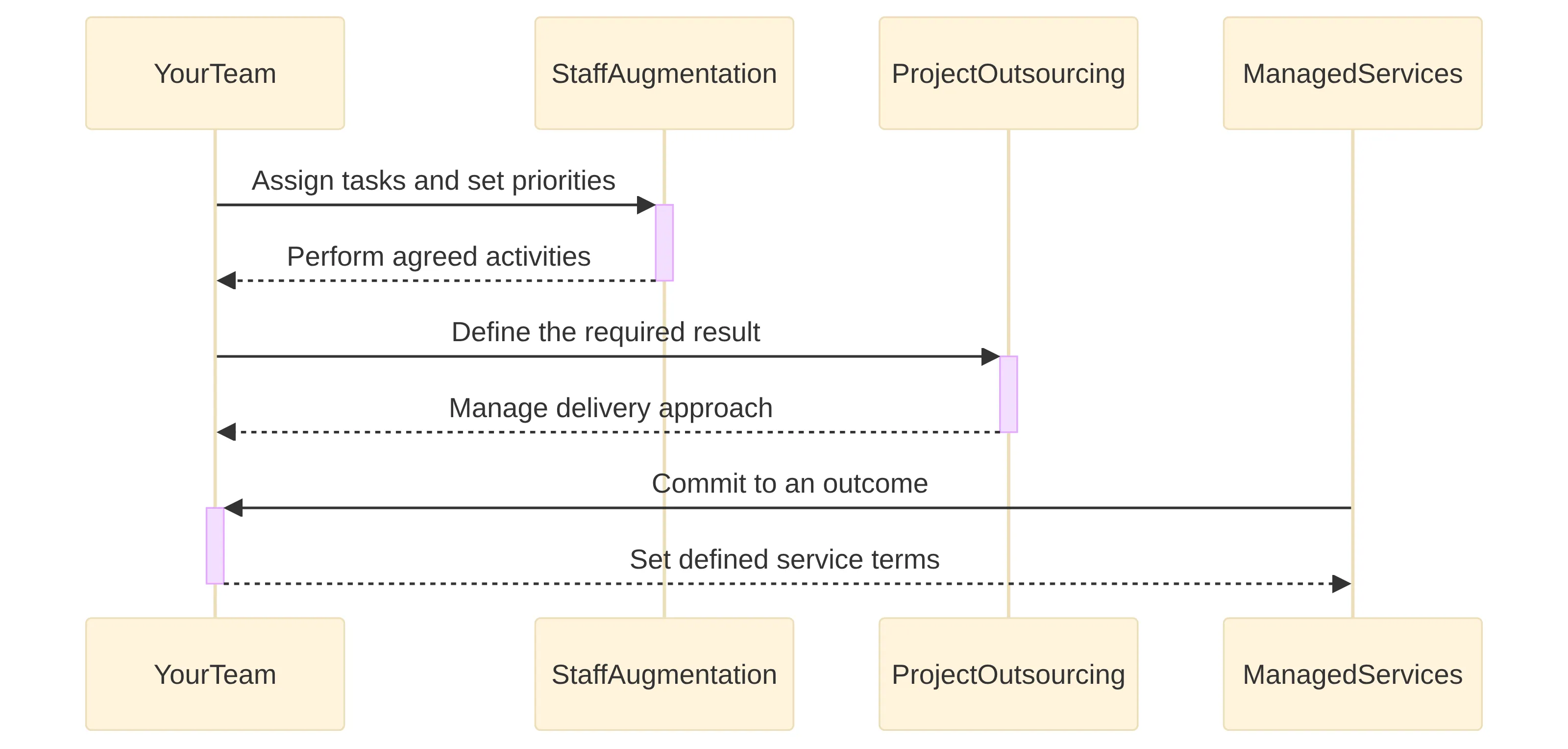
| Decision authority | Who assigns tasks, sets priorities, reviews work, and accepts completion? | Staff augmentation keeps these activities with the client; project outsourcing gives the provider more control over delivery approach. |
| Result definition | Is the request for capacity, a defined deliverable, or a continuing service? | A well-defined project may suit outsourcing; a continuing operational service requires explicit managed-service terms. |
| Work shape | Is the need a skill gap, capacity surge, specialized expertise, or a non-core function? | The cited comparison associates the first three with staff augmentation and the last with outsourcing. |
| Operational boundary | Who handles monitoring, support, uptime requirements, and related decisions? | If continuous operations or uptime SLAs are central, examine managed services rather than assuming a capacity arrangement fits. |
The worksheet does not rank the models. It exposes which decisions, deliverables, and operating responsibilities a proposal must address.
Internal hiring keeps both daily direction and capability development inside your organization. It may be the relevant comparison when you need a function to become part of your long-term operating model rather than a temporary external workstream.
Choose the model whose decision rights match your actual need. If your engineering leaders have the capacity to direct external contributors, staff augmentation may preserve the control you need. If your organization wants to specify a result and transfer delivery management, examine project outsourcing or managed services instead. If the capability should remain internal and develop over time, evaluate hiring against the same work, duration, and ownership criteria.
Complete the work-shape brief before provider discussions
Complete the work-shape part of the responsibility brief in sequence:
- Describe duration and phase. For a temporary or project-specific need, including an engagement expected to last under 12 months, evaluate staff augmentation as one possible model. If the work is intended to become a permanent capability, include internal hiring in the comparison.
- Name the missing capability. Record whether the gap involves specialized technical skills, a temporary capacity surge, or a function that the provider would manage.
- Define the output. State whether the request concerns additional capacity, a well-defined project or non-core function, or a continuing service. Include boundaries, dependencies, and acceptance conditions.
- Mark the operating burden. If continuous monitoring, support, or uptime service-level agreements are central requirements, evaluate whether managed services are more appropriate than staff augmentation.
- Record the change condition. Note what event would cause the external work to expand, reduce, transfer, or end.
Different workstreams can produce different entries in the same brief. The resulting record lets a provider respond to the actual work shape instead of asking the service label to carry unresolved decisions.
A short work-shape brief should answer five questions before a provider conversation:
- Is the need temporary, recurring, or permanent?
- Is the output a capability, a defined deliverable, or a continuing service?
- Who has the context required to set priorities each week?
- Which skills are missing, and which decisions must stay internal?
- What event would make you add, reduce, transfer, or end the external work?
These answers do not select a provider. They identify the operating model that a provider would need to support.
Write scope and accountability into the engagement boundary
Scope and accountability describe different parts of the engagement. Scope states what work is included; accountability states who must manage the work and stand behind the agreed result.
The cited comparison distinguishes staff augmentation from managed services by commitment: managed services involve a provider commitment to an outcome at a defined price, while staff augmentation supplies additional capacity without the same outcome commitment. A project engagement requires its own explicit boundary when the provider is expected to manage delivery.
Write that boundary in practical terms:
- Name the systems, repositories, environments, and workflows included.
- Separate provider activities from decisions that remain with your engineering leadership.
- Define the artifact, service, or milestone that demonstrates completion.
- State who accepts the work and what information supports that acceptance.
- Record dependencies that could prevent delivery without assigning responsibility for them.
- Specify how knowledge, documentation, and unfinished work move back to your team.
A consulting engagement can combine external diagnosis, architecture, and initial development with internal participation and later maintenance by your team. That arrangement works only when participation is more than a general intention. Assign your team’s decisions, the provider’s deliverables, and the handoff conditions before the engagement begins.
If you need someone to manage the route to a defined outcome, do not describe the request as capacity alone. If you need contributors under your own direction, do not assume that an external team will own the result. Match the language of the request to the accountability you expect.
Compare commercial terms without treating them as universal rules
Commercial terms should follow the responsibility boundary rather than determine it. The cited comparison associates staff augmentation with time-and-materials billing and outsourcing with fixed-price, milestone-based, or outcome-based billing. A separate managed-services comparison distinguishes an outcome commitment at a defined price from staff augmentation’s additional-capacity model.
Treat those arrangements as patterns, not universal rules. Ask every provider to explain:
- What unit is being priced: time, named resources, milestones, a service, or an outcome?
- Which assumptions make the price valid?
- What happens when scope, priorities, dependencies, or staffing needs change?
- Which internal management effort remains after the engagement begins?
- What notice, transition, or handoff conditions apply?
- Which items are excluded from the quoted amount?
Staff augmentation changes may be easier to make by adding or removing individual resources, while outsourcing changes may require contract amendments. That difference matters when your roadmap has uncertain phases. A fixed price can make a defined scope easier to compare, but it does not remove the need to define acceptance or dependencies. A resource-based arrangement can offer flexibility, but it leaves more delivery management with your organization.
Compare total responsibility, not only the line item. Include internal direction, architecture decisions, acceptance work, transition effort, and operational ownership in your evaluation. A lower quoted rate does not by itself answer whether the model fits your management capacity or delivery risk.
Turn the boundary brief into provider diligence
Use the completed responsibility brief as the structure for provider diligence. Keep each answer beside the field it addresses so that technical, security, procurement, and executive reviewers can examine the same boundary.
- Role fit: Which work requires architecture judgment, implementation capacity, delivery management, or operational ownership?
- Decision rights: Who assigns tasks, changes priorities, approves technical direction, and accepts completed work?
- Ramp plan: What information, access, working hours, communication practices, and initial deliverables are needed before productive work begins?
- Quality control: Which review, testing, documentation, and release activities are included, and which remain with your team?
- Knowledge retention: How will decisions, system context, and unfinished work remain usable by your organization after the engagement changes?
- Scope control: How are new requests classified, approved, priced, and scheduled?
- Continuity: What happens if the required skill changes, the phase ends, or the assigned resource is no longer available?
- Tool and AI use: If the provider uses AI tools or AI-focused training, what work may use them, what human review is required, and how are your code, data, and instructions handled?
- Commercial boundary: Is the proposal priced around resources, milestones, a service, or an outcome, and what assumptions sit behind it?
- Evidence of fit: What artifact, decision record, review practice, or handoff output would demonstrate that the requested work occurred?
Architecture consulting can assess product goals, operating realities, team skills, budget, and timelines before presenting options and trade-offs. Ask for that reasoning when the main risk is choosing a direction, not merely adding hands.
Also separate capability questions from proof questions. A capability question asks whether the provider performs the work. A proof question asks what artifact, decision record, review practice, or handoff output would demonstrate that the work occurred. Record each answer beside the requirement it addresses. The resulting document gives your procurement, security, engineering, and executive stakeholders the same decision record.
Make regulated-industry requirements explicit before choosing a model
Regulated-industry requirements should be written as responsibility and evidence questions before you select a delivery model. If your project operates in financial services, healthcare, or another regulated environment, put the applicable access, review, change, incident, and ongoing-operations requirements into the work brief rather than leaving them implied.
Use a requirement sheet with these fields:
- Access: Which people, environments, repositories, data sets, and credentials are in scope?
- Authority: Who approves architecture changes, production releases, data handling, and exceptions?
- Evidence: Which records must exist to show what changed, who approved it, and when?
- Availability: What support hours, monitoring responsibilities, response expectations, and uptime service-level agreements must the model address?
- Change: How will urgent fixes, planned releases, dependencies, and rollback decisions be handled?
- Incident ownership: Who detects, communicates, investigates, and coordinates the response?
- Location and communication: Which working hours, time-zone overlap, language, and escalation paths does the team require?
- Exit: What documentation, access removal, knowledge transfer, and outstanding-work record must exist at transition?
If continuous monitoring, support, or uptime SLAs are central requirements, evaluate managed services rather than assuming that staff augmentation covers operational ownership. If your internal team must retain control of priorities and technical decisions, document that boundary before selecting an outcome-based arrangement.
This checklist does not decide your legal, compliance, security, or procurement obligations. It makes those obligations visible to the stakeholders who must define and approve them. Keep the requirement sheet attached to the delivery decision so a commercial change does not silently change the control boundary.
Test the boundary against a staff-augmentation proposal
Use the responsibility brief to test a staff-augmentation proposal rather than treating the category as a default fit. The relevant questions are whether your organization can direct the work, whether the need involves a capacity or specialist gap, and which delivery and operational responsibilities remain internal.
We offer month-to-month staffing-augmentation plans, and clients can scale up or down with 30 days’ notice. We ship custom software development solutions with senior engineers. These statements give you terms to compare with the brief—engagement duration, scaling conditions, resource profile, and work type—but they do not decide the responsibility boundary for your enterprise.
Use this model as a candidate when your engineering organization can:
- Set priorities and assign work directly.
- Review technical output and make acceptance decisions.
- Provide the system context, access, and internal stakeholders needed for the work.
- Retain responsibility for architecture, delivery coordination, and operational decisions outside the engagement.
- Define how the additional contributors will work with your existing team.
Ask about a different model when you need the provider to own continuous operations, guarantee an uptime service level, or manage a defined outcome without your team directing daily tasks. Ask about internal hiring when the need is a durable capability that you intend to retain, develop, and govern inside the organization. Ask about project delivery when the work can be bounded by a deliverable and you want the provider to manage the delivery path.
The practical next step is not to accept or reject staff augmentation by category. Write the workstream, decision rights, expected duration, specialist skills, quality evidence, operational boundary, and handoff conditions. Then test whether the proposed engagement matches that record.
Use the responsibility brief to request a quote
Before requesting a project quote, complete the responsibility boundary for the workstream. Record the desired result, duration, decision rights, provider responsibilities, internal responsibilities, acceptance evidence, commercial assumptions, regulated-industry requirements, and exit conditions. Add the relevant company and project details needed for the request.
Use the completed record to state the arrangement under consideration: staff augmentation for client-directed capacity, project delivery for a defined result with provider-managed execution, managed services for an ongoing operational boundary, or internal hiring for capability retained inside the organization.
Keep unresolved assumptions visible rather than hiding them inside a service label. A qualified professional should decide individual legal, financial, compliance, procurement, or technical suitability.
What should an enterprise engineering leader verify before choosing a consulting model?
What are the different types of software consulting services?
Software consulting services can include architecture consulting, project delivery, staff augmentation, and managed services. Each type addresses different needs, such as providing expert advice, managing project execution, adding temporary capacity, or taking over operational responsibilities.
How does staff augmentation differ from outsourcing?
Staff augmentation involves adding external professionals to your existing team under your management, while outsourcing delegates an entire project or function to an external provider who manages delivery.
What should I consider when evaluating a software consulting provider?
When evaluating a provider, consider their ability to meet your specific needs, the clarity of their service offerings, their experience in your industry, and how they handle accountability and decision rights.
What are the billing models typically associated with software consulting services?
Billing models can vary; staff augmentation is often billed on a time-and-materials basis, while outsourcing may use fixed-price or outcome-based billing.
What factors should influence my choice between staff augmentation and managed services?
Consider the level of control you want over daily operations, the need for specialized skills, the duration of the project, and whether you require ongoing support or monitoring.
What are the key questions to ask before deciding on a software consulting model?
Key questions include: Who will direct the daily work? Who is accountable for the results? How clearly can you define the scope and acceptance conditions? How much operational responsibility should remain within your organization?