Make the SRE question an operating decision
A site reliability engineer helps turn production reliability from an informal expectation into an operating practice with measurable responsibilities. SRE applies software-engineering practices to improving the availability and performance of deployed systems, including during deployments, hardware failures, and cybersecurity attacks. The work can cover availability, performance, latency, efficiency, capacity, and incident response.
For a hedge fund, the decision is therefore not simply whether to add another technical title. You need to determine whether your organization can measure service health, operate production systems, respond to incidents, manage changes, and improve recurring weaknesses with clear ownership. If those responsibilities are scattered, delayed, or handled only after an outage, dedicated or augmented SRE support may be appropriate.
A practical decision has three parts:
- Define the reliability outcomes and production services that need accountable ownership.
- Test whether your current team has the skills, time, measurements, and incident practices to support them.
- If a gap exists, choose an internal hire, augmented capacity, or project-based support that gives your team specific responsibilities and reviewable outputs.
This guide follows that sequence. It explains the role first, then connects SRE work to hedge-fund operating demands, support triggers, and external-partner vetting. The result should be a bounded staffing or delivery decision rather than a generic request for more infrastructure capacity.
Define the role by the production outcome it owns
Site reliability engineering is a discipline that applies software-engineering principles to operations and infrastructure so deployed systems can remain reliable and scalable. An SRE works on the conditions that affect production service: availability, performance, latency, efficiency, capacity, and response to incidents. The role is not limited to keeping servers running. It connects system design, automation, measurement, deployment, and operational response.
The role also has a distinctive posture toward manual operational work. SRE commonly emphasizes automation and infrastructure as code while combining software-engineering and operations practices. That means an SRE may treat a repeated manual task, recurring alert, fragile deployment, or unclear recovery procedure as a candidate for engineering work rather than accepting it as permanent operating overhead.
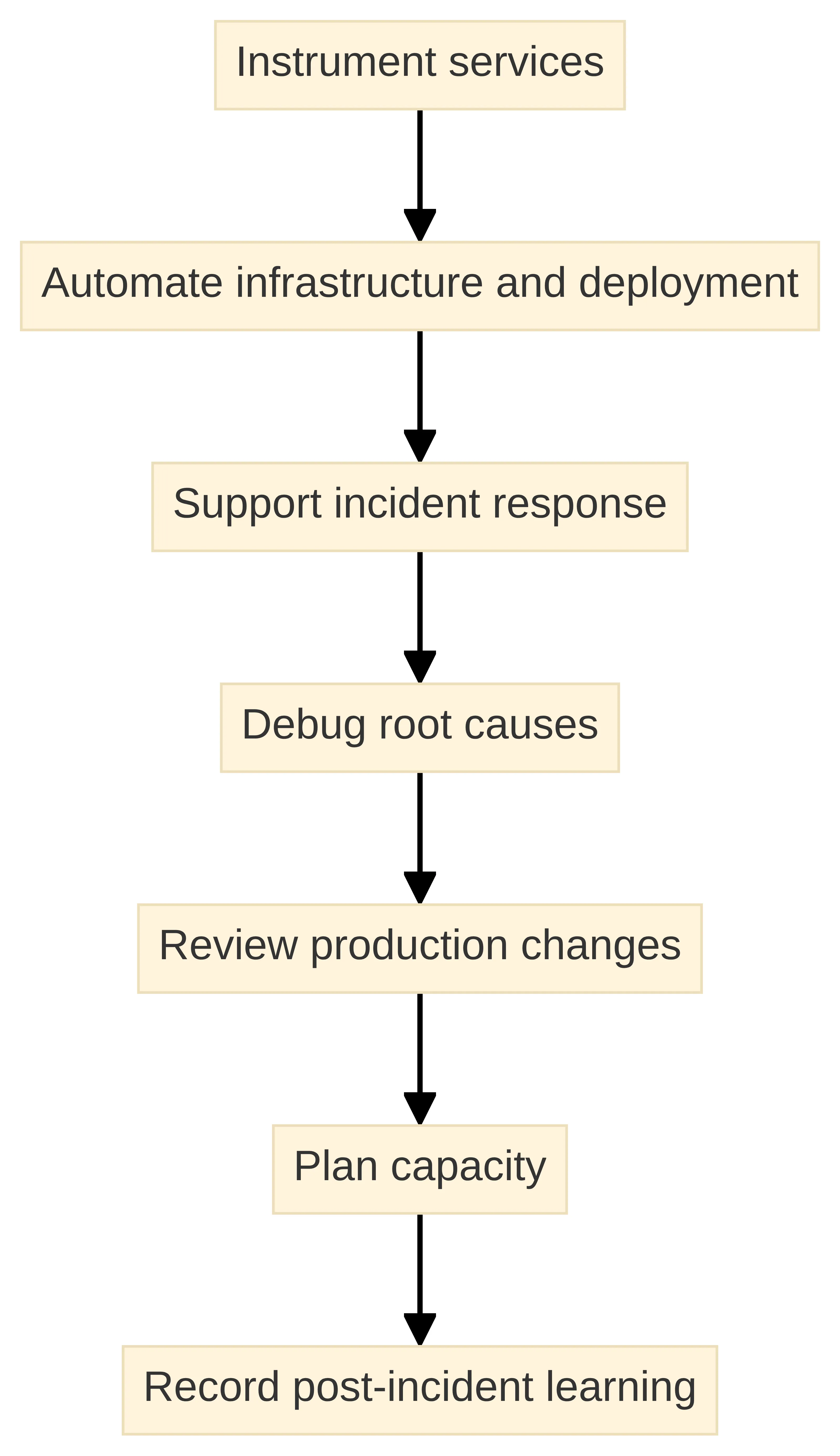
The production outcome is accountable operation: the service has defined health signals, an understood failure response, controlled changes, and a way to learn from incidents. The exact division of work depends on your architecture and team, but a useful SRE remit can include:
- Instrumenting services so you can observe relevant behavior.
- Automating infrastructure, configuration, deployment, and recurring operational tasks.
- Supporting incident response and coordinating technical investigation.
- Debugging root causes rather than stopping at symptom removal.
- Reviewing changes that could affect production stability.
- Planning capacity as demand and system dependencies change.
- Recording post-incident learning and converting recurring weaknesses into engineering work.
- Working with development, operations, support, security, and business stakeholders.
These outputs make the role concrete. If a proposed SRE position has no defined services, health measures, incident responsibilities, or improvement backlog, the position is not yet an operating design; it is only a title.
The skill profile follows the work. A global hedge-fund SRE posting emphasizes distributed systems, cloud and network architecture, software development, automation, observability, incident management, troubleshooting, communication, and financial-industry experience. Citadel’s published SRE description also connects the work with automation, instrumentation, optimization, incident response, consultative support, and close partnership with investment and enterprise teams.
Treat those examples as signals for evaluation, not as a universal credential list. Your environment may need deeper strength in distributed systems, data infrastructure, networking, deployment automation, or incident leadership. In every case, look for the ability to understand how a production service behaves, make that behavior visible, change it carefully, and explain the operational consequence to people who own the business process.
Read SRE work through its operating outputs
A title tells you little about how reliability work will affect your fund. Outputs are more useful because they show what the team can inspect, operate, and improve. Ask what will exist after the work and who will use it during normal delivery and under pressure.
The main output categories are:
- Service instrumentation: signals that show whether a service is available, responsive, within its expected performance range, and operating within capacity.
- Operational automation: code or configuration that reduces repetitive manual work and makes infrastructure or deployment behavior more consistent.
- Incident practice: an actionable response process, technical investigation, communication path, and post-incident review.
- Production-change analysis: an account of how a release could affect service behavior.
- Reliability improvement: prioritized work that addresses recurring alerts, failure modes, dependency weaknesses, performance constraints, or recovery problems.
- Team support: documentation, consultation, and collaboration that help developers and other operators build and run services with clearer reliability expectations.
An SRE can contribute to all six categories, but you should define which ones matter to the engagement. A project focused on observability will produce a different handoff from a project focused on incident response or capacity planning.
SRE practices can use service-level indicators, objectives, agreements, and error budgets to measure service health and balance reliability with delivery. Use the terms only when you have defined what is being measured, over what period, and who acts when the result crosses a threshold.
An SLA can specify service objectives and metrics, response times, exceptions, responsibilities, availability, pricing, and remedies. That makes it a useful reference for clarifying expectations, but it does not replace technical ownership. Your team still needs to know which system produces each measure, who investigates a breach, what conditions affect interpretation, and how corrective work enters the delivery plan.
A useful SRE handoff should let you answer four questions without relying on the individual engineer’s memory:
- Which production services and dependencies are in scope?
- Which signals show their health and capacity?
- What happens when an alert or service objective is missed?
- Which reliability issues remain open, and who owns the next action?
Shared visibility between security and SRE can also help prioritize vulnerability remediation and identify security-related causes of reliability or performance problems. Make those connections explicit in the handoff rather than treating reliability, security, and delivery as separate records.
Connect reliability measures to delivery and operational risk
Reliability measures matter because they change how you make delivery decisions. Without defined signals and objectives, a team may describe a service as healthy because no one has reported a problem, even while latency, capacity, failed changes, or recovery performance are worsening. SRE practices can use SLIs, SLOs, SLAs, and error budgets to measure service health and balance reliability with delivery.
Start by connecting each important service to a small set of operating questions:
- Is the service available when the business process needs it?
- Is its latency acceptable for the workflow it supports?
- Is demand approaching a capacity constraint?
- Are deployments or configuration changes creating instability?
- Can the team detect, contain, investigate, and recover from an incident?
- Are security events or dependency failures visible in the same operational picture?
The answers should lead to action. A measure without an owner, threshold, review cadence, or response path is descriptive rather than operational.
Operational risk enters through dependencies, changes, visibility, and recovery. A production-scale framework links reliability and operational-risk decisions to resilient environments, controlled and auditable production changes, measurable service health, incident learning, recovery, and service continuity. Those are engineering concerns, but they also affect how technology leaders assess exposure around a business process.
Security should be part of the same conversation without being collapsed into reliability. Shared visibility can give security teams reliability context when prioritizing vulnerability remediation, while SRE teams gain security context for reliability issues and possible security-related performance causes. For your fund, ask whether the proposed SRE work will expose the right service, dependency, and incident information to the people who must make security and operational decisions.
Do not turn a service objective into a promise that every business outcome will be protected. A service measure describes a defined technical condition. It does not by itself establish a legal, regulatory, investment, or financial result. Keep the technical objective, its measurement method, the exceptions, and the responsible teams separate from any broader conclusion about the fund.
That separation improves the decision. You can ask an external provider to instrument a service, improve change controls, or establish an incident process while retaining internal responsibility for interpreting the effect on your business and control environment.
Place SRE beside—not above—the adjacent engineering roles
SRE, DevOps, software engineering, and operations overlap. Their distinction is one of emphasis: SRE focuses on delivery and production stability, while DevOps focuses on the end-to-end application lifecycle. The practical difference is emphasis: SRE gives production reliability, measured service health, incident response, and recurring operational improvement a defined center of gravity.
Use the distinction to clarify accountability, not to create rigid labels. A software engineer may design and change application behavior. An operations professional may administer and support runtime environments. A DevOps-oriented team may connect development and delivery through automation and collaboration. An SRE focuses those practices on keeping production services within agreed reliability conditions and improving the system when they are not.
| Role or approach | Primary question | Typical contribution to production | Boundary to clarify |
|---|---|---|---|
| Software engineering | What should the application do, and how should it be built? | Application code, tests, and changes to product behavior | Who owns service health after the change reaches production? |
| Operations | How is the runtime environment administered and supported? | Environment support, operational procedures, and issue handling | Which recurring tasks become automation or engineering work? |
| DevOps | How can teams connect development, delivery, automation, and collaboration? | Delivery pipelines, infrastructure automation, and cross-team flow | Who owns reliability targets and end-to-end incident learning? |
| SRE | How will the production service remain measurable, reliable, and recoverable while delivery continues? | Instrumentation, automation, incident response, change management, root-cause work, and reliability improvement | Which services, objectives, escalation rights, and engineering outputs are in scope? |
A practical comparison describes DevOps as often emphasizing delivery and collaboration, while SRE emphasizes production stability, reliability targets, fault tolerance, and end-to-end incident ownership. That does not mean a DevOps team cannot perform SRE work or that an SRE operates apart from developers. It means your staffing brief should state the problem and decision rights instead of assuming the label defines them.
If the main gap is a slow or inconsistent delivery pipeline, a delivery-focused role may be appropriate. If the gap is repeated production instability, unclear incident ownership, weak service measures, or recurring manual recovery work, SRE responsibilities may be more directly relevant. Choose based on the operating gap and expected outputs.
Translate the role into hedge-fund operating demands
A hedge fund should evaluate SRE work in the context of the production systems that support its own processes, data, teams, and dependencies. The relevant question is not whether the environment resembles a generic technology company. It is whether the engineer can understand the operational consequence of failure, delay, incorrect configuration, limited capacity, or an unexamined dependency in the service being supported.
Citadel’s published SRE description illustrates one fund-specific model: the work includes close partnership with investment teams and enterprise functions, alongside automation, instrumentation, optimization, incident response, and consultative support. A separate global hedge-fund SRE posting emphasizes distributed systems, cloud computing, network architecture, software development, automation, observability, incident management, troubleshooting, communication, and financial-industry experience. These examples support a focused evaluation of technical depth and business-context communication, not a claim that every hedge fund uses the same organization.
Translate those demands into an operating brief before you evaluate candidates or providers. Describe:
- The production services and data flows that matter to the initiative.
- The teams that depend on those services and the decisions they make when service health changes.
- The signals that should be visible to engineering, security, and operational stakeholders.
- The access and escalation boundaries for the work.
You do not need to promise a regulatory result to make these requirements meaningful. You need to state the technical and operational conditions the fund expects the work to address.
Communication is part of the technical requirement. An engineer who can identify a failure mode but cannot explain its effect, uncertainty, owner, or next decision will create a different operational gap. Ask candidates and providers to explain a production issue in two forms: first as a technical diagnosis for engineers, and then as a bounded operational update for the stakeholders who need to decide whether to pause, escalate, accept, or remediate the situation.
Use four signals to test whether support is needed
You may need dedicated or augmented SRE support when reliability work is persistent enough to require ownership, measurement, and engineering time that the current team cannot consistently provide. Use four signals to test the case. They are decision prompts, not automatic proof that an external engagement is necessary.
-
Production health is not sufficiently visible. You cannot identify the signals that describe availability, performance, latency, efficiency, capacity, or incident response for an important service. Start by defining the service, measures, owners, and response thresholds.
-
Incidents consume attention without producing durable improvement. The team repeatedly restores service but lacks time or skill for root-cause debugging, post-incident review, automation, or prevention work. Assign an owner for the investigation and the resulting improvement backlog.
-
Changes create uncertainty in production. Deployments, configuration changes, or dependency changes are difficult to assess, audit, or reverse. Map the change path, define review and escalation points, and make the resulting records usable by the people responsible for operations.
-
Reliability ownership is fragmented. Developers, operations, security, and business stakeholders each hold part of the picture, but no role connects service health, incidents, dependencies, and recovery. Define the cross-team SRE responsibility before adding capacity.
These signals point to different interventions. A measurement gap calls for observability and service-objective work. A repeated-incident gap calls for incident leadership and engineering improvement. A change gap calls for production change discipline. A fragmented-ownership gap calls for a role with explicit authority, boundaries, and handoffs.
For a short-term or initiative-specific need, ask whether the partner offers project-based support. If the gap is continuous and tied to a long-lived service, dedicated internal or augmented capacity may fit better. In either case, write the trigger, expected output, internal owner, and review point before you start searching.
Choose the form of support that matches the gap
The form of support should follow the type and duration of the reliability gap. A staffing-partner framework identifies direct hires, contingent staffing, and project-based support as different ways to address business needs, with flexibility and scalability as selection considerations. Apply that distinction to the work rather than selecting an engagement model first.
- Build internal ownership when reliability is a permanent operating responsibility, the service requires sustained context, and your organization is prepared to own the role, development path, and long-term operating model.
- Augment the existing team when you already have internal ownership but need additional capacity, specialized production experience, or help establishing a defined practice. Keep the internal owner responsible for priorities, access decisions, and acceptance of the work.
- Use project-based support when the need has a clear boundary, such as defining service measures, improving instrumentation, documenting incident response, or addressing a specified automation backlog. Set the handoff conditions before the project begins.
- Use contingent or flexible staffing support when demand or duration is uncertain and you need a defined capacity arrangement while the operating need becomes clearer. Document how the support can scale, pause, or transition.
These are planning categories, not guarantees about what a provider can deliver. Match the category to the missing capability, expected duration, decision rights, and work products.
Before discussing providers, prepare a one-page support brief with:
- Services, environments, and dependencies in scope.
- Current reliability signals and the measures you need to establish.
- The incidents, changes, or manual tasks creating the operating gap.
- Skills required, including technical depth and communication context.
- Expected outputs and acceptance conditions.
- Internal owners for priorities, access, approvals, and escalation.
- The intended support duration and transition or renewal decision.
A staffing partner should understand the business, role, team, and urgency before proposing a fit. Speed matters only with quality: moving quickly with mismatched profiles creates more work for your internal team. Ask how the provider will preserve consistency if the need expands across services or teams.
Keep the engagement boundary separate from the service agreement. An SLA can describe objectives, monitored metrics, response times, exceptions, responsibilities, availability, pricing, and remedies, but the technical brief must still state what the engineer will build, operate, document, or transfer. Do not use a response-time promise as a substitute for a defined reliability work plan.
Vet an external SRE partner by evidence and control
An external SRE partner should be evaluated on more than the ability to present technically attractive profiles. Use the following criteria:
- Business understanding: Can the provider understand your service, team, urgency, dependencies, and operational consequences before recommending a profile or delivery model?
- Production-environment experience: Can the proposed engineer discuss distributed systems, cloud or network architecture, software development, automation, observability, incident management, troubleshooting, and post-incident analysis in concrete terms?
- Financial-services context: Can the person communicate with the teams who depend on production systems and understand why service behavior, data flows, and operational decisions require careful handling? Treat financial-industry experience as a relevant preference where your environment needs it, not as an automatic substitute for technical evidence.
- Communication: Can the proposed team explain a diagnosis, uncertainty, escalation, and next action to both technical and non-technical stakeholders?
- Control awareness: Can the provider work within defined change, access, documentation, incident, recovery, and continuity boundaries?
- Delivery flexibility: Can the engagement support the actual duration and scale of the gap without sacrificing consistency?
- Ownership clarity: Will your team know who is responsible for priorities, approvals, incident decisions, deliverables, and handoff?
These criteria turn a general staffing conversation into a testable operating decision.
Ask the provider questions that require evidence rather than broad assurances:
- Which production reliability problem does the proposed person or team solve first?
- What will be measured, instrumented, automated, documented, or transferred?
- How will the engineer approach an incident that has several possible causes?
- How will proposed production changes be reviewed, recorded, and escalated?
- How will the provider work with development, operations, security, and business stakeholders?
- What internal owner must remain involved, and what decisions will stay with your fund?
- How will the provider report open risks, blocked work, unresolved incidents, and changes to scope?
- How will the engagement scale or transition without losing operational context?
A provider that understands the business need should be able to connect its answers to your services, measures, dependencies, and control boundaries. The answer should describe a working arrangement, not merely a list of tools.
Request a sample of the working record you would receive: a service map, reliability objective, incident review, change record, risk register, runbook, or handoff plan. The sample should make ownership and action visible. For production systems at scale, controlled and auditable changes, measurable service health, incident learning, recovery, and continuity are relevant evaluation dimensions. An SLA can clarify service expectations, but it should sit alongside technical work products and accountable decision rights.
Test ownership before granting production access
Production access should follow an ownership test, not precede it. Before an external SRE begins work, write down the service scope, approved tasks, internal owner, escalation route, change path, incident responsibilities, documentation requirements, and handoff condition. The purpose is not to eliminate collaboration; it is to make collaboration reviewable when the system is under pressure.
Use a short access-and-ownership checklist:
- Name the systems, environments, repositories, and dependencies in scope.
- Separate observation, diagnosis, change, deployment, and approval responsibilities.
- State which production changes require internal review or authorization.
- Define how incidents are declared, escalated, communicated, investigated, and closed.
- Identify the records that must be updated after a change or incident.
- Set the conditions for expanding access, reducing access, or transferring the work.
- Assign an internal owner who can accept or reject the proposed output.
Controlled and auditable production changes, measurable service health, incident learning, recovery, and continuity are all relevant to production-scale reliability planning. SRE work can include change management, incident response, root-cause debugging, and cross-team collaboration, but those responsibilities still need to be assigned in your operating model.
Test the arrangement with a bounded scenario before expanding access. Give the proposed team a service map, selected health signals, a recent or simulated incident description, and the applicable change boundary. Ask for:
- The first facts they would seek.
- The signals they would inspect.
- The hypotheses they would separate from confirmed findings.
- The immediate owner and escalation path.
- The change or mitigation they would propose.
- The record they would leave for the internal team.
This test reveals whether the provider can reason across reliability, security context, production behavior, and communication. It also gives you a concrete basis for deciding what access is justified and what work remains internal.
Do not transfer accountability simply because an external engineer performs technical work. Define who remains responsible for business decisions, approvals, service expectations, and acceptance of risk. A service agreement can identify responsibilities and exceptions, but your internal operating model must make the final ownership boundaries explicit.
State what the evidence can—and cannot—establish
SRE applies software-engineering and operations practices to production reliability, with work that can include automation, instrumentation, service measurement, incident response, change management, root-cause debugging, and post-incident improvement. SRE and DevOps overlap, so the label alone does not determine the work arrangement. Your decision depends on the production services, operating gap, expected outputs, and accountable owners.
A single hedge-fund job posting describes one employer’s qualifications and preferences; it does not create a universal SRE requirement. Citadel’s published description illustrates one fund-specific way to connect SRE work with investment and enterprise teams; it does not establish that every hedge fund uses the same structure. Use those examples to form interview questions and evaluation criteria, then test the proposed engineer against your own architecture and operating demands.
Reliability planning can address technical and operational conditions such as service health, controlled changes, incident learning, recovery, continuity, and shared security visibility. Keep those conclusions with the people responsible for your organization, controls, and decisions.
Turn the decision into a bounded provider conversation
Before you seek SRE support, write a brief that names the production services, reliability gap, measures, incident and change responsibilities, expected outputs, access boundary, internal owner, and review date. Then ask each potential provider to respond to that same brief. This gives you a basis for comparing technical fit, domain understanding, communication, control awareness, delivery flexibility, and ownership instead of comparing titles alone.
A qualified professional should determine individual suitability for your organization and operating environment. If your brief identifies a defined production reliability and operational ownership gap, we can provide two senior-level resources embedded in your team within a week.
What should a hedge fund clarify before engaging SRE support?
What is the role of a site reliability engineer (SRE)?
A site reliability engineer applies software engineering principles to operations and infrastructure, focusing on improving the reliability and performance of deployed systems.
How can a hedge fund determine if it needs SRE support?
A hedge fund may need SRE support if it faces persistent issues with production health visibility, repeated incidents without improvement, uncertainty in production changes, or fragmented ownership of reliability responsibilities.
What criteria should be used to evaluate an external SRE staffing partner?
When evaluating an external SRE partner, consider their understanding of your business, production-environment experience, ability to communicate effectively, awareness of control processes, and flexibility in delivery.
What are the key outputs expected from SRE work?
Key outputs from SRE work include service instrumentation for monitoring health, operational automation to reduce manual tasks, incident response processes, change management protocols, and reliability improvement initiatives.
How does SRE differ from DevOps?
SRE focuses on production stability, reliability targets, and incident management, while DevOps emphasizes delivery speed and team collaboration. Both roles overlap but have distinct areas of emphasis.
What should a hedge fund include in a brief before seeking SRE support?
A brief should outline the production services in scope, the reliability gaps, expected outputs, incident and change responsibilities, internal ownership, and review conditions.