
Technical debt is a future-cost decision, not an automatic defect
Technical debt describes a shortcut or compromise that delivers a short-term benefit while weakening a software system’s long-term health. The phrase does not mean that every imperfect implementation is defective, and it does not tell you whether remediation deserves priority. It gives you a way to discuss a trade-off: what did the decision save or enable at the time, and what future cost or constraint might it create?
For a hedge fund, that distinction matters because software decisions can sit close to investment workflows, data movement, operational support, and control activities. A small change that reduces immediate delivery effort may later increase maintenance work or make a larger system change more difficult. An expedient design decision can reduce short-term effort while increasing future system and maintenance costs. That is the financial logic behind the metaphor, not a claim that every debt item will produce the same result.
The practical question is therefore not, “Is this code clean?” The better question is, “What exposure does this compromise create, how soon could it matter, and what response is proportionate?” Use that question to separate tolerable trade-offs from debt that is already obstructing delivery, increasing operational friction, or creating a control concern.
This guide gives you a decision path. First, describe the compromise without judging it. Next, connect it to an operating workflow and record its evidence. Then rank it across five dimensions: exposure to investment workflows, operational criticality, compliance impact, remediation effort, and reversibility. Finally, choose among monitoring, containment, targeted remediation, broader redesign, or outside engineering capacity. The framework is a planning aid, not a promise of a particular performance, cost, compliance, or investment result.
Overview
Technical debt becomes actionable when you can connect a specific compromise to a specific consequence and a decision owner. An inventory that merely lists old code, failed scans, or complaints will not tell you what to do first. A useful record explains the original trade-off, the workflow it touches, the conditions under which it becomes costly, and the response that would change those conditions.
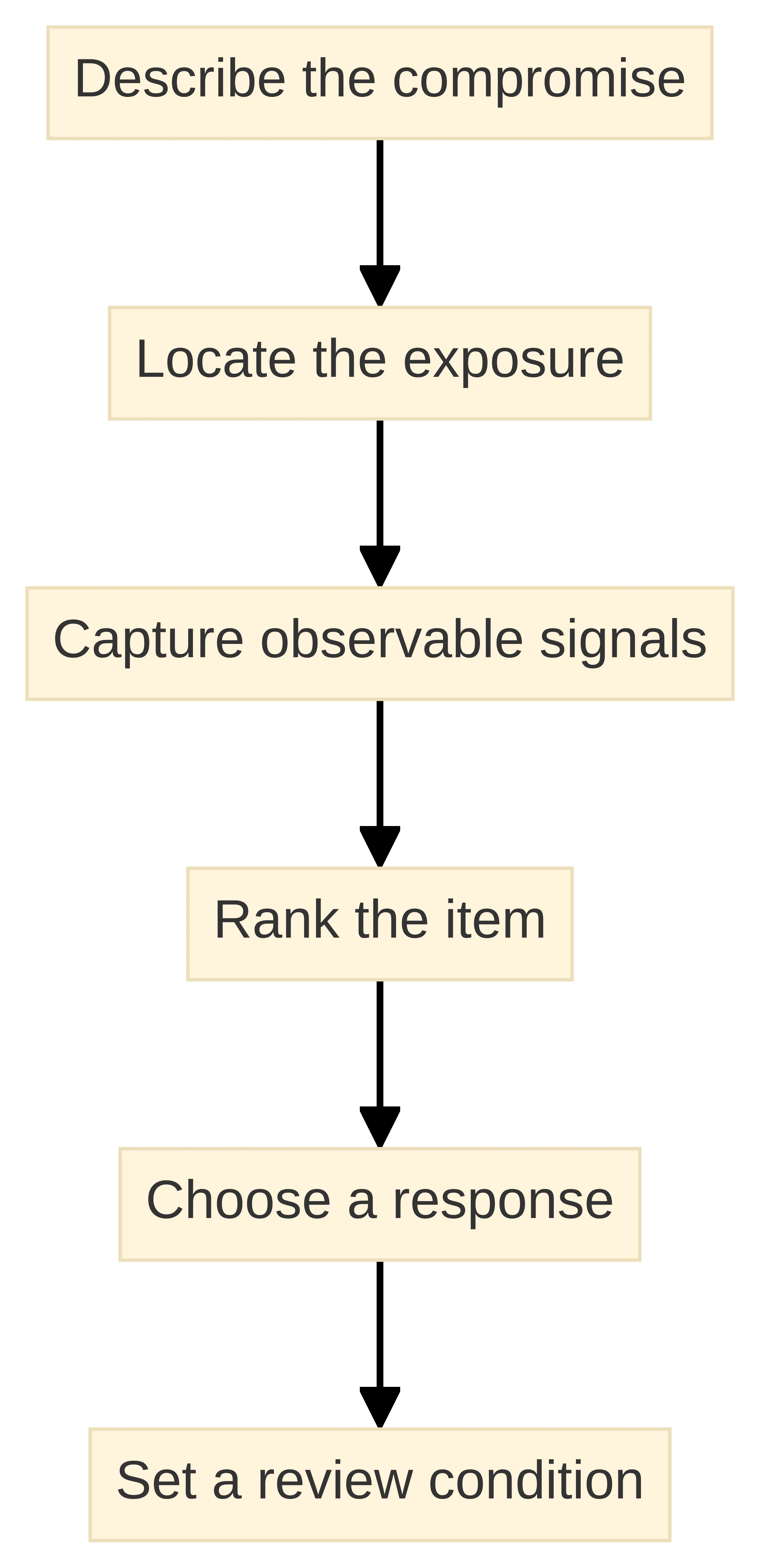
Use the following sequence for a hedge fund software environment:
- Describe the compromise. Record what was shortened, deferred, coupled, undocumented, or left dependent on a fragile assumption.
- Locate the exposure. Identify the investment workflow, data movement, operational task, control activity, or delivery path that could be affected.
- Capture observable signals. Use recurring support work, customer or internal user issues, operational friction, release constraints, failed checks, or repeated manual intervention as evidence rather than labels.
- Rank the item. Score its workflow exposure, operational criticality, compliance impact, remediation effort, and reversibility using explicit descriptions instead of an unexplained number.
- Choose a response. Decide whether to accept and monitor the debt, contain it, remediate it, replace the affected design, or obtain additional engineering capacity.
- Set a review condition. State what would cause the decision to change, such as a workflow expansion, a repeated incident pattern, a control requirement, or a material change in the remediation effort.
The Carnegie Mellon Software Engineering Institute recommends making debt visible through issue-management tools, architecture and release reviews, and documentation of difficult development trade-offs. A measurable management approach can also define objectives across product, process, and resources, then track the practices used for different debt types. Visibility is the foundation; prioritization is the decision that follows.
Describe the compromise before labeling the debt
A technical-debt record should begin with the decision that created the compromise, not with a judgment about code quality. The record should answer four questions: what changed, why was the shortcut taken, what assumption does it rely on, and what future work could that assumption create?
For example, imagine that an engineering team builds a data transformation directly inside an application because an immediate workflow needs to ship. The implementation may be reasonable for the initial scope. The debt appears when later work must reuse the transformation, change its rules, trace its outputs, or separate it from the application release cycle. The relevant record is not “bad data code.” It is “a transformation was placed inside one application to reduce immediate delivery effort; reuse and independent change now require additional work.”
Other illustrative forms can be written in the same way:
- A tightly coupled component may have reduced the number of moving parts for an early release while making isolated changes harder.
- A manual operational step may have allowed a workflow to run before automation was available while creating recurring support effort.
- A thin test boundary may have shortened initial delivery while leaving a high-change area harder to modify with confidence.
- An undocumented exception may have solved a time-sensitive business case while making future diagnosis dependent on a small number of people.
- An outdated platform dependency may continue to function while increasing the work required for upgrades or replacement.
- A temporary data-quality rule may have kept a process moving while obscuring which upstream condition needs correction.
These examples are prompts for description, not proof that a particular hedge fund has any of these conditions. Attach the item to a system boundary, workflow, owner, and observable signal before assigning a severity. The systems-engineering literature also points toward identifying causes before debt accumulates to the point of affecting a system and toward estimating potential future impact. That makes the original compromise relevant, even when the present symptom appears elsewhere.
Use precise language in the inventory. Replace “legacy mess” with “a release-dependent integration has no independent test boundary.” Replace “unmaintainable” with “a change requires edits in three coupled components and manual checks after deployment.” Specific wording gives engineering, operations, and business owners something they can challenge, measure, or accept.
Separate intentional trade-offs from hidden accumulation
Intentional technical debt has a stated reason, an owner, and a condition for review. Hidden accumulation lacks one or more of those properties. The difference is not whether the software is elegant; it is whether the trade-off remains understood and bounded.
An intentional trade-off might be acceptable when a short-lived experiment needs a narrow implementation, the affected workflow is contained, the operating team understands the limitation, and a later decision point is recorded. Acceptance does not mean ignoring the item. It means choosing to carry it with a defined observation method and a reason that can be revisited.
Hidden accumulation often develops through individually understandable choices. A team defers documentation because delivery is urgent. A temporary integration becomes a permanent dependency. A manual workaround is repeated until support treats it as normal. A design decision is remembered by the person who made it but not recorded where later engineers can find it. Each choice may be small, yet the combined effect can make future change less predictable.
Use this test for every inventory item:
- Purpose: What short-term benefit justified the compromise?
- Owner: Which team or role can explain its behavior and decide how it should be handled?
- Boundary: Which workflow, component, data path, or operating activity is affected?
- Condition: What event would make the current acceptance no longer reasonable?
- Evidence: Which recurring signal shows that the item is costing time, creating friction, or constraining change?
- Response: Is the appropriate action to monitor, contain, remediate, redesign, or replace?
The distinction also prevents two opposite errors. Treating every shortcut as urgent can divert capacity from work with greater operational or business exposure. Treating every old implementation as harmless can leave recurring risks without an owner. A decision record makes the trade-off visible without assuming that remediation is always the correct response.
One practitioner argues against reserving a fixed 20% of engineering time for technical debt and favors decisions based on customer and business impact instead. That view is useful as a challenge to automatic quotas, although it is practitioner commentary rather than a universal rule. The practical conclusion is narrower: do not use age, untidiness, or a fixed percentage alone to decide what to fix. Use explicit impact and conditions.
Look for evidence in the operating workflow
Operational evidence shows whether a technical compromise is merely present or is creating a material decision problem. Start with the workflow rather than the repository. Ask where the item appears in investment-related processing, data movement, production support, release coordination, reporting, or control activity, and then record what happens there.
Useful evidence can include:
- repeated support requests tied to the same component or procedure;
- recurring internal user or customer issues associated with one workflow;
- operational friction such as repeated manual intervention, difficult handoffs, or unclear escalation;
- release work that repeatedly pauses because a dependency cannot be changed independently;
- a control activity that depends on undocumented behavior or a fragile manual step;
- recurring incidents, near misses, or investigations with the same technical cause;
- delayed diagnosis because system behavior, debugging methods, or escalation criteria are not documented;
- a proposed change that requires more coordination than its business scope would suggest.
Prioritize debt by operational impact, including support volume, customer issues, and recurring operational friction. The recommendation does not turn support volume into a complete severity score. It gives you a concrete starting signal. Pair it with the workflow’s importance, the consequences of interruption, and the effort required to change the underlying condition.
Recurring examples deserve separate treatment. A single manual workaround may be an accepted local choice. The same workaround appearing across releases, teams, or workflows can indicate a broader technical risk. The CMU Software Engineering Institute recommends connecting recurring debt patterns with risk-management practices so that priorities and resources can be assigned appropriately. Record the pattern, not only each instance.
Use an evidence note with five fields: the observed behavior, the affected workflow, the frequency or trigger, the immediate consequence, and the person who can validate the observation. You do not need a perfect measurement before recording an item. You do need enough detail to distinguish a concrete operating burden from a general preference for a different design.
Keep hypothetical concerns separate from observed facts. “This may become difficult to scale” is a forecast. “The release requires a manual reconciliation step owned by one team” is an observation. Both can matter, but they should not be presented as the same kind of evidence.
Rank each item across five decision dimensions
A technical-debt ranking should show why one item deserves attention before another. Use five decision dimensions: exposure to investment workflows, operational criticality, compliance impact, remediation effort, and reversibility. These dimensions are a planning framework, not a universal industry score. Describe each dimension in words before assigning a low, medium, or high rating.
1. Exposure to investment workflows
Investment-workflow exposure asks how directly the compromise touches a process used to make, implement, monitor, reconcile, or explain investment decisions. A debt item in an isolated internal utility may have limited exposure. An item in a data path that feeds a decision-support workflow may deserve closer examination, even if it has not caused an incident. Record the specific workflow and the dependency rather than assuming that proximity alone makes the item urgent.
2. Operational criticality
Operational criticality asks what happens if the affected component, handoff, or procedure becomes unavailable, delayed, or difficult to change. Consider the consequence of interruption, the available workaround, the number of teams involved, and the ability to diagnose or recover. Support volume and recurring operational friction are useful signals, but they do not replace a description of the workflow consequence. A component can generate frequent tickets without being critical, while a rarely used component can matter during a narrow but consequential operating window.
3. Compliance impact
Compliance impact asks whether the debt could affect a documented control, evidence trail, access boundary, retention practice, data-handling process, or other obligation that applies to the organization. Do not convert this screen into a legal conclusion. Our published hedge-fund guidance connects IT compliance and SEC-related requirements with data security and compliance, so those concerns belong in the planning discussion. The debt record should identify the relevant control or requirement and the technical dependency that may affect it; a qualified legal, compliance, or security professional must determine the applicable obligation and individual conclusion.
4. Remediation effort
Remediation effort asks what must change and what must remain stable while it changes. Record the likely work in terms of boundaries, dependencies, data movement, testing, migration, operational preparation, and ownership. Avoid false precision when discovery has not established the scope. A broad rewrite may have more visible technical appeal than a smaller containment step, but the larger option also creates a larger coordination and transition burden.
5. Reversibility
Reversibility asks how easily you can undo, isolate, roll back, or replace the proposed response if the result is not useful. A contained change with a clear rollback path may be easier to authorize than a wide redesign that changes several workflows at once. Low reversibility does not automatically make remediation wrong; it means the decision needs stronger boundaries, testing, ownership, and staged checkpoints.
After describing the five dimensions, use a simple decision note:
- High exposure and high criticality: investigate the operating consequence promptly and define a bounded response.
- High compliance impact but uncertain technical cause: identify the control dependency and involve the appropriate control owner before choosing implementation work.
- High remediation effort with limited current exposure: record the item, contain the risk if needed, and compare it with roadmap work rather than funding a redesign by default.
- Low exposure and high reversibility: monitoring or a small corrective change may be proportionate if the owner and review condition are clear.
- Recurring operational friction across several items: treat the pattern as a risk signal and assess whether shared architecture, documentation, or ownership is contributing.
This ranking makes trade-offs visible. The final choice still depends on available capacity, business timing, control obligations, and the quality of the evidence.
Make the inventory measurable before funding remediation
A technical-debt inventory becomes useful when each item has a measurable objective, an observation method, and a decision owner. Measurement does not require pretending that every future cost can be reduced to a single number. It requires defining what you are trying to learn or change.
The Brazilian Symposium on Software Quality study frames debt-management measurement around product, process, and resource objectives. Apply that structure to your inventory:
- Product objective: What system behavior, boundary, or quality condition should change?
- Process objective: What delivery, support, review, or control activity should become easier to understand or execute?
- Resource objective: What engineering, operational, or coordination effort should be examined before and after the response?
For each objective, choose an observable measure that fits the item. Examples include the number of recurring support issues associated with a component, the number of manual handoffs in a workflow, the time needed to trace a change through a dependency, the proportion of releases requiring a particular workaround, or whether a documented escalation path exists. These are measurement candidates, not promises that remediation will improve a particular result.
Use a compact record with these fields:
- debt description and originating trade-off;
- affected workflow and owner;
- current signal and observation period;
- five-dimension ranking with rationale;
- proposed response and alternatives;
- effort assumptions and unresolved questions;
- objective, measure, and review date;
- condition that would change the decision.
The CMU Software Engineering Institute recommends recording debt during architecture and release reviews, tracking it in issue-management tools, and documenting difficult trade-offs during development. That practice gives the inventory a place in normal engineering governance instead of leaving it as a separate list that no delivery decision uses.
Measure the cause as well as the symptom. A recurring support request may be caused by an unclear operational boundary, a fragile dependency, missing diagnostics, or a workflow rule that has changed. If you measure only the ticket count, you may miss the condition that generates it.
Choose remediation against the roadmap, not against a fixed quota
Technical-debt work should compete for capacity on the basis of exposure, consequence, effort, and timing rather than a fixed percentage of engineering time. A quota can create protected capacity, but it can also fund low-impact cleanup while a more consequential item remains unexamined. One practitioner specifically argues against reserving a fixed 20% for debt and favors business-impact-based decisions; treat that as a useful counterpoint, not as a universal planning rule.
Compare remediation with the work already on the roadmap using a common decision note:
- What outcome does the planned feature, release, or operational change require?
- Does the debt block that outcome, increase its delivery risk, or merely make the implementation less elegant?
- Can the new work include a bounded debt correction without expanding its scope beyond control?
- Would postponing remediation create a foreseeable condition that changes the five-dimension ranking?
- What is the smallest response that changes the relevant exposure or operating burden?
- Which work should stop, move, or receive less capacity if remediation is funded?
Four responses are usually easier to compare than a binary “fix or ignore” choice:
- Accept and monitor. Keep the current design, record the reason, assign an owner, and watch a defined signal.
- Contain. Add a boundary, runbook, diagnostic, approval step, or operational safeguard that limits the current exposure without redesigning the whole system.
- Remediate in place. Change the affected code, data path, dependency, or process while keeping the broader architecture stable.
- Replace or redesign. Use a larger change when the existing boundary prevents a proportionate response or when the future impact justifies the transition burden.
A short-term delivery benefit can be rational when its future cost is visible and accepted. The problem is not that a team ever chooses speed. The problem is that the cost of the choice becomes detached from later planning. Put the debt item on the same roadmap discussion as new development, operational work, and control-related work so the trade-off is explicit.
If operational interruptions are consuming capacity, an outside arrangement may release some engineering time. When outsourcing releases engineering capacity, reserve that capacity for focused technical-debt work through dedicated sprints or an explicit allocation. That recommendation should be paired with the practitioner’s warning against automatic quotas: protect capacity for a defined purpose, then reassess whether the purpose is still justified.
Select a response that matches the evidence
A technical-debt response should match the evidence you have about cause, exposure, and future impact. The right response may be smaller than the architecture change originally proposed, or it may require more discovery before implementation can be responsibly scoped.
Use these decision branches:
Choose acceptance and monitoring when the trade-off is understood and bounded. Acceptance fits when the affected workflow has limited exposure, the owner can explain the behavior, the current operating burden is low, and a review condition is recorded. Create a visible item with a measure and a trigger for reconsideration. Do not call the item resolved merely because no immediate change is planned.
Choose containment when the exposure matters but the cause is not ready for broad remediation. Containment can focus on a narrower boundary, an explicit operational procedure, a diagnostic, a documented escalation path, or a release restriction. Define what the containment action covers and what remains outside it. If the control or security consequence is uncertain, involve the relevant qualified owner before treating containment as sufficient.
Choose targeted remediation when the cause and boundary are clear. Targeted remediation is appropriate when you can state what will change, what must remain stable, how the result will be observed, and who owns the decision. Keep the work tied to the measured objective. A cleaner implementation by itself is not a sufficient reason to expand scope.
Choose redesign or replacement when the existing boundary prevents a proportionate response. A larger intervention may be justified when the compromise reaches several workflows, recurring patterns point to a shared cause, or future impact is likely to exceed the transition burden. Stage the work so that ownership, testing, operational handoffs, and rollback or recovery conditions are explicit.
Choose additional discovery when the proposed response is larger than the evidence. Discovery should answer the missing questions rather than become an indefinite study. State the technical boundary, the workflow to trace, the evidence to collect, the decision that the work will support, and the point at which you will stop or proceed.
The systems-engineering literature identifies the need to detect causes before debt accumulates to the point of affecting a system and to quantify potential future impact. That supports a disciplined discovery step, but it does not supply a universal formula for your environment. The CMU guidance similarly emphasizes visibility, architecture and release reviews, and documentation of trade-offs before prioritization.
Do not promise that any branch will guarantee improved performance, lower cost, compliance, delivery speed, or investment results. State the intended change and the condition by which you will judge whether the response remains appropriate. Then assign the action to a named owner and place the decision where roadmap or operational governance can revisit it.
Test whether outside engineering capacity is appropriate
An outsourced engineering partner is appropriate only when the technical-debt work has a bounded decision, a defined workflow or system boundary, an internal owner, and a way to evaluate the work. Additional capacity cannot compensate for an undefined problem or unclear decision rights.
Start with an internal-fit test:
- Does your team understand the affected workflow well enough to explain the current compromise?
- Can an internal owner approve changes and resolve conflicts with roadmap work?
- Is the work constrained by capacity, by a missing skill, by the need for an independent assessment, or by a combination of those conditions?
- Can you provide the access, documentation, environments, and operational context needed for the work?
- Can your team review the proposed change and own it after the engagement ends?
Then test the partner fit. Ask for answers that reveal how the work will operate, not general assurances:
- How will you turn the initial description into a bounded assessment or remediation plan?
- Which evidence will you request about workflows, dependencies, support patterns, controls, and current ownership?
- How will you separate observed facts from assumptions and unresolved questions?
- What will you deliver at the end of discovery, and which decisions will that deliverable support?
- How will internal engineers work with the partner during diagnosis, implementation, testing, and handoff?
- How will responsibility transfer, and who handles recurring issues after the engagement?
- What escalation criteria apply if the work affects an investment workflow, operating control, or release boundary?
- How will you report scope changes, decision dependencies, and unresolved technical risks?
It also recommends a collaborative ramp-up in which internal engineers work alongside partner teams while responsibility transfers gradually. Use those conditions as evaluation criteria rather than accepting “we will document everything” as a complete plan.
A partner should be evaluated against the actual debt decision, not against a generic reputation or a promise to improve the entire platform. A narrow assessment may be the right engagement when the cause, impact, or remediation effort is uncertain. A bounded implementation may be appropriate when the decision is already clear and internal ownership can supervise the work. If neither boundary exists, continue internal discovery before requesting outside capacity.
Our published hedge-fund guidance advises annual IT assessments to identify vulnerabilities and document findings for compliance and SEC audits. That is business guidance, not a universal legal or regulatory requirement. Treat any assessment cadence as a planning choice that must be matched to your applicable obligations and reviewed by the appropriate professionals.
Make knowledge transfer and ownership part of the engagement
Knowledge transfer is part of the technical-debt work, not an administrative task after the engineering work is complete. A partner arrangement should explain how system context, recurring issues, debugging methods, escalation criteria, and operational responsibility move between teams.
Define the handoff in stages:
- Orientation: internal owners explain the affected workflows, system boundaries, current trade-offs, and known operating signals.
- Joint investigation: internal and external engineers trace causes, compare assumptions, and update the debt record together.
- Joint implementation: both teams agree on the change boundary, test evidence, release conditions, and rollback or recovery responsibilities.
- Controlled transition: the internal team observes or leads the operating process while the partner remains available for agreed escalation conditions.
- Ownership confirmation: named internal owners accept the documentation, measures, unresolved risks, and follow-up decisions.
Use a collaborative ramp-up rather than an abrupt transfer of operational responsibility. That approach gives you a way to test whether the partner understands the environment and whether the internal team can operate the result.
Put ownership into the project brief. Identify who can approve scope, who owns the affected workflow, who accepts testing evidence, who handles production or operational questions, and who decides whether a follow-up item is accepted or remediated. If those roles cannot be named, the engagement is not ready for implementation.
Documentation should be useful during a decision, not merely complete at closeout. Require a current system boundary, the originating compromise, known dependencies, observed evidence, debugging steps, escalation criteria, measure, unresolved assumptions, and post-engagement owner. Keep the material connected to the issue or delivery record where future engineers will encounter it.
Use the handoff to test the result. Ask an internal engineer to explain the changed behavior, reproduce the relevant checks, identify the remaining limitations, and describe the escalation path. If the explanation depends entirely on the partner, responsibility has not transferred yet.
Recognize what the available evidence cannot decide
A technical-debt framework cannot determine your priority without facts about the affected system, workflow, controls, ownership, and delivery context. The same implementation pattern can be tolerable in one boundary and consequential in another. Use the framework to expose the missing decision inputs rather than to manufacture certainty.
The concept of technical debt does not establish that a particular shortcut will create a particular cost. The research connects expedient design decisions with possible future system and maintenance costs, while a systematic review describes technical debt as a compromise between short-term benefit and long-term system health.
The five dimensions also require interpretation. “High compliance impact” should not be assigned merely because software supports a financial-services process. Identify the applicable control or obligation and the technical dependency before drawing a conclusion. “High operational criticality” should not be assigned merely because a component is old or difficult to understand. Record the consequence of interruption, the available workaround, and the evidence of recurring burden.
Do not infer a remediation budget, staffing requirement, delivery date, or investment effect from the debt label. Those decisions require system-specific discovery and accountable owners. Do not treat an annual assessment recommendation as a universal legal requirement. Our guidance offers it as advice for identifying vulnerabilities and documenting findings; the applicable requirement must be determined for the relevant organization and situation.
Research and practitioner perspectives also leave room for disagreement about planning methods. One practitioner rejects a fixed time allocation for debt, while the outsourcing guidance recommends protecting capacity recovered from operational interruptions for focused debt work. The useful boundary is not to select one statement as a universal rule. Define the purpose of protected capacity, connect it to an observed problem, and review whether the allocation is producing information or change that justifies continuation.
Use professional review for individual legal, regulatory, cybersecurity, financial, or compliance conclusions. The engineering decision can specify the technical facts, dependencies, options, and measures that those reviewers need, but it should not substitute for their judgment.
Key Highlights
Technical debt is a short-term software compromise with possible long-term cost or health consequences. The decision is not whether every compromise should be removed; the decision is whether the trade-off remains understood, bounded, and proportionate to its exposure.
Keep these principles in your planning discussion:
- Describe the originating decision before labeling the implementation.
- Connect the item to a workflow, owner, observable signal, and review condition.
- Use recurring support volume, user issues, and operational friction as evidence of impact, not as a complete severity score.
- Rank exposure to investment workflows, operational criticality, compliance impact, remediation effort, and reversibility.
- Make debt visible in issue management, architecture reviews, development trade-offs, and release reviews.
- Define product, process, and resource objectives before selecting measures.
- Compare remediation with roadmap work instead of reserving a fixed quota by default.
- Choose acceptance, containment, targeted remediation, redesign, replacement, or further discovery according to the evidence.
- If outside capacity is considered, define the assessment or remediation boundary, internal ownership, knowledge transfer, escalation criteria, and handoff before implementation.
A useful next step is a short decision brief that turns one suspected debt item into a bounded question. The brief should make it possible for an internal team or an outside engineering partner to understand what must be examined, what decision is pending, and what evidence will count.
Prepare the project brief before requesting a quote
A technical-debt project brief should define the decision before it asks for implementation capacity. Keep the first version concise, but include enough context to prevent a generic cleanup proposal.
Include these points:
- Decision: State what you need to decide, such as whether to contain, remediate, replace, or further assess a specific compromise.
- Boundary: Name the affected application, service, data path, workflow, operating activity, or control dependency.
- Trade-off: Describe what short-term benefit the original choice provided and what future cost, constraint, or uncertainty now matters.
- Evidence: List observed support patterns, operational friction, release constraints, manual steps, recurring issues, or unresolved questions.
- Ranking: Explain the item’s exposure to investment workflows, operational criticality, compliance impact, remediation effort, and reversibility.
- Deliverable: Specify whether you need an assessment, prioritized inventory, remediation plan, implementation, migration, documentation, or handoff support.
- Ownership: Identify the internal decision owner, workflow owner, control stakeholders, technical reviewers, and post-engagement owner.
- Measures: State the product, process, or resource objective and how you will observe progress or decide whether to continue.
- Constraints: Record relevant access, environment, release, documentation, timing, and knowledge-transfer conditions without assuming that a provider can resolve them automatically.
An outside engineering conversation is most useful when the work is bounded and the internal team can participate in discovery, review, and ownership. A qualified professional should determine individual legal, regulatory, cybersecurity, financial, or compliance suitability; the project brief should supply the technical facts that support that review.
When the brief defines a bounded technical-debt assessment or remediation need with clear workflows, controls, ownership, and measures, you can use it to request a project quote from us.
What should a hedge fund clarify before addressing technical debt?
What is technical debt in software engineering?
Technical debt refers to the compromises made during software development that provide short-term benefits but may lead to increased future costs or complications. It highlights the trade-offs between immediate delivery and long-term system health.
How can hedge funds assess the impact of technical debt?
Hedge funds can assess technical debt by connecting specific compromises to their consequences, identifying affected workflows, and using observable signals such as recurring support issues or operational friction to prioritize remediation efforts.
What criteria should hedge funds use to prioritize technical debt remediation?
Hedge funds should prioritize technical debt based on exposure to investment workflows, operational criticality, compliance impact, remediation effort, and reversibility, ensuring that the most critical issues are addressed first.
When should hedge funds consider outsourcing technical debt remediation?
Hedge funds should consider outsourcing when the technical debt work has a clear boundary, defined workflows, an internal owner, and when additional capacity is needed to address specific issues effectively.
What steps should be taken to ensure effective knowledge transfer during technical debt remediation?
Effective knowledge transfer should include orientation sessions, joint investigations, and controlled transitions where internal teams work alongside external partners to ensure understanding of workflows and responsibilities.
How can hedge funds document and track technical debt?
Hedge funds can document technical debt by maintaining an inventory that includes descriptions of compromises, affected workflows, observable signals, and prioritization criteria, ensuring visibility and accountability in managing debt.