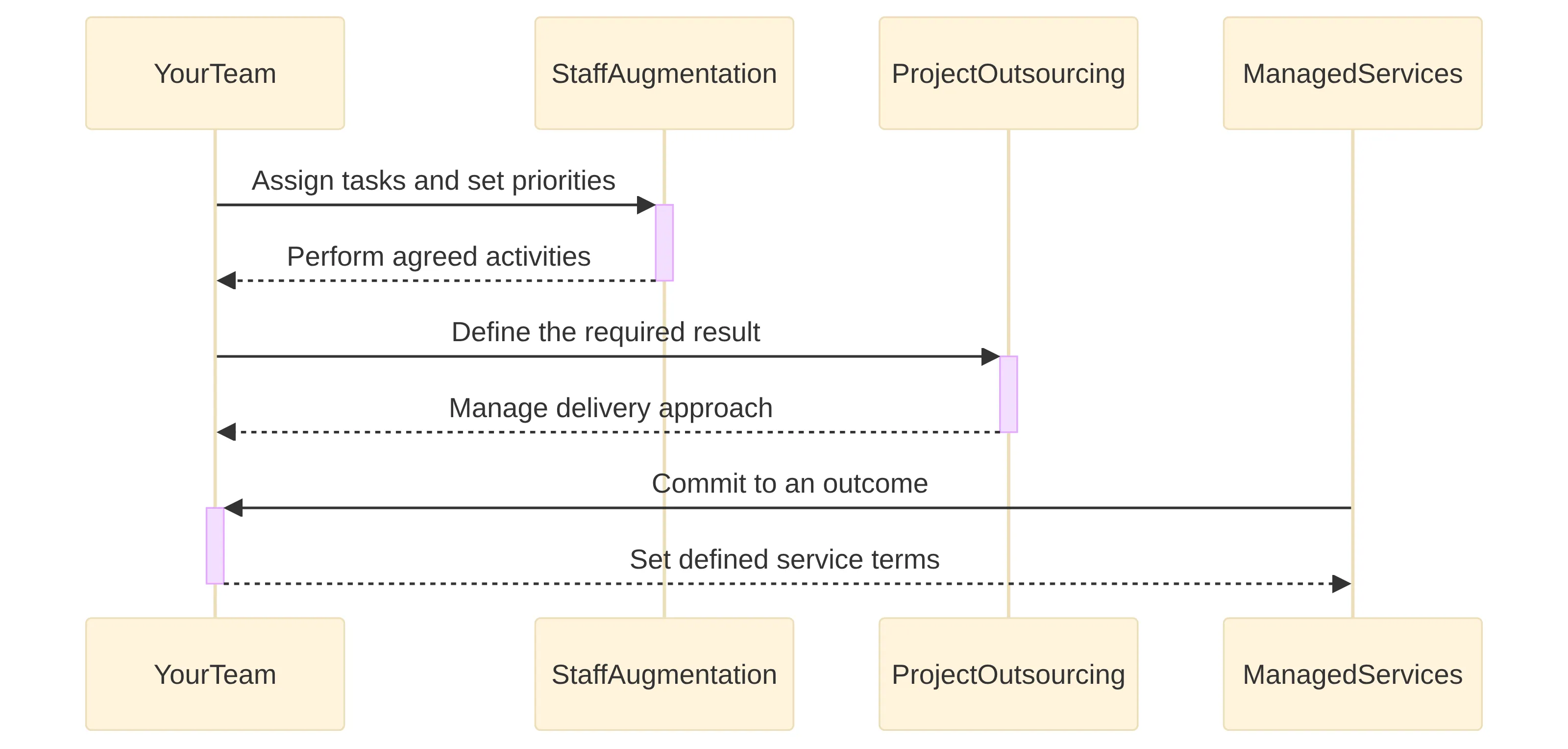
Staff augmentation adds external capacity while you retain control
Staff augmentation adds external professionals to your engineering team for a defined need or period while you retain direct control of the work. The model addresses a capacity or skill gap without requiring a full-time hire: you add people to an existing delivery structure rather than handing the work to a separate provider-owned team.
The practical question is not simply whether you need more engineers. Staff augmentation fits when your organization knows what work must be done, has someone who can direct that work, and needs additional execution capacity or specific expertise. The external professionals may support a short-term project, respond to a hiring restriction, or add capability during a period of higher demand. Those uses describe the model’s purpose; they do not guarantee a particular speed, quality level, or financial result.
The model therefore leaves a significant part of delivery ownership with you. You retain the roadmap, priorities, working standards, and day-to-day direction. The arrangement can give you additional capacity, but it does not replace the internal leadership needed to use that capacity well.
Neutech offers month-to-month staffing augmentation plans that let clients scale up or down with 30 days notice, as described on our hiring resource page. That is a Neutech-specific commercial condition, not a universal feature of staff augmentation. If you compare providers, treat the engagement period and notice terms as questions to document rather than assumptions about the category.
That division affects how you should define the engagement. Your organization normally supplies the product context, decides which work has priority, reviews the output, and determines whether the work meets its standards. The provider may supply the people and handle agreed employment administration. Those functions are distinct from deciding what the team builds and how the work is accepted.
Your organization retains design authority, priorities, and standards in the staff augmentation model. The provider handles employment, payroll, and benefits for the people it places. This means the engagement can reduce some administrative tasks without transferring technical accountability for the product or system.
Before work starts, assign the internal roles that will exercise that authority. Identify who sets priorities, who reviews technical output, who approves changes, and who resolves conflicts between delivery work and other internal commitments. If those decisions have no clear owner, the arrangement may add people without creating usable capacity.
How an augmented engineer works inside your team
An augmented engineer works inside your environment, follows your processes, and reports to your managers for day-to-day execution. The person can join your existing team, attend stand-ups, use your tools, follow your coding and security standards, and report to your lead.
Integration is the operating feature that distinguishes staff augmentation from a provider-owned delivery lane. The engineer is expected to participate in the communication, review, and technical routines that already govern your project. You therefore need to provide the access, context, decision paths, and working agreements required for that participation. The specific tools, meeting schedule, and access permissions remain matters for your organization to define.
Your managers usually assign priorities, coordinate daily work, review output, and decide how added capacity fits into your systems and processes. The manager or technical lead is not only an administrative contact; that person connects the additional engineer to the backlog, architecture decisions, review standards, and release work.
A typical operating sequence looks like this:
Your team defines the work, priority, acceptance expectations, and access required.
The augmented engineer joins the relevant workflow and receives tasks through your management structure.
Your manager or technical lead coordinates the work and reviews the output.
Your organization decides whether the result is accepted, revised, released, or carried forward.
The sequence keeps control with your team. It also makes internal management capacity a condition of the model rather than an optional extra.
The engineer integrates into your existing workflow while your team retains operational control.
How staff augmentation differs from hiring, outsourcing, managed services, and consulting
The delivery-model comparison below uses control, accountability, and the thing supplied as the main distinctions. Staff augmentation combines external capacity with client-directed execution.
A service directed toward an outcome or service level
The provider commits to the defined service or outcome
Consulting
The consultant or consulting firm
Advice, recommendations, or a specialized approach
Your organization acts on the advice and manages its resulting decisions
The central boundary is who controls execution and what the engagement promises. With staff augmentation, you manage the augmented staff and receive an input: people performing activities under your direction. Managed services place management with the provider and commit the provider to an outcome at a defined price. Staff augmentation supplies an input without a commitment that the activity will produce the desired outcome.
Outsourcing also transfers delivery management to the provider, although the scope may be a project or a function rather than an ongoing service. Consulting is different again: it supplies advice or recommendations through an externally managed engagement rather than adding an executor to your team. Permanent hiring fits a role that is permanent and core to your business; staff augmentation adds capacity without a full-time hire.
Use the distinction as a decision test. Choose a people-and-capacity model only when your organization wants to direct the work. If you want another organization to manage delivery or own a defined outcome, compare a provider-led model instead.
When the model fits a capacity or skill gap
The fit question is whether the need is execution capacity or direction. The model can add capacity without permanent hiring and can provide specific expertise that is missing internally. In IT work, that expertise may include software engineering, DevOps, quality assurance, or cybersecurity support for a high-priority project.
The strongest fit is an execution-capacity problem. Your team has a defined backlog or technical need, an internal lead can assign and review the work, and the additional professional can operate within your existing environment. Your team may be able to absorb people faster than it can hire them, but the arrangement still depends on having enough direction for those people to act on.
Staff augmentation is a poor fit when your organization lacks internal leadership to direct the work or wants the provider to own the outcome. Those conditions point to a direction or accountability gap rather than a simple shortage of execution capacity.
Use this short test before comparing providers:
Can an internal manager or technical lead assign work and review the result?
Is the missing need a specific skill or additional execution capacity?
Does your organization want to retain control of priorities, standards, and acceptance?
Would you rather have a provider manage delivery against an outcome?
If the first three answers are yes and the last answer is no, staff augmentation merits evaluation. If the missing piece is direction or provider-owned delivery, start with a different engagement model.
How common the model is - and what that evidence does not show
Staff augmentation is used as a temporary strategy by IT organizations addressing short-term capability deficiencies, hiring restrictions, or changes in demand. Organizations may work through IT service providers or contract directly with independent contractors. Common use cases include new product launches, short-term skill shortages, global market expansion, and seasonal hiring surges.
Those examples describe situations in which the model may be relevant; they do not establish that every organization uses the same arrangement or that the model is appropriate for a particular team. Your decision still depends on the work, the internal management structure, and the responsibility boundary you want.
Oyster states that U.S. staffing companies connect around 11 million temporary and contract workers with jobs in a typical year. The 11 million figure covers temporary and contract workers connected with jobs by U.S. staffing companies in a typical year; it does not measure staff augmentation alone and cannot establish a market-wide prevalence rate for this specific model.
Treat broader contract-workforce figures as context rather than proof of fit. For your organization, the more useful question is whether the need is temporary or specialized, whether internal leaders can absorb the added professionals, and whether you intend to retain delivery control.
What staff augmentation costs and what changes the price
Staff augmentation commonly uses time-based billing for talent capacity. A comparison table lists time-and-materials billing per person for staff augmentation, while managed services use a fee tied to scope or an outcome. Staff augmentation may bill an hourly rate per contractor against approved timesheets, covering contractor pay, employer burden, and the staffing firm’s margin.
That structure means your cost discussion should start with the unit being purchased and the time being recorded, not with a promise of savings. Ask how the provider defines the billable unit, how approved timesheets are handled, which employment or administrative costs are included, and what happens when the required capacity changes.
A Cleveroad roundup of U.S. staff-augmentation providers lists three hourly price tiers: $50 to $100, $100 to $150, and $150 to $200. The roundup is a dated market example rather than a universal price: the tiers come from a U.S. provider roundup, and it does not establish that every role, provider, or engagement falls within them.
Use the ranges only as bounded comparison context. Do not present one of the tiers as your expected quote without matching the role, requested expertise, expected time, contract terms, and billing assumptions to the actual requirement.
A cost worksheet should make the commercial assumptions visible before you compare proposals. Record these items separately:
The role, capability, and level of expertise requested.
The expected hours, duration, and method for approving time.
The rate structure and whether it is time-and-materials per person.
Contractor pay, employer burden, staffing margin, and other included administrative costs.
The conditions for scaling capacity up or down and ending the engagement.
Any difference between a people-based engagement and a provider-owned scope or outcome.
Direcstaff says it quotes requirements individually, so a single published tier cannot answer every pricing question. Compare like with like: the same work package, capacity assumption, duration, responsibility boundary, and commercial terms.
What the client must manage after the engagement starts
Staff augmentation can increase management overhead because you manage individual subcontractors, and knowledge may remain vested in individual personnel. The practical consequence is that additional capacity also creates coordination work: someone must maintain priorities, review output, preserve context, and manage changes in the team.
The CGI comparison lists no service-level commitment as a disadvantage of using staff augmentation as a permanent operating model. That boundary matters when your organization needs a provider to commit to an outcome or defined service level. Staff augmentation supplies people under your direction; it does not, by itself, transfer that service commitment to the provider.
Knowledge continuity deserves explicit attention because knowledge may remain vested in the individual, as with internal staff, but with less control. Keep work connected to your systems and practices through documented decisions, code review, shared working context, and a clear handoff plan. These are operating controls for your team, not automatic outcomes of the engagement model.
Using staff augmentation as a permanent mode of operation may involve higher cost, according to the CGI comparison. Treat that statement as a qualification about the model’s permanent use, not as a universal cost conclusion. Compare the full operating burden, including internal management time and continuity work, rather than comparing hourly rates alone.
Integrating augmented workers into your team can create potential co-employment and worker-classification risks. The risk is tied to the way the relationship operates, including the degree of integration and direction, so it belongs in the engagement review alongside access, supervision, and contractual responsibilities.
Record who employs the professionals, who directs daily work, what the provider handles, and how the working relationship will operate. Keep those facts consistent across the proposal, operating plan, and contract questions. Do not assume that calling an arrangement staff augmentation resolves the classification question.
Managing people, continuity, and relationship risks remains with the client.
Record the conditions before evaluating a provider
An evaluation record turns a general interest in staff augmentation into a defined decision. Use one document to capture the need, the internal operating conditions, and the commercial questions that any provider must answer.
Record the following:
The need: the product, system, backlog, skill gap, or capacity pressure; the work that must be completed; and the reason a permanent hire is not the selected path.
The role: the technical capability, level of responsibility, expected contribution, and boundaries of the assignment.
Internal ownership: the manager or technical lead who assigns work, reviews output, resolves priorities, and accepts results.
Integration requirements: the tools, repositories, meetings, communication channels, environments, access permissions, coding practices, and security standards involved.
Delivery expectations: the work package, review points, acceptance conditions, dependencies, and escalation path.
Continuity: how decisions, documentation, code, credentials, and working context will be maintained if the assignment changes or ends.
Commercial assumptions: the billing unit, expected time, approval process, notice terms, scaling conditions, included administration, and treatment of unused capacity.
Risk questions: the employment, worker-classification, co-employment, procurement, data-access, and contractual questions that require a responsible internal owner. If in doubt, contact a qualified professional or the responsible authority promptly.
For financial services or healthcare work, include the security, access, data-handling, uptime, and escalation requirements that apply to the system. For any organization, use the record to test whether the proposed arrangement supplies people under your direction or transfers delivery to a provider. Those are different decisions.
Provider questions should test the proposed arrangement rather than rely on the category label. Ask who will perform the work, who will manage it each day, how your team will review output, what information the provider needs, how time is approved, and what happens when the required capacity changes.
Ask for the commercial assumptions in the same terms as your internal record. A proposal is easier to compare when it identifies the role, expected capacity, billing basis, engagement period, responsibilities, access conditions, and exit process. If a proposal describes an outcome while your team expects to direct individual professionals, resolve that difference before treating the proposal as comparable.
Identify staff augmentation through its operating boundaries
Read a staff augmentation arrangement through four operating boundaries:
Integration: External professionals work in your environment, follow your processes, and join your team for a defined need or period.
Direction: Your managers assign priorities, coordinate work, review output, and decide how the added capacity fits your systems.
Accountability: You retain direct control of the work; the arrangement supplies an input rather than a provider commitment to an outcome at a defined price.
Purpose: The model addresses a specific skill or capacity gap without a permanent hire.
This structure separates staff augmentation from adjacent models. Managed services or outsourcing place delivery direction and outcome responsibility with the provider; consulting is advisory-focused; permanent hiring creates a core employee role. Before considering the model, assess the defined need, internal management capacity, commercial terms, continuity, and risk questions.
What should a CTO clarify before evaluating staff augmentation?
Are “resource augmentation” and “team augmentation” different from staff augmentation?
They can describe the same model: adding external professionals to your team for a defined period while you retain control of the work. The terminology does not determine who manages the people, who owns delivery, or what the provider handles, so those responsibilities should be confirmed in the engagement terms.
Can staff augmentation become a long-term staffing model?
It can, but the arrangement may create additional management overhead and knowledge-continuity work when used permanently. Review whether a permanent employee, managed service, or another structure better matches the ongoing responsibility.
What should a U.S. company verify before integrating augmented engineers into its team?
Verify who employs the professionals, who directs daily work, which access and security controls apply, how output is reviewed, how time and capacity are approved, and how knowledge and access are handled at exit.
Start with the workstream scorecard
Use a workstream scorecard rather than a provider label as the starting point. Record who sets priorities, how stable the scope is, who can manage and review the work, who owns the deliverable, where knowledge must remain, and how much flexibility the engagement needs. Staff augmentation adds external engineers to your team under your management, using your tools and processes. Project outsourcing delegates a defined function or project to a provider that manages its team and delivers defined outcomes.
Read the control and accountability rows together. With augmentation, you retain control over tasks, priorities, architecture, and code. With outsourcing, the provider handles implementation, team management, and delivery within the requirements you define. The scorecard therefore distinguishes capacity added to your team from responsibility assigned for a defined deliverable.
When a workstream needs client-set priorities and close integration, mark its control row toward augmentation. When its result and acceptance conditions can be specified and a provider should carry execution, mark it toward outsourcing. If those conditions split across workstreams, record a hybrid pattern instead of forcing one label across the portfolio. Neither model is automatic.
Use the scorecard rows to make the operating choice explicit:
Control: Who assigns daily work, changes priorities, and owns architecture, code review, and security standards?
Scope: Are requirements expected to change during delivery, or can the result and acceptance conditions remain stable?
Capacity: Who will manage, review, onboard, and provide technical context to the people doing the work?
Accountability: Will your organization retain delivery responsibility, or will the provider carry responsibility for a defined deliverable?
Knowledge: Must working knowledge stay in your team and repositories, or is provider-held knowledge acceptable until handover?
Mark each row toward augmentation, outsourcing, or a hybrid arrangement. The pattern matters more than a single label: changing scope and retained control lean toward augmentation, while stable deliverables and provider-owned execution lean toward outsourcing. Split marks identify a workstream that may need a hybrid design or a separate ownership boundary.
Score the workstream before choosing a model
Apply the scorecard to each workstream rather than to the organization as a whole. Mark the control, scope, capacity, accountability, knowledge, and flexibility rows before comparing providers. Staff augmentation may fit when you have technical leadership and need additional capacity or specialist skills; outsourcing may fit when deliverables are stable and a provider should own execution; mixed rows support a hybrid arrangement. These are fit signals, not rankings.
Then test the marks against operating reality. Augmentation puts day-to-day direction, code review, and delivery responsibility with your organization. Outsourcing assigns execution of a defined result to a provider that manages its team. The work package and the allocation of decision rights determine which pattern is workable for a particular workstream.
Cost comparisons need careful boundaries. For engagements under 12 months, staff augmentation is typically 20% to 30% cheaper than outsourcing; this is a relative engagement-cost comparison for that duration, with the difference attributed to project-management and vendor-margin costs, not a prediction for your work.
The same source reports a projected software development outsourcing market value of $618 billion in 2026. That figure is a market projection, not evidence that either model will cost less for your work. Our month-to-month staffing-augmentation plans let clients scale up or down with 30 days’ notice. That is a specific Neutech term, not a general feature of staff augmentation.
The reported figure - 78% of businesses planned to expand IT staff augmentation - has no stated denominator or sampling frame; treat it as market context rather than a forecast for your organization, and use your own work package, operating constraints, and accountability requirements instead.
Convert the marks into a workstream decision:
If the control, flexibility, and knowledge rows lean toward augmentation, use that model for work your team can direct, review, and absorb.
If the scope and accountability rows lean toward outsourcing, define the deliverable, acceptance conditions, and provider-owned execution clearly.
If the rows split, consider a hybrid arrangement or separate the workstreams so each has an explicit ownership boundary.
Treat cost as a comparison row rather than a deciding shortcut; review onboarding, supervision, tooling, compliance, utilization, and knowledge transfer alongside rates.
First define the work, decision rights, required skills, and control requirements. When contracts, worker classification, sensitive access, security, or material operational risk is involved, contact a qualified professional or the responsible authority promptly.
The figures provide context, not a guaranteed price or outcome.
Read the score as trade-offs
Do not collapse the scorecard into one headline price. Use four gates before comparing commercial terms:
Control gate: Mark augmentation when your organization needs to assign work, set priorities, and retain architecture and code-review decisions. Mark outsourcing when the provider will manage execution within defined requirements.
Scope gate: Changing requirements lean toward augmentation or a hybrid arrangement; stable deliverables make provider-led execution easier to specify.
Capacity gate: Augmentation requires internal direction, review, and onboarding capacity. If existing leads are already at capacity, record that constraint rather than treating additional engineers as an automatic remedy.
Accountability gate: Keep delivery responsibility with your organization for a capacity model; assign responsibility for a defined deliverable to the provider for a project-delivery model.
After those gates, compare rates, ramp and scaling expectations, knowledge location, communication, security controls, and handoff. A hybrid model can place augmented engineers on core product work while an outsourced team handles a well-defined deliverable.
The most reliable sequence is to define the work first, assign decision rights second, and compare providers third. This order prevents a low hourly rate from hiding the internal management load of augmentation or the coordination and change costs of outsourcing.
A provider comparison should therefore show more than a price. It should show who directs the engineers, who reviews the work, how scope changes are handled, where knowledge remains, what evidence supports quality, and what happens when the engagement ends. Those answers let you compare like with like.
A defined operating model makes provider comparisons more meaningful.
Fill in the workstream scorecard
A work package gives each model the same starting point. Staff augmentation works best when your organization already owns the roadmap, architecture, backlog, code review, security standards, and day-to-day delivery decisions. A project with defined deliverables can instead be assigned to a provider that manages execution.
Describe the work in operational terms rather than using only a role label such as backend engineer or delivery partner. Your brief should make clear what must change, what must remain under internal control, and what evidence will show that the work is complete.
Complete one scorecard for each workstream before requesting a proposal:
Work objective: Name the product, system, feature, or workstream and the change or deliverable required.
Scope stability: Separate fixed requirements, sprint-level changes, and unresolved discovery.
Required skills: Distinguish ongoing capacity from specialist capability needed for a limited period.
Internal capacity: Identify the manager, technical reviewer, product contact, onboarding owner, and knowledge-transfer owner.
Ownership boundary: State who owns implementation, delivery coordination, documentation, and handoff.
Access and controls: Describe the repositories, systems, data, environments, and security standards the work may require.
Exit condition: Define when the added capacity, outsourced workstream, or transition should end.
After recording the fields, mark each row toward augmentation, outsourcing, or hybrid. The record does not force every workstream into one model; it shows where control, scope, capacity, knowledge, and accountability point.
Scope stability is an early gate. When requirements change every sprint, augmentation or a hybrid model may be easier to adjust because you can redirect people and priorities inside the existing delivery process. Fixed-scope outsourcing for daily product iteration can generate change orders when priorities change repeatedly.
Management capacity is a second gate. If your leads cannot provide direction, code review, and onboarding, augmentation may add coordination work at the same time you are trying to remove a capacity constraint. If neither your team nor the provider can clearly own the missing responsibility, pause the comparison and rewrite the work package.
A shared work package gives each delivery model the same starting point.
Use the score to test operating mechanics
Use the table as evidence for the scorecard marks, not as a universal performance ranking.
Scorecard row
Augmentation-leaning evidence
Outsourcing-leaning evidence
Control
You assign work, set priorities, and retain control over architecture, code, and review standards.
The provider manages its team and implementation within your requirements and acceptance conditions.
Delivery responsibility
Your organization retains responsibility for delivery.
The provider carries responsibility for the defined deliverable.
Scope changes
You can generally reprioritize the people you have engaged.
Scope changes generally require a contract amendment or renegotiation.
Commercial structure
Commonly hourly or daily time-and-materials rates.
May use fixed-price, milestone-based, or outcome-based billing.
Initial start and scaling
One comparison reports a 1-2 week start time and scaling that can take days.
Comparisons report several weeks for discovery and a signed statement of work, with later scaling potentially taking weeks to months.
Knowledge location
Knowledge stays in your team and repositories.
Knowledge may remain with the provider until handover.
Communication and review
Engineers participate in your workflows, while your team retains code-review and security-standard decisions.
Communication gaps can relate to language, time zones, and culture; a technical counterpart and acceptance conditions remain important.
Mark the row from the work package, then ask each provider to explain how its proposal matches that row. This keeps a rate, start-time estimate, or delivery label from hiding a different allocation of responsibility.
The table describes model mechanics, not universal performance. A time-and-materials arrangement can still have a defined scope, and a fixed-price project can still require substantial client review. The contract, work package, and actual allocation of decision rights determine how the model operates.
Ramp time and scaling time are also different questions. One comparison reports a 1-2 week start time for staff augmentation and several weeks for project outsourcing when discovery and a signed statement of work come first. Another comparison reports that later scaling may take days for augmentation and weeks to months for outsourcing. Ask providers to separate candidate availability, onboarding, discovery, contracting, and expansion rather than giving you one blended estimate.
Communication and knowledge location affect the amount of control you can exercise after kickoff. With augmentation, external engineers use your tools and processes, and knowledge generally stays in your team and repositories. With outsourcing, knowledge may remain with the provider until handover, creating a dependency that should be addressed in documentation and transition planning.
Outsourcing can also bring communication gaps, less control, security concerns when sensitive data is shared, and variable quality. These are evaluation questions rather than automatic defects. Ask how the provider will communicate decisions, document work, expose progress, handle sensitive access, and let your technical counterpart inspect the result.
Validate the people and controls behind the score
Treat internal capacity as a scorecard gate, not a simple headcount question. Mark augmentation only when the work package names the people who will set direction, review code, and onboard the engineers. If those roles are already at capacity, a provider-owned workstream or a staged plan may fit the constraint. This follows the operating responsibility recorded in the scorecard; it is not a judgment about engineer quality.
Complete the capacity row with a named manager, reviewer, onboarding owner, and person responsible for absorbing knowledge. Then record whether the team can monitor productivity and development progress. A gap in any role is a reason to revisit the ownership boundary before requesting proposals.
Use this internal capacity check before choosing augmentation:
Can a named technical manager set priorities and monitor progress?
Can a named reviewer assess code and make architectural decisions?
Can someone provide repository, environment, and workflow orientation?
Can your product or engineering lead answer questions without delaying existing work?
Can your team document decisions and transfer knowledge as the engagement changes?
Can your organization evaluate productivity and development progress throughout the engagement?
A company using full-time contractors or internal employees needs technical managers who can evaluate productivity and monitor development progress. If you cannot staff those responsibilities, do not assume that more individual engineers will solve the problem. Revisit whether the work should be assigned as a provider-owned outcome.
Specialist duration is another fit test. Staff augmentation can provide access to rare expertise when your project needs a skill that you do not want to keep on staff year-round. That pattern suits a focused capability gap when your team can still define the work, provide technical context, and review the contribution.
Write the specialist need as a bounded capability statement. Identify the system or workstream, the decisions the specialist may make, the artifacts they must leave behind, and the internal person who will absorb the knowledge. The specialist role does not transfer your responsibility for direction, documentation, or acceptance.
Test whether the provider can own an outcome
Provider-owned delivery requires a result that you can describe and evaluate. Outsourcing may be a poor fit when the work is core intellectual property, the finished result cannot be described clearly, or no internal technical counterpart can review and accept the work. Assigning an entire project to an outsourced team transfers responsibility for that project’s outcomes to the team, but it does not eliminate your need to define the result and acceptance conditions.
Ask whether the provider can own a workstream without taking control of your unresolved product decisions. If the answer depends on daily reprioritization from your team, the work may be better structured as augmentation or a hybrid arrangement. If the result, boundary, and acceptance test are clear, provider-led delivery becomes easier to govern.
Outsourcing has clear boundaries that should stop you from using it as a generic answer to an unclear problem:
Unstable product work: Fixed-scope outsourcing can generate change orders when priorities change every sprint.
Core intellectual property: A core differentiator may require control and knowledge retention inside your organization.
Undefined completion: A provider cannot supply clarity when you cannot describe what finished means even roughly.
No internal counterpart: Someone inside your organization must review and accept the result.
Continuous operational ownership: A project deliverable is different from a function that must be owned continuously.
When any boundary applies, narrow the workstream, retain internal control, or choose a model that matches the unresolved responsibility. Do not call a project outcome-defined when the provider is actually waiting for daily product decisions.
A function that needs continuous ownership requires a different test from a project with a finish line. Augmenting an on-call rotation does not solve a function that needs 24/7 ownership; a managed SRE service does. The practical boundary is responsibility for the operating function, not the number of engineers available.
Define whether you need people who join an existing rotation or a provider that owns the service function. Specify escalation, operating responsibility, access, review, and acceptance conditions before selecting a delivery model. If those responsibilities are not yet defined, do not treat an available engineer as a substitute for an operating service.
Build a total-cost and coordination ledger
A total-cost ledger prevents you from comparing a vendor rate with an incomplete picture of your own operating cost. Onboarding, internal supervision, tooling, compliance, utilization, and knowledge transfer all affect the total cost of a staff-augmentation engagement. Outsourcing core product work can also create knowledge loss, communication overhead, and the cost of bringing work back in-house later.
Record each cost as a cash item, an internal-capacity item, or a transition item. Keep the categories separate so that a low external rate cannot hide the time your technical leads spend directing, reviewing, correcting, documenting, or coordinating the work.
Build the ledger around these fields:
External charge: Record the hourly, daily, monthly, fixed-price, milestone, or outcome-based amount and the assumptions behind it.
Onboarding: Estimate the internal time needed for access, architecture, workflows, domain context, and initial review.
Supervision: Record manager, product, and technical-lead time required to assign work and resolve questions.
Quality oversight: Record code review, acceptance review, test review, security review, and correction effort.
Tooling and access: Include environments, licenses, repositories, data controls, and any required coordination tools.
Compliance work: Record diligence, approvals, access reviews, documentation, and recurring control activity.
Utilization: Note expected productive capacity and the effect of waiting, context switching, or unassigned time.
Knowledge transfer: Record documentation, pairing, handoff, training, and the time needed to preserve context.
Coordination and rework: Include communication overhead, change handling, defect correction, and dependency management.
Exit or transition: Include the work required to end, renew, replace, or bring the engagement back inside your organization.
The ledger is a decision aid, not a promise of savings. Use the same fields for both models and keep assumptions visible.
A published rate is not a market-wide benchmark. Uvik Software publishes general rates around $50 to $99 per hour by role; those figures describe one provider’s published rates and should not be treated as Neutech pricing, a universal range, or evidence of total engagement cost.
The useful question is not whether one hourly rate is lower. Ask what work, supervision, delivery responsibility, quality oversight, and transition effort that rate includes. If the proposal does not state those boundaries, request a revised comparison before choosing.
Location should be evaluated through coordination requirements rather than price alone. Choosing offshore staffing purely on cost can create asynchronous friction when a developer is in a time zone 12 hours away, eroding the cost savings. Outsourcing can also bring communication gaps related to language, time zones, and culture.
Record the overlap your work requires, the decisions that cannot wait for the next working day, and the communication path for urgent issues. If the model depends on rapid product iteration or close architecture review, include the coordination load in the ledger. Do not treat a nominal rate as the cost of a delivery arrangement.
A lower published rate can still carry coordination and transition costs.
Use different models for different workstreams
A hybrid arrangement can combine augmented engineers for core product work with an outsourced team for a well-defined deliverable. The value comes from separating responsibilities, not from placing two providers on the same unclear work. Keep architecture, evolving product decisions, and strategic context with the team that must retain control; assign an external workstream only when its boundary and acceptance conditions are clear.
You can also start with augmentation while scope is forming and transition to outsourcing once the work stabilizes. That transition should be a deliberate change in responsibility, not an informal assumption that the provider will gradually take over.
Divide the workstream before you divide the vendors:
Keep changing requirements, architecture decisions, and core product priorities with the team that owns the product.
Assign stable modules, migrations, integrations, or other defined deliverables only when the provider can manage execution.
State the interface between the workstreams, including dependencies, review authority, environments, and acceptance.
Decide where documentation and operational knowledge must remain during the engagement.
Define the event that permits a transition from capacity support to provider-owned delivery.
Hybrid delivery was a prominent IT engagement-model trend in 2026, and organizations rarely chose one model exclusively. That trend does not determine your model. Your work package still needs one accountable owner for each outcome.
Before moving from augmentation to outsourcing, test whether the work has become stable enough to transfer. Confirm that the output is defined, the provider can manage the required team, acceptance criteria are written, knowledge-transfer obligations are clear, and your internal counterpart can review the result.
If the work has not reached that point, keep the responsibility boundary unchanged and improve the work package first. If it has, record the new owner, scope, decision rights, handoff artifacts, and commercial terms in the applicable statement of work.
Turn the choice into provider questions
A provider conversation should test the proposed operating model, not only the provider’s profile. Ask questions that expose who will work, who will direct the work, who will own delivery, how knowledge will be retained, and what the agreement says when circumstances change.
A staff-augmentation arrangement commonly uses a master services agreement or staffing agreement for the overall relationship and a statement of work or work order for each placement. The placement document commonly identifies the role, candidate, bill rate, start date, and expected duration. Use that structure as a prompt to locate the terms that affect your specific engagement.
Ask about the people and their integration:
What seniority and specific skills does each proposed engineer bring to the work package?
Which tools, repositories, meetings, review practices, and communication channels will the engineers use?
Who will provide onboarding, daily direction, code review, and architectural decisions?
What internal management time does the provider expect from your team?
How will the provider handle a skill mismatch, absence, replacement, or change in workstream?
What artifacts will document decisions and preserve knowledge for your team?
How will you and the provider monitor productivity and development progress?
The answers should match your selected model. A provider offering augmentation should explain how its engineers will work under your direction. A provider offering outsourcing should explain how it will manage execution and demonstrate progress toward the defined outcome.
Ask questions about accountability and performance evidence:
Which party owns daily task assignment, technical decisions, delivery coordination, and acceptance?
What is the provider responsible for delivering, and what remains your responsibility?
How will progress, risks, defects, dependencies, and changes be reported?
Which acceptance conditions will show that the work is complete?
What evidence can the provider provide for comparable skills, work, or delivery practices without exposing confidential information?
How will documentation and knowledge transfer occur during the engagement rather than only at the end?
What happens if the work cannot be accepted or the assigned people do not fit the stated need?
Do not accept a performance claim that cannot be connected to your work package. A clear role history is not the same as evidence that a provider can own your particular outcome, and a list of engineers is not the same as a delivery plan.
Before signing, review the contract terms that define the operating boundary:
Scope, role, required skills, work location, and who directs the work.
Rates, billing cycle, payment terms, overtime, expenses, and any rate-change process.
Start date, expected duration, renewal process, and termination notice.
Intellectual-property ownership, confidentiality, data handling, and obligations that survive termination.
Replacement, continuity, knowledge transfer, and documentation responsibilities.
Non-solicit or direct-hire provisions and any conversion fee.
Access, security, review, incident handling, and return or deletion of information.
A proposal is not a substitute for the agreement. Keep the work package and the contract aligned so that the person directing the work, the party owning the outcome, and the commercial terms describe the same arrangement.
The strongest proposals explain responsibility, evidence, and operating boundaries.
Make access and production responsibility testable
An external engineer who can commit code, modify build scripts, access package registries, or deploy infrastructure becomes part of your software production system. Apply equivalent identity, authorization, provenance, and review controls to that access.
Put the access boundary in the work package and implementation plan. Identify which repositories, environments, registries, infrastructure components, and data the work requires; who approves access; how changes are reviewed; and how activity can be attributed to the responsible identity. Treat access as a delivery responsibility, not as an onboarding detail.
Make these controls explicit before external engineers touch production systems:
Named identities and role-based authorization for each environment.
Review requirements for code, build changes, package changes, and infrastructure changes.
Traceable provenance for commits, deployments, dependencies, and approvals.
Confidentiality and intellectual-property obligations that match the systems and data involved.
A documented process for access changes, removal, incident response, and knowledge transfer.
A clear owner for security standards and acceptance of production changes.
An outsourcing label does not remove the need to inspect access. An arrangement that functions like staff augmentation can still create worker-classification or co-employment concerns, and a provider-managed team still needs controls appropriate to the systems it can affect.
Bring qualified reviewers into material-risk decisions
Some delivery-model questions are not engineering questions alone. Staff augmentation can create worker-classification and co-employment concerns because external workers are integrated into your team. Outsourcing may have cleaner boundaries, but an arrangement that functions like staff augmentation can still raise those concerns.
Bring your responsible legal, procurement, or security function into the decision promptly when the engagement involves worker classification, co-employment, contract uncertainty, sensitive or regulated access, material operational risk, intellectual-property restrictions, or unusual termination and continuity terms. The review should examine the actual working arrangement, not only the label on the proposal.
Use a simple escalation sequence:
Define the work, decision rights, required skills, access, and proposed ownership model.
Mark the issues that could affect classification, confidentiality, security, procurement, or continuity.
Give the responsible reviewers the work package, proposed contract structure, access plan, and risk assumptions.
Resolve the material conditions before work begins or narrow the engagement until they are resolved.
Do not select a model only because its headline rate is lower. Do not assume that contractual and compliance obligations are interchangeable between augmentation and outsourcing.
Convert the decision into a project brief
The right delivery model is the one whose responsibilities match the work. Staff augmentation fits a team that can direct engineers and needs flexible capacity or specialist skills. Outsourcing fits a defined deliverable that a provider can manage and own. A hybrid approach fits separate workstreams with separate ownership boundaries.
Turn your decision into a concise brief containing the work objective, scope stability, required skills, decision rights, internal management capacity, architecture and code ownership, delivery accountability, access requirements, knowledge-retention plan, cost-ledger assumptions, and material-risk questions. A qualified professional should decide individual legal, procurement, classification, security, or compliance suitability where those issues apply.
We can use that brief to understand the engineering capacity or defined software workstream you need, the skills involved, the control you want to retain, and the responsibilities an external team would carry. Include the operating constraints and risk questions rather than sending only a role title or a target rate.
Begin with the responsibility decision
The responsibility decision is the shortest route through a staff augmentation vs managed services comparison: decide who should direct the work and who should own the outcome. With staff augmentation, your managers direct external engineers and you own the outcome. With managed services, the provider manages delivery and owns the result within the agreed scope and service levels.
That distinction determines more than the reporting line. It affects how much management capacity you need, how precisely you must define the work, how changes are approved, where operational knowledge sits, and what your contract must measure. A flexible engineering need and a defined operational function may both require outside help, but they transfer responsibility in different ways.
The delivery-model choice should follow the work rather than a preference for a particular label. Staff augmentation fits when you need additional capacity or skills and can keep an internal lead involved in daily direction. Managed services fits when you can describe an ongoing function or outcome clearly enough for a provider to manage it against agreed measures.
A Deloitte 2024 survey of more than 500 executives reported that outcome-based models and insourcing were both gaining ground. That finding does not select a model for your organization; it reinforces the practical point that delivery arrangements can change as ownership, scope, and internal capacity change.
Separate capacity from an outsourced outcome
Staff augmentation adds external professionals to your team while your managers direct the work. The engineers work within your environment, follow your processes, and receive day-to-day priorities from your leads. You retain responsibility for sequencing work, resolving competing priorities, reviewing performance, and accepting the resulting delivery.
Staff augmentation therefore buys capacity rather than a finished operational outcome.
Managed services hand a defined function or outcome to a provider that manages delivery and is accountable under the agreed scope and service levels. The provider leads its own team and processes, while you receive the reporting, governance, and performance information specified in the arrangement.
A managed service requires a clearer boundary around what is included, how completion or performance is measured, and how changes are handled. Service levels can define measures such as 99.9% uptime or a support-ticket response within a specified number of hours; those measures are examples of contract terms, not universal performance promises.
Commercial and duration labels help distinguish the models, but they do not replace a responsibility analysis. One comparison describes staff augmentation as flexible, typically 3-12 months, while managed services are described as long-term contracts, typically 24+ months. Another comparison describes staff augmentation as typically lasting 6+ months and managed services as typically involving a long-term contract of 24+ months. Treat those figures as source-specific descriptions rather than rules for every engagement.
A separate provider claim states that its staff augmentation is typically up to 10% to 30% cheaper than standard legacy suppliers because it sources through its own technology rather than manual recruiter networks. That statement concerns that provider’s offering in the comparison, not staff augmentation generally. Your decision still depends on the work, controls, management effort, and commercial terms in front of you.
The models differ in both commercial duration and the way performance is defined.
Compare control, accountability, and operating effort
Control and accountability differ across the two models. The comparison below connects each difference to the operating consequence you should plan for.
Criterion
Staff augmentation
Managed services
Who directs the work
Your managers direct tasks, priorities, and timelines
The provider manages its team and delivery
Who owns the outcome
You own the result
The provider owns the result within the contract terms
Your team provides ongoing direction and performance management
The provider handles day-to-day team leadership and delivery management
Quality control
You control quality directly through your own process
You depend more on the provider’s internal quality processes
Knowledge location
Knowledge generally stays closer to your team and systems
Knowledge sits largely with the provider
Commercial pattern
Usually time or headcount based
Usually a recurring or fixed fee tied to scope, deliverables, or service levels
Management capacity is the operating constraint that is easiest to underestimate. Staff augmentation requires your ongoing management, including priorities, reviews, coordination, and decisions about changing work. If your engineering managers cannot take on the daily management of 5 additional contractors, a managed service can remove that burden by handling scheduling, quality assurance, and performance management.
Continuous coverage creates a different boundary. For long-term needs such as 24/7 SOC monitoring, application support, and managed cloud infrastructure, managed services can provide continuous coverage with shared resources. Use that comparison only for the continuous-coverage condition it describes; it does not establish a general staffing requirement for every managed service.
Knowledge retention and quality control should be explicit decision criteria. With staff augmentation, external engineers work alongside your team, so architectural context and working knowledge generally remain nearer to your systems and internal people. With managed services, more of that operational knowledge remains with the provider unless the contract requires documentation, access to artifacts, and an orderly handover.
Staff augmentation also gives you direct control over quality decisions, but that control consumes internal engineering time. Managed services shift day-to-day quality processes to the provider, which reduces direct control and makes reporting, acceptance criteria, service levels, and escalation paths more significant. Choose the model whose accountability structure your team can actually operate.
Separate ramp time from engagement duration
Ramp time and engagement duration measure different parts of the decision. Staff augmentation often starts in days to a few weeks, while managed services usually take longer because scoping and transition must be completed before the provider assumes the defined function. A fast commercial start does not mean that an engineer can contribute meaningfully before access, technical context, workflow alignment, and review practices are in place.
A staff augmentation contractor typically takes 2-4 weeks to onboard, including access setup, introduction to your technology stack, and alignment with your culture and processes. For a team of 5, the estimate is 10-20 person-weeks of lost productivity during staff augmentation integration. Use that estimate as a planning consideration for a five-person team, not as a universal forecast.
Staff augmentation engagements range from a few weeks for a specific deliverable to a year or more for an ongoing role, and they can be extended, scaled, or wound down as project needs change. That flexibility supports work whose duration or priorities are not fully settled at the outset.
Managed services usually require more preparation before starting because scope, service levels, transition responsibilities, and reporting must be defined. The longer-term pattern described for managed services makes continuity and exit planning material from the beginning. Ask what must be ready before service commencement, what the first measurable operating period will be, and how the arrangement ends if the function returns in-house or changes owners.
Provider selection timing should be separated from onboarding timing. One cited comparison gives a vetted staff augmentation partner 2-3 profiles in 72 hours and selection in days 3-5. That comparison describes one partner’s process; it does not guarantee that every provider, role, security review, or hiring market will follow the same schedule.
Use a timeline with separate checkpoints for profile selection, contracting, access approval, technical onboarding, first meaningful contribution, and steady-state delivery. The resulting plan is more useful than a single start-date promise because it exposes where your own approvals or systems may delay productive work.
A start date is less useful than checkpoints that expose the path to productive work.
Test scope and leadership capacity against each model
Staff augmentation often fits time-bound or changing work when you have leads to direct the work and need additional capacity or specific skills. Priorities that change sprint to sprint favor the model because your managers can redirect the engineers without renegotiating the entire delivery boundary. Staff augmentation can struggle without an internal owner.
Managed services often fit ongoing, well-defined functions that you want a provider to run. Written deliverables, acceptance criteria, recurring operations, and required service levels provide the basis for the provider’s accountability. If you cannot document requirements, deliverables, and acceptance criteria, a managed service can be hard to scope and measure.
Use these branches to turn the distinction into a working decision:
Choose staff augmentation as the starting point when your priorities may change, your internal lead can direct daily work, and you need people or specific skills rather than a provider-owned outcome. Assign that internal lead before adding external engineers.
Choose managed services as the starting point when the function is ongoing, repeatable, and measurable. Define the function and its measures before asking a provider to own delivery.
Treat 24/7 operational coverage as a separate test. Managed services fit when you need 24/7 operational coverage. Do not solve a structural ownership requirement with a few augmented engineers who still depend on your team for every shift and escalation.
Stop and clarify the model when nobody has time to lead augmented engineers or when the managed-service scope cannot be written down. Resolve that ownership or scope gap before selecting a provider.
Budget and contract flexibility should support the fit decision rather than decide it alone. One selection guide says staff augmentation fits a monthly budget per engineer of $2,000 - $7,500. That is a source-specific budget reference, not a universal market price or a quote for your role, seniority, location, or requirements.
At Neutech, we offer month-to-month staff augmentation plans that let clients scale up or down with 30 days’ notice. That business arrangement applies to our staff augmentation service; it does not turn managed services into a month-to-month model or remove the need to define ownership, access, and delivery responsibilities.
Choose the model whose scope and leadership demands your organization can actually support.
Compare total cost rather than rates alone
Commercial structure follows the ownership split. Staff augmentation is usually priced by time and materials, per person, per hour, day, or month, so cost flexes with headcount and duration. Predictability depends on how well you estimated the scope and how often priorities change.
Managed services are usually priced as a recurring fee tied to a defined scope or outcome, which can make budgeting more predictable. Those inclusions only matter if the contract describes them clearly.
Staff augmentation usually has a lower hourly cost, but the relevant comparison is total cost - including management time, tools, and overruns - with the managed-services fee for the outcome. A lower rate does not answer whether your managers have enough time to direct the work or whether the expected duration is stable.
Build the comparison around the same work package:
Identify the outcome, function, or capacity each option must provide.
Add internal management, review, security, procurement, and transition effort to the staff augmentation case.
Identify what the managed-services fee includes and what counts as a change request.
Price the consequences of delay, rework, incomplete handover, or a return to internal ownership.
Separate flexible capacity from permanent capacity so a temporary model is not used to solve a long-term headcount need.
The cost decision becomes more defensible when both models are measured against the same responsibilities and operating conditions rather than against headline rates.
Ask providers to price the same work package under both models. A staff-augmentation proposal should expose headcount, duration, and management assumptions, while a managed-services proposal should expose scope, included responsibilities, service levels, and change treatment. Comparable inputs prevent a fixed fee from appearing cheaper simply because internal responsibilities are omitted.
Use a mixed model only where ownership is clear
A hybrid arrangement can use managed services for high-volume, repeatable work and staff augmentation for high-impact or niche areas. The combination is workable only when the boundary between the two models is visible to your teams, providers, and control functions.
Define which group owns each function, who approves changes, where shared dependencies are managed, and how incidents or delivery defects cross the boundary. A managed service should not become a vague destination for unresolved work, and augmented engineers should not be expected to compensate for an undefined provider-owned function. Assign one accountable owner for each outcome even when several teams contribute to it.
Permanent capacity is a separate question from flexible delivery capacity. If you need permanent capacity rather than flexible capacity, neither staff augmentation nor managed services may fit; permanent recruiting may be the cleaner path.
Use staff augmentation when the need may scale down or change with the project. Use managed services when an ongoing function can be bounded, measured, and assigned to a provider. Choose a permanent internal path when the capability must remain part of your organization’s enduring structure, knowledge base, and management system. Do not force a temporary engagement model to carry a permanent organizational requirement.
A mixed model deserves a written responsibility map before contracting. Record the function, accountable owner, service boundary, dependencies, escalation route, reporting cadence, data access, and exit condition for each workstream. Then test whether a priority change in one workstream affects the other.
Approve the hybrid arrangement only when the interfaces are specific enough for your engineering managers and providers to act without negotiating ownership during an incident or release. If the boundary cannot be explained in a short operating document, simplify the model or define the missing responsibilities first.
Prepare onboarding or transition before delivery begins
Managed-services transition requires a different preparation pattern because delivery accountability is moving to the provider. Use a competent transition-management team and consider an early transition simulation or dry run as part of planning. Document architecture decisions, tribal knowledge, and undocumented workarounds before the provider takes over delivery accountability.
Transition material should identify system ownership, operating procedures, dependencies, known failure modes, credentials, monitoring, escalation routes, and unresolved work. The provider should be able to understand not only what the system does but also why the current team made key decisions. Start the service-level measurement period only when the transition boundary and acceptance conditions are clear.
The cited transition guidance recommends budgeting two to four weeks of structured transition and knowledge-transfer time before the managed-services SLA clock starts. A managed-services plan should show transition and knowledge transfer as a separate pre-service phase rather than treating the contract start date as the beginning of measured steady-state delivery.
Contracting, security classification, and access provisioning should run in parallel rather than waiting until after signature. Parallel planning does not mean granting access early; it means allowing legal, security, procurement, and engineering workstreams to prepare their approvals without making every dependency sequential.
In a cited study of contracts with detailed transition plans, 62% of the contracts had milestone-based payments and nearly 30% had time-based payments scheduled monthly or at another predefined increment. Payment timing should match a defined transition or delivery condition, with the condition, evidence, acceptance owner, and escalation route stated in the agreement.
Preparation time and payment conditions should be planned before delivery begins.
Make governance, security, and exit terms testable
Contract governance should convert expectations into terms that a team can inspect before work begins. Before signing either model, put code ownership, access and security, data handling, and exit obligations in the contract. For managed services, also define scope, acceptance, service levels, and change requests.
Use this checklist:
Code and intellectual property: Put full IP and code ownership in writing, and require code to remain in your own repository.
Scope and acceptance: For managed services, define deliverables and the test that proves each deliverable is complete.
Service levels: Specify targets by severity, the measurement method, and service credits where applicable.
Change control: State how a change is requested, priced, approved, scheduled, and recorded.
Access: Put least-privilege access, multi-factor login, and prompt offboarding in the contract.
Data: Define confidentiality, data-handling rules, and permitted data locations.
Reporting: Define weekly or monthly reporting and who attends each review.
Exit: For managed services, specify the documents, credentials, and transition support required at the end.
Governance becomes useful when each term has an owner and a test. Name who approves repository access, who accepts a deliverable, who measures a service level, who authorizes a change, and who confirms that offboarding is complete. Attach the required artifact to each decision, such as an accepted pull request, service report, access record, handover document, or credential-revocation record.
Use the same discipline for communication. Set the meeting cadence, attendees, escalation time, decision log, and reporting format before delivery starts. A contract that names a service level but does not define its measurement method leaves the parties with a number they cannot reliably interpret.
Exit readiness should be tested at the start of the engagement rather than added after a dispute. Confirm where source code, documents, credentials, configuration, operational history, and unresolved defects will be stored. Confirm who can retrieve them, when access is revoked, and what transition support is included.
Staff augmentation and managed services need different exit emphasis. Staff augmentation needs clear notice, scale-down, replacement, and access-removal terms. Managed services needs clear handover artifacts, credentials, service history, transition support, and acceptance of the returned function. Put those conditions in writing before either model becomes difficult to change.
Bring qualified reviewers in when risk becomes material
In regulated industries, control repository and environment access and use least-privilege credentials; the cited guidance associates these controls with HIPAA and SOC 2 obligations.
If you are in a regulated industry, prioritize providers with compliance vetting. A cited comparison says staff-augmentation data security is governed by your internal policies, while managed services requires a vendor security assessment and SOC 2 or equivalent vendor compliance. Treat those statements as decision prompts: identify the applicable obligations, map each access path, and assign an owner for approving the arrangement.
Operational ownership should be escalated when the work requires continuous coverage, privileged production access, or a provider-controlled transition. Do not use augmentation for a function that needs 24/7 ownership; the cited guidance says a managed SRE service addresses that structural problem. Managed services fit when you need 24/7 operational coverage.
Bring operational, security, legal, and procurement reviewers into the decision before contracting when the service touches regulated data, production systems, material uptime obligations, intellectual property, or a change in delivery accountability. Their role is to resolve the conditions that the engineering comparison cannot resolve by itself.
Engagement duration can also signal that the model needs another review. Use staff augmentation when you have 3+ months of sustained work; if you have 4 weeks of work, the cited selection guidance recommends using a freelancer instead. That boundary is a source-specific recommendation, not a universal contract rule, but it helps distinguish a sustained capacity need from a short deliverable.
Ask the responsible reviewers to decide whether the proposed model matches the work’s permanence, access, risk, and operating burden. Do not approve an arrangement simply because a provider can start quickly or because its commercial label appears familiar.
Turn the decision into a quote-ready brief
A quote-ready brief should make responsibility visible before you compare providers. Record the following:
The capacity, function, or outcome you need.
The internal person who will direct the work or govern the provider.
The stability of priorities and the level of scope definition available today.
The expected start window, duration, and conditions for scaling or ending the engagement.
The quality, acceptance, reporting, service-level, and escalation measures that matter.
The repository, environment, data, and production access required.
The ownership, confidentiality, change-control, handover, and offboarding terms that must be contractual.
The management effort and total cost you can support under each model.
Use staff augmentation when your team can direct changing work and needs flexible engineering capacity. Use managed services when you can define an ongoing function or outcome and want the provider to manage delivery against agreed measures. If neither description fits, pause and clarify whether the real need is permanent internal capacity, a bounded project, or a mixed arrangement with explicit ownership.
Individual operational, legal, security, procurement, and suitability decisions should be made by the qualified professionals responsible for those areas. Give those reviewers the brief, proposed responsibilities, access model, commercial terms, and exit plan so they can assess the conditions that matter to your organization.
What should a CTO clarify before choosing between the two models?
What does managed services mean in IT?
The term can refer to IT operations delivered under service-level agreements or to managed product delivery, where a provider owns an engineering outcome. Confirm which meaning applies, then define the function, scope, measures, escalation path, and accountability in the agreement.
What is the difference between managed services and project outsourcing?
Managed services usually cover an ongoing function or outcome under continuing service levels. Project outsourcing uses a fixed scope and agreed acceptance criteria, with the engagement ending at handover. Use the latter when the deliverable and completion test can be defined in advance.
Can staff augmentation and managed services be used together?
Yes. A hybrid arrangement can assign repeatable, high-volume work to managed services while using augmented engineers for niche or high-impact work. Document one accountable owner, boundaries, dependencies, escalation routes, access rules, and exit conditions for each workstream.
Is staff augmentation suitable when an organization needs permanent engineering capacity?
It may not be. Staff augmentation and managed services are flexible delivery models; if the capability must remain permanently inside the organization, permanent recruiting may be a cleaner path. Clarify whether the need is temporary capacity, an outsourced function, or enduring headcount before selecting a model.
Build a shortlist around evidence, not popularity
A staff augmentation shortlist should begin with the work your team needs to absorb, not with a ranking or a provider’s broadest marketing claim. Staff augmentation adds external specialists to your internal team while you retain control over the project, workflows, and team management. In this model, the proposed engineers work inside your repositories, tools, sprint cadence, architecture, and code-review standards. You still direct delivery.
For a startup or growth-stage product team, compare each provider against the same practical questions: Can the proposed person handle the technical gap? Will that person work naturally within your operating environment? Can your security controls cover the access they need? Do the engagement terms fit the time horizon and management capacity you have? Can the provider show how it screens and supports personnel after placement? A defensible shortlist records the answer to each question and keeps unknowns visible instead of converting them into a ranking.
Start with a comparison record rather than a scorecard that implies false precision. Give every provider the same fields for technical capability, seniority, integration, security, communication, commercial terms, and delivery proof. Mark each field as demonstrated, described, or unresolved. This lets you distinguish a provider that has answered a material question from one that has merely used the right vocabulary.
Confirm that staff augmentation fits the delivery need
Staff augmentation fits a need for specific engineering capacity inside a team that already owns delivery. You retain day-to-day direction, task delegation, and project management, while the external specialist contributes the skill or capacity your team lacks. That arrangement differs from managed services, where the provider controls service delivery against an agreed service structure.
Compare the models by control, responsibility, and the kind of commitment they create:
Criterion
Staff augmentation
Managed services
Project-based consulting
Permanent hiring
Primary focus
Add specific talent to an existing team
Hand off an ongoing function or service
Address a defined business or technical problem
Fill an enduring role within the internal workforce
Who manages the work
You manage the augmented person and work
The provider manages service delivery
Control is shared, with the consultant often guiding the approach
An internal manager directs the employee’s work
Who owns delivery
You retain project ownership
The provider commits to service delivery or an outcome
Responsibility depends on the defined engagement
The internal team retains delivery responsibility
Who supplies the capacity
An external specialist works within your team
A provider supplies and operates the service
A consultant or consulting team addresses the assignment
Your organization recruits and employs the person
Integration
High integration with your workflows
Often operates as a separate service lane
Integration varies by assignment
The employee joins the internal workforce and operating environment
Engagement shape
A defined capacity gap, short-term pressure, or niche expertise
Ongoing operations with defined service levels
A bounded problem, assessment, or specialized intervention
An internal role the organization intends to retain
The management distinction is central. Staff augmentation adds external capacity while your team directs tasks, project work, and day-to-day priorities. Managed services transfer service-delivery responsibility to the provider. Project-based consulting addresses a defined problem, with control and responsibilities set by the engagement. Permanent hiring places the role inside the organization, so the internal team manages the person and carries the longer-term staffing commitment.
Integration and flexibility also describe different decisions. Staff augmentation is relevant when a team has a specific skill gap or delivery constraint but wants to retain control of the work. Permanent hiring may fit when the need is intended to become an enduring internal role rather than a defined external capacity requirement. The contract or employment arrangement still determines duration, notice, and changes to the engagement; do not infer those terms from the model name alone.
Ask each provider to identify the delivery model, the person or team you would receive, who would manage the work, who would own the result, and what commitment the arrangement requires. Those answers show whether you need additional capacity inside an existing team, an outside service owner, specialized intervention, or an internal hire.
Managed services and staff augmentation also differ in what the commercial promise represents. Under managed services, the provider commits to an outcome at a defined price. Staff augmentation supplies engineering input or capacity without a commitment that the activity itself will produce a specified outcome. That distinction matters when your team has a clear technical direction and needs additional hands versus when you want an outside provider to own a service result.
Your first action is to write one sentence that names the gap: a missing skill, a short-term delivery constraint, or a niche capability inside an existing product team. If you cannot identify the internal person who will direct the work, or if you want the provider to own an operational outcome, pause the staffing comparison and examine a delivery model with clearer provider responsibility.
Set the same requirements for every provider
A provider comparison becomes useful only after you define the role and the conditions around it. Staff augmentation is intended to add specific talent to an existing team, so describe the gap in operational terms rather than asking for a generic software developer. The brief should make every provider respond to the same requirement.
Your comparison brief should include:
Technical scope: the languages, systems, architecture responsibilities, and production concerns connected to the work.
Domain context: the product environment and any financial services, healthcare, e-commerce, or data-system requirements that affect engineering decisions.
Team position: the internal manager or technical lead who will direct the work and the roles the proposed engineer will collaborate with.
Integration expectations: repositories, development tools, sprint cadence, code-review practices, documentation habits, and meeting participation.
Communication needs: working hours, required overlap with your United States team, escalation paths, and expected response windows.
Security boundary: the environments, data, credentials, pipelines, and production systems the person may access.
Engagement shape: the likely role duration, desired start window, capacity, billing basis, notice terms, and process for changing the requirement.
Required proof: the experience examples, technical assessment, references, vetting description, and named-person commitment you expect before selection.
Ask every provider to answer the same questions in the same order. What comparable technical work has the proposed person performed? How does your technical team assess candidates? Who will actually join the engagement? How will access and security controls be handled? Which engagement and billing terms apply? What support continues after placement? Consistent questions make differences visible without pretending that unlike providers can be ranked by a single label.
Normalize the answers before you compare them. A provider may describe a team while another proposes one engineer; a third may discuss a broad portfolio without naming the person for your role. Record the unit being offered, the experience that applies to the role, the controls that apply to the access boundary, and the commercial basis for the engagement. Do not treat a broad organizational capability as proof about the individual who would join your team.
Send the same role brief and question set to every provider under consideration. Require each response to identify the proposed person, delivery model, technical assessment, security approach, communication arrangement, and engagement terms. Keep a separate column for unanswered questions so the shortlist reflects what is established rather than what sounds plausible.
A shared brief makes differences between providers easier to verify.
Verify technical fit and actual seniority
Technical fit is more specific than a list of tools. Compare the proposed engineer’s architecture judgment, debugging approach, code-quality standards, production experience, and familiarity with the domain problem your team is facing. A provider’s stated technical coverage is a starting point; the individual’s ability to reason through your actual constraints determines whether the capacity will fit.
Engineer-led vetting can test architecture judgment, debugging ability, code quality, and production experience. Recruiter-only screening does not provide the same technical signal. Ask who conducts the technical assessment, what the assessment examines, and whether the process includes work similar to the role you described. You do not need an identical test for every role, but you do need a comparable basis for judging the people proposed.
Seniority also requires a direct check. Ask how the provider defines the level being offered, whether the proposed team mixes junior and senior engineers, and whether the person you interview is the person who will join. If the provider can substitute personnel, ask which conditions trigger a substitution and how the replacement’s capability will be assessed. Record the name, role, relevant experience, and technical assessment outcome for each person you are considering.
Ask the proposed engineer to explain a relevant technical decision rather than repeating a résumé summary. You can ask what constraints shaped the decision, how the person investigated a failure, which trade-offs were accepted, and how the result was reviewed in production. The point is to connect the stated experience to technical reasoning that resembles the work your team needs.
Use a technical conversation with the named engineer before you narrow the shortlist. Give that person enough context to discuss trade-offs in your architecture, debugging constraints, and delivery environment. If you cannot connect the stated seniority to the individual’s reasoning and production experience, keep the provider in an unresolved category rather than treating the label as established.
Check how proposed engineers will integrate with the team
Team integration is part of technical fit because the proposed engineer will work inside your repositories, tools, sprint cadence, architecture, and code-review standards. Ask how the person will receive context, join planning, participate in reviews, document decisions, and communicate blockers. The practical question is not whether the provider offers an external resource; it is whether that person can operate within the system your team already uses.
A useful integration plan names the first working relationships and routines:
the internal manager or technical lead who assigns and reviews work;
the repositories, environments, and communication tools required from day one;
the sprint or delivery cadence the engineer will follow;
the code-review and architecture forums the engineer will join;
the time-zone overlap required for planning, incident discussion, and decisions;
the escalation route when a dependency, access issue, or production concern blocks progress.
Communication and time-zone alignment should be stated as working conditions rather than left to assumption. Ask the provider to describe the proposed overlap with your United States team, the person responsible for communication, and the support available when the assigned engineer is unavailable. If the answer depends on a different person or an informal arrangement, record that dependency in the comparison.
Integration should also be visible in the first work handoff. Ask how the proposed engineer will receive the product context, architecture material, repository permissions, active priorities, and review expectations. Ask which parts of that handoff your team owns and which parts the provider supports. A clear division reduces ambiguity about whether the engagement is supplying capacity or asking the provider to manage delivery.
Your team retains delivery control in a staff augmentation arrangement, so integration does not remove your management responsibility. If your team has no available technical lead, no review capacity, or no owner for daily direction, treat that constraint as a fit issue and reconsider whether adding an individual contributor is the right engagement shape.
Match security requirements to the access boundary
Security requirements should follow the systems and data an external engineer can access, not only the person’s job title, seniority, or engagement type. Map the access boundary before you compare providers. A developer who works only with synthetic test data has a different control need from a developer who can reach production systems, customer information, payment flows, clinical data, or sensitive financial records.
A staff augmentation security review should cover more than a confidentiality agreement or a general supplier certification. Check the provider’s approach to:
individually assigned developer identities;
authentication, authorization, and least-privilege permissions;
development devices, workspaces, logs, and test data;
secure-development practices and code repositories;
continuous integration and deployment environments;
production access and approval paths;
incident response and escalation;
access expiration, offboarding, and credential removal.
One published external-developer control register organizes 24 security checks across six lifecycle stages: scope, identity, workspace, code, production, and exit. You can use those stages as a practical prompt for your own checklist. The useful result is not a score; it is a written connection between each control, the system or data it protects, the person who approves access, and the point at which the access ends.
For financial services or healthcare work, connect the security discussion to the actual data flows and systems involved. Ask which environments contain sensitive information, who can approve access, how development and production access differ, and which personnel or device controls apply. Cross-border processing questions should be tied to the relevant data flows and jurisdictions rather than treated as a generic label.
Give each provider the same access scenario and ask how its controls would operate at onboarding, during development, during production work, and at offboarding. If a response stays at the level of an NDA or a general certification without addressing identities, permissions, environments, incident response, and exit procedures, mark the security requirement unresolved.
Security fit depends on controls tied to the actual systems and data.
Request controls that can be verified before access
An external developer should receive an individually assigned identity with appropriate authentication, least-privilege permissions, documented approvals, and defined access-expiration conditions. Ask the provider and your internal system owner to identify who approves access, where approvals are recorded, which permissions are granted, and what event ends those permissions.
A practical control request can cover the following records:
the role assessment and system or data-flow map;
the categories of data the engineer may handle;
processing roles and applicable transfer safeguards where relevant;
the subprocessor list where another organization participates;
the role-access matrix and approval records;
the process for revoking access;
personnel safeguards, confidentiality terms, and training records;
device-security information for the working environment.
Offboarding should address more than disabling a user account. An account change does not necessarily revoke active sessions, API tokens, SSH keys, certificates, or service credentials. Ask for the revocation sequence, the owner of each step, and the record that shows completion. Apply the same question to temporary access granted for a release, incident, or production investigation.
For work involving European Union data or cross-border processing requirements, include the applicable processing roles, transfer safeguards, and subprocessor information in the review. Keep those questions tied to the data flows and jurisdictions in your engagement rather than adopting a generic checklist without examining the actual access boundary.
Turn the control discussion into a pre-access sequence:
Map the systems, environments, and data the proposed engineer may reach.
Assign an individual identity and document the requested permissions.
Record the approver, authentication requirements, and access-expiration condition.
Confirm the working environment, device controls, and personnel safeguards.
Record the offboarding owner and the steps for removing direct and indirect credentials.
Keep the record with the engagement documentation so access decisions can be compared with the original boundary.
Before access begins, require a control record that names the engineer, systems, permissions, approver, expiration condition, and offboarding owner. A provider that cannot explain those items should not move forward for an engagement that requires the affected access.
Compare engagement terms as part of provider fit
Commercial terms affect delivery fit because they determine how you add capacity, change the requirement, and manage the engagement over time. Compare contract transparency, billing basis, hiring speed, scalability, communication, and ongoing support alongside technical and security criteria. A technically capable provider may still be a poor fit if the terms prevent you from adjusting the engagement when the product need changes.
Staff augmentation is generally paid on an hourly, monthly, or project-based basis for external talent or dedicated teams. Ask each provider to state the billing basis, included capacity, treatment of partial periods, notice requirements, replacement terms, and any conditions that change the charge. Keep the proposal’s language separate from your assumptions about how the arrangement will work.
Scalability and hiring speed should also be concrete. Ask how quickly a proposed person can begin, what happens if the required skill changes, how additional capacity is introduced, and what support continues after placement. Do not treat a general statement about flexibility as a contract term until the proposal or agreement explains the mechanism.
Compare the commercial terms in the same order for every provider:
billing basis and included capacity;
initial term and notice requirements;
conditions for scaling up or down;
process and timing for personnel changes;
responsibilities for communication and ongoing support;
treatment of access, security, and offboarding obligations;
conditions that could change the stated commercial arrangement.
This structure keeps a flexible headline from obscuring the conditions attached to it.
Build a commercial comparison with one row for each provider and columns for billing basis, term length, notice, capacity changes, replacement, support, and unresolved conditions. Use that record to decide whether the engagement can accommodate your expected product planning horizon without hiding material obligations in broad language.
Demand delivery proof instead of accepting broad claims
Delivery proof should connect the provider’s stated capability to the role you need filled. Ask for relevant portfolio examples, references where appropriate, a description of technical vetting, the proposed team composition, and a clear division of client and provider responsibilities. A broad list of technologies or industries does not establish that the named engineer can work in your architecture and delivery environment.
Use questions that require specific answers:
Which proposed person performed work comparable to this role?
What was that person responsible for, and what did the client team retain?
How did the provider assess architecture judgment, debugging, code quality, and production experience?
Who conducted the assessment, and can the proposed engineer explain the relevant decisions directly?
What team structure, review practice, and communication pattern supported the work?
Which parts of the example are comparable to your domain, systems, data, or delivery constraints?
May you speak with an appropriate reference about collaboration, technical judgment, and continuity?
Treat a provider’s own description as a starting point for questions, not as independent confirmation of delivery capability. Ask the provider to connect each statement to the proposed person, the engagement model, and the terms that would apply to your team. This keeps the comparison fair: every provider must explain what it will actually supply rather than relying on the breadth of its public description.
Separate four kinds of proof in your notes: the provider’s description, the named engineer’s demonstrated reasoning, evidence from comparable work, and the terms that would govern your engagement. These categories answer different questions. A portfolio may establish that related work exists, while a technical conversation tests the proposed person and a contract explains what the provider will actually supply.
Keep a separate record for demonstrated experience, described process, and unresolved claims. Move a provider forward when the named person and operating model answer the role-specific questions. Keep the provider unresolved when the portfolio, technical assessment, or proposed-person commitment remains too general to support a decision.
Normalize provider claims before shortlisting
Use a normalized comparison record to place every provider against the same requirements. For each criterion, capture the requirement, the provider’s stated position, the documentation or other support offered, whether the response is comparable with other providers, and the unresolved question. Apply those fields to technical expertise, domain fit, vetting depth, security and risk controls, engagement terms, pricing transparency, communication, time-zone alignment, portfolio, delivery history, scalability, and ongoing support. This makes incomparable claims visible and keeps the shortlist tied to explicit comparative gates rather than popularity or broad positioning.
Use one comparison sequence for each provider and mark each criterion as comparable, unresolved, or outside the requirement:
Requirement: write the role, technical and domain need, team workflow, access boundary, and engagement terms that apply to every provider.
Provider position: record what the provider says about the proposed person, team integration, security controls, and terms.
Comparable support: request relevant portfolio or delivery material, vetting details, security-control documentation, and written engagement terms; note whether each provider addresses the same requirement.
Comparison gap: record what prevents a like-for-like judgment, such as an unconfirmed seniority level, an unclear identity or offboarding process, or a billing basis that is not documented.
Gate result: keep the provider in the shortlist only when the defined requirement is met or the unresolved condition is explicit. Do not convert an unanswered question into a ranking.
Remove a provider from the active shortlist when it cannot show the required technical capability, leaves a material security control undefined, proposes an engagement that your team cannot manage, or supplies terms that you cannot compare. A missing answer is a decision boundary, not a reason to fill the gap with an assumption.
Keep conditions attached to each shortlisted provider. For example, a provider may remain under consideration while you resolve the identity and offboarding process, confirm the proposed engineer’s seniority, or clarify the billing basis. The shortlist should therefore show both the providers that meet the current gates and the specific evidence required before a final selection.
The final output does not need a universal winner. It can identify the providers that meet the gates, the conditions attached to each option, and the questions that must be resolved before selection. That format is more useful for a growing product team because it links the next conversation to your technical, operating, security, and commercial requirements.
Evaluate Neutech against the same criteria
Neutech provides senior software designers and developers to augment product and development teams. Evaluate that offering against the role brief you prepared: compare the proposed person’s technical experience, domain context, operating responsibilities, and ability to work within your team’s delivery environment.
Neutech integrates its staff augmentation personnel into client teams similarly to in-house hires. Ask how that integration would apply to your repositories, tools, sprint cadence, code reviews, communication routines, access controls, and internal management structure. The comparison should concern the actual person and engagement you would receive, not the label alone.
Neutech offers month-to-month staff augmentation plans that allow clients to scale up or down with 30 days’ notice. Include that stated term in the commercial comparison, then match it against your required capacity, notice period, billing basis, replacement conditions, and support expectations. The written proposal should establish which terms apply to your defined need.
Apply the same gates here as elsewhere: named-person technical fit, evidence of seniority, working integration, access controls, communication, delivery proof, and commercial clarity. Neutech’s stated offering addresses the type of personnel, integration approach, and month-to-month structure; your comparison still needs to connect those points to the role and access boundary you defined.
Use the same technical, integration, security, proof, and commercial gates for Neutech that you use for every other provider. Keep Neutech on the shortlist when its proposed personnel and terms meet your stated requirements; keep any unresolved condition visible until the next conversation addresses it.
Verify Neutech’s stated personnel, integration approach, and commercial terms against the role brief.
Prepare the information needed for a project-quote request
A strong next conversation starts with a defined capacity gap and a clear delivery boundary. Staff augmentation fits when you need specific talent inside a team that retains day-to-day control; security requirements should follow the systems and data the proposed engineer can access. Carry both decisions into the request instead of asking for a generic staffing proposal.
Prepare a concise brief containing:
the role, capacity gap, and expected duration;
required technical and domain experience;
the internal manager and team workflow;
repositories, tools, communication routines, and time-zone overlap;
the systems, data, environments, and credentials within the access boundary;
required identity, approval, permission, incident, and offboarding controls;
the proof and technical questions the provider must answer;
acceptable billing, notice, capacity-change, replacement, and support terms.
A qualified professional should decide individual legal, security, financial, or procurement suitability for your organization.
Use this brief to compare the proposed engineer, integration plan, security controls, and engagement terms against the same requirements you applied to every other provider. The result should be a focused request for the software development capacity your team has defined, with open questions clearly identified.
What should founders ask before shortlisting a provider?
How should you compare staff augmentation companies when providers offer different team sizes?
Normalize the comparison around the unit you would actually receive: an individual engineer, a dedicated team, or another delivery arrangement. Record the proposed person or team, responsibilities, seniority, management structure, integration plan, security boundary, and commercial terms. Do not treat a provider’s broader team capability as evidence about a specific engineer or assume that a larger offering fits a smaller capacity gap.
What should be confirmed before an external engineer receives production access?
Map the systems and data involved, assign an individual identity, define least-privilege permissions, document the approver and expiration condition, and confirm authentication, device, development, incident-response, and offboarding controls. The exit process should address active sessions, API tokens, SSH keys, certificates, and service credentials—not only account deactivation.
Can a provider remain on the shortlist when some information is unresolved?
Yes, but label the condition explicitly and set a requirement for resolving it before selection or access. Typical unresolved items include the named engineer’s seniority, security controls, replacement process, billing basis, or notice terms. Remove the provider if a material technical, security, delivery-model, or commercial requirement cannot be clarified.
Use a staged path from uncertainty to implementation
For startup and growth teams, the decision can be sequenced rather than treated as a single either-or choice: resolve uncertainty about the product direction or architecture first, then add implementation capacity when the work is clear. Consulting or discovery can help clarify an unresolved software choice; staff augmentation can then add external professionals to the client team for implementation.
That sequence starts with the uncertainty that blocks progress. A team may have a product idea but need expert input before choosing custom software or an off-the-shelf platform. An undocumented legacy system may also need to be mapped before development is planned. In either case, discovery addresses the unresolved direction before the team decides whether implementation capacity is the remaining gap.
Once the direction and work are sufficiently clear, the remaining question is whether the team has enough developer hours or a needed specialized skill. Staff augmentation can fit when internal management and a product roadmap are in place but implementation capacity is missing. Its embedded model places external specialists in the client’s tools and daily work, while the client’s team remains responsible for overall delivery.
Your first pass can be simple. Ask two questions:
Is the work clear enough to assign? If you can describe the product outcome, technical direction, immediate tasks, and acceptance conditions, execution capacity may be the missing piece.
Is the decision itself still open? If you are still evaluating the architecture, the product approach, or the shape of the solution, guidance may be more valuable than additional hands on the existing plan.
A clear plan with a capacity gap points toward staff augmentation. An unclear problem with significant technical or product consequences points toward consulting. If your team has a clear deadline but lacks either the hours or a specialized capability to meet it, staff augmentation can fit the situation.
What staff augmentation and consulting provide
Staff augmentation and consulting solve different delivery problems. Staff augmentation adds external professionals to your team, while consulting is a service model centered on expertise, guidance, or agreed deliverables rather than on adding people to your internal staffing structure. The distinction is about how work is organized, who directs it, and what you are buying.
With staff augmentation, external engineers join the operating rhythm of your product or development team. Your managers can assign tasks, set priorities, review work, and manage performance. The augmented professionals contribute capacity or specialized skill inside your existing delivery system, so your team remains responsible for overall delivery.
With consulting, the provider typically directs the agreed work and takes responsibility for agreed deliverables. The engagement may address strategy, architecture, a complex technical problem, discovery, or a defined project outcome. You still contribute context and decisions, but the service is organized around the expertise or result specified in the engagement rather than simply adding another person to your team.
The practical buying question is not whether one model contains more expertise. Both models can involve experienced professionals. The question is whether you need capacity inside your operating model or external direction around a problem, decision, or deliverable.
Staff augmentation is therefore a fit when your internal team already owns the roadmap and can direct the work. Consulting is a fit when you need a provider to help define the approach, solve a broader challenge, or deliver an agreed result. A consulting engagement can also be an entry point to implementation, but its initial value lies in resolving the uncertainty or responsibility that prevents effective execution.
Before you compare proposals, describe the thing you want to obtain. Two engineers who will work with your technical lead describes an augmentation need. An architecture recommendation with acceptance criteria and a defined decision describes a consulting need. Clear wording at this stage makes later comparisons more meaningful.
The models differ mainly in how work is organized and directed.
Compare the models across control and delivery ownership
The control-and-ownership comparison below shows where responsibility sits in each model.
Criterion
Staff augmentation
Consulting
Who assigns daily work?
Your managers assign tasks and set priorities.
The provider typically directs the agreed work.
Who reviews performance?
Your team reviews the work and manages performance.
The provider usually manages its consulting team.
Who controls the working context?
Your team sets the tools, workflow, and delivery priorities.
The engagement follows the agreed scope, method, and deliverables.
Who retains overall delivery responsibility?
Your team remains responsible for overall delivery.
The provider takes responsibility for agreed deliverables.
What is the external contribution?
Added team capacity or a specific skill inside your delivery system.
Guidance, specialized problem-solving, or a defined outcome.
What does your internal team need to provide?
Day-to-day management and technical direction.
Business context, decisions, approvals, and access to relevant subject-matter contacts.
Staff augmentation gives you more direct control, but control also leaves management work with your team. You decide what gets built next, how the work enters the backlog, which standards apply, and how the contribution fits the rest of the product. That arrangement works when your technical leadership has enough context and time to direct the additional capacity.
Consulting shifts more direction toward the provider for the agreed work. That can reduce the need for your team to manage each task, but it increases the importance of a precise brief, decision rights, and deliverable boundaries. You should know whether you are purchasing a recommendation, an architecture, a discovery output, an implementation, or another defined result.
Neither model removes your responsibility to make business decisions. The difference is where day-to-day work direction and agreed delivery responsibility sit. Choose staff augmentation when you want external professionals operating under your team’s direction. Choose consulting when you want the provider to direct a defined body of work or help resolve a problem that your team has not yet framed sufficiently.
Match the model to scope certainty and change
Scope certainty is the most useful dividing line after control. Staff augmentation suits defined-scope execution needs, while consulting suits broader challenges that require strategic guidance or specialized problem-solving expertise. You do not need every implementation detail finalized before adding capacity, but you should understand the product direction, the work to be done, and who will direct it.
A signed rollout specification with development behind schedule illustrates the staff-augmentation side of the decision: the plan is clear, and additional engineers are needed to execute it. By contrast, choosing between custom software and an off-the-shelf platform illustrates the consulting side: expert input is needed before you commit to a build path.
Changing priorities do not automatically disqualify staff augmentation. In that model, it is easier to adjust people, priorities, and workload as your team’s needs change. The flexibility is useful when your internal leadership can keep translating changing business priorities into technical work.
Consulting requires a sharper boundary around what the engagement is expected to resolve. Changes to agreed consulting scope may require a revised statement of work or a change request. That does not make consulting inflexible; it means the commercial and delivery consequences of a new question need to be made explicit.
Use this distinction before you request proposals:
If the direction is decided and execution is behind, define the roles, skills, and capacity you need, then evaluate staff augmentation.
If the direction is undecided, commission the guidance or discovery needed to make the decision, then define implementation separately.
If the direction is partly clear but a technical unknown could change the build, separate the uncertainty-resolution work from the implementation work.
The more a new question could alter the architecture, product boundary, or delivery plan, the more valuable it is to resolve that question before adding a larger execution team.
Assess flexibility, duration, and commercial boundaries
Commercial structure should follow the delivery model you are choosing. Staff augmentation is usually billed on a time-and-materials basis, such as hourly or monthly rates. Consulting is often billed through a fixed-price, milestone, retainer, or statement-of-work engagement. These are common patterns, not guarantees, so your comparison should focus on what the proposed structure makes clear about control, scope, and change.
Staff augmentation can last from weeks to ongoing team support. That duration suits work where the need may change as the roadmap, workload, or skill gap changes. You pay for access to additional execution capacity within a team structure that you continue to manage.
Consulting is usually tied to a defined project, phase, or business need. The commercial boundary should identify the question being addressed, the work included, the deliverables, the acceptance conditions, and the treatment of work that falls outside the agreed scope. A lower apparent commitment is not useful if the proposal leaves the intended result undefined.
Review each proposal against the same commercial questions:
What are you paying for? Identify people and capacity, or identify guidance and deliverables.
How does the engagement change? Check whether you can adjust people and workload directly or whether a scope change requires a revised statement of work.
How long is the need expected to last? Separate a short execution gap from a defined discovery phase or project.
What counts as complete? For consulting, connect completion to the agreed deliverable and acceptance conditions. For augmentation, define the role, responsibilities, and internal measures your team will use.
Who carries the next decision? Make clear whether your team or the provider is expected to decide what happens after the agreed work.
Commercial flexibility has practical value only when responsibility remains clear. A flexible arrangement with no owner for prioritization can create confusion; a fixed engagement with no usable definition of done can create a different kind of confusion.
Measure the client involvement each model requires
Client involvement looks different in staff augmentation and consulting. Staff augmentation can place external specialists inside your team, using your tools, attending daily stand-ups, and reporting to your internal technical leads. Your organization supplies the operating context and manages the work as part of its normal delivery rhythm.
That arrangement requires an available manager or technical lead. You need someone who can assign work, answer questions, review contributions, resolve conflicts, and keep priorities current. If nobody can perform those functions, adding engineers may increase the number of people available without creating a workable delivery system.
Consulting requires a different form of participation. Your team must provide the business context, technical information, approvals, and subject-matter access that the agreed work depends on. The provider may direct the work, but its conclusions and deliverables still depend on decisions and information from your side.
Consulting engagements should define the intended outcome, acceptance criteria, and what constitutes done. Those definitions let you evaluate whether the work answers the original question rather than merely producing activity. They also give both sides a reference point when priorities shift.
Your availability can affect the consulting engagement directly. Delayed approvals, unavailable subject-matter contacts, or shifting client priorities can change the project’s schedule and cost. Treat access to the right people as part of the delivery design, not as an administrative detail to solve later.
Use the involvement test this way:
Choose staff augmentation only when your team can provide continuing day-to-day direction.
Choose consulting when your team can provide timely context and decisions while the provider leads the agreed work.
Reconsider the model if your team lacks both management capacity and decision availability; neither arrangement can compensate for an absent owner without changing the scope and responsibility structure.
Apply the choice to startup and growth-stage teams
Startup and growth-stage teams often face a mixed constraint: you may know what the product needs to become, yet lack enough senior engineering capacity to turn that direction into a reliable plan and implementation. The right model depends on which part is actually missing.
Staff augmentation can fit when you have internal management and a product roadmap but lack the developer hours or specialized skills needed to meet a deadline. You keep the roadmap and daily priorities inside your team while adding the capacity required to execute a defined body of work. This model can also make sense when a specific technical skill is needed for a limited period and your internal lead can manage the contribution.
Consulting can fit when the product decision itself remains open. If you are deciding between custom software and an off-the-shelf platform, advisory or discovery consulting can provide expert input before you commit. The same logic applies when the architecture, integration boundary, or technical approach could materially change the work that follows.
Consider these startup and growth-stage patterns:
A roadmap exists, but delivery is behind: Staff augmentation is the more direct fit when your technical lead can assign and review the work.
A product idea exists, but the technical path is unresolved: Consulting can help define the architecture or delivery direction before implementation is staffed.
A team needs senior architectural judgment and execution capacity at the same time: Separate the decision work from the build work, or begin with a short discovery phase that produces a usable implementation boundary.
You are carrying product, hiring, and technical decisions simultaneously: Do not assume that adding engineers will resolve an ownership gap. Decide who will direct the work before choosing staff augmentation.
You need senior architecture without immediately building a full in-house team: Define which decisions must remain with your team and whether the external contribution is guidance, embedded execution, or both in sequence.
If your team spans the United States and Brazil or other LATAM locations, put expected working-hour overlap and English-language documentation in the operating brief. These details affect how you assign work, make decisions, and preserve context across the engagement.
The aim is not to avoid internal ownership. The aim is to match external support to the specific constraint your team can describe.
Use discovery first when the system or direction is unclear
Discovery should come before implementation when an unresolved question could change what you build. Choosing between custom software and an off-the-shelf platform is one example: expert input can help you decide before you commit development capacity to either path.
An undocumented legacy system presents a related problem. Discovery consulting can precede staff augmentation so the system is mapped before development is planned. The purpose of the first phase is to turn an unclear environment into information your team can use to define work, ownership, and technical priorities.
A staged engagement does not mean every project needs two separate providers or two formal contracts. It means you should distinguish the work of understanding the system or decision from the work of implementing the resulting plan. That distinction lets you stop after discovery if the conclusion changes the direction, or add execution capacity once the work is sufficiently defined.
A practical discovery-to-implementation path can follow four steps:
Name the unresolved decision. State what you do not yet know and why it affects the build.
Define the discovery output. Specify the intended outcome, the information to be examined, the recommendation or map required, and the acceptance conditions.
Translate the result into executable work. Turn the decision into a defined scope, technical roles, priorities, and ownership.
Choose implementation capacity. If the resulting plan is clear but your team lacks hours or a specific skill, staff augmentation can fit the next phase.
This sequence is especially useful when you feel pressure to hire or add engineers before you can explain the work. Capacity is valuable after the work has a direction; discovery is valuable when the direction itself is the constraint.
Clarify responsibility before choosing for regulated software
If your software is subject to regulatory, security, or internal control requirements, make responsibility boundaries explicit before you choose an engagement model. The decision is not only about who writes code. You should also identify who owns the architecture decision, technical documentation, security work, compliance-related requirements, release approval, incident handling, and operational handoff for the project.
Start by writing the responsibility beside each material activity. Mark whether your team owns it, the provider owns it, or both sides must contribute. Then ask how the chosen model supports that arrangement. Staff augmentation may place engineers inside your team, but your organization still needs to direct their work and retain overall delivery responsibility. Consulting may place more direction and agreed deliverables with the provider, but your team still needs to supply decisions, access, and acceptance.
Use these questions before you approve a statement of work or add an external engineer:
Who has authority to approve architecture and changes to it?
Who defines the required documentation and decides whether it is complete?
Who reviews security and compliance-related work before release?
Who owns production readiness, operational decisions, and the handoff?
Which decisions require your internal subject-matter experts?
What evidence or deliverable must exist before the next phase begins?
If the engagement ends, who retains the context needed to maintain the system?
If your team has clear internal ownership, augmentation may suit the execution work. If you need defined guidance or deliverables, consulting may suit the decision or advisory work. If responsibility remains ambiguous, resolve the boundary before comparing rates or staffing levels.
Run a decision check against your team’s actual constraints
The following decision check turns the comparison into a practical choice. Answer each question for the specific project rather than for your organization in general.
Can you describe the work that should happen next? If yes, staff augmentation may fit the execution need. If no, consulting or discovery may be needed before implementation.
Is the primary gap capacity or direction? A shortage of developer hours or a specialized skill points toward augmentation. An unresolved architecture, product approach, or complex problem points toward consulting.
Who will direct the daily work? If your managers will assign tasks, set priorities, review work, and manage performance, the staff-augmentation model matches that control structure. If the provider will direct agreed work, define the consulting deliverables and decision rights.
Who remains responsible for delivery? With staff augmentation, your team remains responsible for overall delivery. With consulting, the provider takes responsibility for agreed deliverables. Put the distinction in ordinary language before work begins.
How will the work change? Staff augmentation is easier to adjust as people, priorities, and workload change. Consulting scope changes may require a revised statement of work or change request.
Can your team support the chosen model? Augmentation requires continuing management. Consulting requires timely context, approvals, and subject-matter access.
What happens when the first phase ends? Define whether you will continue execution, move to a new phase, add capacity, or stop after the decision or deliverable.
Your answers should produce one of three outcomes:
Staff augmentation: The problem and direction are clear, your team can manage the contribution, and the missing resource is capacity or a specific skill. Define the role, priorities, reporting relationship, and expected period of support.
Consulting: The problem, architecture, or desired result needs external guidance, and the provider can take responsibility for agreed work or deliverables. Define the question, scope, acceptance conditions, and decision boundaries.
Discovery followed by staff augmentation: The direction is uncertain now, but you expect a defined implementation need after the uncertainty is resolved. Define the discovery output first, then reassess the implementation capacity gap.
This check also exposes a poor fit early. If your team cannot direct augmented engineers and cannot provide the approvals or subject-matter access required for consulting, the engagement needs a different operating plan before you select a model. Do not treat a delivery label as a substitute for ownership.
The decision becomes clearer when the project’s work, ownership, change path, and support needs are explicit.
Take the next step with a defined software project
The right model follows the constraint your team needs to solve. Staff augmentation fits when direction is clear and execution capacity or a specific skill is missing. Consulting fits when the problem, architecture, or intended result needs external guidance and defined deliverables. When both needs exist, discovery can clarify the work before an implementation team is added.
Bring a short project brief to the next conversation: describe the problem, what is already decided, the uncertainty that remains, the capacity or expertise gap, who will direct the work, and what would count as complete. That information makes it possible to discuss the engagement model rather than starting with a generic request for software help.
At Neutech, we provide senior software designers and developers to augment product and development teams. Our staff-augmentation personnel are fully integrated into client teams, similar to in-house hires. We offer month-to-month staff-augmentation plans, allowing clients to scale up or down with 30 days notice.
A qualified professional should determine individual suitability for a particular project, especially where your software has specialized operational or compliance requirements. Use the project brief and the responsibility boundaries to frame that discussion.
Questions to resolve before choosing staff augmentation or consulting
What is the difference between staff augmentation vs consulting in software delivery?
Staff augmentation adds external engineers to your team under your managers’ direction, while consulting provides guidance, specialized problem-solving, or defined deliverables that the provider typically directs. Choose based on whether your main gap is execution capacity or unresolved direction, architecture, or scope.
Can a software project use consulting and staff augmentation together?
Yes. A staged approach can use discovery or advisory work to resolve an architectural, product, or legacy-system uncertainty, followed by embedded engineering capacity for implementation. Define the discovery output and acceptance conditions first, then reassess the skills and capacity needed for execution.
What responsibilities should regulated software teams assign before choosing a delivery model?
Assign ownership for architecture decisions, technical documentation, security and compliance-related work, release approval, incident handling, operational readiness, and handoff. Staff augmentation does not transfer overall delivery responsibility from your team, while consulting should specify the provider’s agreed deliverables and your approval obligations.
What should a startup confirm before adding external engineers?
Confirm that an internal technical lead can assign work, set priorities, answer questions, review contributions, and manage performance. Also define the product direction, immediate work, required skills, decision rights, and expected duration. If those elements are not sufficiently clear, discovery or consulting may be needed first.
How should a team compare proposals for these services?
Compare each proposal against the same points: what you are buying, who directs daily work, who remains responsible for delivery, how scope changes are handled, what counts as complete, which client inputs are required, and what happens when the first phase ends. This exposes differences in responsibility and operating fit that pricing alone will not show.
The model becomes clearer when you trace three questions:
Who supplies the people? An external provider supplies professionals for an agreed engagement, while the provider generally handles sourcing, screening, and employment or contracting administration.
Who directs daily work? Your engineering manager, technical lead, or other designated owner assigns work and guides the person through your delivery process.
Who owns the delivery? Your organization keeps project ownership rather than buying a finished result from the provider.
That last boundary separates capacity from delivery. Staff augmentation gives you additional people to apply to your backlog, product, platform, or engineering initiative. It does not, by itself, give you a provider-owned delivery function, a replacement for technical leadership, or a defined outcome managed entirely outside your organization.
For an enterprise engineering leader, the practical question is therefore not simply whether you need another engineer. The question is whether you need additional capacity that your existing team can direct. If you need a team to take responsibility for a defined result, the model belongs in a different comparison with managed services or project outsourcing.
Separate supplying people from directing delivery
Responsibility in a staff augmentation arrangement is divided between the provider’s employment or contracting administration and your team’s delivery leadership. The provider generally handles sourcing, screening, and employment or contracting administration, depending on the arrangement. Your engineering manager or technical lead directs the day-to-day work.
Your leads normally remain responsible for the work decisions that determine how the added capacity is used. In the supported operating model, your leads assign tasks, review code, and decide what ships. Augmented personnel commonly work alongside your employees and may take day-to-day direction from your organization.
That division creates a practical operating requirement: you need an internal owner with enough time and authority to do more than approve a requisition. The owner must be able to explain priorities, place work in context, review the output, resolve competing requests, and reject work that does not meet the team’s standard. A provider can supply a person; your organization still supplies the product context and delivery decisions.
Before an engagement begins, assign responsibility for each of these activities:
backlog or task assignment;
technical review and acceptance;
access and workflow decisions;
priority changes;
performance feedback and issue escalation; and
the decision about what is ready to ship.
This arrangement can fit an existing product team because the added engineer operates within your direction rather than through a separate provider-controlled project structure. It also means that management effort remains part of your operating cost. The model changes where capacity comes from, not who must make the daily engineering decisions.
Staff augmentation changes where capacity comes from, not who directs delivery.
Show how augmented engineers join the workflow
Workflow integration is the practical test of whether an external engineer is augmenting your team rather than operating as a separate delivery unit. An external engineer may join your stand-ups, work from your backlog, use your repositories, and submit code through your review process.
A workable integration plan should make the normal path through your engineering system explicit:
Work enters through your backlog. Define how the engineer receives tasks, sees acceptance expectations, and learns which priorities take precedence.
Daily coordination happens through your team rhythm. Identify the stand-ups, planning sessions, design discussions, and escalation channels that apply to the role.
Code follows your review process. Establish who reviews changes, how feedback is recorded, and who decides whether work can move forward.
The engineer works in the repositories and tools required for the assignment. Access should match the role and the systems that the work actually requires.
Your lead remains the point of direction. The engineer should know who can change priorities, answer technical questions, and resolve conflicting instructions.
The word “may” matters because integration depends on the engagement, the role, and your operating setup. A provider should not be treated as having delivered a successful integration merely because an engineer is available. You need a defined workflow, a named internal owner, and a review path that lets the person contribute without creating a parallel process.
For regulated or operationally sensitive teams, include the required access boundaries in the workflow plan. The workflow should describe what the engineer needs to do the assigned work and who controls those permissions.
Integration works when the external engineer follows your defined workflow.
Name the capacity gap before comparing models
Start by naming the capacity gap rather than choosing a delivery label first. Staff augmentation adds external professionals to an existing team for temporary or specialist capacity. Permanent hiring adds an employee for a permanent core role. Recruiting is the sourcing and selection activity used to fill a role. Consulting is advisory-focused. Managed services and project outsourcing are alternatives for provider-managed delivery.
Model
What you are obtaining
How the work is handled
Common fit
Staff augmentation
External professionals added to an existing team
Your managers or technical leads assign work, review code, and decide what ships
Temporary or specialist capacity that your team can direct
Permanent hiring
An employee added to your workforce
Your managers or technical leads manage the role
Permanent core roles and long-term commitment
Recruiting
Sourcing and selection activity
Helps you fill an employee or contract role
A need to identify and select candidates
Managed services
A provider-run function or defined result
The provider runs the function and is accountable for results in the service agreement
A scope or outcome that can be specified and measured
Project outsourcing
A whole project assigned to a vendor
The vendor plans, builds, and ships the work
A provider-controlled project result
Consulting
Advice or specialist guidance
The engagement is advisory rather than daily placement in the delivery workflow
A need for direction rather than added delivery capacity
The practical choice is whether your team needs additional people inside its existing workflow or a provider-controlled result. In staff augmentation, your leads assign tasks, review output, and decide what ships. In managed services, the provider runs a defined function and is accountable for results set out in a service-level agreement. Project outsourcing gives a vendor a whole project to plan, build, and ship. These distinctions describe the engagement pattern; they do not establish that one model fits every organization.
The U.S. context shows that contract work is a substantial workforce category, although workforce volume does not establish that any particular engagement will fit your team. U.S. staffing companies connect around 11 million temporary and contract workers with jobs in a typical year; the figure describes connections in a typical year, not IT staff augmentation quality or project results.
The financial comparison also depends on what is being measured. One comparison of full-time in-house hiring and augmented staff lists recruitment and sourcing at $5,000 - $15,000 per full-time in-house hire, versus zero for augmented staff when the provider handles sourcing. It lists benefits and payroll taxes at approximately 30% of base salary for full-time in-house employees, versus zero for augmented staff where those costs are included in the hourly rate. Those figures describe that comparison’s assumptions; they are not a universal price for either model.
At Neutech, we offer month-to-month staff augmentation plans, allowing clients to scale up or down with 30 days’ notice. That is a first-party engagement term for our plans, not a general condition of every staff augmentation arrangement.
Identify when additional capacity is the real need
Additional engineering capacity becomes relevant when your team has work to direct but lacks enough people with the required skills or available time. Staff augmentation can provide targeted skills, use flexible contracts for a set period or project duration, and expand or reduce the workforce based on demand.
Common situations for evaluating the model include:
a new product launch that creates a temporary increase in engineering work;
a short-term shortage in a specialist skill;
expansion into a new market that creates additional delivery requirements; and
a seasonal hiring surge or other demand increase.
Staff augmentation can manage engineering capacity more flexibly than relying entirely on full-time employees. Flexibility, however, does not answer the ownership question. Your team still needs to know what the added engineer will work on, who will direct the work, and how the engagement will end or change.
A useful distinction is between a capacity gap and a capability or accountability gap. A capacity gap means your team knows what must be done and needs more people to do it. A capability gap may mean you lack a particular technical skill, which can sometimes be addressed through a targeted external role. An accountability gap means nobody on your side can own priorities, technical decisions, or acceptance. Staff augmentation does not remove that gap.
Use the model for an evaluation when the work can be connected to an existing owner and workflow. If the actual need is a provider to define the approach, manage delivery, and stand behind a specified result, compare managed services or another delivery model instead.
Estimate the cost of the capacity gap
After the capacity gap is defined, estimate the operating cost rather than looking only at the external rate. Staff augmentation is usually priced on time and materials, per person or per hour, so cost flexes with headcount and duration. Cost predictability depends on how well the scope was estimated, and each augmented person adds management overhead from onboarding through day-to-day direction.
A five-part estimate keeps the rate from standing in for the full operating burden:
Capacity. Count the people or roles required and the amount of time each role is expected to remain engaged.
Duration. Separate a short burst of work from an engagement that may continue without a natural end date.
Internal direction. Account for the time your managers and technical leads spend assigning work, reviewing output, and resolving issues.
Onboarding and training. Include the time required for the person to understand your product, tools, codebase, controls, and ways of working.
Knowledge transfer. Plan for documentation, cross-training, and handoff rather than treating the end of the engagement as the first transfer event.
Staff augmentation can scale up or down quickly and can have minimal impact on an existing IT operating model, but it can represent higher labor costs than permanent resources and can create risks when used as a long-term solution. Hidden costs can include management overhead, knowledge transfer, training, and productivity loss during onboarding.
For a managed-service comparison, read the quoted fee against its defined scope, included provider management, and measurement approach. That commercial basis differs from a person’s time-based rate, so the figures are not interchangeable without comparing what each includes.
One provider, Lifted, states that its own staff augmentation is typically up to 10% to 30% cheaper than standard legacy suppliers. That 10% - 30% range is a provider-specific comparison against the supplier group it describes, so use it only as that provider’s stated comparison rather than as a general budget assumption.
A sound cost model compares equivalent scopes. Put the external rate beside internal management time, access setup, onboarding, training, knowledge transfer, and the expected duration. Then compare that total operating burden with the cost and commitment of permanent hiring or the fee for a clearly defined managed service.
Test whether internal leadership can absorb the team
Internal leadership capacity is the central fit test for staff augmentation. The model requires management capacity and technical direction; it can fail when the missing capability is leadership or architecture rather than additional implementation capacity.
Your internal owner should have the time and authority to:
assign work and explain the context behind it;
review the resulting code or technical output;
make priority decisions when requests compete;
say no when proposed work does not fit the product or technical direction; and
escalate issues that cannot be resolved within the team.
Staff augmentation works when your team can absorb people faster than it can hire them and someone on your side has the authority to direct, review, and reject work when necessary. Staff augmentation works best when you have someone to manage the work; without an internal owner, the arrangement will struggle.
The role of the owner matters more than a headcount target. Adding people without adding enough direction can increase coordination work without resolving the original delivery constraint. If your technical lead is already unable to review changes or make decisions, adding external engineers may enlarge the queue that needs attention.
A published worked example illustrates why duration must be part of this assessment. In BD Emerson’s example, a $165,000 hire costs $240,876 a year with benefits plus a $33,000 recruiting fee, compared with $263,200 a year for one engineer at $140 an hour; at that rate, the example makes the hire cheaper after about 18 months. Those amounts are the conditions and result of that example, not a general price comparison for every hire or engagement.
Use the example’s logic without treating its numbers as your forecast: identify how long the need is likely to last, calculate the management burden, and decide whether the role belongs in your permanent core. If the gap is leadership or architecture, resolve that gap before adding execution capacity.
Protect continuity, security, and knowledge transfer
Continuity and system access need explicit treatment because external capacity does not remove your responsibility for the product, the workflow, or the systems the work touches. Plan knowledge transfer at the beginning of the initiative rather than leaving it until later, because delaying it increases the risk of incomplete transfer or additional handoff costs.
A practical continuity plan should identify:
which decisions and technical context must remain with your full-time team;
what documentation the augmented engineer will create or maintain;
who will learn the relevant system or component during the engagement;
when walkthroughs, pairing, or cross-training will happen; and
what constitutes a usable handoff at the end of the engagement.
Ongoing maintenance needs the same treatment. When staff augmentation is used for ongoing maintenance work, you still need to address knowledge transfer to your full-time employees. A maintenance engagement can continue for a long time, but duration does not remove the need for your organization to understand the systems it owns.
Security oversight remains with you when temporary workers access your systems. Staff augmentation requires you to maintain that oversight and can potentially create more vulnerability points. Define the systems, repositories, data, environments, and permissions required for the role; assign an owner for access decisions; and include access removal in the transition plan.
The right boundary is not “external people cannot access internal systems.” The useful boundary is that every access decision should connect to an assigned task, an accountable owner, and a planned change or removal point. Apply the controls required by your own environment before the person begins work.
Run a fit test before contacting providers
Run the fit test in sequence after defining the capacity gap and its operating cost:
Do you need people or a defined result? If you need additional people working within your existing workflow, staff augmentation is the relevant model to examine. If you need a provider to run a defined function against measurable deliverables, compare managed services.
Do priorities change frequently? Frequent changes in priorities favor staff augmentation. A fixed budget for a stable scope favors managed services.
Is there an internal owner? Staff augmentation requires someone on your side with time and authority to assign work, review it, and say no when necessary.
Is the need temporary or permanent? Staff augmentation is suited to temporary or specialist needs, while traditional hiring is suited to permanent core roles and involves a long-term commitment.
Can the alternative be measured? If requirements, deliverables, and acceptance criteria cannot be documented, a managed service will be hard to scope and measure.
How quickly must capacity become productive? The decision framework recommends leaning toward staff augmentation when someone needs to become productive within two weeks, alongside the other conditions it identifies. Treat two weeks as that framework’s decision condition, not as a universal ramp-time promise.
If those conditions leave staff augmentation under consideration, assess the provider across four areas:
compliance and risk management relevant to your systems and sector;
scalability and hiring speed for the capacity you may need; and
ongoing support after the person joins your workflow.
Clarify the engagement itself as well: who screens candidates, who handles employment or contracting administration, how substitutions are handled, what your leads must provide, how knowledge transfer is planned, and how the arrangement changes when priorities or capacity needs change. The answers should make the working arrangement concrete rather than leaving it as a general promise.
For U.S. teams, keep contractual, employment, tax, procurement, security, and compliance questions separate from the basic model comparison. A clear staffing model does not settle those questions for your organization.
Escalate decisions with formal legal or compliance exposure
Formal legal and compliance exposure changes the decision from a general delivery-model comparison into a fact-specific review. Mark the arrangement for additional review when it raises questions about employment classification, tax treatment, contracting authority, procurement requirements, security responsibilities, regulated information, or sector-specific compliance.
Record the issue before selecting a provider or granting access. For each question, identify the jurisdiction, the parties involved, the systems or information affected, the decision owner, and the condition that must be satisfied before work begins. Contractual, employment, tax, procurement, security, and compliance requirements may vary by jurisdiction, so do not treat a general staff augmentation description as a substitute for the terms that govern your organization.
This boundary applies especially when your engineering team supports financial services, healthcare, or another regulated environment. The delivery model may explain who directs the work, but it does not determine whether a proposed arrangement satisfies your organization’s legal, security, privacy, procurement, or compliance obligations. Keep those gates visible in the project brief and resolve them through the appropriate internal review path.
Turn the capacity assessment into a project brief
A project brief turns a general staff augmentation question into a decision that your engineering team can evaluate. Capture the facts that determine capacity, control, cost, and continuity:
the role, skills, and capacity gap;
the work or backlog the added person will support;
the expected duration and whether priorities are likely to change;
the internal manager or technical lead who will assign and review work;
the stand-ups, repositories, tools, and review process the engineer may join;
the access boundaries and security owner;
the onboarding, training, and management effort your team can provide;
the knowledge-transfer activities required from the beginning; and
the questions covering technical expertise, compliance and risk management, scalability, hiring speed, and ongoing support.
The resulting decision path is direct. If you need targeted capacity, can direct the work through an internal owner, and can plan the operating and transition costs, staff augmentation may warrant further evaluation. If you need a provider to own a defined result, or if your team lacks the direction required to absorb additional people, compare a managed delivery model or resolve the leadership gap first.
A qualified legal, tax, employment, security, or compliance professional should decide individual suitability when those issues are material to your arrangement. Your project brief should give that review a clear set of facts rather than asking a general model label to answer a jurisdiction-specific question.
Once the role, duration, workflow, internal ownership, access requirements, and evaluation questions are clear, you can move from a category definition to a scoped capacity discussion.
What should an engineering leader clarify before exploring staff augmentation?
What should a staff augmentation agreement define before work starts?
Define the role and skills, expected duration, work and acceptance process, internal manager, access requirements, provider responsibilities, escalation path, knowledge-transfer duties, substitution terms, and conditions for changing or ending the engagement. Contractual, employment, tax, procurement, security, and compliance requirements may require separate review.
How should companies manage system access for augmented engineers?
Grant only the access required for assigned work, connect each permission to an accountable internal owner, and document the repositories, environments, data, and tools involved. Include access review and removal in the transition plan, because your organization remains responsible for security oversight when temporary workers use its systems.
How do you plan the end of a staff augmentation engagement?
Set the handoff plan at the beginning rather than waiting for the final weeks. Identify the full-time employees who will receive the knowledge, require documentation and walkthroughs during the engagement, define what constitutes a usable handoff, and schedule access removal or changes when the work ends.
Start with the decision the model must support
Staff augmentation temporarily adds external professionals to your existing engineering team while you keep day-to-day control, work assignment, product priorities, and technical decisions. The provider supplies people with defined skills; your organization remains responsible for directing the work and the resulting delivery. That distinction should guide the decision from the beginning: you are adding capacity or capability, not automatically transferring ownership of a product, service, or outcome.
The delivery model must match the responsibility you want to keep. Use this comparison to define the boundary before you evaluate a provider:
Model
What you add or assign
Who manages the day-to-day work
Where delivery responsibility sits
Direct hiring
Capacity through your internal hiring path
Your manager or technical lead
Your organization
Staff augmentation
External professionals added to your existing team
Your manager or technical lead
Your organization
Project outsourcing
A project or function assigned to an external provider
Staff augmentation therefore differs from managed services in two connected ways: you manage the workers directly, and you retain accountability for the outcome. Project outsourcing moves a complete project or function to a vendor that manages its own team. Direct hiring keeps both employment and management inside your organization. Each model can be reasonable; the question is which party should make daily technical decisions and carry delivery responsibility.
Your first decision is not which provider has the strongest profile. Your first decision is whether the work requires more people inside your operating model or a partner that owns a defined result. Staff augmentation fits the first case when you have an internal owner and need additional skills or capacity for a defined period. Managed services fit the second case when you want the provider to manage service delivery and agreed outcomes.
Keep that distinction visible in every later question about cost, ramp time, quality control, access, and contracts. A provider can help supply capable engineers, but the model itself does not transfer your product priorities, architecture authority, review duties, or accountability.
Test whether the gap is capacity, capability, or accountability
Staff augmentation is best suited when you have internal management capacity but need specific skills or additional capacity for a defined period. The fit is strongest when your systems are prepared, your technical ownership is clear, and your team can absorb people faster than it can hire them. Someone on your side must have the time and authority to assign work, review it, and reject work when necessary.
Test the gap with four questions:
What is missing? Name the technology, role, or amount of capacity rather than describing the problem as a general need for help.
Who owns the work? Identify the technical lead, engineering manager, or hands-on CTO who will set priorities, answer questions, and review contributions.
Can your process absorb another engineer? Confirm that repositories, environments, tickets, meetings, and review practices are ready for another participant.
How long will the gap last? Separate a defined bridge, roadmap surge, or specialist need from a permanent operating requirement.
If you can answer these questions clearly, staff augmentation may address the gap. If you cannot identify an internal owner, resolve that constraint before adding engineers; onboarding and code review remain necessary.
Leadership and architecture gaps require a different test. Staff augmentation may fail when the missing capability is leadership or architecture because the necessary judgment still has to come from your side. Adding implementation capacity will not by itself create a technical direction, settle competing priorities, or establish an architecture decision process.
A fixed-scope requirement points in another direction as well. Staff augmentation may be a poor fit when you need a fixed price for a fixed scope because the model is time-and-materials; a project-based arrangement is more aligned with transferring defined deliverables and milestones to an external team. Choose that boundary before discussing candidates.
A hiring bridge can be a legitimate use case. Staff augmentation may bridge an open full-time role when the expected search for the right candidate is 90 days, and the engineer may sometimes convert into that role. After a Series A or B, augmentation may also help cover 3 to 6 months of urgent roadmap work when your hiring funnel will not catch up in time. Treat both as defined transition cases, with an explicit point at which you reassess the model.
Overview
A staff augmentation agency supplies external engineers or other technical professionals who work inside your existing team, tools, meetings, and processes. You retain technical and managerial direction, product priorities, and accountability for the outcome. The model can suit a defined skill or capacity gap when your internal team has enough management capacity to integrate the additional people.
The evaluation therefore has several parts: define the gap, prepare the internal owner and workflow, assess the actual engineers, control access, assign responsibility in the contract, and model the full operating cost. A provider conversation should answer each part rather than focus only on resumes or a headline rate.
The financial boundary also needs to be explicit. One software-development comparison places typical staff augmentation at $50 to $200+ per hour, depending on role seniority and location; that range is a source-specific orientation, not a quote for your engagement. Another cited guide says staff augmentation pricing and onboarding assume 3+ months of sustained work and suggests a freelancer instead for 4 weeks of work. Use the duration and role definition to decide whether the model is proportionate before you compare providers.
A practical sequence keeps the decision grounded:
Define the required skills, expected contribution, internal owner, duration, and delivery responsibility.
Establish a working process, controlled access, and a budget ceiling before the first provider discussion.
Evaluate technical expertise, compliance and risk management, scalability and hiring speed, and ongoing support.
Ask how candidates are vetted, how you will interview them, and how communication and escalation will work.
Review the governing agreement and the placement-specific work order before access or work begins.
Plan continuity, replacement, scaling, and roll-off from the start.
This sequence preserves your control while testing whether the provider can supply the people and operating support the engagement requires.
Use both rate and duration to test whether the model fits.
Key Highlights
The central decision is whether your team needs controlled additional capacity or an external party to own delivery. The following points keep that distinction practical:
Staff augmentation fits a defined gap. You need specific skills or capacity for a defined period, and an internal technical owner can direct the work.
Preparation is part of the model. Establish a work owner, working development process, controlled access, and a clear budget before an engineer joins.
Evaluate the named people. Use realistic coding challenges, structured rubric-based interviews, and direct interviews with the candidates who would actually join your team.
Treat access as a delivery control. Use least-privilege access, scheduled revocation, clear intellectual-property clauses, and an AI-tool policy where relevant to the work.
Make the contract operational. Resolve scope, rates, term, notice, ownership, confidentiality, non-solicit, termination, and replacement terms before work begins.
Plan the end state. Documentation and live handovers reduce the risk of knowledge drain; consider ending the engagement when the triggering gap is closed or coordination costs exceed the capacity benefit.
These are decision gates, not promises about a particular provider. A provider should be evaluated against the same operating conditions you would require from any external engineering arrangement.
Prepare the internal operating conditions
Your internal operating conditions determine whether added engineers can contribute productively. Staff augmentation requires someone such as a tech lead, engineering manager, or hands-on CTO to direct the work, and additional engineers integrate into your process rather than replace it.
Name the owner in writing and define the authority that comes with the role. That person should be able to prioritize tickets, explain the relevant architecture, review changes, resolve blockers, and decide when work is ready to move forward. The owner does not need to perform every task, but the owner does need enough capacity to manage the relationship and the technical work.
If no one can take that responsibility, do not treat augmentation as a solution to the management gap. Onboarding, review, and decision-making still have to happen inside your team.
Your development process should be usable before the first engineer arrives. A working process can include standups, a ticket system, and code review; it does not need to be elaborate, but it must make work, decisions, and review points visible.
Prepare a short operating brief that covers:
the product or service area and the work the engineer will own;
the repository, environments, build process, and deployment boundary;
the expected meetings, communication channels, and escalation path;
the person who approves technical changes and the person who accepts completed work; and
the documents or decisions that an incoming engineer must read first.
Keep access provisioning under your control. Prepare repository access, environment access, and least-privilege credentials as separate decisions instead of granting broad access at onboarding.
Your budget ceiling should be clear before the first provider call. Establishing a ceiling per engineer per month helps determine which seniority tiers and geographies are realistic, but the monthly figure should sit beside the expected duration, management time, tooling, onboarding, review, and handover work.
Duration matters because the cited guidance says staff augmentation pricing and onboarding assume 3+ months of sustained work. For 4 weeks of work, that guidance suggests using a freelancer instead. Apply that boundary to the work package you have defined, not to a general preference for short or long contracts.
A clear budget is not a commitment to spend. It is a way to prevent a conversation about candidates from moving ahead before you know the financial and managerial conditions you can support.
Trace the engagement from need to roll-off
The staff augmentation process typically runs from needs assessment and sourcing through client selection, onboarding, integration under client direction, and eventual extension, reduction, or conclusion. Treat each stage as a checkpoint with a visible owner rather than as a handoff that makes responsibility disappear.
Needs assessment starts with the skill gap or capacity constraint in your existing team. Define the role, experience level, technology stack, expected contribution, duration, and the work that will demonstrate progress.
Sourcing is the provider’s responsibility under the model. The provider sources candidates who match the required skills, experience level, and cultural fit. Ask how the provider translates your role definition into candidate selection and how substitutions are handled.
Selection remains your decision. You review profiles, conduct interviews, and select the professionals who fit the work. Do not treat a provider’s screening step as a substitute for your own technical and working-style assessment.
Onboarding moves the selected professionals into your systems, tools, and workflows like internal team members. Give them the context, access, ownership boundaries, and review expectations needed to begin work without guessing.
Integration places the augmented staff under your technical and managerial direction. They use your tools, participate in your meetings, and follow your internal processes. The provider can support the relationship, but your team still directs the work.
Scaling and roll-off should be defined before the engagement becomes urgent. Decide what would justify adding another engineer, reducing capacity, extending the placement, or ending it. Tie those decisions to the work package, internal management capacity, and the original gap rather than to a vague sense that more help is always useful.
Augmented staff may roll off when a project ends or permanent hiring fills the skill gap, and you can extend, reduce, or conclude the engagement. Consider ending staff augmentation when the triggering gap is closed or coordination costs exceed the capacity benefit. A written review point makes that decision easier to take before an open-ended arrangement becomes the default operating model.
Keep ownership visible at every checkpoint, including the end.
Evaluate the actual engineers, not only the agency profile
Provider evaluation should cover technical expertise, compliance and risk management, scalability and hiring speed, and ongoing support. Those categories are useful only when you turn them into questions about the people and operating practices that will affect your work.
Ask the provider to show how it handles the following:
Technical expertise: How does the provider map the role to the technology stack, domain constraints, and work that must be completed?
Compliance and risk management: Which responsibilities remain with you, which support can the provider offer, and how are those responsibilities written into the agreement?
Scalability and hiring speed: How does the provider handle a change in the number or profile of engineers without lowering the selection standard?
Ongoing support: Who handles placement issues, communication problems, replacement requests, and changes in the work package after onboarding?
Use the answers to compare operating discipline, not just the size of a talent pool.
Technical vetting should match the role, technology stack, and project needs because the same seniority title can cover different expertise. A senior data engineer, DevOps engineer, full-stack engineer, and AI engineer may need different demonstrations of judgment and production experience.
Use realistic coding challenges and structured technical interviews scored against a rubric, then interview the candidates before they join. The work sample should resemble the decisions the engineer will make, while the rubric should make the evaluation criteria visible to everyone involved. Ask each candidate to explain trade-offs, testing choices, operational implications, and how they would seek clarification.
Do not accept a generic seniority label as proof of fit. Select against the defined role and keep a record of why the selected person meets that role’s requirements.
Communication and integration gaps can cause rework, slow delivery, and misunderstood features. Structured onboarding and documented context can mitigate those problems, but they need a named owner and a routine rather than a one-time welcome message.
Ask how the engineer will work with your team across communication channels and time zones. Define the overlap needed for standups, reviews, incident discussions, and decisions; define the response path when the overlap is insufficient; and identify which decisions must be documented asynchronously. Time-zone fit is an operating question, not an assumption about where the engineer is located.
Assign a team contact, document the product and architecture context, and set escalation norms before work begins. Review integration early enough to change the arrangement if communication is preventing the work from being understood.
Compare operating discipline, not just the size of a talent pool.
Make access and accountability testable
Security, intellectual-property, and compliance exposure can cause breach costs, lost ownership of work, and regulatory fines. Use least-privilege access, scheduled revocation, intellectual-property assignment clauses, and an AI-tool policy that matches the systems and information the engineer will use.
Keep access provisioning under your control, including repository access, environment access, and least-privilege credentials. Create an access inventory before onboarding and give each permission a purpose, owner, and removal condition. Schedule revocation when the placement ends or when a permission is no longer necessary.
Ask the provider and the engineer how code, documents, credentials, prompts, training data, logs, and other work information may be handled. Put the agreed boundaries into the contract and the working process rather than relying on an informal understanding.
An external engineer with production-system access becomes part of that software production system. If identity, authorization, provenance, and review controls are not equivalent to the controls applied to internal contributors, the attack surface expands and auditability weakens.
Translate that principle into concrete checks:
assign an individual identity rather than sharing credentials;
restrict permissions to the repositories, environments, and actions required for the role;
require the same code review and change-approval path used for comparable internal work;
preserve enough provenance to identify who changed code, build scripts, package configuration, or infrastructure; and
remove access when the role, work package, or engagement ends.
The more sensitive the system, the less acceptable an informal access arrangement becomes.
Regulated work requires you to identify which controls remain with your organization. In regulated industries, HIPAA and SOC 2 obligations can involve access controls that remain with you, even when an external engineer performs the work.
Ask your security, privacy, compliance, and engineering owners to map the engagement to the relevant data, environments, approvals, retention requirements, and incident process. Do not grant access to sensitive systems or regulated data until those responsibilities and controls have been assigned and reviewed.
Resolve the contract before work begins
A staff augmentation arrangement commonly uses an MSA or staffing agreement for the overall relationship plus an SOW or work order for the specific placement. The broader agreement can establish rates, liability, ownership, confidentiality, and general responsibilities; the placement document can identify the role, candidate, bill rate, start date, and expected duration.
In the arrangement described by the contract guidance, the vendor remains the specialists’ employer while you direct their work. The contract should address roles, rates, ownership, replacement, and release. Providers may assist with compliance, contractor management, and worker classification, but define responsibilities clearly in the contract and service agreement.
Do not let the work order remain a generic staffing request. It should describe the role and operating boundary well enough for your technical, procurement, security, and legal reviewers to understand what is being purchased and who makes each decision.
Contract review should cover scope, rates, term, notice, intellectual property, confidentiality, and non-solicit provisions. The cited checklist uses two to four weeks’ notice for ending a placement without cause and a restricted non-solicit period of 12 months or less as checks; treat those figures as review points, not universal terms.
Ask these questions before the placement starts:
What work, skills, location, working hours, and manager does the placement cover?
Are rates, overtime, expenses, billing cycles, payment terms, and any permitted increases explicit?
What are the start date, expected end date, extension process, and notice requirements?
Who owns code, documents, designs, data work, and other outputs, and does confidentiality survive the engagement?
What direct-hire or conversion restrictions and fees apply, and for how long?
Which party is responsible for worker classification, compliance support, access controls, and incident notification?
Staff augmentation contracts typically use hourly or daily rates and flexible terms. Managed-services agreements more commonly include detailed service levels, response times, performance metrics, and longer commitments. Match the contract structure to the delivery responsibility you chose.
Termination and replacement terms should work under pressure. Require a termination-for-cause right covering misconduct, confidentiality breaches, performance failures, or security risks, and address replacement without an additional placement fee. Define who can remove a person, how access is revoked, and what handover is required after removal.
Staff augmentation usually needs a lighter service-level agreement focused on availability, hours, and replacement speed. Uptime and response-time targets fit a service with measurable output rather than an individual placement. If you need the provider to meet an uptime target or deliver a defined service outcome, reconsider whether managed services better matches the responsibility you want to assign.
Write the boundary plainly: you are buying access to defined skills and agreed availability, or you are buying a service with an externally owned result. Those are different commitments.
Compare flexibility with total operating cost
Staff augmentation can provide rapid access to missing skills, scale with demand, and have minimal impact on your existing operating model. It may avoid benefits and other permanent-employee overhead, although contract workers’ hourly rates may be higher than equivalent full-time salaries. One comparison describes the model as usually cheaper for short needs and more expensive for long ones.
Those advantages do not establish a universal saving. Contracting organizations can add overhead and margin, and the cost offset from avoiding hiring and de-hiring is lost when staff augmentation becomes a long-term solution. Used long term, the model can also create management overhead, lack a service-level commitment, and concentrate knowledge in individuals.
Evaluate the complete operating case rather than comparing a bill rate with a salary alone. Include:
provider charges and expected hours;
internal management, review, onboarding, and coordination time;
security, access, tooling, and procurement work;
documentation, handover, replacement, and possible downtime; and
the cost of hiring, retaining, or releasing permanent staff for the same period.
The result should show what the arrangement costs your organization to operate, not only what appears on the provider invoice.
Ramp time is another part of the cost comparison. One cited comparison lists staff augmentation onboarding at 1 to 3 weeks for the placement, while traditional full-time hiring takes 6 to 12 weeks from sourcing to offer. These are different measures: the first describes onboarding, while the second describes sourcing through an offer, so do not treat them as identical end-to-end delivery timelines.
Use the figures as a planning prompt. Ask what must happen after an offer or selection before the engineer can safely contribute: access approval, product context, environment setup, technical review, and team integration. A faster start has value only when your organization can absorb the person and provide the direction required by the work.
A worked comparison illustrates why duration changes the result. In that example, a $165,000 annual hire costs $240,876 per year with benefits plus a $33,000 recruiting fee, while an engineer billed at $140 per hour costs $263,200 per year; the comparison says the hire becomes cheaper after about 18 months at that rate. Those amounts describe that example’s assumptions, not a general market price or your expected cost.
Build your own model with the same scope and time period on both sides. Include the number of productive hours, management effort, recruiting or procurement work, benefits, transition time, replacement risk, and any cost of ending the arrangement. The cited risk framework also proposes a total-cost model and a 90-day cost review because hidden costs and management overhead can make an engagement exceed the cost of hiring.
Use the review to change the model when the facts change. A short bridge, specialist gap, or urgent roadmap need may justify flexibility; a permanent capability or growing coordination burden may justify hiring or another delivery structure.
Compare total operating cost and ramp time, not invoice rate alone.
Protect continuity while the engagement changes
Continuity depends on treating documentation and handover as part of the engagement rather than as an end-of-contract favor. Without documentation or a transfer plan, knowledge drain at contract end can cause a velocity collapse; live handovers and documentation can mitigate it.
Set continuity expectations at the start:
keep architecture decisions, operational procedures, and important product context in shared locations;
require meaningful code, configuration, and decision documentation as part of normal work;
identify an internal owner for each important area rather than allowing knowledge to remain with one person;
schedule handover sessions before a planned roll-off; and
record the access, credentials, open issues, and unfinished work that must transfer.
A replacement should receive the same context as the departing engineer, subject to your access controls. That makes continuity a managed process instead of a last-minute request.
Your engagement should have an explicit end-state test. Consider ending staff augmentation when the triggering gap is closed, a direct hire is fully ramped, a defined project is complete, or coordination costs exceed the capacity benefit.
Review the original reason for the placement at each planned checkpoint. If the work has become a permanent core capability, if the internal team now has the required skill, or if managing the arrangement absorbs the capacity it was meant to add, compare hiring or another delivery model before extending by default.
Separate Neutech’s description from the evaluation test
Neutech provides senior software designers and developers to augment product and development teams. We fully integrate our staff augmentation personnel into client teams similarly to in-house hires. Those statements describe our service; they do not remove your responsibility to evaluate role fit, technical capability, access, management capacity, or delivery accountability.
Use the same questions for our service that you would use for any provider:
Which senior engineer or designer would work on the defined role, and how can you interview that person?
Who on your side will direct the work, review contributions, and make technical decisions?
How will the engagement fit your repositories, meetings, communication channels, time-zone needs, and security process?
What work package, duration, ownership terms, replacement path, and handover expectations should the agreement define?
That separation keeps a provider description useful without turning it into a conclusion about suitability.
Neutech offers month-to-month staffing augmentation plans that allow clients to scale up or down with 30 days’ notice. Treat that as a contract point to place beside your work package, budget, access requirements, and continuity plan. Flexibility in duration does not replace an internal work owner or make delivery accountability move outside your organization.
Bring qualified reviewers into material-risk decisions
Contracts, sensitive systems, regulated data, and material operational risks deserve review by the people who hold responsibility for those areas. Bring procurement and legal reviewers into the agreement, security reviewers into access and production controls, and compliance or privacy reviewers into regulated-data questions.
Ask those reviewers to resolve the questions that can change whether the engagement is allowed or workable:
Who owns the work and the relevant intellectual property?
Which party handles worker classification, confidentiality, incidents, and required notices?
What identity, authorization, provenance, review, retention, and revocation controls apply?
Which data, repositories, environments, and production actions may the engineer access?
What happens if the placement fails, a security concern arises, or the engineer must be removed?
Do not grant access or commit to an engagement while those material responsibilities remain unclear. General guidance can help you prepare the questions, but the responsible qualified reviewers should decide how your specific obligations apply.
Turn the decision into a provider conversation
A provider conversation becomes useful when you bring a defined role, an internal owner, a working process, an access boundary, a budget, a duration, and a clear statement of who owns delivery. Staff augmentation can be a practical fit when you need additional skills or capacity and can manage the work; it is a weaker fit when the missing capability is leadership, architecture, or ownership of a fixed outcome.
Prepare these points before you proceed:
the skill or capacity gap and the work it must address;
the technical and managerial owner on your side;
the systems, repositories, data, environments, and permissions involved;
the interview and technical-evaluation process for the named engineer;
the rates, term, notice, ownership, confidentiality, replacement, and handover questions;
the total-cost assumptions and the point at which you will reassess the model; and
the delivery responsibilities that remain with your organization.
For individualized legal, procurement, security, compliance, employment, or financial decisions, involve the qualified professional responsible for that area before granting access or committing to an engagement. With that preparation, you can assess whether the model fits your team and whether a proposed engagement has a clear operating boundary.
What should an engineering leader clarify before contacting a staff augmentation agency?
What is a staff augmentation agency?
A staff augmentation agency sources, vets, contracts with, and often employs external engineers who join an existing client team. The client directs their day-to-day work, tools, priorities, and technical decisions, while the agency supports the staffing relationship rather than owning the client’s delivery outcome.
When does staff augmentation fit an enterprise engineering team?
It may fit when the team has a defined skill or capacity gap, an internal technical owner with time and authority to assign and review work, a usable development process, controlled access, and a defined period of need. It is a weaker fit when the missing capability is leadership, architecture, or ownership of a fixed-scope outcome.
What should a staff augmentation contract include?
Review the scope, role, rates, term, expected duration, notice, intellectual-property ownership, confidentiality, non-solicit terms, access responsibilities, replacement process, termination rights, and handover obligations. Arrangements commonly use an MSA or staffing agreement for the relationship and an SOW or work order for the specific placement. Qualified legal, procurement, security, or compliance reviewers should assess terms that apply to your organization.
How should an organization control risk when onboarding augmented engineers?
Interview the actual candidates using role-relevant technical evaluation, then onboard them through documented context, named ownership, and explicit communication and escalation practices. Keep repository and environment access under your control, use individual identities and least-privilege permissions, apply the same review and approval controls as comparable internal work, schedule revocation, and document code, decisions, and handover information.
When should a company stop using staff augmentation?
Consider ending the engagement when the triggering skill or capacity gap is closed, a direct hire is fully ramped, the defined project is complete, or coordination and management effort exceed the capacity benefit. Review the decision against the original work package and compare permanent hiring, project-based delivery, or managed services before extending by default.
Use a control-and-accountability matrix before requesting a quote
A control-and-accountability matrix turns this comparison into a pre-quote responsibility record. Instead of treating model names as a verdict, record the owner and open question for each operational row. The record should cover direction, work allocation, delivery, integration, engagement shape, ongoing operations, and exit. That keeps the quote discussion tied to the engineering work rather than to package labels.
Fits sustained delivery without building internal management, including needs involving continuous operations.
The matrix is useful because each row produces a question for the engagement. Who directs people and allocates work? Who manages day-to-day communication? Who owns delivery of the defined function or outcome? How closely should external contributors join internal workflows? If the need includes 24/7 monitoring, support, or an SLA, managed services may warrant evaluation because providers specialize in continuous operations. If the need is temporary, project-specific, or changes with project phases, staff augmentation may warrant evaluation for its defined-engagement flexibility.
Use the internal-capability row carefully. A decision guide supports considering staff augmentation when strong project management and technical leadership are available to direct external talent. That condition does not establish a universal choice; it identifies the management arrangement the engagement would require. Similarly, managed services can suit teams that want to focus on other initiatives or offload responsibility, but the scope and operating expectations still need to be stated.
Complete the record before requesting a project quote by writing down the information that will govern the engagement. Include the function or outcome in scope, who manages the work, how changes are handled, and which party owns the code and other deliverables. Record access and security expectations, data and confidentiality requirements, service levels, reporting cadence, named people, notice and scale-down terms, and the handover or exit process. Before signing, get ownership, scope, service levels, changes, access, data, exit, reporting, named people, and scale-down terms in writing.
The resulting matrix does not rank the two models. It shows which operating assumptions a proposed engagement must satisfy. A staff-augmentation discussion should make client direction, team integration, and changing capacity explicit. A managed-services discussion should make delegated delivery, service scope, operational expectations, and transition responsibilities explicit. Unresolved rows are questions to carry into the quote request rather than assumptions to leave implicit.
Define what each model actually changes
Staff augmentation and managed services change different parts of your engineering operating model. Staff augmentation adds specific talent to an existing team; managed services hand off delivery of a function or outcome to a provider.
With staff augmentation, you retain the product context, priorities, and day-to-day direction while adding engineering capacity. The arrangement is useful when your team knows what must be built or maintained but lacks enough people, a particular technical skill, or temporary capacity for the work. The external engineers become part of the delivery flow that your team already owns.
Managed services move the boundary outward. Managed IT services are described as outsourcing IT operations to a specialized third-party provider, with the scope customized to the business’s needs. In a software engineering context, apply that concept to a defined service or outcome rather than assuming that every outsourced development engagement is managed services. A provider may take responsibility for a function, a continuing operational area, or an agreed delivery scope, while your team retains the responsibilities expressly left in the agreement.
The distinction matters because “external engineering” is too broad to guide a decision. A team of outside engineers can still be staff augmentation if you direct their daily work. A provider-managed function can still involve engineering work even though the provider controls delivery. Define the boundary before comparing cost, staffing, or technical expertise.
Use two plain-language tests:
Capacity test: Do you need named or selected engineering capability inside your own team and workflow? Start by examining staff augmentation.
Responsibility test: Do you need a provider to manage delivery of a defined function or outcome so your team does not coordinate the work day by day? Start by examining managed services.
These tests describe the operating relationship, not a promise about price, speed, or results. Those matters depend on the scope and terms you establish separately.
Start with the operating boundary, not the label “external engineering.”
Follow the manager and the work
Staff augmentation and managed services assign day-to-day work management to different parties. Staff augmentation leaves direct day-to-day control with you, through your manager or technical lead; managed services place service-delivery control with the provider, through a vendor manager.
In a staff-augmentation arrangement, your internal lead normally supplies the immediate operating context. That person helps set priorities, allocates work, explains product decisions, reviews progress, and connects the engineers with the rest of your team. The external contributors can work within your existing planning and communication routines because the model integrates at a high level with internal workflows.
In managed services, the provider manages the delivery lane. Your team still needs to define the service, share relevant context, make decisions that remain internal, and assess whether the agreed work is being delivered. The provider’s manager coordinates the managed-services work rather than waiting for your technical lead to assign every task. This creates a different communication pattern: you communicate requirements, constraints, decisions, and feedback at the service boundary, while the provider organizes delivery within that boundary.
The distinction also affects work allocation. Staff augmentation is client-directed: your team decides which engineering problem receives attention and how the assigned capacity fits into the product plan. Managed services are outcomes-based and provider-managed: the provider organizes work toward the defined service or outcome.
Choose staff augmentation only when you can name the person who will direct the work and make timely product or technical decisions. Choose managed services only when you can describe the service boundary, expected outcome, communication path, and decisions that remain with your team. If neither boundary is clear, clarify the operating model before evaluating candidates.
Compare control, integration, and management load
Staff augmentation and managed services differ across the same decision criteria, but the difference is a change in responsibility rather than a simple quality ranking.
Criterion
Staff augmentation
Managed services
Primary purpose
Add specific talent to your existing team
Hand off delivery of a defined function or outcome
Day-to-day control
Your manager or technical lead directs the work
The provider controls service delivery through its manager
Work allocation
Your team allocates tasks and priorities
The provider organizes work toward the agreed service or outcome
Integration
High integration with internal workflows
Often a separate service lane with moderate integration
Delivery accountability
You direct the added capacity and retain the internal delivery context
The provider manages delivery within the agreed scope
Flexibility
Resources can be added or removed as project phases change
Scope and changes need to be defined through the managed-service arrangement
Management load
You need an internal manager or technical lead
You need service governance, but the provider manages the delivery work
Operational fit
Useful for scaling existing engineering capacity
Useful for sustained delivery without building internal management
The matrix shows why “less management” is not the same as “no management.” Staff augmentation requires an internal person who can direct external talent. Managed services reduce day-to-day task direction for your team, but you still need someone to own the service relationship, clarify the scope, review performance against the agreed expectations, and decide when the service must change. Staff augmentation is client-directed, while managed services are outcomes-based and provider-managed.
Flexibility also has two meanings. Staff augmentation can give you capacity that follows project phases, including the ability to add or remove resources as needed. Managed services can have a customized scope, but changes should be defined through scope, change-request, and acceptance terms rather than assumed from the label.
Use the staff-augmentation column when your priority is control over how engineering capacity is applied. Use the managed-services column when your priority is transferring responsibility for a defined delivery or operating function. Record the unresolved rows before choosing a model.
Match the model to the shape of the need
Staff augmentation fits a capacity need that is temporary, phase-dependent, or tied to a specific skill gap, while managed services fit sustained delivery that you do not want to support by building internal management.
Choose staff augmentation as the starting model for evaluation when these conditions describe your situation:
Your product or engineering lead can direct external talent.
Your need is temporary or project-specific and under 12 months.
You expect capacity requirements to change as project phases change.
You need specific technical expertise without making that expertise part of your permanent internal structure.
A decision guide identifies strong internal project management and technical leadership as reasons to consider staff augmentation because those capabilities let you direct external talent. It also identifies a temporary or project-specific need under 12 months as a condition favoring a more flexible defined engagement. If those conditions fit, define the role, technical context, decision rights, and expected capacity before comparing candidates.
Choose managed services as the starting model for evaluation when these conditions describe your situation:
You need sustained delivery of a function or outcome rather than additional individual capacity.
You do not want to build the internal management needed to coordinate that delivery.
You want the provider to organize the delivery work within a defined scope.
You need to offload responsibility so your team can focus on other initiatives.
The managed-services fit is not created by calling a project “ongoing.” You need a service boundary that explains what the provider manages, what your team retains, how the work is assessed, and how changes are handled. If you cannot define that boundary, investigate staff augmentation or clarify the operating need before selecting a managed-services structure.
Choose the model that matches both the work pattern and management capacity.
Separate capacity from operational continuity
Managed services deserve closer evaluation when your engineering need includes continuous operations, defined support expectations, or responsibility for a service that must be maintained beyond a project phase.
Treat that as a fit condition, not as proof that any particular provider offers those capabilities; review any SLA for its actual terms. Ask what is monitored, during which hours, how incidents are classified, who responds, and how performance is measured.
An SLA can clarify what to expect and when to expect it for services and IT support. That clarity depends on the written terms: the service being measured, the target, the measurement method, the response or resolution expectation, and the treatment of exceptions or changes. An SLA is therefore part of the operating boundary, not a substitute for defining the service itself.
Managed services can also fit when your team lacks the time, skills, or experience to manage a particular function internally and wants to focus on other initiatives. In that case, the decision is about responsibility transfer as much as technical capacity. Identify the function you want to hand off and the decisions you still need to make internally.
Staff augmentation remains a better starting point when the immediate problem is simply insufficient engineering capacity and your team can direct the work. Added engineers may help you move through a delivery phase, but the model does not by itself define continuous monitoring, support coverage, uptime expectations, or an operational handoff. If those requirements are central, evaluate a managed-service boundary instead of treating added capacity as an operations agreement. The direct action is clear: use staff augmentation for directed capacity, and investigate managed services for defined continuity responsibilities.
Make responsibility visible in regulated or operationally sensitive work
Regulated or operationally sensitive engineering work needs written responsibility boundaries for code, access, data, service expectations, reporting, and exit. The delivery model should make those boundaries inspectable before work begins.
For financial-services, healthcare, or other systems where interruption and access decisions carry operational consequences, compare the models through the documents each arrangement requires. A managed-services structure may need clear service levels and handover terms. A staff-augmentation structure may need clear ownership of the assigned people, internal direction, access, and scale-down process. The model does not decide your jurisdiction-specific obligations; it determines which operating responsibilities you need to assign and document.
Scope and acceptance: Define the deliverables, service boundary, and test that establishes whether the work is complete.
Service levels: If the arrangement includes support or ongoing operations, define targets, severity levels, measurement, and any service credits or other agreed treatment.
Change requests: Specify how changes are priced, approved, scheduled, and incorporated into the scope.
People and management: Name the relevant people, identify who directs the work, and describe how replacements are handled.
Access and security: Define least-privilege access, multifactor login, and prompt offboarding requirements where applicable.
Data and confidentiality: State data-handling rules, confidentiality obligations, and where data may reside.
Reporting: Set the reporting cadence and identify who attends each review.
Exit and handover: Define the documents, credentials, transition support, and responsibilities required when the arrangement ends.
Scale-down: For staff augmentation, state the notice required to reduce or end the engagement.
The checklist applies to both models, but the emphasis differs. Staff augmentation needs explicit people, direction, access, and scale-down terms. Managed services need explicit scope, acceptance, service levels, change control, exit, and handover terms.
Use the written-responsibility list as a review sheet. Do not treat an informal understanding about ownership or operational coverage as a complete delivery model.
Use the written-responsibility list as a review sheet before signing.
Place Neutech’s Staff Augmentation service in the comparison
Our Staff Augmentation service fits the capacity side of this comparison: we provide senior software designers and developers to augment product and development teams.
Those facts describe a staffing-augmentation arrangement rather than a general promise about managed-services ownership. The relevant question for you is whether you need senior engineering capacity added to a product or development team and whether month-to-month scaling aligns with your planning horizon. If you need a provider to own a defined service, continuous operations, or an outcome under service-level terms, compare that requirement separately against the managed-services conditions described above.
Use our service description to frame the capacity question, not to skip the operating questions. Before moving forward, identify who will direct the engineers, which product or development work they will support, how capacity may change, and which ownership, access, data, and exit terms need to be written down. That keeps the comparison focused on fit rather than treating a staffing model as a universal answer.
Use decision questions before requesting a quote
A pre-quote decision worksheet should record who owns delivery, how work will be managed, and which terms must be written before you compare proposals.
Answer these questions in order:
Who will direct the work each day? If you have a strong internal project manager or technical lead who can direct external talent, staff augmentation is a logical starting point. If delivery should be organized by the provider, define the managed-service boundary instead.
What are you buying: capacity or a delivered function? Write down whether you need additional engineers inside an existing team or a provider-managed function or outcome. Do not use “outsourced engineering” as the final answer; it does not identify who controls delivery.
Is the need temporary or project-specific and under 12 months? If yes, examine staff augmentation as a flexible defined engagement. Record the expected start, phase changes, and point at which the added capacity is no longer needed.
Will capacity change with project phases? If you need to add or remove resources as phases change, examine staff augmentation and record the approval and notice process for those changes.
Then define the service, coverage, measurement, incident expectations, and exclusions instead of assuming those terms from the model name.
What internal management can you keep? Staff augmentation requires an internal owner who can allocate work, resolve priorities, and integrate the added capacity. Managed services still require service governance, but the provider manages the delivery work.
What expertise is missing? List the technical capability, product context, and decision authority you need. Specific expertise on demand points toward staff augmentation when your team can direct it; a defined function that your team cannot manage may point toward managed services.
Where will code, data, and access responsibilities sit? Record code ownership, repository location, confidentiality, data handling, least-privilege access, multifactor login, and offboarding requirements. These terms matter in both models.
How will acceptance and changes work? Define the deliverable or service boundary, the test for completion, the process for change requests, and the person who approves each change. These details are particularly important when delivery responsibility is delegated.
How will the arrangement end or change? Record named people, replacement terms, reporting cadence, notice and scale-down terms, exit documents, credentials, and transition support. Staff augmentation needs a clear scale-down path; managed services need a clear handover path.
The answers create a decision record you can use to compare proposals on the same basis. If the answers point in different directions, resolve the ownership conflict first. A flexible capacity requirement paired with a need for provider-owned 24/7 operations may require separate scopes or a more precise service boundary rather than a forced choice between labels.
Prepare a delivery-responsibility brief before requesting a project quote
Before requesting a project quote, prepare a delivery-responsibility brief. Record the work scope, who directs the work, what responsibility is assigned to the provider, and the conditions for changing or ending the engagement. This keeps the discussion on concrete operating terms rather than on the service label alone.
Begin with a plain description of the need: staff augmentation adds specific talent to an existing team, while managed services hand off delivery of a function or outcome. Then record the operating details that follow from that description without treating either label as a universal answer.
Fill in these fields:
Work and authority: who allocates work, who handles day-to-day communication, and who accepts scope or changes.
Integration and reporting: which internal workflows the work joins, what reporting cadence applies, and who attends each review.
Ownership and access: code and IP ownership, least-privilege access, multi-factor login, prompt offboarding, confidentiality, and where data may live.
Service expectations: scope, acceptance tests, severity targets, measurement method, and service credits if they are part of the agreement.
Continuity and exit: named people, notice and scale-down terms, credentials, documents, handover, and transition support.
For added talent, record the manager and work-allocation route. For provider-managed delivery, record the function or outcome, scope, reporting, and service expectations. The comparison is ready for a quote when these responsibilities, access conditions, acceptance or service measures, reporting, and exit terms are explicit and open questions remain visible.
For individual legal, regulatory, financial, or procurement implications, have a qualified professional decide suitability for your circumstances.
What should you clarify before choosing a delivery model?
What are the key differences between staff augmentation and managed services?
Staff augmentation adds specific talent to your existing team, allowing you to retain control over day-to-day management. In contrast, managed services involve outsourcing the delivery of a defined function or outcome to a provider, who manages the service delivery.
When should I consider staff augmentation for my engineering needs?
Consider staff augmentation when you have strong internal project management, need temporary or project-specific capacity under 12 months, or require specific technical expertise that your team can direct.
How does management responsibility differ between staff augmentation and managed services?
In staff augmentation, your internal manager or technical lead directs the work, while in managed services, the provider’s manager controls service delivery.
What should I include in a pre-quote decision worksheet for evaluating these models?
Your worksheet should address who will direct the work, whether you need capacity or a delivered function, the expected duration of the need, and how changes and acceptance will be managed.
What are the implications of choosing staff augmentation for my team?
Choosing staff augmentation means you will need to manage the added engineers directly, integrating them into your existing workflows and ensuring they align with your project priorities.
What are the implications of choosing managed services for my team?
Opting for managed services means transferring responsibility for a defined function to the provider, which can reduce your team’s management load but requires clear communication about service expectations and boundaries.
Identify the kind of help the enterprise needs
Software consulting services are outside expertise or delivery support for a technology need; they are not a single engagement model. The work may involve diagnosis and architecture, development of a defined project, staff augmentation for a skill gap or temporary capacity need, continuing operations through managed services, or interim and fractional leadership. Architecture consulting can assess current design against product goals, operating realities, team skills, budget, and delivery timelines, then clarify practical options and trade-offs. A consulting engagement can also combine diagnosis, architecture, and initial development with internal participation and later maintenance by the internal team.
For an enterprise engineering leader, classify the immediate need before comparing providers:
A decision about system design points toward architecture consulting.
A defined deliverable points toward project delivery or outsourcing.
A skill gap, temporary capacity surge, or specialized expertise points toward staff augmentation.
A continuing operational requirement may call for managed services.
A time-limited executive gap may call for interim or fractional leadership.
These categories are not promises about fit. They give the provider discussion a concrete starting point: describe the work, the expected duration or phase, the capabilities needed, and whether internal or external teams will continue the work afterward. A provider can then explain which service form it offers and what participation it expects from the enterprise.
The phrase software consulting services LLC describes a search topic, not a delivery decision by itself. Your useful question is narrower: what work must be done, what capability is missing, and which party should direct and own each part of it? That framing keeps the provider category separate from the engagement model.
Separate advice, delivery, capacity, and operations
Software architecture consulting addresses a direction-setting problem. It can assess the current design against product goals, operating realities, team skills, budget, and delivery timelines, then present practical options and trade-offs. Use this type of work when the major uncertainty is which technical direction to choose, not simply how to add more hands.
Project delivery assigns a defined project or function to an external provider that manages its delivery approach. A consulting engagement can cover diagnosis, architecture, and initial development while your internal team remains involved and later absorbs maintenance. This model suits work that can be described through deliverables, dependencies, acceptance conditions, and a clear boundary between provider-managed execution and internal decisions.
Staff augmentation adds external professionals to your existing team while you manage their work. It may address a capacity surge, a skill gap, or a need for specialized expertise without transferring daily direction to the provider. Managed services move further toward provider-owned operations: the cited comparison distinguishes that model through an outcome commitment at a defined price, while staff augmentation supplies additional capacity without the same outcome commitment.
Interim or fractional leadership is another consulting form. Experienced executives can fill a role for a limited period, giving you a temporary leadership option rather than additional implementation capacity.
Internal hiring is the in-house alternative. It adds permanent capability to your organization and keeps employment responsibility, daily direction, and long-term knowledge development inside your organization. That option deserves comparison when the need is durable rather than tied to a temporary project phase.
These categories can overlap in sequence. You might use architecture advice to define a project, add external engineers during a capacity gap, and later decide whether operations should remain internal or move to a managed model. Start by naming the work you need, not by selecting a familiar service label.
Turn delivery-model differences into a responsibility worksheet
Turn the service comparison into a responsibility worksheet before you discuss providers. Fill in the boundary fields first, then use the model descriptions to identify which terms require clarification.
Boundary field
Record before the provider discussion
Clarify against the delivery model
Decision authority
Who assigns tasks, sets priorities, reviews work, and accepts completion?
Staff augmentation keeps these activities with the client; project outsourcing gives the provider more control over delivery approach.
Result definition
Is the request for capacity, a defined deliverable, or a continuing service?
A well-defined project may suit outsourcing; a continuing operational service requires explicit managed-service terms.
Work shape
Is the need a skill gap, capacity surge, specialized expertise, or a non-core function?
The cited comparison associates the first three with staff augmentation and the last with outsourcing.
Operational boundary
Who handles monitoring, support, uptime requirements, and related decisions?
The worksheet does not rank the models. It exposes which decisions, deliverables, and operating responsibilities a proposal must address.
Internal hiring keeps both daily direction and capability development inside your organization. It may be the relevant comparison when you need a function to become part of your long-term operating model rather than a temporary external workstream.
Choose the model whose decision rights match your actual need. If your engineering leaders have the capacity to direct external contributors, staff augmentation may preserve the control you need. If your organization wants to specify a result and transfer delivery management, examine project outsourcing or managed services instead. If the capability should remain internal and develop over time, evaluate hiring against the same work, duration, and ownership criteria.
The delivery model changes who directs the work and who stands behind the result.
Complete the work-shape brief before provider discussions
Complete the work-shape part of the responsibility brief in sequence:
Describe duration and phase. For a temporary or project-specific need, including an engagement expected to last under 12 months, evaluate staff augmentation as one possible model. If the work is intended to become a permanent capability, include internal hiring in the comparison.
Name the missing capability. Record whether the gap involves specialized technical skills, a temporary capacity surge, or a function that the provider would manage.
Define the output. State whether the request concerns additional capacity, a well-defined project or non-core function, or a continuing service. Include boundaries, dependencies, and acceptance conditions.
Mark the operating burden. If continuous monitoring, support, or uptime service-level agreements are central requirements, evaluate whether managed services are more appropriate than staff augmentation.
Record the change condition. Note what event would cause the external work to expand, reduce, transfer, or end.
Different workstreams can produce different entries in the same brief. The resulting record lets a provider respond to the actual work shape instead of asking the service label to carry unresolved decisions.
A short work-shape brief should answer five questions before a provider conversation:
Is the need temporary, recurring, or permanent?
Is the output a capability, a defined deliverable, or a continuing service?
Who has the context required to set priorities each week?
Which skills are missing, and which decisions must stay internal?
What event would make you add, reduce, transfer, or end the external work?
These answers do not select a provider. They identify the operating model that a provider would need to support.
Write scope and accountability into the engagement boundary
Scope and accountability describe different parts of the engagement. Scope states what work is included; accountability states who must manage the work and stand behind the agreed result.
The cited comparison distinguishes staff augmentation from managed services by commitment: managed services involve a provider commitment to an outcome at a defined price, while staff augmentation supplies additional capacity without the same outcome commitment. A project engagement requires its own explicit boundary when the provider is expected to manage delivery.
Write that boundary in practical terms:
Name the systems, repositories, environments, and workflows included.
Separate provider activities from decisions that remain with your engineering leadership.
Define the artifact, service, or milestone that demonstrates completion.
State who accepts the work and what information supports that acceptance.
Record dependencies that could prevent delivery without assigning responsibility for them.
Specify how knowledge, documentation, and unfinished work move back to your team.
A consulting engagement can combine external diagnosis, architecture, and initial development with internal participation and later maintenance by your team. That arrangement works only when participation is more than a general intention. Assign your team’s decisions, the provider’s deliverables, and the handoff conditions before the engagement begins.
If you need someone to manage the route to a defined outcome, do not describe the request as capacity alone. If you need contributors under your own direction, do not assume that an external team will own the result. Match the language of the request to the accountability you expect.
Compare commercial terms without treating them as universal rules
Commercial terms should follow the responsibility boundary rather than determine it. The cited comparison associates staff augmentation with time-and-materials billing and outsourcing with fixed-price, milestone-based, or outcome-based billing. A separate managed-services comparison distinguishes an outcome commitment at a defined price from staff augmentation’s additional-capacity model.
Treat those arrangements as patterns, not universal rules. Ask every provider to explain:
What unit is being priced: time, named resources, milestones, a service, or an outcome?
Which assumptions make the price valid?
What happens when scope, priorities, dependencies, or staffing needs change?
Which internal management effort remains after the engagement begins?
What notice, transition, or handoff conditions apply?
Which items are excluded from the quoted amount?
Staff augmentation changes may be easier to make by adding or removing individual resources, while outsourcing changes may require contract amendments. That difference matters when your roadmap has uncertain phases. A fixed price can make a defined scope easier to compare, but it does not remove the need to define acceptance or dependencies. A resource-based arrangement can offer flexibility, but it leaves more delivery management with your organization.
Compare total responsibility, not only the line item. Include internal direction, architecture decisions, acceptance work, transition effort, and operational ownership in your evaluation. A lower quoted rate does not by itself answer whether the model fits your management capacity or delivery risk.
Turn the boundary brief into provider diligence
Use the completed responsibility brief as the structure for provider diligence. Keep each answer beside the field it addresses so that technical, security, procurement, and executive reviewers can examine the same boundary.
Role fit: Which work requires architecture judgment, implementation capacity, delivery management, or operational ownership?
Decision rights: Who assigns tasks, changes priorities, approves technical direction, and accepts completed work?
Ramp plan: What information, access, working hours, communication practices, and initial deliverables are needed before productive work begins?
Quality control: Which review, testing, documentation, and release activities are included, and which remain with your team?
Knowledge retention: How will decisions, system context, and unfinished work remain usable by your organization after the engagement changes?
Scope control: How are new requests classified, approved, priced, and scheduled?
Continuity: What happens if the required skill changes, the phase ends, or the assigned resource is no longer available?
Tool and AI use: If the provider uses AI tools or AI-focused training, what work may use them, what human review is required, and how are your code, data, and instructions handled?
Commercial boundary: Is the proposal priced around resources, milestones, a service, or an outcome, and what assumptions sit behind it?
Evidence of fit: What artifact, decision record, review practice, or handoff output would demonstrate that the requested work occurred?
Architecture consulting can assess product goals, operating realities, team skills, budget, and timelines before presenting options and trade-offs. Ask for that reasoning when the main risk is choosing a direction, not merely adding hands.
Also separate capability questions from proof questions. A capability question asks whether the provider performs the work. A proof question asks what artifact, decision record, review practice, or handoff output would demonstrate that the work occurred. Record each answer beside the requirement it addresses. The resulting document gives your procurement, security, engineering, and executive stakeholders the same decision record.
Make regulated-industry requirements explicit before choosing a model
Regulated-industry requirements should be written as responsibility and evidence questions before you select a delivery model. If your project operates in financial services, healthcare, or another regulated environment, put the applicable access, review, change, incident, and ongoing-operations requirements into the work brief rather than leaving them implied.
Use a requirement sheet with these fields:
Access: Which people, environments, repositories, data sets, and credentials are in scope?
Authority: Who approves architecture changes, production releases, data handling, and exceptions?
Evidence: Which records must exist to show what changed, who approved it, and when?
Availability: What support hours, monitoring responsibilities, response expectations, and uptime service-level agreements must the model address?
Change: How will urgent fixes, planned releases, dependencies, and rollback decisions be handled?
Incident ownership: Who detects, communicates, investigates, and coordinates the response?
Location and communication: Which working hours, time-zone overlap, language, and escalation paths does the team require?
Exit: What documentation, access removal, knowledge transfer, and outstanding-work record must exist at transition?
If continuous monitoring, support, or uptime SLAs are central requirements, evaluate managed services rather than assuming that staff augmentation covers operational ownership. If your internal team must retain control of priorities and technical decisions, document that boundary before selecting an outcome-based arrangement.
This checklist does not decide your legal, compliance, security, or procurement obligations. It makes those obligations visible to the stakeholders who must define and approve them. Keep the requirement sheet attached to the delivery decision so a commercial change does not silently change the control boundary.
Test the boundary against a staff-augmentation proposal
Use the responsibility brief to test a staff-augmentation proposal rather than treating the category as a default fit. The relevant questions are whether your organization can direct the work, whether the need involves a capacity or specialist gap, and which delivery and operational responsibilities remain internal.
We offer month-to-month staffing-augmentation plans, and clients can scale up or down with 30 days’ notice. We ship custom software development solutions with senior engineers. These statements give you terms to compare with the brief—engagement duration, scaling conditions, resource profile, and work type—but they do not decide the responsibility boundary for your enterprise.
Use this model as a candidate when your engineering organization can:
Set priorities and assign work directly.
Review technical output and make acceptance decisions.
Provide the system context, access, and internal stakeholders needed for the work.
Retain responsibility for architecture, delivery coordination, and operational decisions outside the engagement.
Define how the additional contributors will work with your existing team.
Ask about a different model when you need the provider to own continuous operations, guarantee an uptime service level, or manage a defined outcome without your team directing daily tasks. Ask about internal hiring when the need is a durable capability that you intend to retain, develop, and govern inside the organization. Ask about project delivery when the work can be bounded by a deliverable and you want the provider to manage the delivery path.
The practical next step is not to accept or reject staff augmentation by category. Write the workstream, decision rights, expected duration, specialist skills, quality evidence, operational boundary, and handoff conditions. Then test whether the proposed engagement matches that record.
Use the responsibility brief to request a quote
Before requesting a project quote, complete the responsibility boundary for the workstream. Record the desired result, duration, decision rights, provider responsibilities, internal responsibilities, acceptance evidence, commercial assumptions, regulated-industry requirements, and exit conditions. Add the relevant company and project details needed for the request.
Use the completed record to state the arrangement under consideration: staff augmentation for client-directed capacity, project delivery for a defined result with provider-managed execution, managed services for an ongoing operational boundary, or internal hiring for capability retained inside the organization.
Keep unresolved assumptions visible rather than hiding them inside a service label. A qualified professional should decide individual legal, financial, compliance, procurement, or technical suitability.
What should an enterprise engineering leader verify before choosing a consulting model?
What are the different types of software consulting services?
Software consulting services can include architecture consulting, project delivery, staff augmentation, and managed services. Each type addresses different needs, such as providing expert advice, managing project execution, adding temporary capacity, or taking over operational responsibilities.
How does staff augmentation differ from outsourcing?
Staff augmentation involves adding external professionals to your existing team under your management, while outsourcing delegates an entire project or function to an external provider who manages delivery.
What should I consider when evaluating a software consulting provider?
When evaluating a provider, consider their ability to meet your specific needs, the clarity of their service offerings, their experience in your industry, and how they handle accountability and decision rights.
What are the billing models typically associated with software consulting services?
Billing models can vary; staff augmentation is often billed on a time-and-materials basis, while outsourcing may use fixed-price or outcome-based billing.
What factors should influence my choice between staff augmentation and managed services?
Consider the level of control you want over daily operations, the need for specialized skills, the duration of the project, and whether you require ongoing support or monitoring.
What are the key questions to ask before deciding on a software consulting model?
Key questions include: Who will direct the daily work? Who is accountable for the results? How clearly can you define the scope and acceptance conditions? How much operational responsibility should remain within your organization?