Treat quality as a lifecycle management question
Software quality assurance management is a lifecycle discipline that builds quality into delivery from requirements through release and focuses on preventing defects rather than leaving quality to final-stage testing. Software quality also arises from the interaction of people, processes, and technology, so a quality approach needs more than a test suite or a single QA role.
For a fintech or healthcare team, the practical question is not whether testing exists. The question is whether the team can connect its intended behavior, risk decisions, engineering work, test results, release judgment, and later improvement into a usable chain of accountability.
That chain normally answers five questions:
- What does the product need to do, and which quality characteristics matter for the workflow?
- Which functions, data paths, and operational conditions carry the greatest risk?
- Which activities prevent defects, and which activities detect them after implementation?
- How does the team learn from results and adjust the process?
A quality approach is therefore a management system for decisions as well as a collection of technical checks. It can support disciplined delivery, but it does not guarantee error-free software, security, compliance, or uninterrupted service.
Separate assurance from testing and quality control
Software quality assurance, software testing, and quality control address different parts of the quality problem. SQA is process-oriented and preventive; testing and quality control are primarily product-oriented and detection-oriented. Quality control inspects products against required quality standards and is used to identify and fix defects.
| Activity | Main question | Typical contribution |
|---|---|---|
| Quality assurance | How should work be planned and performed so defects are less likely to enter the product? | Defines processes, reviews, audits, standards, responsibilities, and improvement activities. |
| Software testing | Does the implemented product behave as expected under selected conditions? | Executes planned checks, records results, exposes defects, and supports verification. |
The boundaries can overlap in practice. The distinction still matters because a passing test result does not show that requirements were complete, risks were prioritized correctly, or changes were controlled.
Software testing is necessary, but testing by itself is generally not sufficient to establish confidence that software is fit for its intended use. Treat testing as one part of a broader quality system. If your plan assigns all quality responsibility to end-stage execution, it is addressing detection while leaving prevention and governance underdefined.
Assign quality across people, process, and technology
Software quality is a cross-functional responsibility. Software quality assurance management is commonly organized as a discipline shared across the software team rather than as testing owned by one department. It most directly affects product and engineering teams across requirements, design, coding, testing, release, and maintenance, with QA, security, compliance, operations, and clinical or financial specialists involved when the product’s data or workflows require their judgment. Quality assurance engineers can build quality into requirements analysis, design, coding, testing, and maintenance, while inspections, risk management, and configuration management provide a supporting framework. Effective SQA depends on appropriate processes, skilled professionals, and organizational support. The survey figures below describe tester participation and test-build effort, not how many organizations use SQA management; when a numerical prevalence benchmark matters, it should be checked against current industry or organizational data.
A workable operating model assigns distinct responsibilities without isolating them:
- Product and business stakeholders describe intended outcomes, user conditions, operational constraints, and unacceptable failure modes.
- Developers clarify design decisions, implement controls, participate in reviews, and address defects or process findings.
- QA leadership or management defines the quality framework, coordinates activities, supports improvement, and aligns quality work with business objectives.
- Security, compliance, operations, and clinical or financial subject-matter specialists contribute where the product’s data or workflows require their judgment.
A quality assurance project manager can establish the framework, coordinate activities, drive continuous improvement, and align quality work with business objectives. That role does not remove responsibility from engineers or stakeholders; it makes ownership and escalation easier to see.
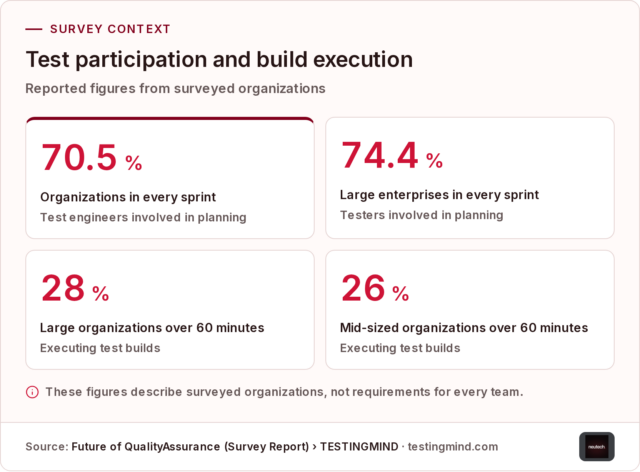
A cited survey reported that 70.5% of organizations involved test engineers in every sprint planning session, while 74.4% of large enterprises did so. The same report said 28% of large organizations and 26% of mid-sized organizations spent more than 60 minutes executing test builds. These figures describe selected participation and execution patterns. They can help teams examine whether testers join planning early and whether test-build duration leaves enough time to act on findings.
A quality process can follow seven broad stages from defining quality requirements through documenting best practices. You can translate that sequence into your own governance without treating the number seven as a mandatory framework:
- Define the quality requirements and the conditions that matter.
- Review requirements and designs before implementation advances.
- Execute the selected testing and quality-control activities.
- Evaluate results, defects, exceptions, and process adherence.
- Decide whether the product or change is ready for the next gate.
- Record lessons and practices that should influence later work.
The useful test is whether each stage has an owner, an input, an output, and a decision.

Begin with requirements and risk
A documented software requirements specification provides a baseline for validation and verification. Requirements gathering is therefore a quality activity, not merely a product-management handoff. QA involvement during requirements gathering can expose ambiguity before that ambiguity becomes code, test rework, or a release dispute.
Start your assessment by asking whether the requirements describe more than happy-path functionality. For each material workflow, identify:
- The expected behavior and the users, systems, or services involved.
- Data conditions, permissions, integrations, and operating assumptions.
- Quality objectives and targets that can be evaluated.
- Failure conditions, rejected inputs, exceptions, and recovery expectations.
Risk-based testing prioritizes functions that carry the greatest risk. Risk-based thinking can focus attention on higher-risk processes and outputs and support systematic planning, implementation, checking, and improvement. That does not mean ignoring lower-risk work; it means deciding where deeper analysis, broader coverage, or earlier review is justified.
Quality planning defines quality objectives, requirements, targets, and quality assurance activities. For a payment, lending, claims, clinical, or records workflow, begin with the consequence of an incorrect result, unavailable service, incorrect permission, or mishandled data. Then map the quality work to that consequence. The result should be a reasoned allocation of attention, not a generic list of tests.
Prevent defects before implementation hardens them
Defect prevention places quality decisions in requirements and design rather than relying on testing after code is written. Formal technical reviews evaluate design and prototype quality against stated quality requirements, giving technical staff a structured setting to examine assumptions before implementation is difficult to change.
A prevention-oriented workflow can include:
- Reviewing functional and non-functional requirements for ambiguity, contradiction, missing conditions, and testability.
- Conducting a structured design or prototype review against stated requirements and identified risks.
- Using peer review for implementation and configuration changes.
- Involving stakeholders who understand the user, operational, data, or domain consequences of failure.
Solid requirements, peer reviews, controlled changes, and stakeholder involvement provide a baseline for software teams. These practices do not eliminate defects, but they create opportunities to find incorrect assumptions before the team depends on end-stage execution to reveal them.
A survey reported that 55% of surveyed professionals said their organizations had experienced application quality issues in the preceding 12 months that they attributed to development moving faster than testing. That figure describes a reported survey experience, not a prediction for your project. It does support a practical question: can your review and test activities keep pace with changes that affect high-risk behavior?

Make the quality plan and checkpoints explicit
A software validation plan similarly defines and controls the validation effort by specifying its scope, approach, resources, schedules, and the types and extent of activities, tasks, and work items.
Your plan should make the operating model inspectable. Record:
- The product and release scope covered by the plan.
- The quality objectives, applicable internal or external expectations, and risk assumptions.
- The people accountable for requirements, reviews, testing, defect decisions, approvals, and exceptions.
- The environments, test data, tools, and access conditions needed to perform the work.
- The entry and exit questions for each checkpoint.
Validation procedures establish the specific actions or sequence of actions used to complete individual validation activities, tasks, and work items. Keep the plan at the level of scope and control, then make procedures specific enough that a qualified team member can perform and record the activity consistently.
SQA quality checkpoints are periodic gates at which development is assessed against the plan. A checkpoint is useful only when it leads to a decision: proceed, revise, defer, accept a documented risk, or escalate the issue. Do not treat a gate as a meeting that produces no change in ownership or delivery status.
Build an evidence trail from requirement to defect
Requirements traceability can link requirements to test cases, test execution, and defects.
- The requirement or quality objective being addressed.
- The risk, user impact, or operational condition associated with it.
- The design or implementation reference that realizes the behavior.
- The test case, test data, environment, and execution result.
- The defect, severity, owner, disposition, retest, and regression impact.
- The decision to fix, defer, accept, or escalate the issue.
- The release, change, or maintenance record that closes the loop.
Test documentation and reporting support traceability, compliance, and knowledge transfer and can include test plans, test cases, test scripts, and test reports. The documentation should help someone understand what was expected, what was examined, what happened, and what decision followed. More documents are not automatically better; the record needs to remain connected to the decision it supports.
Software quality management can use measurable quality goals instead of relying only on the opinion that software is high quality. Avoid turning every available metric into a target.
Process evaluation checks whether defined standards are being followed correctly and adjusts them when they are not working; process monitoring collects process metrics at set intervals. Early detection and resolution of defects can help minimize costs by reducing rework and avoiding potential production issues.
Choose testing by risk and system purpose
A testing strategy can combine functional and non-functional activities according to the system parts involved and the reason for testing. Unit, integration, system, regression, performance, security, usability, and accessibility testing can each address different questions; none should be included merely to make the plan look complete.
Use the product’s risk and purpose to decide where each activity belongs:
- Integration testing examines interactions between components, services, data stores, or external systems.
- System testing examines the product or service across an end-to-end workflow.
- Regression testing checks whether a change has affected behavior that previously worked.
- Performance testing examines behavior under relevant load, response, or resource conditions.
- Security testing examines selected security properties and failure conditions.
- Usability and accessibility testing examines whether people can use the relevant workflows under the intended conditions.
Non-functional testing evaluates software under real-world conditions and can include performance, security, usability, and compatibility testing. For a fintech or healthcare workflow, select coverage based on the consequences of failure, the system boundary, the data involved, and the users who depend on the result.
Quality management may combine automated testing for repeatable checks with manual testing where human judgment matters. Automation can make repeated execution practical, but it does not decide which scenarios deserve coverage or whether the observed behavior is acceptable.
ISO/IEC/IEEE 29119-3:2013 supports dynamic, functional, non-functional, manual, automated, scripted, and unscripted testing, and its documentation templates can be used with any software development lifecycle model. The related test processes can cover organizational, management, and dynamic test levels, while static testing in the form of reviews is defined separately in ISO/IEC 20246.
These references can help you organize terminology and documentation, but a reference does not automatically determine the coverage your product needs. Select the applicable practices after considering the product, technology, risk, stakeholders, and operating environment.
Use release and change decisions as quality gates
Quality checks can be integrated into a CI/CD pipeline, while a test strategy and plan can define scope, the manual-to-automated testing ratio, team and training needs, schedules, entry and exit criteria, environments, and metrics.
Before a release or material change, ask:
- Are the requirements and high-risk behaviors in scope for this decision?
- Were the planned tests executed in an environment and with data that support the conclusion?
- Which defects remain open, and what is their impact on users, data, transactions, care, or service operation?
- Who has authority to approve an exception or accept residual risk?
- What monitoring, rollback, recovery, or follow-up work is required after release?
A single passing test does not guarantee long-term performance. Treat release as a controlled decision, not as the permanent end of quality work. Continuous testing can help teams assess when software needs maintenance, updates, or improvements.
In one survey, 89% of respondents said AI changed how they tested applications, 86% considered human involvement extremely important to functional testing, and 57% said humans were critical to peer review and to designing test strategies based on real-world user behavior. A separate report said more than 88% of organizations had adopted CI/CD tools, with more than 20% releasing every day and 40% releasing weekly. These reported percentages describe surveyed groups and do not set a release cadence or remove the need for human judgment.
Extend the approach to security and service continuity
Security and service continuity belong inside the quality conversation when software handles regulated data, financial activity, clinical workflows, or an operationally important service. Few software development life cycle models explicitly address software security in detail, so secure software development practices usually need to be added to the selected life cycle.
NIST’s SSDF provides high-level secure software development practices that can be integrated into SDLC implementations. Following those practices should help software producers reduce vulnerabilities in released software, mitigate the potential impact of exploiting undetected or unaddressed vulnerabilities, and address root causes to prevent future recurrences. Use that premise to add security work to the lifecycle rather than treating security as a final approval label.
Your continuity view should connect prevention with response:
- Identify the events that could interrupt service, expose data, corrupt results, or affect transactions or care workflows.
- Assign ownership for detection, communication, containment, recovery, and follow-up.
- Maintain incident response, business continuity, incident recovery, and disaster recovery plans.
- Test response and recovery plans under conditions relevant to the service.
- Improve detection processes when exercises, incidents, or monitoring reveal gaps.
The management support needed for an incident management plan depends on its scope. An organization-wide plan probably needs senior-executive-level support, while an individual-service plan may need sponsorship from the senior management responsible for that service. Define the scope before deciding who must authorize the work.
Adapt the evidence chain to fintech and healthcare
Fintech and healthcare teams should tailor quality practices to the domain, technology stack, and software risks involved. A general quality process can provide structure, but it does not by itself establish compliance with a particular obligation or prove that a product is suitable for a specific jurisdiction, data category, or workflow.
- For financial workflows, examine transaction correctness, permissions, data integrity, reconciliation, availability, and change impact.
- For healthcare workflows, examine the intended use, data handling, user roles, workflow safety, availability, and the consequences of incorrect or unavailable information.
- For shared platforms, examine integrations, service boundaries, configuration, auditability, recovery, and dependencies that could affect several products.
ISO 9001:2015 does not specify how risk and opportunity determinations must be documented. That principle supports proportional documentation: retain enough connected information to explain the decision and demonstrate how risk was considered, without assuming that one template satisfies every situation.
Use applicable obligations and specialist interpretations as inputs to the plan. Do not present a general SQA checklist as proof of HIPAA, PCI, SOC 2, or another compliance status.
Plan the work across setup and ongoing operation
SQA continues across requirements, development, testing, release, maintenance, and improvement. PDCA provides a useful way to organize that continuity: plan objectives and processes, implement and control the plan, check processes and results against requirements, and act to improve performance. PDCA operates as a cycle of continual improvement with risk-based thinking at each stage.
A quality operating calendar can include:
- Planning and requirements review before development commitments are finalized.
- Design, peer, and technical reviews during implementation.
- Test preparation and execution throughout development and before release.
- Checkpoints for release, change, incident, and operational decisions.
- Monitoring of process adherence, defects, test results, and service conditions.
- Retrospectives and improvement actions after releases, incidents, and recurring findings.
SQA practices can include standards, reviews, audits, traceability, and monitoring.
One cited estimate puts QA process setup at 2-6 weeks, including requirements and existing-process analysis, process redesign, software testing, and monitoring and improvement. That estimate describes process establishment, not the lifetime of quality assurance or a uniform preparation period for every product. In planning terms, separate the initial effort from the recurring work that follows. The initial effort may define scope, clarify requirements, identify process gaps, establish review and testing responsibilities, and set up the records used to monitor results. Afterward, the team still needs to apply the process to new requirements, changes, releases, incidents, and improvement work. Treat that range as a setup planning reference, not as the duration of all quality work. Ongoing quality activities continue after the initial process is established.
A cited survey reported that around 7% of organizations never involved testers in sprint planning, rising to 10.4% among small enterprises. The figures describe a surveyed pattern rather than a staffing rule or a measure of quality. Use them as a prompt to examine whether test perspectives enter planning early enough to affect requirements, risk, test scope, and timing. Participation alone does not show that the quality approach is effective; also consider which decisions the involvement changes and whether resulting findings are acted on.
One cited estimate put a fully loaded in-house QA engineer at roughly $70,000 - $130,000 or more per year in the United States and Western Europe, including salary, benefits, tooling, and management. The estimate describes an annual staffing cost in those jurisdictions, not the cost of every quality-management model. Separate that figure from requirements analysis, risk work, reviews, test data, environments, tools, documentation, defect management, monitoring, and improvement. A staffing figure cannot stand in for a full quality-management budget. Compare an estimate by asking which activities, people, environments, and ongoing responsibilities are included and which remain with the product team. The cited jurisdiction and annual basis also matter: the figure is not a universal rate for every location or delivery model.
Estimate cost from coverage and operating demands
Software quality cost depends on the coverage and operating demands you choose, not on a universal percentage or staffing label. Reviews, audits, documentation, and monitoring require additional time and effort, while quality processes, tools, and skilled resources can increase project costs.
Build your estimate from these cost drivers:
- Requirements analysis, risk assessment, design reviews, and process planning.
- Test design, execution, defect triage, retesting, and regression coverage.
- Test data creation, protection, refresh, and disposal.
- Environments, infrastructure, CI capacity, devices, browsers, and system dependencies.
- Test-management, defect-tracking, performance-testing, and automation tools.
- Manual judgment, automation engineering, specialist review, training, and management.
- Documentation, reporting, audits, monitoring, incident exercises, and improvement work.
- The product’s scope, change rate, risk, integrations, data conditions, and required coverage.
A test environment that closely resembles production can be expensive, especially when specialized hardware or software licenses are required. Test-management, defect-tracking, performance-testing, and automation tools can also incur licensing or ongoing maintenance costs. Price those needs explicitly instead of hiding them inside a generic testing line.
One cited pricing estimate put software testing at 15-25% of total development budgets for standard products and 30-40% for safety-critical or compliance-heavy domains. The same estimate identified scope, automation maturity, and whether QA was in-house or outsourced as factors affecting the result. These ranges are published planning context, not a universal price for SQA management and not a jurisdiction-specific quote.
The cited pricing guide also said automation engineers commanded 15-30% more than the cited fully loaded in-house QA engineer estimate and identified device labs, browser grids, CI capacity, and test-management tooling as additional infrastructure. Use the figures to ask what is included in a proposal. A lower testing percentage may reflect narrower coverage, fewer environments, less documentation, or a different staffing model rather than a lower total operating need.
Then separate setup, execution, governance, and maintenance so you can compare proposals on the same basis.
Turn the model into a first evaluation
Use this sequence with your product and engineering leads:
- Name the quality owner for the initiative and identify the people who approve requirements, changes, releases, exceptions, and residual risk.
- Document the product requirements, quality objectives, high-risk functions, relevant data conditions, and service dependencies.
- Review the requirements and design before implementation hardens ambiguous or unsafe assumptions.
- Create a traceability path from requirements to test cases, execution results, defects, retests, and release decisions.
- Define the testing strategy by system purpose, risk, environment, data, and the role of manual judgment or automation.
- Set entry and exit criteria for the relevant delivery and release checkpoints.
- Decide what process metrics and quality results will trigger investigation or improvement.
A QA process can include requirements review, a requirements traceability matrix, risk analysis, design reviews, and testing activities moved earlier in development. Process evaluation checks adherence to defined standards and can adjust them when they are not working. Do not approve a process because it has a polished document; examine whether the team follows it and whether it produces useful decisions.
Bring in qualified evaluation when exposure becomes material
Qualified technical, security, compliance, legal, or regulatory evaluation is warranted when an unresolved quality issue could materially affect users, regulated data, transactions, care workflows, or service continuity. The trigger is the potential exposure and unresolved uncertainty, not the size of the QA department. A team may need more than a routine test review when it cannot establish what changed, which users or data are affected, whether a control worked, or who can authorize residual risk. The appropriate reviewer depends on the issue: technical expertise for system behavior, security expertise for vulnerabilities or access, compliance or legal expertise for obligations, and regulatory expertise where an authority or jurisdiction is implicated.
A survey reported that 73% of surveyed software experts were at least somewhat concerned that application quality was suffering as AI accelerated development; 45% of U.S. respondents were very or extremely concerned. Those percentages describe surveyed groups and do not establish the risk of your product. They do reinforce the need to keep human review, requirements judgment, and release accountability in the operating model. For an actual concern, use the survey only as context; base the decision on the product’s requirements, risks, affected data or workflow, test results, change impact, and available response and recovery plans. A percentage from another surveyed group cannot replace an assessment of the specific system.
Pause the affected decision, preserve the relevant records, identify the responsible authority, and obtain the qualified review needed for the product, data, jurisdiction, and operational condition. A useful handoff states the affected service or workflow, the known change or symptom, the records reviewed, the remaining uncertainty, the immediate decision being considered, and the questions for the reviewer. Avoid treating a general quality checklist or one passing test as proof that the issue is resolved. A qualified professional decides individual suitability and the appropriate response to a specific exposure. If the team cannot establish an appropriate response promptly, contact a qualified professional or the responsible authority promptly.
Define the next step for a quality initiative
A defined quality initiative starts with a bounded decision, not a request to improve everything at once.
This brief gives your team a concrete basis for deciding whether it needs process setup, requirements and risk work, test strategy, traceability, release controls, security and continuity planning, or ongoing improvement.
We provide the next step for fintech and healthcare teams that are evaluating a defined software quality assurance management initiative and its quality, security, compliance, or operational risks. Individual suitability and any material regulatory or professional decision should be assessed by appropriately qualified specialists.
What should a regulated team clarify before evaluating its quality approach?
Is software quality assurance management only necessary for large fintech or healthcare organizations?
No. It is a cross-functional discipline that can be scaled to the product’s risks, technology, data, and operating context. General practices do not by themselves establish HIPAA, PCI, SOC 2, or another compliance status; applicable obligations should be confirmed with qualified specialists.
How long does software quality assurance management take to set up, and when does it end?
One cited estimate puts QA process setup at 2-6 weeks for requirements and process analysis, redesign, testing, and monitoring and improvement. That is a setup reference, not an end-to-end duration. Quality assurance continues through requirements, development, testing, release, maintenance, change assessment, incident learning, and process improvement.
What does software quality assurance management typically cost?
There is no reliable universal price for the full management discipline. One cited estimate places software testing at 15-25% of the total development budget for standard products and 30-40% for safety-critical or compliance-heavy domains, with scope, automation maturity, and in-house versus outsourced QA affecting the result. A complete estimate should also account for requirements and risk work, reviews, staffing, environments, test data, tools, documentation, audits, monitoring, defect management, incident exercises, and ongoing improvement.
Can a passing test result prove that software is ready for release?
No. Testing is necessary, but testing alone is generally insufficient to establish that software is fit for its intended use. Release readiness should also consider requirements coverage, risk, change impact, unresolved defects, test conditions, traceability, entry and exit criteria, residual-risk authority, monitoring, rollback, and recovery needs.