Start with the release decision QA must support
Software quality assurance should support a release decision that is explicit about risk, evidence, ownership, and remaining work. A test result is useful when you can connect it to the requirement or risk it examined, the environment in which it ran, the defects it found, and the person or group responsible for deciding what happens next.
Testing can reveal defects, but it cannot prove that software is defect-free or that all defects have been found. That boundary matters in fintech and healthcare, where a passing result does not by itself establish that a transaction flow, protected-data workflow, clinical integration, or operational process is ready for every condition you may face.
Use four questions to assess a QA approach before you compare providers or approve a work package:
- What could fail? Identify the functions, data paths, integrations, user groups, and operating conditions where failure would have material consequences.
- What will be examined? Define functional behavior, non-functional characteristics, security risks, compatibility needs, and regression exposure.
- What will prove the work happened? Require a usable chain from requirements through tests, execution results, defects, retesting, and release status.
- Who decides what happens next? Establish ownership for fixing, accepting, scheduling, or escalating each material finding.
Risk-based testing prioritizes test execution according to the potential risk of failure and its impact on users and business operations. Traceability links requirements, tests, results, and defects, while test coverage measures whether requirements were adequately validated and the tests executed successfully. Those ideas give you a better comparison basis than a proposal that lists a large number of test cases without explaining what risk each case addresses.
Define QA before comparing testing services
Software quality assurance is a systematic approach for ensuring that development processes and work products follow defined quality standards and procedures throughout the software development life cycle. QA is primarily preventive and process-oriented, whereas software testing is primarily detection-oriented and product-focused.
That distinction changes what you should ask a prospective partner to deliver. QA can include requirements reviews, process definition, standards, audits, peer reviews, test planning, defect analysis, release criteria, and process improvement. Testing is the product-focused work of planning and executing checks, reporting defects, and verifying whether software behaves as required. Quality control evaluates software deliverables to identify whether they meet quality requirements, while QA establishes and improves the processes used to achieve quality.
When a proposal uses QA, testing, and QC interchangeably, ask the proposer to separate the work into these practical categories:
- Process assurance: How will requirements, coding, testing, documentation, and release readiness be governed?
- Product testing: Which features, interfaces, data conditions, and quality attributes will be examined, and by which methods?
- Quality control: How will the team determine whether a deliverable meets the stated requirement, and what happens when it does not?
- Improvement: How will recurring defects, escaped defects, rework, and weak controls change the delivery process?
A useful scope can contain all three categories. A testing-only engagement may be appropriate for a bounded release or an independent check, but it should not be presented as proof that the whole development process is controlled.
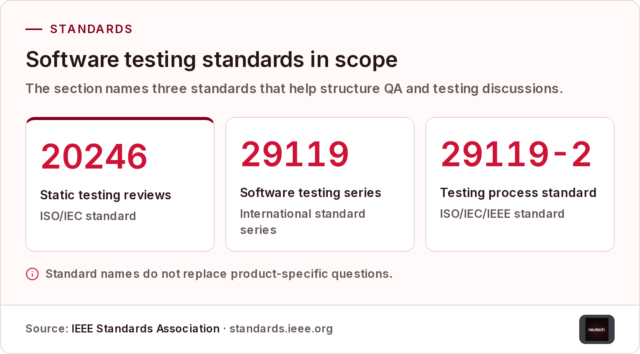
ISO/IEC/IEEE 29119-2 defines testing processes at organizational, test-management, and dynamic-test levels and supports manual, automated, functional, non-functional, scripted, and unscripted testing. The ISO/IEC/IEEE 29119 series provides internationally agreed software-testing standards intended for organizations performing software testing, and its processes can be used with any software development lifecycle model. Static testing in the form of reviews is defined in ISO/IEC 20246.
These standards can provide a shared vocabulary for a proposal, but a standard name does not answer your product-specific questions. Ask how the proposed process will be adapted to your architecture, users, data, integrations, release model, and material risks. Compare the resulting work products and decision rules, not the label alone.

Map quality work across the delivery lifecycle
QA should enter during requirements collection and analysis, continue through planning, design, coding, testing, and launch, and remain active as the product changes. Requirements analysis studies project documentation, functional and technical specifications, and user stories to identify what to test and potential risks before testing begins.
For your team, that means asking quality specialists to examine ambiguity before implementation turns it into code. A payment rule, data-retention expectation, authorization boundary, clinical workflow, or reconciliation condition that remains unclear can create test disagreement later. A requirements review should identify the expected behavior, unacceptable behavior, relevant data conditions, and the evidence needed to decide whether the requirement was met.
A shift-left approach moves testing closer to the beginning of software development. A QA test strategy and plan can define scope, the manual-to-automated testing ratio, team needs, schedule, entry and exit criteria, environment, and test metrics.
A practical lifecycle map should answer these questions:
- Requirements and design: Which requirements are testable, which risks need clarification, and which design choices affect security, performance, data integrity, or recoverability?
- Planning: Which test levels, environments, data sets, roles, tools, and entry or exit conditions are required?
- Development: Which reviews, checks, and test preparation will occur before a feature reaches a shared environment?
- Integration and system testing: Which workflows cross services, external systems, identity boundaries, or data stores?
- Release: What evidence must exist before release, who reviews unresolved findings, and what conditions block or limit release?
- Ongoing change: Which tests are repeated after changes, and how are new defects, recurring causes, and changed risks fed back into the process?
QA can design test scenarios and cases, prepare environments and test data, and write automated test scripts when appropriate. Teams can execute manual and automated tests, report issues in a defect-tracking system, and report test results on an agreed schedule. Regression testing validates that related functionality has not been broken in a new development iteration, and release testing is part of the QA process.
Regression testing checks whether later changes have broken functionality that previously worked. Ask for both activities when the product is changing: new features need focused validation, while established behavior needs protection against unintended change.
An estimate places the cost of fixing a production defect at up to 100 times the cost of fixing the same bug during requirements analysis. Treat that figure as an estimate, not a universal multiplier, but use its practical implication: early clarification and review deserve a defined place in the work package.

Turn product risk into a coverage plan
Risk-based testing prioritizes testing around the features and functions that matter most for mitigating software-development risk. The approach matches test effort to risk, giving higher-risk items more thorough testing and making testing decisions and risks easier to communicate and track.
Start your coverage plan with consequence rather than with a generic test catalogue. For each major workflow, record the failure condition, who or what could be affected, the business or operational impact, the likelihood or uncertainty you know about, the controls already present, and the evidence needed before release. The result should show why a particular function receives deeper testing and why another receives a lighter check.
Non-functional testing evaluates software under real-world conditions, including performance, security, usability, and compatibility across devices and operating systems. Testing approaches should match the software’s purpose and risks; high-traffic applications need thorough performance testing, while financial software demands extensive security testing.
For a fintech or healthcare system, ask whether the proposed coverage addresses more than the happy path. Depending on your product, the plan may need to examine authorization boundaries, data handling, transaction consistency, service dependencies, response under load, recovery behavior, device or browser differences, accessibility, and operational monitoring. The plan should identify which of these areas are in scope, which are out of scope, what test method applies, and who owns any separate specialist review.
Unit, integration, and end-to-end testing require different effort because they involve different depth and stability. ISO/IEC/IEEE 29119-2 defines software-testing processes at the organizational, test-management, and dynamic-test levels and supports dynamic, functional and non-functional, manual and automated, scripted and unscripted testing.
Use the levels to expose gaps in a proposal:
- Integration checks can examine interactions among services, data stores, identity systems, and external interfaces.
- Non-functional checks can examine qualities such as performance, security, usability, and compatibility under defined conditions.
The right mix depends on your risks. A partner that promises automation without explaining test level, environment, data, and maintenance assumptions has not yet given you a coverage plan.
Testing type affects QA cost: automation requires coding ability, while performance and security testing are specialized disciplines associated with smaller talent pools and higher-stakes failure modes. Include those cost consequences in the coverage decision rather than treating every test type as interchangeable labor.
A useful request asks each prospective partner to identify the risk addressed by each major test stream, the test level used, the expected evidence, the skill required, and the condition that would trigger more work. That structure lets you compare coverage and price together.
Use security and regulated-data questions as fit tests
Security fit begins with the product’s security requirements and operating risks, not with a generic statement that a provider works with regulated companies. The December 2025 NIST draft described secure-by-design work as identifying security requirements, assessing the security risks software is likely to face during operation, and using design and architecture to mitigate those risks.
Ask a prospective partner to explain how it would translate your system context into testable security questions. The answer should connect the data handled, trust boundaries, user roles, integrations, deployment conditions, and likely misuse or attack paths to the proposed review and testing work. A qualified security specialist or responsible authority should determine how those findings relate to your specific obligations.
Threat modeling, attack modeling, and attack-surface mapping are examples of risk-modeling methods that can help assess software security risk. Design and architecture should mitigate identified security risks, and risk-based analysis should justify cases in which security requirements are relaxed or waived.
Use questions such as these during partner evaluation:
- Which assets, data flows, identities, interfaces, and privileged operations will be included in the threat model?
- How will identified risks change the test scope or the design review?
- Which assumptions must be validated in an environment that resembles production?
- How will exceptions, accepted risks, and relaxed requirements be documented and approved?
- Which findings require a separate security assessment rather than ordinary functional testing?
Standard vulnerability-management programs include identifying, analyzing, remediating, and reporting vulnerabilities. Monitoring threat feeds and information sources can help identify vulnerabilities actively exploited in the wild.
Ask how a prospective partner will handle a vulnerability after discovery. A credible answer should identify the reporting path, severity and business context, analysis responsibility, remediation owner, retest condition, communication audience, and record that remains after closure. Do not treat a test report as a substitute for vulnerability management, incident handling, privacy review, or a regulatory determination.
Regulated-data fit is demonstrated through reasoning about your product’s actual risks, not through a broad compliance label. Ask the partner to walk through a representative fintech or healthcare workflow without exposing unnecessary sensitive data, then identify what it would test, what it would document, and which decisions belong to your security, privacy, clinical, financial, or regulatory owners.
A partner may support testing and evidence production, but QA does not replace those accountable reviews. Keep the boundary explicit before granting system access or relying on a test result for a material decision.

Build an evidence chain from requirement to result
An evidence chain should let you move from a requirement to the test that examined it, the result that was produced, the defect record that explains any failure, and the decision that follows. An SQA program can define standards, review requirements early, use peer reviews and traceability, track defects and root causes, measure review coverage and release stability, and refine its process as risks and tools change.
Testing documentation records execution status and defects and can support release decisions, audits, maintenance, and regression testing. The value of the documentation is practical: another responsible person should be able to understand what was tested, under what conditions, with which result, and what remains unresolved.
Before testing begins, request or create a compact evidence set containing:
- Quality standards: The expected standards for requirements, code, testing, documentation, and release readiness.
- Requirement inventory: Functional and non-functional requirements, acceptance conditions, assumptions, and known risks.
- Test strategy and plan: Scope, test levels, manual-to-automated ratio, responsibilities, environments, data, schedule, entry criteria, exit criteria, and metrics.
- Test cases and scenarios: The behavior or risk each test examines, including relevant boundary and failure conditions.
- Execution records: The run date, environment, data condition, result, failed step, and responsible tester or system.
- Defect records: Reproduction details, severity, priority, affected component, owner, status, retest result, and release impact.
- Release record: The coverage status, unresolved findings, accepted limitations, decision owner, and follow-up commitments.
Test planning should identify functional and non-functional requirements and clarify tester responsibilities before execution. A proposal that lists test activities but omits ownership, conditions, or outputs is difficult to govern.
Traceability confirms relationships between requirements, tests, execution results, and defects. Test coverage measures whether requirements were adequately validated through testing and whether those tests were executed successfully. These are related but different questions.
A traceability record can show that a requirement has a linked test, while coverage analysis can show whether the requirement was adequately validated and whether the test actually ran successfully. Teams can use traceability reporting to find untested requirements before execution and use defect trends to identify functions that may need additional validation.
Ask to see the relationship in a form your delivery team can use. A static spreadsheet, test-management record, or integrated report may all be workable if it remains current, identifies gaps, and supports release discussion. The tool matters less than whether the chain is complete enough for accountable decisions.
Agree on communication before the first test run. Set the reporting cadence, decision participants, defect response expectations, escalation route, evidence location, and format for unresolved risk. Testing documents created and updated during testing can help track execution status, log defects, and maintain a real-time record of testing activities.
Ask how the partner will communicate a blocked test, an unstable environment, missing data, a repeated defect, or a result that cannot support a release decision. Clear communication is part of the control structure; it is not a presentation detail added after testing ends.
Make manual testing and automation serve different jobs
Manual testing brings human judgment to exploratory, usability, and edge-case evaluation; automated testing runs predefined checks consistently and is especially useful for regression validation.
Do not evaluate automation as a replacement for judgment. Ask which risks require exploration, interpretation, or observation and which checks are stable enough to repeat frequently. A balanced plan may use human-led exploration for new or uncertain behavior and automated checks for repeatable regression paths, with the balance changing as the product and release pattern change.
Automation candidates can include repetitive, stable, data-driven, and frequently executed tests, after you consider complexity, risks, and maintenance effort. A structured automation testing process can improve software quality, reduce manual effort, and support faster and more reliable releases. A faster release cadence usually requires more automated regression testing and dependable CI gates.
Use this selection test before approving an automation backlog:
- Is the behavior stable enough that a script will not require constant redesign?
- Does the check run often enough to justify its creation and maintenance?
- Can the environment and test data produce a reliable result?
- Does the check address a meaningful risk or protect an established workflow?
- Is the failure message clear enough for the delivery team to act on it?
- Who will maintain the script when the product, dependency, or environment changes?
A short, maintained suite can be more useful than a large set of brittle scripts.
A U.S. automation-pricing estimate puts project pricing at $5,000 to $50,000+, depending on project requirements and scale. The figure measures an estimated project price in the United States, not a universal rate or a complete QA budget. Automation testing costs also include planning, framework development, test-script creation, CI/CD integration, tools, infrastructure, and ongoing maintenance.
One estimate says an automated regression suite of about 8 person-weeks pays for itself after roughly 14 replaced regression runs, or about six to seven months of fortnightly releases. Ask the proposer to identify the scripts, runs, maintenance effort, and release frequency behind any payback calculation.
A U.S. compensation estimate reports that automation testers earn $20K - 40K more per year than manual testers at the same experience level because they write code instead of executing scripts by hand. That figure describes a reported United States pay difference for the same experience level; it is not a quote for outsourced work.
Compare proposals by the skill and responsibility required. A person executing defined checks, an engineer building a maintainable automation framework, and a specialist conducting performance or security testing represent different work packages. Require the proposal to separate those roles, outputs, assumptions, and maintenance obligations.
Convert defect reports into accountable decisions
Defect triage prioritizes defects using severity, risk, and relevant context such as validity, urgency, complexity, and business impact. Bug triage turns defect reports into a prioritized action plan for what to fix now, fix before release, schedule later, accept as a limitation, or reject.
A defect report is not complete when it enters a backlog. The team needs a decision, an owner, a status, a next action, and a reason that can be revisited when context changes. A cross-functional triage group may need engineering, product, operations, security, privacy, clinical, financial, or regulatory input depending on the affected workflow.
Severity describes a defect’s effect on functionality, while priority reflects its urgency and user impact; severity may be categorized as critical, major, minor, or trivial. Severity describes technical impact, while priority describes business urgency and may change as context changes. Release dates and user counts can influence priority, not severity.
Keep the terms separate in your defect system:
- Severity asks: How badly does the defect affect the system or function under the observed conditions?
- Priority asks: How soon does the organization need to act, given users, timing, exposure, dependencies, and available capacity?
- Triage asks: What action follows, who owns it, and what evidence is required before closure or release?
A triage matrix can compare technical severity with business priority to decide whether a defect is fixed now, scheduled later, or backlogged.
Defect priority can reflect affected users, revenue or contractual exposure, regulatory or legal deadlines, reputational visibility, release timing, fix risk and cost, and dependencies. Those factors belong in the decision record when they materially change urgency.
For a regulated product, ask whether a proposed release contains unresolved findings that affect protected data, transaction correctness, access control, clinical workflow, financial reporting, or an operational dependency. Do not let a low user count automatically make a severe technical failure low priority, and do not let a high business urgency conceal that the proposed fix has its own implementation risk.
Software quality assurance includes tracking defects, escaped defects, and root causes after each release. When the same issue repeats, fix the process, not just the bug.
After closure, ask whether the defect points to an ambiguous requirement, missing review, weak test data, an environment difference, an ineffective regression check, unclear ownership, or a design risk. Add the appropriate process change, new test, review condition, or monitoring task. The follow-up should remain linked to the original finding so recurrence can be evaluated rather than discussed only from memory.
Estimate duration from the work package
QA duration depends on the work package you are buying: process setup, requirements analysis, test design, environment and data preparation, execution, defect retesting, release work, and continuing change management. A provider estimates QA process setup at 2-6 weeks, covering requirements and process analysis, redesign, testing, and process monitoring and improvement. An estimate says testing typically takes 3 to 6 weeks, depending on system complexity.
The 2-6-week range measures a cited estimate for setting up a QA process, while the 3-6-week range measures a separate estimate for testing a system whose complexity affects duration. Do not treat either range as a promise for your product or add them mechanically. Ask which activities are included, which can run in parallel, what must exist before work starts, and what event marks completion.
Continuous testing can help assess when software needs maintenance, updates, or improvements; a single passing test does not guarantee long-term performance. A practical plan therefore separates the initial assessment from the recurring work required as code, dependencies, infrastructure, users, and risks change.
Build your planning range in stages:
- Preparation: Confirm requirements, risk priorities, ownership, environments, data, and evidence outputs.
- Design: Create scenarios, cases, automation candidates, entry conditions, exit conditions, and reporting rules.
- Execution: Run the agreed manual, automated, functional, non-functional, integration, and end-to-end work.
- Resolution: Triage defects, retest fixes, rerun affected regression checks, and record unresolved risk.
- Release and change: Complete release testing, preserve the decision record, and define the recurring checks for later changes.
A quote that gives only a calendar duration without these activities does not tell you what the duration covers.
A pricing guide estimates software testing at 15-25% of the total development budget for standard products and 30-40% of the total development budget for safety-critical or compliance-heavy domains. Those percentages measure an estimate of testing as a share of total development spending under the source’s categories; they are not a required allocation for every fintech or healthcare product.
A U.S. QA salary estimate reports a US full-time median of $102,610 per year, or approximately $50 per hour, for the cited QA role. That figure measures a reported US employment median for the cited role, not an outsourced project price. Use salary and percentage figures only as planning signals, then request a scope-based estimate that identifies the actual work, roles, duration, tools, and assumptions.
Compare cost using the same scope
Software testing cost depends on scope, the mix of manual and automated work, the tools and devices involved, and where testers are based. Automation testing costs vary with project size, application complexity, testing requirements, overall scope, team expertise, application type, planning, framework development, test-script creation, CI/CD integration, tools, infrastructure, and ongoing maintenance.
One commercial estimate puts software testing at 15-25% of development budget for standard products and 30-40% for safety-critical or compliance-heavy domains; scope, automation maturity, and sourcing model affect the estimate. The percentages measure testing as a share of the total development budget under that commercial guide’s categories. They do not establish a price for your product.
Testing type is another cost driver. A manual functional cycle, automation framework work, performance testing, security testing, test-data preparation, environment setup, and ongoing maintenance should appear as separate lines or clearly defined components in a quote.
A QA cost estimate identifies testing type as the biggest driver of QA cost and gives US rates of approximately $36 per hour for manual QA, $57 per hour for test automation, and $74 per hour for security testing.
The same source says performance testing and security testing are priced higher because they reflect smaller talent pools and higher-stakes failure modes. Ask each provider to disclose whether quoted rates cover management, test design, automation maintenance, environments, devices, reporting, retesting, and specialist review.
One estimate puts a two-week testing scope with a test plan and one manual test cycle at roughly $4,010 in US salary, $2,520 in UK salary, $2,220 in German salary, and $410 in Indian salary before a partner’s overheads. The figures measure estimated salary cost for the same two-week scope and one manual cycle in the named countries; they are not comparable partner quotes or a complete delivery budget.
Use a common scope when comparing proposals. Give every partner the same description of:
- product surface, architecture, integrations, and environments;
- workflows, user roles, data conditions, and highest-risk functions;
- required test levels and non-functional checks;
- manual work, automation work, framework creation, and maintenance;
- test data, devices, tools, infrastructure, and CI/CD access;
- evidence, reporting cadence, defect triage, retesting, and release support;
- schedule assumptions, team roles, location, and client responsibilities.
Ask every partner to quote against the same checklist. A lower total can reflect narrower coverage, fewer retests, weaker evidence, different assumptions, or omitted specialist work rather than a lower cost for the same result.
Decide what has to be tested first, automate once releases are frequent and the product is stable, and ask every partner to quote against the same checklist. Faster release cadence usually requires more automated regression testing and dependable CI gates.
Compare commercial models against the uncertainty in the work. A fixed scope may fit a bounded release with stable requirements; a time-based engagement may fit discovery, changing requirements, or investigation; a continuing arrangement may fit frequent releases and maintenance. Whichever model you choose, define the acceptance conditions, evidence outputs, defect ownership, change process, and boundary of specialist reviews before comparing the headline price.

Escalate material risk to qualified specialists
Material risk needs an accountable decision, not a routine pass or fail label. If a defect, security issue, compliance concern, or operational condition could materially affect users or a financial or healthcare system, pause the affected release decision long enough to identify the impact, preserve the relevant records, and involve the qualified security, privacy, clinical, financial, legal, regulatory, or operational specialists responsible for that question.
Vulnerability management commonly includes identification, analysis, remediation, and reporting phases. Use that sequence as a practical boundary: identify what happened, analyze exposure and impact, assign remediation or a documented decision, and report through the responsible channel. Do not conceal, downgrade, or close a material finding merely because a deadline is approaching, and do not treat ordinary QA as a substitute for incident response or a formal compliance determination.
Ask these questions when a finding may be material:
- What users, data, transactions, services, or clinical or financial processes may be affected?
- Is the issue active, exploitable, recurring, or connected to another unresolved finding?
- Which qualified owner has authority to decide whether to stop, limit, remediate, or continue the affected operation?
- What evidence must be preserved and what notification or reporting path applies?
- What retest or independent review is required before the risk can be considered addressed?
The appropriate specialist determines the individual legal, regulatory, security, clinical, or financial response. Your QA process should make the issue visible and route it to that decision.
Turn the assessment into a quote-ready brief
A quote-ready QA brief should turn your product context and risk priorities into a defined work package. Before you request proposals, document:
- the product, users, environments, integrations, and delivery stage;
- the highest-risk workflows and the consequences of failure;
- functional and non-functional coverage, including security and performance questions;
- required test levels, manual work, automation candidates, and maintenance expectations;
- requirements, test cases, execution records, defect reports, traceability, coverage, and release evidence;
- defect severity and priority rules, triage participants, escalation routes, and ownership;
- process setup, testing, retesting, release, and continuing-change timeline assumptions;
- scope, roles, tools, devices, environments, location, client responsibilities, and cost drivers;
- unresolved questions that require qualified security, privacy, clinical, financial, legal, regulatory, or operational review.
Use that brief to ask each prospective partner for the same scope, assumptions, outputs, exclusions, decision points, and change conditions. A qualified professional should decide individual suitability for material security, legal, regulatory, clinical, or financial questions.
What should a fintech or healthcare team clarify before selecting QA support?
What should a QA partner demonstrate before receiving access to regulated software or data?
Before access is granted, require a product-specific walkthrough of the proposed scope, risks, test methods, evidence outputs, ownership, escalation route, and assumptions about environments and data. The partner should explain how it will address security requirements, trust boundaries, data flows, and material failure conditions. Confirm separately with your security, privacy, clinical, financial, legal, or regulatory owners which access and reviews are appropriate; a generic compliance claim does not establish fit.
When should a release decision be paused because of a QA finding?
Pause the affected release decision when a defect, vulnerability, data issue, or operational condition could materially affect users, transactions, protected data, clinical or financial workflows, or a critical dependency. Record the impact and evidence, involve the accountable qualified specialists, assign remediation or a documented risk decision, and define the retest or review required before proceeding. Do not close or downgrade a material finding only because a deadline is approaching.
How should QA duration be estimated for a product that is still changing?
Estimate separate work packages for preparation, test design, environment and data setup, execution, defect retesting, release support, and recurring regression or change management. One cited estimate puts QA process setup at 2-6 weeks, while another puts testing at 3-6 weeks depending on system complexity; these are separate estimates, not universal timelines to add together. Ask what each range includes, which activities can run in parallel, what dependencies may delay work, and what event marks completion.
How can teams compare QA proposals that use different pricing models?
Give each provider the same scope, risk priorities, test levels, manual and automated work, environments, tools, evidence outputs, defect-handling responsibilities, retesting expectations, schedule assumptions, and client responsibilities. Then compare the included coverage, specialist work, maintenance, exclusions, and change conditions rather than the headline price. Cost varies with scope, testing type, automation, tools and devices, tester location, application complexity, and ongoing maintenance, so a lower estimate may represent narrower work rather than equivalent coverage.