
Start with the answer: an SRS makes requirements reviewable
A software requirements specification (SRS) is a structured record of how a proposed software product should function and what requirements the project must satisfy. An SRS can establish a shared basis between customers and suppliers, and it assesses requirements before more specific system-design work begins. Early requirements assessment is intended to reduce later redesign. The document does not replace conversation, design, testing, or specialist review; it gives those activities a stable object to examine.
The illustrative SRS in this guide follows one small system from purpose through acceptance evidence. It names the system boundary, identifies actors and assumptions, separates functional requirements from quality requirements, describes data and interfaces, and connects each requirement to a testable result. You can copy the structure, not the decisions. Replace every product name, workflow rule, performance target, data field, and control assumption with information agreed for your project.
A useful SRS gives you enough detail to ask whether a requirement is clear, necessary, prioritized, and testable. Write requirements in concise, unambiguous language, use realistic scenarios to show intended behavior, and place measurable acceptance criteria beside the requirement they assess. The sections below turn those principles into a concrete drafting path.
Define what the example can—and cannot—decide
The illustrative SRS can show how to organize and connect software requirements, but it cannot decide whether your project needs a particular feature, architecture, control, service level, or compliance measure. Its system, actors, fields, thresholds, and workflows are fictional drafting material. They are useful prompts for your project discussions, not requirements that become valid merely because they appear in an example.
Your project team must decide what the product is intended to do, who will use it, which information it handles, and what constraints shape delivery. Those decisions require a clear understanding of the product and continuous communication with the project team and customer. Treat each illustrative statement as a question: does this apply to our system, and what evidence would show that the agreed requirement has been met?
The example cannot establish legal, regulatory, security, or compliance status. A requirement such as record access, retention, authentication, or activity history may be a sensible topic for discussion, but its presence in an SRS does not prove that the resulting system satisfies an external obligation. Record the applicable obligation, interpretation, ownership, and evidence separately when your project requires them.
The illustrative system and its document boundary
The illustrative system is a Settlement Exception Portal for an operations team that reviews transaction exceptions received from an upstream transaction service. The portal lets an authorized operations user find an exception, inspect its available details, assign responsibility, record a review, choose a disposition, and search the resulting history. The example uses a narrow workflow so each requirement can point to an observable outcome.
The portal’s purpose is to give an operations team a consistent workspace for reviewing exception records. The proposed system accepts exception records from an external source, presents those records to users, stores review information, and makes the review status searchable. The proposed system does not execute transactions, change balances, make financial decisions, or replace the upstream transaction service.
The document boundary contains these areas:
- In scope: exception intake, record search, assignment, review notes, disposition, status history, and a basic export for operational analysis.
- Outside the example: transaction authorization, settlement execution, customer communications, identity-provider administration, enterprise reporting, and decisions about regulatory applicability.
- Open boundary questions: the source format, identity system, retention period, export destination, expected workload, and ownership of operational decisions.
A boundary statement prevents the requirements from quietly expanding while the team is still trying to agree on the product.
Context before requirements: actors, assumptions, and constraints
The context section gives the requirements meaning before the document lists individual behaviors. A practical SRS structure can include purpose, definitions, a system overview, and background, followed by assumptions, constraints, business rules, and product vision. Use those sections to explain why the proposed portal exists and which surrounding conditions shape it.
The illustrative portal has three actors:
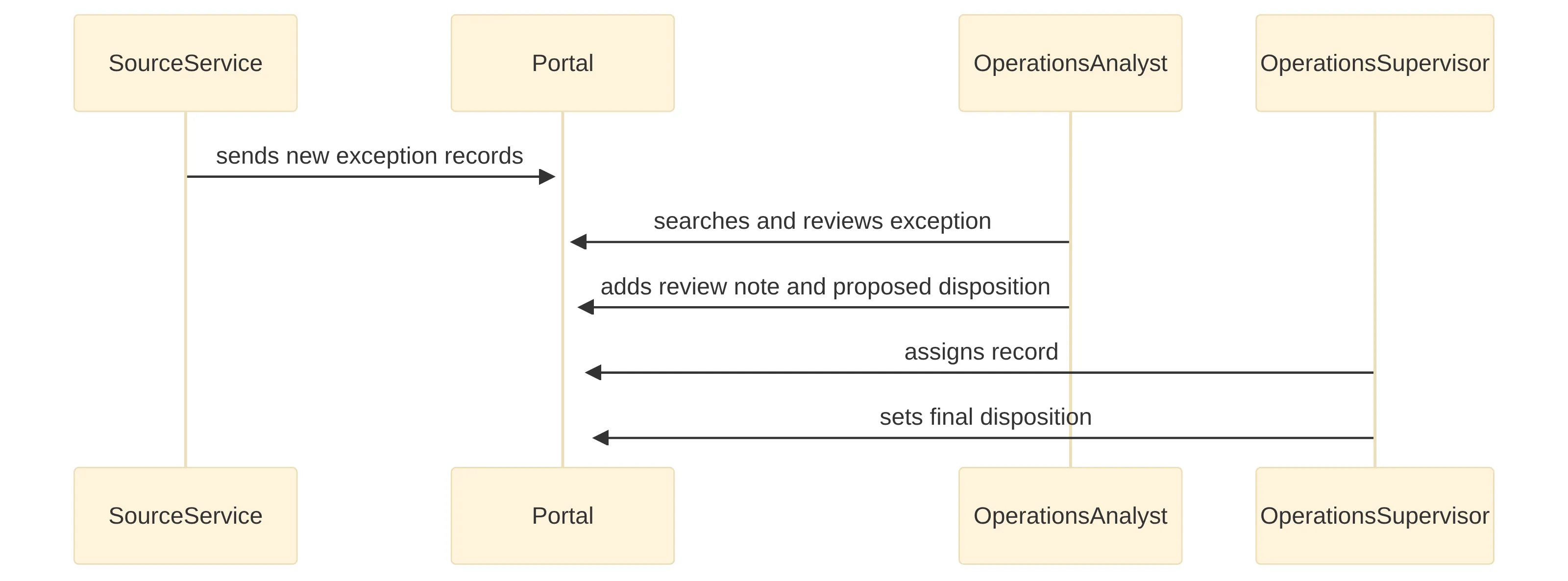
- Operations analyst: searches exception records, reviews details, adds a note, and proposes a disposition.
- Operations supervisor: assigns records, changes a proposed disposition to a final disposition, and reviews status history.
- Source service: sends new exception records to the portal through the agreed intake interface.
The actors are example roles, not a claim about your organization. Replace them with named responsibilities from your operating model, including who may approve a decision and who owns each interface.
The illustrative assumptions are that each exception has a source identifier, the source service can resend a record without creating an unintended duplicate, and users have already been identified by an access-management system. The example also assumes that an exception can remain open while the team gathers information. Each assumption should become a project question with an owner and a resolution date before the related requirement is baselined.
The illustrative constraints are that the portal cannot alter source transaction data, cannot treat a missing source field as a confirmed value, and cannot mark an exception final without the required review information. These constraints narrow the behavior rather than describing implementation. Your project may add constraints arising from existing systems, approved technologies, operating hours, data handling rules, budget, or delivery sequencing.
Turn the core workflow into functional requirements
In an online shopping example, login, search, and order placement are functional requirements, while response time, security, availability, and scalability are non-functional requirements. The illustrative functional requirements below use a numbered form so you can refer to each behavior in design notes, tests, and review decisions.
| ID | Illustrative requirement | Trigger and result |
|---|---|---|
| REQ-001 | The portal shall accept a valid exception record from the source service. | When the source sends a record with the required fields, the portal creates one open exception or reports a defined validation error. |
| REQ-002 | The portal shall let an operations analyst search and filter exception records. | The analyst enters one or more supported criteria and receives matching records with their current status. |
| REQ-003 | The portal shall let an operations supervisor assign an open exception to an operations analyst. | The supervisor selects an eligible analyst, and the portal records the assignment and its time. |
| REQ-004 | The portal shall display the stored exception details and status history. | An authorized user opens a record and sees source details, assignment, notes, disposition, and recorded status changes. |
| REQ-005 | The portal shall let an operations analyst add a review note and proposed disposition. | The analyst submits the required review information, and the portal stores it against the exception. |
| REQ-006 | The portal shall let an operations supervisor set a final disposition after required review information is present. | The supervisor selects an allowed disposition, and the portal changes the exception to its final state. |
| REQ-007 | The portal shall export the selected exception results in the agreed format. | An authorized user selects a result set and receives an export containing the fields approved for that use. |
The functional requirement table uses one action and one observable result per row. Keep that discipline when you adapt it: name the actor, action, object, condition, and outcome. Replace vague verbs such as support, handle, or manage with behavior that another person can demonstrate. If a requirement combines several independent outcomes, split it before assigning acceptance criteria.
Add quality requirements that make behavior usable
The illustrative quality requirements describe conditions around the portal’s behavior rather than adding new business actions. Response time, security, availability, and scalability are examples of non-functional requirements; your project must select qualities and targets that match its actual workload, users, architecture, and operating conditions.
| ID | Illustrative quality requirement | Example measure |
|---|---|---|
| NFR-001 | The portal shall return a search response within the agreed response target for the agreed test workload. | The example target is 95% of searches within two seconds under the defined test dataset and concurrent-user load. |
| NFR-002 | The portal shall prevent an unauthenticated request from retrieving exception details. | A test without an accepted user session receives the agreed denial response and records the event required by the project. |
| NFR-003 | The portal shall preserve status history when an exception changes state. | A test confirms that each recorded change retains the prior state, new state, actor, and timestamp. |
| NFR-004 | The portal shall remain usable when a source record contains an allowed optional field with no value. | A test confirms that the record can be reviewed without treating the missing optional field as a value. |
| NFR-005 | The portal shall support the agreed concurrent workload without exceeding the agreed error threshold. | The example requires a workload test with a project-defined user count, duration, and error limit. |
| NFR-006 | The portal shall provide an export that uses the approved field set and format. | A test compares the generated file with the approved schema and checks that excluded fields are absent. |
The targets in this table are illustrative values, not performance promises or universal thresholds. A target becomes meaningful only after you define the workload, measurement method, environment, data volume, and acceptable result. Keep the quality requirement separate from the implementation choice: the SRS may require a response condition without prematurely dictating a particular database, hosting arrangement, or programming language.
Describe data, interfaces, and technical boundaries
The data and interface section turns broad behavior into a system boundary that can be designed and tested. Specific requirements can cover system attributes, functional requirements, and database requirements. Use this section to state what information the portal receives, stores, displays, changes, and sends, while leaving implementation decisions open unless the project has already constrained them.
The illustrative data model contains these records:
- Exception: source identifier, received time, current status, assigned analyst, and final disposition.
- Exception detail: the source fields that the portal is permitted to display for review.
- Review note: author, creation time, note text, and related exception.
- Status event: prior status, new status, actor, time, and reason where the workflow requires one.
- User reference: the identifier and role information needed to apply the example’s workflow permissions.
For every field in your actual project, define its meaning, type, source, allowed values, required or optional status, owner, and handling rule. Do not infer a business meaning from a field name alone.
The illustrative interfaces are an inbound record interface from the source service, a user-identity interface, and an outbound export. The SRS should describe each interface’s purpose, direction, input and output fields, validation behavior, error handling, retry behavior, ownership, and versioning boundary. The example does not select a protocol or message format because those choices depend on the systems that must connect.
The technical boundary separates required behavior from proposed design. The requirement says that the portal must preserve status history and reject unauthorized detail access; it does not by itself select a database schema, access product, hosting model, queue, or programming language. Record those choices in design documentation after the relevant requirements, constraints, and operational conditions are understood.
Show illustrative acceptance criteria for selected requirements
Acceptance criteria define measurable conditions for confirming that a requirement is complete. The illustrative criteria below also use realistic scenarios, because a scenario can show stakeholders exactly what the system should do without turning every design detail into a requirement.
| Requirement | Illustrative acceptance evidence |
|---|---|
| REQ-001 | Given a valid source record, the intake test confirms that one open exception is created with the approved mapped fields. Given a missing required field, the validation test confirms that the record is rejected with the agreed error result. |
| REQ-002 | Given three stored exceptions with different statuses, a search for one status returns only the matching records and displays their current status. |
| REQ-003 | Given an open exception and an eligible analyst, the assignment test confirms that the selected analyst and assignment time are stored and visible. |
| REQ-004 | Given an exception with two status changes and one note, the display test confirms that the details, note, and status history appear in the approved order and with the approved labels. |
| REQ-005 | Given an open exception, the review test confirms that a permitted analyst can save a note and proposed disposition, while an empty required note is rejected. |
| REQ-006 | Given an exception with the required review information, the disposition test confirms that a permitted supervisor can set an allowed final disposition. Given missing review information, the same action is rejected. |
| REQ-007 | Given a filtered result set, the export test confirms that the file contains the approved rows, columns, format, and no excluded field. |
| NFR-001 | A controlled performance test records the agreed dataset, workload, measurement method, and response results, then compares the results with the defined target. |
| NFR-003 | A state-change test confirms that the previous state remains available after a new state is recorded, with the required actor and time. |
Write acceptance criteria before implementation is complete, then review them with the people who will approve the result. A criterion should identify the starting condition, action, expected result, and evidence to retain. If you cannot describe the evidence, revise the requirement or identify the missing project decision instead of treating a general statement as complete.
Show the traceability matrix in miniature
A requirements traceability matrix connects a requirement to the design and test material that will account for it. A matrix can include a requirement ID, description, test case ID, and status, and linking each requirement to one or more validating test cases creates forward traceability. The miniature below adds design evidence so you can see the relationship across the delivery record.
| Requirement ID | Requirement description | Design reference | Test reference | Status |
|---|---|---|---|---|
| REQ-001 | Accept a valid exception record. | Intake mapping and validation design. | TC-001 valid intake; TC-002 missing field. | Draft |
| REQ-003 | Assign an open exception. | Assignment action and permission design. | TC-003 eligible assignment. | Draft |
| REQ-004 | Display details and status history. | Exception view and history model. | TC-004 history display. | Draft |
| REQ-006 | Set a final disposition after review. | Disposition state-transition design. | TC-005 valid finalization; TC-006 missing review. | Draft |
| NFR-001 | Meet the agreed search response target. | Search query and performance design. | PT-001 defined workload test. | Draft |
| NFR-003 | Preserve status history. | Status-event storage design. | TC-007 state preservation. | Draft |
The matrix is a working control for omissions and unresolved decisions, not a substitute for the requirements themselves. When a requirement changes, update its description, design reference, acceptance evidence, and status together. When a test fails, the matrix helps you locate the affected requirement and decide whether the defect is in implementation, interpretation, or the requirement itself. Use the matrix as a readiness check as well as a lookup table. A requirement with no design reference is not yet connected to an implementation approach; one with no test reference has no stated path to acceptance. A requirement marked Draft should remain visibly distinct from one approved through the project process. Review these gaps by requirement, not only by document section, because a polished SRS can still contain an untestable or unowned row. This check does not decide whether the requirement is correct. It identifies the conversation, design decision, or evidence still needed before the team relies on it. It also makes review more efficient: stakeholders can focus on unresolved behavior, while technical and assurance reviewers can focus on the links and evidence relevant to their responsibilities.
Adapt every illustrative requirement to the real project
Adapting the example means replacing its assumptions and decisions with project-specific facts before you treat the document as a working baseline. Document requirements for each feature before building that feature, then update the documentation after initial user feedback. A practical SRS can be revised as the product becomes clearer; it does not need to pretend that every decision was known at the beginning.
Use this adaptation sequence:
- Rewrite the purpose and boundary. Name the product, users, business process, excluded behavior, and external systems in your project’s language.
- Replace the actors. Identify each role’s permitted actions, approval responsibility, information needs, and handoff points.
- Rebuild the workflow. Draw the actual path from trigger to outcome, including rejected, delayed, corrected, and reopened cases.
- Replace the data model. Confirm every field’s source, meaning, owner, allowed values, required status, and destination.
- Rewrite functional requirements. Keep one observable behavior per requirement and state the actor, condition, action, and result.
- Set quality targets. Define workload, response measurement, availability period, access conditions, error threshold, and evidence method before choosing numbers.
- Add technical constraints. Record existing interfaces, approved platforms, deployment boundaries, data locations, and dependencies that the team has actually agreed.
- Write acceptance evidence. Give each requirement a scenario, expected result, test or review method, and completion record.
- Prioritize the work. Mark what must exist for the first usable release, what can follow, and what remains a decision rather than a requirement.
- Build the traceability links. Connect the requirement to the relevant design, test, implementation component, and status.
Use consistent terminology across the adapted document. If the project calls the same object an exception, case, item, and incident in different sections, choose one term or define the distinctions. Clear language reduces interpretation work; traceability, acceptance criteria, prioritization, and visual aids then give the team ways to inspect whether the document still matches the product. To keep the adaptation auditable, label each statement by decision state: illustrative, project-confirmed, or specialist-confirmed. Illustrative entries prompt discussion; project-confirmed entries reflect stakeholder agreement about product behavior or constraints; specialist-confirmed entries record an applicable interpretation, control decision, or required evidence. Do not promote a statement merely because it has been copied into a table. Move it to the next state only when its owner, rationale, and supporting evidence are recorded. This labeling gives reviewers a practical filter: product stakeholders can resolve workflow and priority questions, while designated specialists address obligations and controls. It also preserves the distinction between a useful example and a requirement that the project is prepared to build and test.
Separate product decisions from specialist confirmation
The boundary between product decisions and specialist confirmation keeps an SRS from presenting an unresolved obligation as an ordinary feature choice. Your product team can define the workflow, users, data objects, desired outcomes, priorities, and acceptance evidence. The team should separately identify questions whose answers depend on an applicable legal, regulatory, security, privacy, assurance, or operational interpretation.
Use a decision register beside the SRS for questions such as:
- Which external obligations apply to this product, organization, data set, and jurisdiction?
- Which role owns the interpretation and approval of each obligation?
- What implementation evidence must the project retain?
- Which proposed control is a product requirement, which is an architectural decision, and which is an operating procedure?
- What happens when the project’s intended workflow conflicts with an applicable obligation?
Do not turn a placeholder such as restricted access, retained history, or approved export into a claim that the project is compliant. Record the question, responsible specialist, decision, rationale, and evidence expected.
For entities subject to the HIPAA Security Rule, required implementation specifications must be implemented. That distinction belongs in the project’s applicable specialist review, not in an illustrative requirement presented as a compliance conclusion.
Review the document before baselining it
The review process turns drafted requirements into an agreed project record. A review process can assign approval to project management or customers and stakeholders, review to systems engineering, and assurance auditing to software assurance. Use the roles that fit your governance model, but make approval, review, and assurance responsibilities explicit rather than assuming that one meeting resolves them all.
Before baselining the illustrative SRS structure for your project, check:
- Purpose: Does the document explain the product’s intended outcome and boundary?
- Actors: Does every important action have an accountable role?
- Requirements: Is each statement specific, necessary, internally consistent, and free of hidden design decisions?
- Quality: Does each target name its workload, measurement method, and acceptable result?
- Data: Does each field have a meaning, source, owner, and allowed handling?
- Interfaces: Are inputs, outputs, validation, errors, retries, and version boundaries defined?
- Acceptance: Can the team demonstrate or measure completion for every material requirement?
- Traceability: Does each requirement connect to design and test evidence?
- Open decisions: Are unresolved assumptions visible with an owner and next decision?
- Approval: Have the designated stakeholders completed the review required by your project process?
Approved requirements should be baselined and maintained in the project’s configuration-management system. A baseline gives the team a named version to build and test against; it does not make the requirements permanent. Record who approved the baseline, what remains open, and how later changes will be evaluated.
Treat the SRS as a maintained project record
Software requirements can change during the project lifecycle as new information and experience emerge. Treat the SRS as a maintained project record rather than a document that becomes irrelevant after kickoff. A change may affect scope, design, tests, data, interfaces, operating work, approval, or the evidence needed to accept the result.
For each proposed change, record:
- The requirement, assumption, defect, or feedback that prompted the change.
- The requested wording and the reason for it.
- The affected actors, workflow, data, interface, quality target, design item, and test.
- The impact on scope, sequence, dependencies, and previously accepted behavior.
- The person or group responsible for deciding the change.
- The approval status, effective version, and updated traceability links.
This record lets you distinguish a clarified requirement from a changed requirement. It also gives the team a way to revisit why a decision was made when later implementation evidence raises a question.
Update feature requirements after initial user feedback when that feedback changes the intended behavior or exposes an unclear assumption. Keep the original decision history available, but make the active requirement unambiguous. A short, current requirement is more useful than a long document that preserves conflicting versions without identifying which one governs the next build.
Use the example as the next drafting action
The illustrative SRS gives you a practical starting structure: define the boundary, describe the actors and context, write functional and quality requirements, specify data and interfaces, attach measurable acceptance criteria, and maintain traceability through review and change. Start by replacing the fictional portal with your own product and rewriting its purpose in one precise paragraph. Then select one real workflow and carry it through the requirement, acceptance evidence, design reference, and test case.
For requirements that determine individual legal, regulatory, security, or compliance obligations, have the applicable qualified specialists decide suitability before you baseline the requirement. Use the SRS to record the resulting decision and evidence, not to imply that an illustrative example settles it.