Software integration connects systems through a shared flow
Software integration is the relationship or mechanism that connects separate systems so they can exchange information or services. In IT discussions, integration is also called systems integration: it can connect data, applications, application programming interfaces (APIs), and devices across an IT environment.
The connected systems may perform different jobs. One application may hold information, another may use that information, and a third may provide a service or action. The integration creates a path between them so the relevant information or service can move from one system to another.
The word integration describes the connection and the way it operates, not the applications themselves. An application is a participating system. Data is what may travel between systems. An API can provide a way for systems to interact. The integration is the organized relationship that makes the exchange possible.
A simple model makes the distinction clear:
- A producing system creates, exposes, or sends information or a service.
- A flow routes or transforms what the receiving system needs.
- A consuming system receives the information or uses the service.
That model applies whether the connected systems are separate applications, broader enterprise systems, cloud services, on-premises systems, or combinations of these environments. Software integration therefore answers a practical question: how does one system interact with another without treating them as the same system?
Follow the path from one system to another
A software integration becomes easier to understand when you follow the information from its producer to its consumer. The producer is the system that makes information or a service available. The consumer is the system that receives the information or uses the service. The integration connects the two and defines how the exchange takes place.
The path may contain several distinct functions:
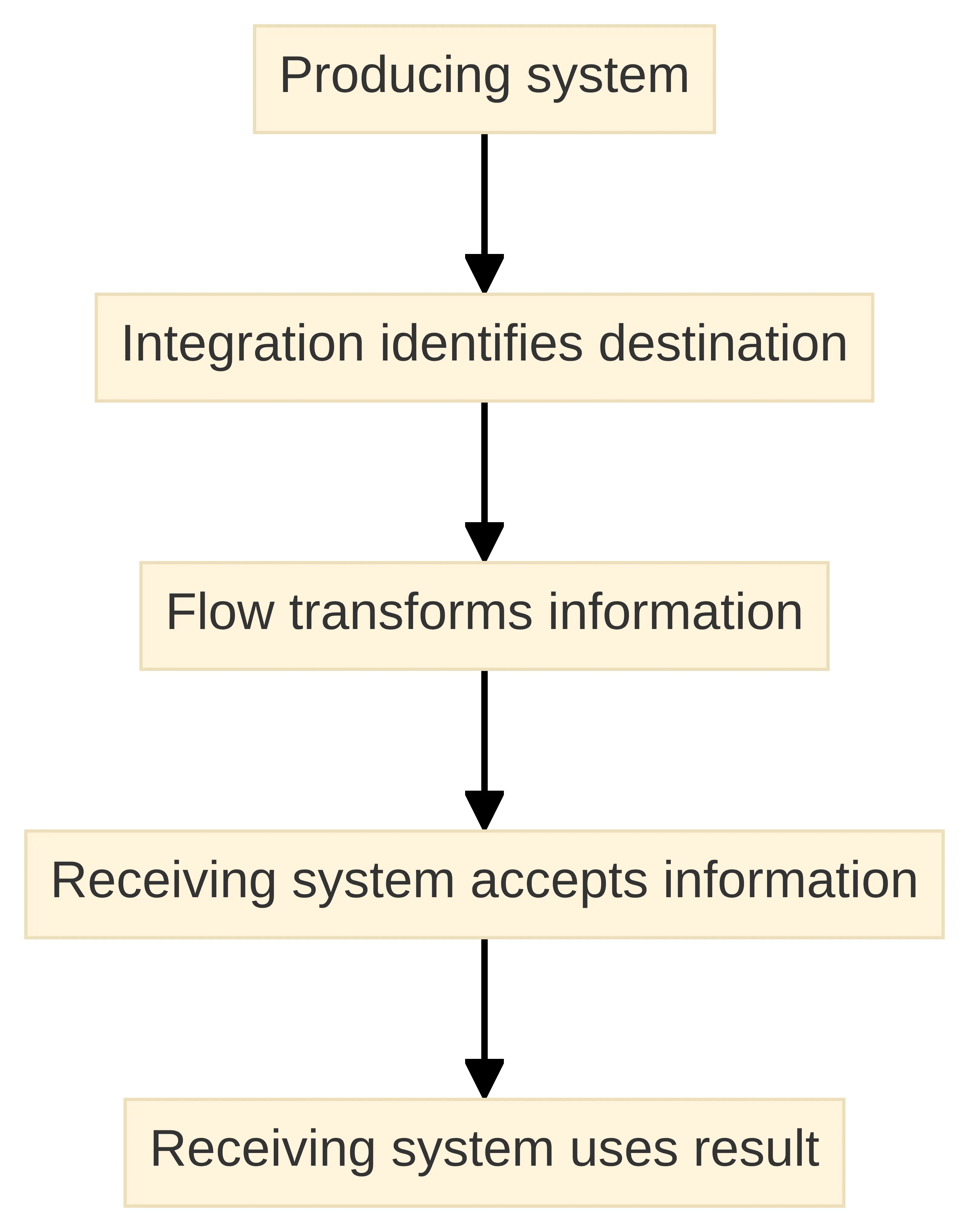
- The producing system exposes or sends information.
- The integration identifies where that information should go.
- The flow may transform the information so the receiving system can use it.
- The receiving system accepts the information or invokes the available service.
- The receiving system uses the result in its own process.
The word may matters here. Not every integration performs the same sequence in the same way. Some flows connect systems directly, while others use an intermediate integration layer. An API can expose a service or data within that exchange. The API is therefore part of the interaction mechanism; it is not automatically the entire integration.
The producer-to-consumer model also keeps the scope clear. A connection is not useful merely because two systems are technically linked. You need to identify what leaves the producing system, what route carries it, what changes along the way, and what the receiving system does with it. Those questions describe the integration as a flow rather than reducing it to a list of software names.
A flow can also involve more than two participants. One system may produce information for several consumers, or one application may receive information from several sources. The same model still works: identify each producer, the connecting path, and each consumer.
What software integrations can connect
Software integrations can connect more than two applications. Business integration can connect processes, applications, services, systems, and data across on-premises and cloud environments, while IT integration can also include APIs and devices.
You can classify the connected participants by asking what each participant contributes:
- Applications: Software products or services that perform a defined business or technical function.
- Systems: Broader environments that may include applications, data stores, infrastructure, or operating processes.
- Data: Information exchanged, combined, or made available between systems.
- APIs: Interfaces that expose ways for applications, systems, and workflows to exchange data or services.
- Business processes: Sequences of work that may depend on multiple applications or services.
- Devices: Hardware endpoints that can participate in an IT environment.
These categories can overlap in a real architecture. An application may expose an API. A system may contain several applications and data stores. A business process may depend on a cloud service and an on-premises database. The integration describes the relationship among those participants, not a single category of software.
The environment also matters. A connection between two cloud applications is an integration. A connection between a cloud application and an on-premises system is also an integration. The basic concept stays the same: separate participants exchange information or services through a defined relationship.
When you hear that a project requires integrations, ask which participants are involved and what must pass between them. The answer is more useful than the word integrations by itself.
A simple example of information moving between applications
A marketing application and a customer relationship management system provide a concrete example of software integration. A business integration can connect a SaaS marketing application with a CRM system, an email client, or an on-premises database.
Imagine the relationship as a set of connected roles rather than as a product list. The marketing application is one participant. The CRM system is another participant. An email client or database may be an additional participant. The integration defines how information or services move between those applications and systems.
The producer and consumer roles can change by flow. The marketing application may provide information that the CRM system receives. In another flow, the CRM system may provide information that the marketing application uses. An email client or database may participate in a separate connection. The important point is the relationship among the systems and the direction of the exchange.
This example also shows why the applications and the integration are different things. The marketing application remains a marketing application. The CRM system remains a CRM system. The integration is the connection that lets them exchange information or services.
You can describe the example in one sentence: a marketing application is integrated with a CRM system when the two systems have a defined way to exchange relevant information or services. That description does not require you to treat either application as the integration itself.
The same reasoning applies to a broader chain. If information moves from one application to a CRM system and then to an email client or database, examine each relationship separately. Identify the producer, the receiving system, and the flow connecting them.
The integration is not the application, API, connector, or data
An integration is the connecting relationship and flow; an application, API, connector, and data are different parts or participants within that relationship. Keeping these terms separate prevents a technology discussion from treating one component as the whole arrangement.
- Application: An application performs a function for its users or for another system. In an integration, it is usually a producer, consumer, or both. The application is not the connection between itself and another application.
- API: An API is an interface through which applications, systems, or workflows can exchange data or services. API integration uses APIs to expose integration flows and connect enterprise software. The API provides an interaction surface; the broader integration includes the connected participants and the exchange around it.
Enterprise integration platforms may include pre-built connectors and reusable integration patterns. A connector can help establish a connection, but it is not the applications, data, or complete business relationship involved. - Data: Data is the information that may move through a flow. It may be exchanged between systems, but the data itself does not describe the route, participants, or service interaction that makes the exchange useful.
- Integration: Integration is the relationship, mechanism, or flow that connects the participants and enables the exchange.
Consider the difference in a planning conversation. Saying that two applications have an API identifies one possible interface. Saying that the applications are integrated describes a wider relationship between them. Saying that a connector is available identifies a connection aid. Saying that data is exchanged identifies something moving through the flow.
Those statements can all be true at the same time. They answer different questions, so you should not use them as interchangeable terms.
What integrations add beyond a connection
Software integration can add functionality beyond establishing a connection between systems.
The distinction is between access and coordinated use. A connection answers whether information or a service can pass from one system to another. Added functionality asks what the receiving system can do with that exchange and how the connected capabilities work together.
For example, a system that receives information from another system may use that information within its own process. A workflow that links several applications may combine their separate functions into a broader business activity. A data stream connected to an application may allow the application to act on the incoming data in real time; Apache Kafka is described as an open-source platform that can integrate data streams with applications for that purpose.
The added function belongs to the relationship among the systems, not necessarily to a new standalone application. That is why an integration can be a meaningful part of an operating model even when the connected applications remain unchanged.
You can test the distinction with two questions:
- What does the connection permit? This identifies the information or service exchange.
- What can the connected systems do together? This identifies the additional function created by combining their capabilities.
The second question should remain specific. Integration does not automatically produce the same function in every environment. The result depends on the systems involved, the information exchanged, and the way the flow is defined.
Application integration and data integration have different focuses
Application integration and data integration describe different focuses, even though the terms are sometimes used interchangeably in enterprise discussions. Treating them as separate concepts helps you ask a more precise question about what must connect.
Application integration focuses on relationships among applications, services, and the workflows that use them. The question is often how one application or service should interact with another so that a broader process can use their functions.
Data integration focuses on the relationship among data sources, data flows, and the systems that exchange or use the data. The question is often how information should move or become available across systems.
The two focuses can appear in the same technology environment. An application may exchange data with another application, so the work has both an application relationship and a data flow. The terms still point to different aspects of the arrangement: application integration emphasizes connected software behavior, while data integration emphasizes connected information.
A useful way to frame the distinction is to finish each phrase:
- Application integration asks: Which applications or services need to interact, and what function should that interaction support?
- Data integration asks: Which data sources or destinations need to exchange information, and what flow connects them?
Neither label alone explains the complete design. You still need to identify the participants, the information or services involved, and the direction of the exchange. Use the label as a starting point, then describe the actual relationship in plain language.
APIs, native integrations, and centralized platforms in context
APIs, native integrations, and centralized integration platforms describe different ways to think about how systems connect. None of these terms replaces the basic producer-to-consumer model; each adds context about the mechanism or ownership of the connection.
When you hear API integration, identify the applications or systems on each side and the information or service that the API makes available.
Native integration needs a definition in context. Native integrations are typically built and maintained by a software provider’s engineers and often use APIs. In a more technically precise use of the term, native integration refers to an integration between applications made by the same organization. These descriptions emphasize different aspects of the term: who builds and maintains the connection, or who makes the connected applications. Ask which meaning is intended before comparing two integration options.
A centralized enterprise integration platform can connect applications through a central integration layer instead of requiring many separate point-to-point connections. Such platforms may also include pre-built connectors and reusable integration patterns.
You can place the terms in one sequence:
- The applications or systems are the participants.
- The API may provide an interface for their exchange.
- A native label may describe how the integration is built or the relationship between its makers.
- A centralized platform may organize several connections through a shared layer.
- The integration is the resulting relationship and flow among the participants.
Use the specific term only after you can explain the connection it describes.
Continuous exchanges are different from one-time migrations
A software integration and a migration can both involve data moving between systems, but they describe different kinds of work. An integration establishes an ongoing or repeatable relationship for exchanging information or services. A migration moves information or system content as part of a transition from one environment or arrangement to another.
The distinction is about the purpose and duration of the movement. An integration connects systems that continue to operate together. A migration supports a change in where information or functionality is located.
The producer-to-consumer model still helps with both situations. For an integration, identify the producer, the route or transformation, and the consumer that will continue receiving or using information. For a migration, identify the source, the destination, and the transition boundary. The questions overlap, but the intended relationship differs.
A project can involve both. Information may be migrated into a new system, and that new system may later integrate with other applications. Do not call the entire project an integration merely because data moves during the transition. Describe the continuing connection separately from the one-time transfer.
Use this practical test:
- If the systems must keep exchanging information or services as part of their operation, you are describing an integration relationship.
- If the movement supports a change from one system or environment to another, you are describing a migration activity.
- If both conditions apply at different stages, name both activities and keep their boundaries separate.
That distinction makes a technology discussion clearer without requiring a particular implementation approach.
Use the producer-to-consumer model to recognize an integration
You can recognize a software integration by tracing the relationship from the system that provides information or a service to the system that receives or uses it. The following questions turn the definition into a practical explanation for a technology discussion:
- What is the producing system? Name the application, system, service, device, or data source that makes information or a service available.
- What is being exchanged? State whether the flow involves data, a service, or both. Avoid describing the connection only by naming the products involved.
- What is the receiving system? Identify the application, system, workflow, or device that receives or uses the exchange.
- What connects the participants? Identify the API, connector, direct relationship, or centralized integration layer that provides the path.
- What happens along the path? State whether the flow routes or transforms information before the receiving system uses it.
- What function does the relationship support? Explain what the connected systems can do together, without assuming that every connection creates the same result.
A complete plain-language description might look like this: one application produces information, an integration flow routes or transforms that information, and another application receives it for use in its own process. The description identifies the participants, the exchange, the path, and the purpose.
The model also helps you separate related terms. The producing and receiving applications are not the integration. The API or connector may provide part of the path. The data is what moves through the path. The integration is the relationship that connects these parts.
Use the six questions when someone says that a project needs integrations. Ask for the flow, not just the label.
Use the definition to frame the next technology discussion
Software integration means connecting separate systems so they can exchange information or services through a defined relationship. The connected systems may be applications, broader IT systems, APIs, devices, services, or data environments. The integration is the flow that relates them; it is not the application, API, connector, or data by itself.
When you need to explain an integration, start with four points: name the producer, identify what crosses the flow, describe the route or transformation, and name the consumer. Then state what the connected capabilities support. This structure keeps application integration, data integration, APIs, centralized platforms, and migrations in their proper context.
For a specific architecture or implementation decision, a qualified technical professional should determine whether an approach fits your environment and requirements. Use the producer-to-consumer description first so that discussion begins with a shared definition rather than an ambiguous label.
Common questions about software integrations
What is software integration?
Software integration is the mechanism that connects separate systems, allowing them to exchange information or services. It involves linking data, applications, APIs, and devices within an IT environment.
How do applications and systems connect through integration?
Applications and systems connect through integration by establishing a defined relationship that allows information or services to flow from one system to another, often involving a producer, a route, and a consumer.
Can you provide an example of software integration?
An example of software integration is connecting a marketing application with a customer relationship management (CRM) system, enabling the exchange of relevant information between the two.
What is the difference between application integration and data integration?
Application integration focuses on the relationships among applications and services, while data integration emphasizes the flow and exchange of data between systems.
What role do APIs play in software integration?
APIs serve as interfaces that allow different applications, systems, and workflows to exchange data and services, facilitating the integration process.
How can I recognize a software integration in a project?
To recognize a software integration, identify the producing system, what is being exchanged, the receiving system, and the connection mechanism, along with the purpose of the relationship.