
The decision is process fit, not technology fashion
RPA software is worth evaluating when your target process consists of repeatable digital steps, follows explicit rules, and uses reasonably consistent interfaces and data. It is software-based automation: software robots perform defined tasks inside digital systems without requiring changes to the underlying systems or infrastructure. The central question is therefore not whether RPA or AI has more attention around it. The question is whether the work you want to automate has the behavior that RPA is designed to execute.
That distinction gives you a practical starting point. Describe the process before you compare tools. Identify the systems involved, the information entering each step, the rules that determine the next action, the points that require judgment, and the exceptions that interrupt the normal path. A process with stable rules and predictable inputs gives RPA a clearer operating boundary. A process that depends on interpretation, changing context, or frequent exceptions requires a different assessment.
You should also separate three decisions that are often collapsed into one:
- Process fit: Does the workflow contain enough stable, rule-based work for automation?
- Operating fit: Can your organization manage the bot, its access, its exceptions, and changes to the workflow?
- Evidence of fit: Has the approach been tested against the actual process rather than a simplified demonstration?
This framework keeps the evaluation grounded in the work. Technology choice follows from that description.
RPA should be treated as a bounded execution layer, not as a general substitute for process design or human judgment. Traditional RPA operates through structured rules and deterministic logic, which limits its effectiveness for contextual understanding, nuanced judgment, and unstructured data interpretation. If the workflow is poorly defined or full of exceptions, automation can reproduce that operating burden at a faster pace rather than remove it.
RPA is a software layer for deterministic work
RPA software uses software robots to perform repetitive, rule-based digital tasks. Those robots can log into applications, read and enter data, follow conditional logic, and pass information between systems through existing user interfaces. This makes RPA different from a conventional integration that depends primarily on APIs or backend connections: RPA can work through the same interfaces that employees use, including interfaces belonging to older systems that have not been rebuilt.
The word “robot” describes software, not a physical machine. An RPA bot follows instructions created for a defined process. It does not automatically understand the business purpose behind each step, reinterpret an ambiguous document, or decide what an unfamiliar case means. Its reliable operating boundary is explicit execution: receive an input, apply a rule, interact with an application, and continue along the configured path.
That boundary matters for enterprise evaluation. A workflow can contain both automatable and non-automatable work. For example, entering structured information into an application may be suitable for a bot, while deciding whether an unusual case satisfies a policy may require human judgment or another technology. Treating the entire workflow as a single automation problem hides that distinction.
A useful mental model is to view RPA as a software layer between a defined process and the applications that execute it. The layer needs more than task instructions. RPA solution selection should evaluate robot management, security, architecture, process evaluation, operational management, and standardized asset management. These areas belong in the evaluation because the bot will operate inside your broader application and control environment, not in isolation.
What happens during a bot run
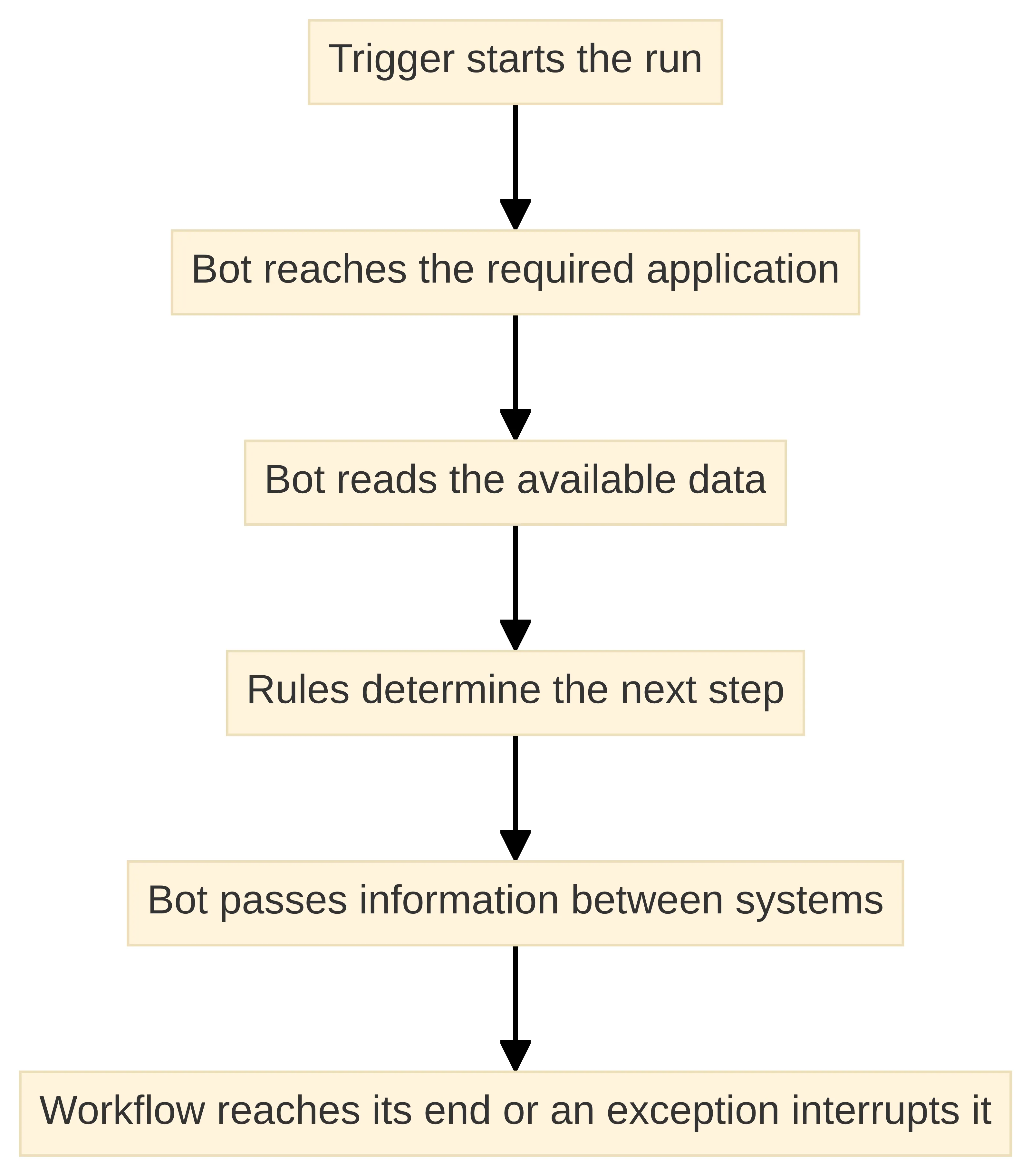
A bot run turns a defined workflow into a sequence of software actions. The exact configuration varies by tool and process, but the general pattern is straightforward:
- A trigger starts the run. The trigger may be a schedule, a programmed condition, or an input.
- The bot reaches the required application. It logs in or opens the relevant interface using the access and configuration assigned to the process.
- The bot reads the available data. It locates fields, records, or other information that the workflow expects.
- Rules determine the next step. Conditional logic directs the bot to enter data, move information, or follow a defined branch.
- The bot passes information between systems. It completes the configured interaction through existing user interfaces and continues until the workflow reaches its end or an exception interrupts it.
This sequence gives you concrete questions for evaluation. What starts the run? Which applications must remain available? What input format does the bot expect? Which rule selects each branch? What happens when a field is blank, a screen changes, or the data does not match the expected pattern? A process description that cannot answer these questions is not yet specific enough for a meaningful RPA assessment.
The run also has an operating context. Someone must manage the automation, its configuration, its access, its exceptions, and its place in the application environment. RPA solution selection therefore includes robot management and operation as well as security, architecture, process evaluation, and operational management. The bot’s visible actions may be simple, but the surrounding controls determine whether the workflow can be operated as a managed capability.
Choose the human boundary before choosing the run mode
RPA has three practical run patterns, and the choice should follow the human boundary in your workflow:
- Unattended RPA runs independently from programmed triggers, inputs, or schedules. This pattern fits a defined sequence that can proceed without a person initiating each run.
- Attended RPA is initiated to assist a person during an interactive process. The person remains involved while the automation handles routine actions on demand.
- Hybrid RPA combines attended and unattended automation so people and bots collaborate across a process.
Do not choose a run mode merely because a process contains repetitive work. First identify where a person must interpret information, approve an action, resolve an exception, or provide an input. Then decide whether the preceding or following steps can run independently, support the person interactively, or require a combination of both.
The human boundary should be explicit before configuration begins. Record the point where structured execution ends and judgment begins, then define what happens when the workflow reaches that point. A bot can handle a defined rule-driven step, while a person may need to address an unfamiliar case. A hybrid design can connect those roles, but it does not remove the need to describe who acts, what information they receive, and how the process resumes.
Read the workflow for signals of suitability
The workflow itself provides the first suitability signals. RPA is generally suited to processes with structured rules, consistent user interfaces, and consistent data formats. Candidate processes should also be assessed for volume, clear process rules, and stability. These characteristics do not establish that automation will produce a particular result, but they make the target easier to describe, test, and operate.
Use this short process-fit screen:
- Repeatability: Do the same steps recur often enough to justify defining them precisely?
- Rule clarity: Can you express the normal path through explicit conditions rather than personal interpretation?
- Input structure: Does the process receive data in formats the bot can consistently locate and use?
- Interface consistency: Do the applications present the fields and screens that the workflow expects?
- Exception pattern: Can you identify the exceptions, their triggers, and the action required for each one?
- Stability: Are the steps and target applications stable enough for the evaluation period?
A “no” answer does not automatically end the investigation. It tells you where the boundary or operating burden may sit. You may be assessing a different automation approach, narrowing the target to a more structured segment, or retaining a human step.
RPA can support work such as data entry, IT operations, application integrations, customer service assistance, and IT helpdesk support. The common feature is not the department name. It is the presence of routine digital actions that can be described and repeated. For an enterprise coordinating teams across the United States and Brazil or other LATAM locations, include the actual handoffs, interfaces, and working hours in the process description rather than assuming that geographic distribution changes the automation fit. Keep the assessment tied to the workflow you intend to run.
Separate execution from judgment when AI is involved
RPA remains relevant alongside AI when you assign each technology a distinct role in the process. RPA works within structured rules and deterministic logic. The two approaches can therefore apply to different parts of the same process rather than being treated as mutually exclusive.
| Evaluation question | RPA’s typical role | AI’s possible role |
|---|---|---|
| What kind of work is being handled? | Execute structured, repeatable steps | Support interpretation of context or less-structured information |
| How is the next action selected? | Apply configured rules and conditions | Provide a suggestion, explanation, or identified anomaly for consideration |
| Where does human involvement sit? | Run independently, assist a person, or combine both modes | Remain part of the decision boundary when contextual judgment is involved |
| What should you test? | Step execution, interfaces, inputs, and exceptions | The quality and usefulness of the contextual support and the human review point |
The table is a division of responsibility, not a technology ranking. Your process may use RPA for a structured handoff and AI for a judgment-heavy step, or it may need neither if the workflow is not sufficiently defined.
Processes with high variability and high exception rates may be better suited to AI-native automation than to RPA, while traditional RPA remains limited for contextual understanding, nuanced judgment, and unstructured data interpretation. Use that distinction as a design question: which steps can follow rules, and which steps require context? Do not describe AI as a replacement for RPA or RPA as a replacement for AI. Assign the human boundary and test each part against the work it must perform.
Treat exceptions and change as part of the operating burden
Exceptions are not an edge detail in an RPA evaluation. A process with many exceptions can create a bot that requires constant attention. Your assessment should therefore describe the exception path with the same care as the standard path:
- Identify the condition that interrupts the normal sequence.
- Record the information available at that point.
- Assign the action that resolves or routes the exception.
- Define how the process resumes, stops, or returns to a person.
- Count the different exception types that the test must exercise.
This turns “exception handling” from a product phrase into an observable part of the workflow.
Maintenance is another part of the operating model. RPA interacts with applications through their user interfaces, and integration depth with the applications used by the target process affects maintenance risk. During evaluation, examine how the automation identifies fields and screens, how configuration changes are managed, and how the team handles a changed application or data format. Test selector stability and configuration complexity on the actual workflow rather than relying on a generic demonstration.
For financial-services, healthcare, e-commerce, or data-engineering operations, add the relevant security, architecture, and operational-management questions to the evaluation record. The exact control requirements depend on your environment, but the selection framework should make those categories visible before you commit to a design.
Establish the baseline before estimating value
Before you estimate the value of RPA, describe the current process in measurable terms. Establish the process cost in hours and errors, then define the expected automation return before evaluating whether the program worked. This baseline gives you a reference for the assessment; it does not guarantee a saving, a reduction, or a particular business result.
Build the baseline around the workflow rather than the tool:
- How many times does the process run during the period you are studying?
- How much human time does the normal path require?
- Which steps generate errors or rework?
- How much variation appears in the inputs and exceptions?
- Which applications and handoffs are involved?
- What operating effort is required to monitor and resolve interruptions?
Keep observed facts separate from assumptions. If you do not have a reliable measurement for a question, mark it as an open item for the evaluation instead of turning an estimate into a result.
A baseline also helps you compare process alternatives without ranking technologies by reputation. You can ask whether the target has enough repeatable volume to justify the design and whether the operating controls are proportionate to the work. Include security, architecture, robot operation, process evaluation, and standardized asset management in the decision record. These criteria help you assess the full operating arrangement rather than only the bot’s ability to complete a visible task.
Use the real workflow as the evaluation environment
A meaningful RPA evaluation should use the actual target process. Testing shortlisted tools on that workflow can reveal selector stability, exception-handling capability, and configuration complexity. It also exposes the details that a simplified demonstration can hide: real application states, real data variation, real branch conditions, and the points where a person must intervene.
Prepare the test with a defined evidence pack:
- A process map showing the normal sequence and each exception branch.
- Representative inputs, including the formats that the workflow actually receives.
- The application list and the interfaces the bot must use.
- The rules that select each branch.
- The human handoff points and the information required to resume work.
- A record of the test observations, open questions, and configuration effort.
Ask each shortlisted tool to address the same workflow conditions. A common test makes the results easier to compare because each option faces the same process, data, interfaces, and exception cases.
Use these questions during the evaluation:
- Does the automation follow the defined normal path with the expected inputs and interfaces?
- Does it identify and route the exception cases you documented?
- Can you explain where a person must intervene and how the process resumes?
- How stable are the selectors or other interface references during the test?
- What configuration effort is required for the target applications and process branches?
- How would the organization manage robot operation, security, architecture, and standardized assets?
The result should be a decision record tied to your workflow. It should show what was tested, what was observed, and which operating questions remain open.
Make the initial decision reversible and evidence-led
RPA software merits further assessment when your target process has repeatable rules, structured inputs, consistent interfaces, and a manageable exception path. It deserves a narrower scope or a different approach when the workflow depends heavily on contextual judgment, unstructured information, or frequent variation. AI can participate in the same process, but the evaluation should still separate structured execution from judgment and define where human intervention remains.
Start with a bounded workflow, establish the current hours and errors, document the process and its exceptions, and test the actual applications and inputs. Then record the operating requirements for robot management, security, architecture, and maintenance. If the evidence does not support a clear process fit, keep the decision open rather than expanding the automation boundary by assumption.
A qualified professional should decide whether a particular design is suitable for your organization’s individual operational, security, legal, regulatory, and compliance requirements. Request a project quote when you are ready to discuss a structured process assessment or implementation scope.