
What Neutech offers—and what this evaluation can establish
We provide senior software designers and developers to augment product and development teams, and we offer custom software development services. We also undertake backend-infrastructure rebuilding for clients. These offerings place us in two related categories: additional engineering capacity for an existing team and delivery of a defined software assignment.
For your hedge fund, that distinction matters. You may need more people inside an established product organization, a team to deliver a bounded application, or work on an existing backend that has become difficult to change. Those needs call for different responsibilities, access arrangements, deliverables, and approval points. They should not be treated as the same engagement.
Automated data integration is described as fundamental for hedge fund managers navigating financial-services complexity, and hedge fund managers face implementation challenges when adopting it. That context makes data movement, system boundaries, ownership, and operational handoff relevant questions when you assess any outside engineering partner. It does not, by itself, establish that our team is suitable for your data environment.
This guide establishes what we offer, how those offerings can map to a hedge-fund technology need, and which questions should shape your evaluation. It does not establish your suitability decision, a particular security or compliance posture, delivery results, pricing, or investment outcomes. Treat our stated capabilities as the starting point for a defined diligence conversation.
The practical decision is therefore narrower than whether Neutech appears relevant in general. Define the assignment first, then test whether our people, technical approach, oversight, access model, and commercial terms fit that assignment. A clear work boundary gives your technology, risk, procurement, and business stakeholders the same question to evaluate.
Choose the engagement path that matches the fund’s technology need
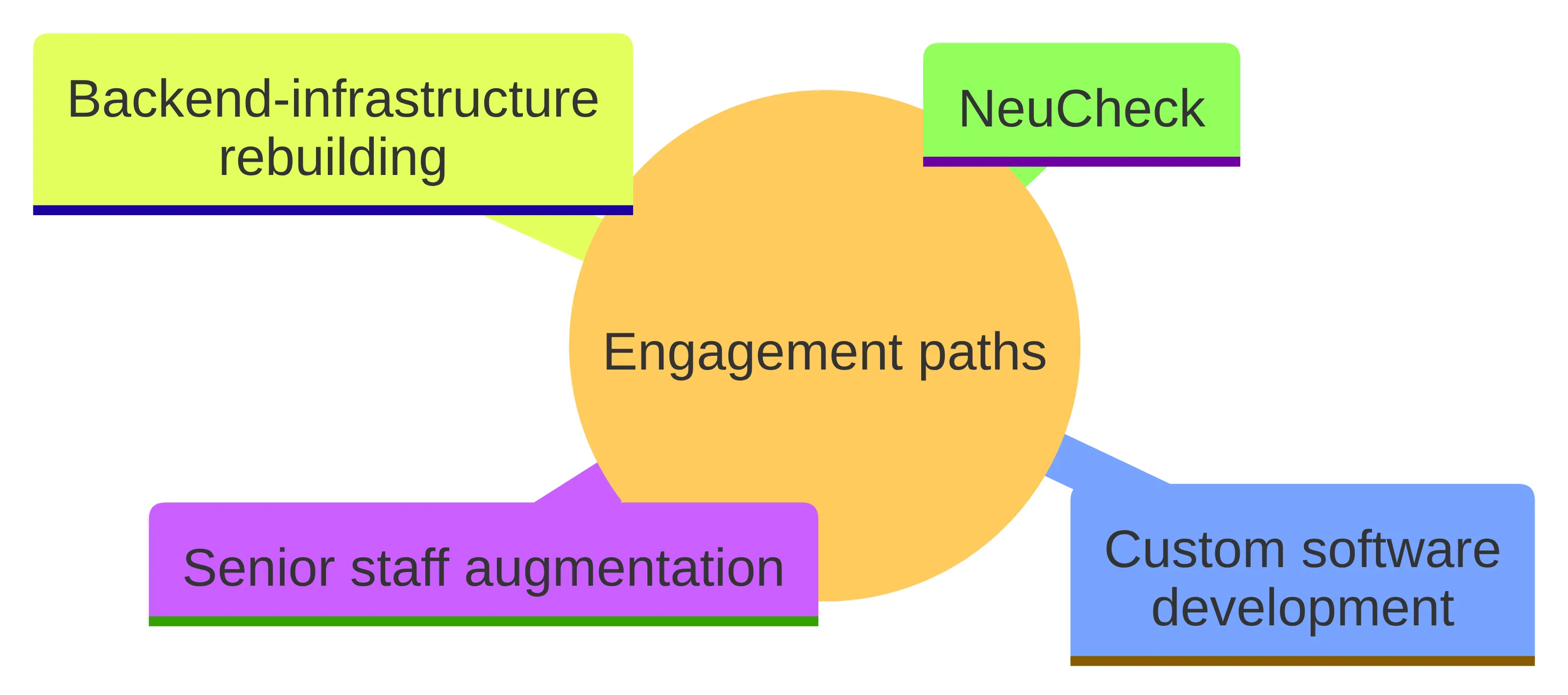
Your fund should choose an engagement path by starting with the work that must be owned, not with a general request for technical help. The following map keeps the options separate.
| Engagement path | Use it as the starting question when you need | Define before moving forward |
|---|---|---|
| Senior staff augmentation | Additional software designers or developers to augment an existing product or development team | Roles, decision rights, reporting line, start conditions, and expected duration |
| Custom software development | A defined software solution rather than additional seats inside an existing team | Functional boundary, technical deliverables, acceptance criteria, and ownership |
| Backend-infrastructure rebuilding | A rebuild of backend infrastructure for an existing client environment | Current constraints, migration boundaries, system dependencies, and operating responsibility |
| NeuCheck | A service that you want to examine through the involvement of senior engineering oversight | What the service covers, the inputs required, the written outputs, and the decisions it is intended to support |
NeuCheck is overseen by our most senior engineers. Those are distinct offerings; the descriptions do not establish that any one path is appropriate for your architecture or operating model.
Use the work product to distinguish the paths:
- If your internal team retains roadmap and delivery ownership, staffing augmentation may be the relevant starting point.
- If you need a defined result with agreed acceptance conditions, custom development may be more appropriate than adding individual contributors.
- If the assignment concerns a difficult or aging backend, isolate infrastructure boundaries before deciding whether the work is a rebuild or a narrower intervention.
- If the immediate question is technical condition or direction, ask what NeuCheck examines and what decisions its output is meant to support.
If you cannot describe the assignment in one sentence, start with a discovery brief rather than a broad staffing request. State whether you need capacity, a defined build, infrastructure work, or technical examination. Then ask for the proposed responsibilities and deliverables for that path. A clear boundary is the first condition for a useful comparison.
Map Neutech’s stated capabilities to hedge-fund software and data work
Your hedge fund’s technology requirement should determine which capability you examine first. Hedge funds should identify software that aligns with their specific strategies and operational requirements. Use that principle to translate a broad technology concern into a bounded workstream.
- Data integration: If your assignment involves bringing data from multiple systems into a usable workflow, define the sources, transformations, destinations, ownership, and operating responsibility. Automated data integration is described as fundamental for hedge fund managers, while implementation challenges remain part of the decision. Ask us to explain which part of that assignment we would own and what would remain with your team.
- Backend infrastructure: If an existing backend limits a system change, ask whether the proposed work is a rebuild, a contained alteration, or an assessment before any implementation begins. We undertake backend-infrastructure rebuilding for clients, but that statement does not define the boundaries of your environment.
- Custom application work: If you have a defined product or workflow to build, compare the proposed scope with our custom software development offering. Ask for the expected deliverables, dependencies, acceptance criteria, and handoff responsibilities rather than relying on a service label.
- Additional engineering capacity: If your internal product or development team owns the roadmap and needs additional contributors, evaluate senior staff augmentation. We provide senior software designers and developers to augment product and development teams.
A data assignment should also identify the point at which engineering work becomes an operating responsibility. For example, specify whether the external team is expected to build an integration, monitor it, investigate failures, maintain data mappings, or hand the system to your internal operations group. Each responsibility changes the required access, documentation, escalation path, and acceptance conditions.
This mapping helps you test fit without assuming that a general capability covers every technical layer. We may be relevant to the category of work while still requiring a separate discussion about your data model, system access, production responsibility, documentation, and control requirements. Keep those questions attached to the assignment they affect.
Evaluate capacity, embedding, and commercial flexibility
Our stated capacity and commercial structure should be evaluated as separate questions. We offer month-to-month staffing-augmentation plans, allowing clients to scale up or down with 30 days’ notice. We can also provide two senior-level resources embedded in a client’s team within one week.
Those are stated staffing and commercial terms, not a commitment that the proposed resources, timing, or structure will match your assignment. Ask for the conditions behind the proposed start date and for the practical meaning of scaling up or down. Your diligence brief should cover:
- The roles and experience required for the assignment.
- The number of resources needed and the expected allocation.
- The work that must be completed before a resource can begin.
- The person who directs day-to-day work and the person who approves deliverables.
- The notice mechanics, transition expectations, and consequences of changing capacity.
- The information that must be available for the proposed start date.
The one-week statement should be connected to a specific staffing request. Ask whether it assumes completed role definitions, available access, an identified internal manager, or other conditions. Ask separately whether the two resources would have the same skills, allocation, and responsibilities that your assignment requires. A stated time frame is useful for planning only when its conditions are visible.
A month-to-month structure may reduce the duration of a commitment, but it does not define the quality of delivery, the suitability of a resource, or the controls required for your environment. Ask us to attach each commercial term to the specific assignment you are considering.
Do not fill gaps with assumptions about price, savings, availability, or delivery speed. Put those items into the commercial discussion and record the answer alongside the scope. If capacity can change with notice, document how open work, credentials, documentation, production responsibilities, and knowledge transfer will be handled when the team changes.
Define how an external team would operate inside the fund
Your operating model should describe how outside engineers work with your team, not merely where they sit on an organization chart. We use Scrum and agile planning for project management. We also describe senior-level resources as embedded in a client’s team and provide senior software designers and developers to augment product and development teams.
Before work begins, write down the following operating conditions:
- Work ownership: Identify who owns the roadmap, technical decisions, prioritization, approvals, and production responsibility.
- Communication: Specify meeting cadence, escalation routes, written records, and the time zone or working-hour overlap your team requires.
- Repository and environment access: List the systems, repositories, data environments, credentials, and approval steps involved. Grant only the access needed for the defined assignment.
- Delivery evidence: State what must be delivered at each checkpoint, including code, configuration, documentation, test records, or decision notes where applicable to the assignment.
- Change control: Explain how scope changes, blocked work, defects, and urgent production matters are recorded and approved.
- Handoff: Define who receives the work, what knowledge must be transferred, and which responsibilities remain after the engagement changes or ends.
Your internal team should also decide which ceremonies are mandatory and which decisions cannot be delegated. Scrum and agile planning describe an approach to project management; they do not determine who approves a production release, who accepts a control change, or who responds when a dependency blocks delivery. Put those decisions in the engagement brief.
Ask us to translate the proposed working model into named responsibilities and concrete outputs. If an external engineer attends your planning meetings, specify whether that person may prioritize work, approve a design, merge code, deploy changes, or only provide recommendations. If accountability remains unclear after that discussion, pause the evaluation rather than treating team integration as automatic.
Assess technical oversight through specific diligence questions
NeuCheck is a service we offer, and NeuCheck is overseen by our most senior engineers. That description gives you a useful subject for diligence, but it does not define the service’s scope or establish what decision your fund should make from it.
Ask specific questions before treating technical oversight as part of your engagement:
- What problem or decision is NeuCheck intended to address?
- What materials, repositories, environments, or system information must you provide?
- What written output will you receive, and who is responsible for acting on it?
- Does the engagement examine architecture, implementation, or another defined subject?
- Which findings require remediation, a design decision, or further investigation?
- How are access, confidentiality, data handling, and ownership addressed for the materials reviewed?
- Does the service create any implementation work, or must that work be scoped separately?
Connect each question to a decision your fund must make. An architecture review may inform whether to rebuild a backend, while an implementation review may identify work inside an existing codebase. Those are different activities with different inputs and outputs. Do not accept a general description of oversight as a substitute for naming the technical subject under review.
Use the answers to separate oversight from delivery. Senior involvement may be relevant to your evaluation, but the right test is whether the proposed activity produces the information your technology, risk, and compliance stakeholders need for the decision at hand. Ask for the scope in writing and connect each expected output to a named decision-maker.
If the proposed service cannot be described through inputs, activities, outputs, and responsibilities, keep it outside the approved assignment until those boundaries are clear.
Make third-party risk evidence part of the partner decision
Your third-party review should be part of partner selection, not an activity left until after technical work is approved. Implementing a Standardized Information Gathering questionnaire can help organizations navigate third-party relationships, safeguard operations, and reinforce trust with clients and regulators.
Use a questionnaire or equivalent diligence brief to request evidence relevant to your engagement. Include:
- The services and environments covered by the proposed work.
- The categories of data the external team may access, process, store, or transmit.
- Access approval, authentication, least-privilege expectations, and credential handling.
- Incident notification responsibilities and the route for escalating a material issue.
- Subcontractor involvement, location of work, and responsibility for their actions.
- Business continuity, recovery expectations, and dependencies that could affect your operations.
- Secure development, change management, testing, and release responsibilities where they apply to the assignment.
- Data retention, deletion, return, confidentiality, intellectual property, and termination terms.
Separate the evidence request into three layers. First, identify what the proposed team will do and which environments it will touch. Second, identify the control or contractual requirement that applies to that activity. Third, specify the document, answer, owner, or approval needed to close the question. This structure makes an open issue easier to assign than a broad request for assurance.
A completed questionnaire is evidence for a diligence discussion; it is not a substitute for your own approval process or a conclusion that every control requirement has been met. If your fund has named contractual, legal, regulatory, or client obligations, write those obligations into the brief and ask for the specific evidence needed to assess them. Do not infer a certification, compliance status, or production control from a service description.
Move forward only when the answers identify who owns each control and what documentation supports the answer. Keep unresolved issues visible in the approval record, including the person responsible for resolving each one and the point at which the issue must be closed.
Separate stated capabilities from evidence still requiring verification
Our stated capabilities include senior software designers and developers for product and development-team augmentation; custom software development; month-to-month staffing-augmentation plans with scale changes on 30 days’ notice; two senior-level resources embedded in a client’s team within one week; Scrum and agile planning; NeuCheck overseen by our most senior engineers; and backend-infrastructure rebuilding for clients.
Those statements answer what we offer. They do not answer whether a proposed engagement fits your fund. Verify the items that depend on your assignment and operating environment:
- Current resource availability, named skills, seniority, and relevant experience.
- The exact work the proposed team will own and the work your internal team will retain.
- Access requirements for systems, repositories, data, environments, and production operations.
- Security, confidentiality, continuity, incident response, and subcontractor arrangements.
- Evidence relevant to your contractual, legal, regulatory, and client obligations.
- Expected checkpoints, acceptance criteria, documentation, handoff, and post-delivery responsibility.
- Fees, notice mechanics, capacity changes, expenses, and termination consequences.
Use a simple distinction in your approval record: stated capability, assignment-specific proposal, supporting documentation, open question, and decision owner. That structure keeps a broad service description from being mistaken for a commitment or control conclusion. Ask us to answer open questions against the exact scope rather than accepting general assurances.
The distinction also helps your stakeholders ask different questions of the same proposal. Your engineering lead can test architecture, skills, dependencies, and delivery ownership. Your risk or compliance function can assess access, data handling, continuity, and third-party obligations. Procurement can evaluate fees, notice, termination, and responsibility for changes. A proposal is easier to approve when each reviewer can see the question that belongs to them.
Prepare a bounded quote request for a defined assignment
Your project brief should give a potential partner enough information to respond to the assignment rather than to a vague category of need. Keep the document short, specific, and usable by technical, risk, procurement, and business stakeholders.
Include these sections:
- Business purpose: State the operational problem, the users or internal teams affected, and the decision the work should support.
- Scope: Describe the systems, workflows, integrations, or infrastructure included. List explicit exclusions so an initial response does not assume unlimited responsibility.
- Required skills: Identify the engineering disciplines, platform knowledge, data experience, and domain context required for the assignment.
- Technical environment: Name the relevant applications, repositories, interfaces, data stores, deployment environments, dependencies, and constraints.
- Data and access: Describe data categories, access levels, approval steps, handling restrictions, credentials, and environments the team may use.
- Delivery expectations: Set checkpoints, acceptance criteria, documentation needs, testing responsibilities, handoff requirements, and any uptime or operational expectations that apply.
- Accountability: Name the internal sponsor, technical owner, risk or compliance participants, approver, escalation contact, and decision rights.
- Commercial structure: State the expected resource model, timing assumptions, duration, capacity changes, notice requirements, and information you need in the commercial response.
Ask for a response that mirrors this structure. Then compare the proposed work, people, timing, controls, outputs, and terms against your brief. If a response leaves ownership or access conditions open, record the gap and resolve it before approval. A bounded assignment gives you a basis for evaluating fit without treating a general capability statement as a project commitment.
Before sending the brief, remove questions that your own team has not decided. Identify whether the request is for staff augmentation, a defined build, backend work, or technical examination. Mark assumptions about system access, timing, data, and internal availability as assumptions rather than commitments. This makes the response easier to compare and reduces the risk that a supplier fills an undefined boundary with its own interpretation.
For the commercial response, request the proposed team structure, allocation, start conditions, notice mechanics, and responsibilities alongside any price information. For the technical response, request scope, deliverables, dependencies, acceptance conditions, and handoff. Keep those responses connected so that a staffing proposal cannot be evaluated separately from the work it is expected to perform.
Decide whether Neutech merits structured follow-up
Structured follow-up is appropriate when the assignment and proposed responsibilities can be documented.
The decision should turn those stated capabilities into an assignment-specific proposal. Require clear scope, named ownership, access conditions, technical outputs, third-party evidence, commercial terms, and a handoff plan. If those points remain unresolved, keep the evaluation open rather than treating a general service description as approval.
Use your brief to decide what happens next: request a scoped response when the assignment and decision owner are clear; resolve diligence questions when access or control responsibilities remain open; or pause when the proposed path does not match the work your fund needs. That sequence keeps a contact conversation separate from an approval decision.
A qualified professional responsible for your fund’s technology, risk, legal, or compliance obligations should decide individual suitability and required controls. With that boundary in place, use your defined assignment and diligence questions to determine whether further discussion is warranted.
What should a hedge fund verify before requesting a project quote?
What services does Neutech provide for hedge funds?
Neutech offers senior software designers and developers for staff augmentation, custom software development, backend-infrastructure rebuilding, and a service called NeuCheck overseen by senior engineers.
What is the flexibility of Neutech's staffing plans?
Neutech offers month-to-month staffing-augmentation plans, allowing clients to scale up or down with 30 days’ notice.
What should hedge funds consider when evaluating Neutech as a partner?
Hedge funds should define their specific technology needs, assess Neutech’s capabilities against those needs, and clarify roles, responsibilities, and access conditions before proceeding.
What are the key factors for hedge funds when assessing third-party software providers like Neutech?
Hedge funds should evaluate third-party providers based on their ability to meet specific operational requirements, compliance standards, data security measures, and the clarity of their service offerings.
How can hedge funds prepare a project brief for Neutech?
A project brief should include the business purpose, scope, required skills, technical environment, data access, delivery expectations, accountability, and commercial structure.