Make staff augmentation concrete with a client-readiness record
To make staff augmentation useful as a decision, treat it as a client-readiness record for one defined software need. Start with the gap: a heavy workload, a temporary vacancy, or a specialized skill requirement. Then identify the internal technical owner who can provide product context and retain responsibility for delivery. This turns an abstract staffing label into a concrete question about whether the team can absorb an additional engineer into its existing work.
The record should describe the workstream, the expected duration, and the path into the product team’s workflows, tools, and projects. An augmented engineer may work remotely or on-site and still needs product-specific onboarding, even when senior and experienced. The point is not to hand over a finished project brief; it is to make the client’s operating role explicit before a provider sources and vets candidates.
Your team generally assigns work, sets priorities, directs technical work, reviews code, and manages delivery in a staff-augmentation arrangement. The external engineer contributes within those decisions rather than receiving a finished project brief and independently owning the entire delivery process.
That distinction gives you a practical definition: you add people to your engineering operation, but you do not hand over day-to-day delivery management. If your team can explain what needs to be done, provide technical direction, and review the work, the model may address a defined capacity or skill gap.
See how one added engineer works inside an existing product team
A growth-stage product team with a working application might need an additional engineer for a specialized feature or a period of heavier delivery work. In a staff-augmentation arrangement, the added engineer joins the team’s existing project rather than receiving an entirely separate project to run.
The engineer works with the team’s workflows and tools, contributes to the client’s projects, and operates within the product context that the client team owns. The client continues to decide which work matters, how the work fits the product, and what quality standards apply.
The added engineer may work remotely or on-site and integrate into the existing workflow. The need might come from a heavy workload, a temporary vacancy, or a specialized skill gap that does not justify permanent recruitment for the resulting need.
A practical version of the scenario looks like this:
You identify a defined feature, technical problem, or backlog of work.
Your product or engineering lead explains the context, priorities, and acceptance expectations.
The added engineer contributes through your team’s working process.
Your team reviews the work and decides how it moves into the product.
The engineer supplies additional execution capacity. Your team retains product direction and delivery ownership.
Follow the engagement from need identification to team integration
The staff-augmentation process typically starts by identifying project needs and skills, then sourcing and vetting candidates through a staffing provider. A useful request describes the work to be done, the technical capability required, the expected relationship with your team, and the period in which additional capacity may be needed.
The sequence usually has four parts:
Define the need. Describe the product area, technical work, skill gap, and capacity problem.
Source and vet candidates. The staffing provider looks for external professionals whose experience matches the stated need.
Select the contributor. Your team assesses whether the proposed person can work within the project’s technical and operating context.
Integrate the contributor. The selected engineer joins the existing workflow, whether the work is remote or on-site.
Companies can use the model for short- or long-term projects and adjust capacity as project demands change.
Integration is more than giving an external engineer access to a repository. Product-specific onboarding gives the engineer the context needed to understand the system, the current work, and the team’s way of making decisions. Senior experience can help with technical contribution, but it does not remove the need to learn your product.
Your team should therefore treat selection and integration as connected decisions. A technically capable person still needs a clear work area, an internal point of contact, access to the relevant tools, and a way to receive and clarify priorities. The engagement becomes operational only when the external contributor can participate in the workflow your team already uses.
The requested skill and the expected duration should be connected to the work rather than stated as headcount alone. A short-term need may call for a narrowly defined contribution, while a longer engagement may require a broader role as project demands change.
Describe the capability you need, the work that capability will support, and the conditions that would change the required capacity. That description gives your team a basis for discussing whether to add one specialist, several specialists, or no external capacity at all.
Assign responsibilities between the client and provider
The client retains the delivery responsibilities that shape the daily work. Your team assigns tasks, sets priorities, directs technical work, reviews code, and manages delivery. Your product and technical leaders remain responsible for deciding what the team should build and how the work should fit the product.
Those responsibilities require an internal operating connection. An external engineer can contribute code, technical analysis, or other engineering work, but the client still supplies the product context and makes the decisions that govern the work.
The provider may handle employment, payroll, contracts, administration, and replacement while the client manages delivery and day-to-day work. This division separates employment administration from project direction.
The provider’s administrative role does not turn the arrangement into provider-managed outsourcing. Your team still needs to communicate priorities, review contributions, resolve technical questions, and manage the person’s work within the product. Before work begins, write down which decisions stay with your team and which administrative responsibilities sit with the provider. Clear ownership prevents the engagement from being treated as either a permanent internal hire or a fully delegated project.
The responsibility split should remain visible during the engagement. Your internal lead directs the work and evaluates the contribution, while the provider may address the employment and administrative side of the relationship. Replacement is also an administrative responsibility that the provider may handle, but changing personnel does not remove your need to provide product context and delivery direction.
Use this division to decide what your team must prepare before the start date. The internal side needs an owner for priorities, technical review, and delivery decisions; the provider-side terms need to explain the administrative responsibilities that support the engagement.
Match the model to a defined capacity or skill gap
A startup or growth-stage product team may consider staff augmentation when its need is specific enough to describe but does not call for a permanent hire. The model can address several situations:
Heavy workload: Your existing engineers need additional capacity for a period of increased delivery work.
Temporary vacancy: A planned or unplanned absence leaves work that still needs technical attention.
Specialized skill gap: Your team needs an expertise that is not available internally for a particular project.
Changing project demand: The amount or type of engineering work changes as the project develops.
The model supports adding specific skills for short- or long-term projects and adjusting capacity as project demands change. The relevant question is not simply whether you need more people. It is whether you can identify the work or capability that the added person will address.
A defined need gives your team a basis for selecting the required experience and integrating the contributor into a real workstream. A vague request for general help makes priorities, evaluation, and onboarding harder to organize.
Describe the gap in operational terms: identify the product area, the work that is waiting, the capability that is missing, and the person who will direct the contribution. If you cannot provide that information, pause before treating staff augmentation as the answer. The model adds capacity under your direction; it does not replace the need for a clear delivery problem.
A defined work or capability gap gives the team a basis for deciding whether to add external capacity.
Separate staff augmentation from permanent hiring and outsourcing
Staff augmentation, permanent hiring, and outsourcing differ in both the employment arrangement and the location of day-to-day delivery management. The following comparison keeps those distinctions visible:
Model
What you add or delegate
Who manages day-to-day delivery?
Main boundary
Staff augmentation
External professionals or teams join your existing team temporarily or for a project
Your client team
You add capacity or a skill while retaining delivery ownership
Permanent hiring
Specialists become permanent members of your team
Your internal team
You create an ongoing employment relationship
Outsourcing
A provider takes responsibility for part or all of a project or function
The provider
You delegate delivery management rather than adding people under your daily direction
Choose the model by asking where the work will be directed. Staff augmentation places day-to-day management with you. Outsourcing places delivery management with the provider. Permanent hiring creates a continuing internal role.
The distinction affects your operating obligations. With augmentation, you must have someone who can direct the work and review the contribution. With outsourcing, you define the required result while the provider manages its own delivery process. With permanent hiring, you take on the continuing employment relationship. Select the arrangement that matches the responsibility your team is prepared to carry.
Account for the management work the client still retains
The client retains management work after an augmented engineer joins. Your team must provide product-specific onboarding, assign useful work, clarify priorities, review contributions, and manage performance. The client also bears delivery risk in the staff-augmentation model.
That responsibility can be easy to underestimate when the added engineer has substantial experience. Seniority may reduce the amount of technical explanation required for some tasks, but the engineer still needs to understand your product and its context. Your internal lead must remain available to make decisions and resolve questions that an external contributor cannot answer independently.
Use this management checklist before adding an external engineer:
Name the internal person who will assign work and answer questions.
Identify the product and technical context that onboarding must cover.
Define how code or other engineering contributions will be reviewed.
Explain how priorities will be communicated when project needs change.
Decide how performance and delivery concerns will be handled.
Make sure your team can retain responsibility for the resulting work.
If your team lacks the capacity to provide these functions, the model may not address the underlying delivery problem. Adding an engineer does not transfer the client’s management responsibility to the provider.
The management load continues after onboarding. Your technical lead still has to connect the external contribution to product priorities, make decisions when requirements compete, and review whether the work is ready to move forward. These are part of retaining delivery ownership, not optional tasks that disappear because the engineer is supplied externally.
Estimate that internal responsibility before you decide how much outside capacity to add. A larger group of augmented engineers creates more coordination and review points for the client team, so the proposed role should match the amount of direction your organization can provide.
Adding an engineer does not transfer the client’s management responsibility.
Use internal technical leadership as the fit test
Internal technical leadership is the central fit test for staff augmentation. The model is generally suited to clients that have technical leadership and need additional capacity or a specific skill. Your team does not need to have every skill in-house, but it does need someone who can provide direction for the added work.
A team with that structure can define the work, connect it to product priorities, review technical contributions, and manage delivery. The external engineer then fills the identified capability or capacity gap within an operating model that the client controls.
Use the following branches to frame your decision:
You have internal technical leadership and a defined gap. Identify the required skill or capacity, name the internal owner, and evaluate augmentation as an option.
You have technical leadership but the need is changing. Define the initial work and the conditions that could change the required capacity, then determine how the engagement should adapt.
You need someone else to direct the entire delivery process. Do not treat staff augmentation as a substitute for provider-managed delivery; first clarify who should own day-to-day execution.
You cannot provide product onboarding or performance management. Resolve that internal responsibility before adding an external engineer.
The fit decision depends on the combination of a defined need and an available client-side owner. Neither additional headcount nor technical seniority removes that condition.
The fit test can be reduced to a few questions:
What specific skill or capacity gap needs attention?
Which internal lead will set priorities and review the work?
What product context must be covered during onboarding?
Does your team want to manage the contributor’s daily work?
If the need changes, can your team redefine the work and capacity required?
Answer yes to the management questions only if your team is prepared to retain delivery responsibility. If the main requirement is a provider that owns day-to-day execution, clarify that boundary before selecting staff augmentation.
Define security, ownership, and continuity boundaries before work begins
Staff-augmentation contracts should define IP ownership, confidentiality, replacement terms, data protection, security requirements, and exit procedures. These terms describe the boundaries under which an external engineer will access your product work and contribute to delivery.
Treat the boundary review as part of defining the engagement, not as a separate administrative detail. Your team should know how work product is owned, how confidential information is handled, what security requirements apply, how replacement is addressed, and how the relationship ends. The exact terms depend on the engagement and should be written clearly before work begins.
Long-term engagements also require attention to knowledge continuity. Documentation and handover processes can support continuity when an external engineer’s involvement changes or ends.
Define what the team should document as the work progresses and how another contributor could understand the relevant decisions, code, and operating context. A handover process gives the engagement a clear transition point. It also keeps product knowledge connected to the client team rather than treating the external contributor as the only place where important context resides.
The boundary review should cover both the start and the end of the engagement. Before access is granted, identify the ownership, confidentiality, data protection, and security requirements that govern the work. Before the relationship changes or ends, identify the replacement and exit steps, the documentation expected, and the handover process.
This keeps commercial terms connected to delivery operations. Your team can then evaluate the arrangement with a clear understanding of who owns the work, who manages the contribution, and how product context will remain available over time.
Prepare the defined need before requesting a project quote
A project quote request becomes more useful when you can describe the skill or capacity gap, the product context, the work to be addressed, and the person who will retain day-to-day delivery responsibility. The process typically begins by identifying project needs and skills before a staffing provider sources and vets candidates.
At Neutech, we provide senior software designers and developers to augment product and development teams. Our staff-augmentation personnel are fully integrated into client teams similarly to in-house hires, and we offer month-to-month staff-augmentation plans that let clients scale up or down with 30 days notice.
Before you proceed, prepare four details:
The technical skill or additional capacity you need.
The product area and work the engineer will support.
The internal technical owner who will direct and review the work.
The workflow, security, ownership, replacement, and exit boundaries that apply.
A qualified professional should determine whether a particular arrangement suits your legal, employment, tax, security, or compliance requirements. If your team has a defined need and can retain day-to-day delivery responsibility, you can use those details to request a project quote from Neutech.
What should a small product team confirm before exploring staff augmentation?
How is software staff augmentation typically billed?
The model is commonly structured around the time contributed by the external engineer, such as hourly or daily rates, rather than a fixed project outcome. Evaluate the full commitment, including onboarding, internal management time, and the expected engagement duration - not only the stated rate.
How long does a staff augmentation engagement usually last?
There is no single required duration. An engagement may support a short-term workload, temporary vacancy, or specialized project need, or continue longer when the capability remains relevant. Define the initial work, expected duration, and conditions that would change the required capacity.
Can a small software team use staff augmentation without a CTO?
A CTO title is not essential, but the team needs an internal technical owner who can set priorities, provide product context, review contributions, and manage delivery. If no one can perform those responsibilities, adding an external engineer will not remove the underlying leadership gap.
What should a staff augmentation agreement clarify before work begins?
It should clearly address IP ownership, confidentiality, data protection, security requirements, replacement terms, and exit procedures. The agreement should also align with the team’s workflow so that administrative responsibilities remain distinct from the client’s responsibility for day-to-day delivery.
When should a team reconsider staff augmentation instead of using it?
Reconsider the model when the need is too undefined to connect to specific work, when the client cannot provide onboarding and technical direction, or when the desired arrangement requires the provider to manage the entire delivery process. Those conditions may indicate that the team needs a different operating model or clearer internal ownership first.
Staff augmentation can keep context with the team that owns delivery
Staff augmentation is a way to add engineering capacity that can keep product context and delivery responsibility with the client team instead of moving delivery to a separate provider. External specialists join the client team’s workflows and tools; the client assigns tasks, sets priorities, reviews the work, and retains technical direction. Knowledge can remain with the client team because augmented staff transfer context as they contribute.
The defining trade-off is continuity of context in exchange for management responsibility. The client keeps project ownership and oversight, but also bears delivery risk and must manage performance. Staff augmentation therefore adds people to an existing operating team rather than transferring responsibility for producing a defined result.
Your team remains responsible for turning added engineering capacity into completed work. External specialists can contribute code, technical knowledge, and execution, but your organization continues to decide what receives attention, how the work fits the product, and when it is ready for review. You also retain project ownership, management control, technical direction, and intellectual-property ownership.
That boundary gives you a useful first test: if you need additional people who can operate under your direction, staff augmentation may fit the shape of the need. If you want another organization to manage delivery and own the process of producing a defined result, you are considering a different model.
How an augmented engineer works inside the existing team
An augmented engineer works inside your existing workflows and tools while following your priorities and technical direction.
A practical operating sequence looks like this:
Define the gap. Describe the work or capability your team needs to add, such as implementation capacity or a specialized engineering skill.
Set the working boundary. Identify the product area, internal tools, workflow, and technical direction that the added engineer will follow.
Assign and prioritize work. Your team decides what the engineer works on and how that work fits with existing priorities.
Review the work. Your managers and technical leads assess progress and work quality within the same oversight structure used for the rest of the team.
Transfer context. The engineer receives the product and delivery context needed to contribute, while relevant knowledge can move back into your team.
Your internal team supplies the operating context that makes integration possible. That context includes the work priorities, technical decisions, tools, and review expectations that govern the project. Staff augmentation therefore works best as an extension of an operating team, not as a substitute for an operating team.
You can keep the arrangement concrete by naming the person responsible for task assignment, the person responsible for technical review, and the product area where the added engineer will contribute. Those are practical planning choices derived from the model’s management structure. The external engineer may be highly capable, but the engagement still depends on your team having a clear route for decisions and feedback.
You retain control over what, how, and when the work is performed. That means the added engineer follows your delivery priorities rather than choosing an independent project plan. It also means your team can place the work beside its existing backlog instead of creating a separate stream with a different management structure.
The model does not remove coordination. It makes coordination your responsibility. Before you explore it, identify the internal owner who can provide priorities, answer technical questions, review the work, and resolve conflicts with the rest of the roadmap.
What the client manages—and what responsibility remains
Your organization manages the work that an augmented engineer performs. You assign tasks, set priorities, review the work, and retain oversight of the project. The same arrangement also leaves delivery responsibility with you: staff augmentation preserves your project ownership, but you bear delivery risk and must manage performance.
This is the trade-off behind the model. You gain direct control over the added capacity, but you do not transfer the work of deciding what matters, resolving priority conflicts, or assessing whether the contribution meets your needs. If your product team is already stretched so far that nobody can provide that direction, added personnel alone will not create a management structure.
Knowledge can remain with your team because augmented staff can transfer context through the work. That possibility depends on the way your team includes the engineer in its workflows and shares product and technical information; it should not be treated as an automatic result of the contract label.
You can support that transfer by keeping decisions visible in the same places your team uses for its own work and by making review part of the normal delivery process. The practical objective is continuity of understanding inside your team, rather than a separate body of knowledge held only by an external provider.
Before adding capacity, assign these responsibilities explicitly:
Priority setting: who decides which work comes first.
Technical direction: who decides how the contribution fits the product and existing engineering approach.
Work review: who assesses the output and provides corrective feedback.
Performance management: who addresses missed expectations or changing needs.
Delivery ownership: who remains accountable for the project’s progress and result.
If your team cannot name those owners, resolve that boundary before treating staff augmentation as the answer.
Staff augmentation, outsourcing, and consulting answer different needs
Staff augmentation, outsourcing, and consulting differ mainly in who supplies execution, who manages the work, and what problem the engagement is meant to solve. The three models can appear together in a software strategy, but they should not be treated as interchangeable.
Criterion
Staff augmentation
Outsourcing
Consulting
Primary need
Additional people for execution inside your existing team
A defined project delivered by an external provider
Strategic insights, frameworks, and solutions for long-term growth
Management of execution
You assign work, set priorities, and review the contribution
The provider manages its team and delivery process
The consultant provides direction while you monitor the resulting work
Technical direction
You retain direction over what, how, and when work is performed
You define the requested result; the provider determines how to deliver it
The consultant supplies strategic guidance rather than joining as execution capacity
Ownership boundary
You retain project ownership and oversight
The provider is responsible for managing delivery of the delegated scope
You receive advice, frameworks, or direction rather than an added delivery role
Fits a need for
A skill gap, capacity surge, or specialized expertise within an existing team
A well-defined project or non-core function that you want a provider to manage
A decision about what to build or a strategic path forward
The practical question is not which label sounds more suitable; it is where you want responsibility for execution to sit. Choose staff augmentation when your team wants more people under its direction. Consider outsourcing when you can define the project or function clearly enough for a provider to manage delivery. Consider consulting when the first need is strategic guidance about what to build rather than additional execution capacity.
A mixed engagement can still contain different responsibilities, but describe each responsibility separately. Do not assume that an adviser will function as an embedded engineer or that an augmented engineer will independently manage a delegated project.
Match the model to the responsibility you want to place externally.
When additional engineering capacity is a practical fit
Staff augmentation can fit your software team when the need is a defined skill gap, a temporary increase in capacity, or specialized expertise within an existing delivery structure. The model adds individuals to the team rather than asking an external provider to take over a complete project.
For a startup or growth-stage product team, translate the need into a specific contribution before discussing providers. A useful description names the product area, the engineering capability required, the work that needs attention, and the internal person who will direct the contribution. That description gives you a way to test whether you need people inside your workflow or a separate delivery unit.
Use these questions to test the shape of the need:
Is the gap specific? You should be able to describe the capability or capacity you need to add without defining an entire external project.
Does an existing team own the work? Staff augmentation assumes that your organization continues to own the product and delivery decisions.
Can your team direct the contribution? Someone inside your organization must be able to assign work, set priorities, and review it.
Could the need change? Staff augmentation lets you add or remove individuals as needs change, while changes to an outsourced scope may require contract amendments.
Is the need execution or definition? If you mainly need help deciding what to build, consulting addresses a different problem.
If the answers point to a bounded gap inside a team that can provide direction, explore staff augmentation as an execution-capacity option. If the work is a self-contained project that another provider should manage, define it for an outsourcing discussion instead. If the central uncertainty is strategic direction, resolve that through consulting before adding execution capacity.
The flexibility trade-off is the management work you retain
Staff augmentation gives you flexibility over the people added to the team, but that flexibility comes with management work. You retain project ownership and oversight. The provider does not assume the delivery risk simply because the engineer is external.
This distinction matters for a small product team. A founder or engineering lead may welcome another experienced contributor but still lack time to set priorities, answer questions, and review the work. In that situation, the capacity gap and the management gap are separate problems. Staff augmentation addresses the first only when your organization can handle the second.
Your retained work usually includes four operating duties:
Direction: decide what the added engineer should work on and how the work fits the product.
Integration: place the engineer inside your workflows and tools rather than leaving the contribution separate.
Review: assess the work and provide feedback through your existing technical structure.
Performance management: address changing priorities, missed expectations, or a mismatch between the role and the need.
These duties are not administrative details around the model. They are the conditions that allow you to use the control the model provides.
Knowledge transfer creates another trade-off. Context can remain with your team when augmented staff work within your environment and transfer what they learn, while outsourced work may leave more knowledge with the provider and create dependency risk. Treat context transfer as an operating responsibility: include it in normal work and review rather than expecting it to happen without a clear process.
If your team wants control but cannot provide ongoing direction, do not confuse nominal control with usable control. Either assign that responsibility internally or examine a model in which the provider manages delivery.
Map control and delivery responsibility before choosing a model
Staff augmentation is a responsibility arrangement: external professionals join your existing software team while you direct their work. You assign tasks, set priorities, and review the contribution. They work within your existing workflows and tools, while you retain management control, technical direction, and IP ownership.
A responsibility map makes the operating boundary concrete:
Boundary
What remains with your team
Execution direction
You control what, how, and when the work is performed.
Project ownership
You retain project ownership and oversight.
Delivery responsibility
You bear delivery risk and manage performance.
Team context
Knowledge can remain with your team because augmented staff transfer context.
The added professional contributes inside your workflows and tools; your team remains responsible for directing and overseeing the work.
The answer changes when the shape of the work changes:
Your team needs execution capacity: Staff augmentation can fit a skill gap, capacity surge, or specialized expertise need. Define the role and assign an internal manager.
You have a well-defined project or function to delegate: Outsourcing may fit because the provider manages delivery of the defined scope. Write the desired result and delivery boundary.
You are still deciding what to build: Consulting may fit because it addresses strategic guidance rather than supplying people for execution. Clarify the strategic question first.
You cannot provide ongoing management: Staff augmentation is a weak fit until you assign responsibility for priorities, review, and performance. Resolve that internal ownership before proceeding.
Team readiness is not a judgment about whether your organization is large or small. A small team can use an embedded engineer if its priorities and management route are clear; a larger team can still be unready if nobody owns the contribution. Use the operating boundary, not the team’s headcount, as the decision point.
Questions to ask before evaluating a staff augmentation provider
Provider evaluation should test whether the proposed engagement can support your technical need, operating environment, and management boundary. Compare the actual arrangement rather than relying on the staff augmentation label alone.
Ask questions in six areas:
Technical and domain expertise: What experience matches the role, product area, or engineering problem you have defined?
Screening and vetting: How are proposed engineers evaluated before they join your team, and what does the evaluation cover?
Security and data protection: What practices address the information, systems, and access conditions relevant to your work?
Contract transparency: Which responsibilities, engagement conditions, and changes are described clearly in the agreement?
Communication and time-zone alignment: How will the proposed working arrangement support your team’s communication rhythm? If your team works with engineers in Brazil or elsewhere in LATAM, ask how overlap with your US working hours will operate.
Relevant track record: What prior work demonstrates experience with a comparable technical or domain requirement?
For software used in financial services or healthcare, make security and data protection explicit evaluation questions rather than leaving them inside a general capability statement. Ask how the proposed engagement handles the systems and information your team identifies as relevant. The evaluation criterion is the provider’s described practice and fit for your conditions, not a broad assurance detached from the work.
Turn the answers into a short comparison record with one row for each evaluation area. Put your requirement in the first column, the provider’s response in the second, and any follow-up question in the third. This record gives your team a common basis for discussing technical fit, operating fit, and contract clarity before moving forward.
Keep the record tied to the role you defined. A general description of an organization cannot answer whether the proposed engineer, working arrangement, and responsibilities match your team’s particular gap.
Record each provider’s response against the role and operating conditions you defined.
Prepare a defined role and capacity gap before the next conversation
A defined role brief gives you a practical basis for deciding whether embedded engineering capacity fits your team. Write down:
the product area or technical capability that needs additional capacity;
the work your team wants the added engineer to perform;
the internal person who will assign priorities and review the work;
the workflows and tools the engineer will join;
the delivery responsibility that remains with your organization; and
the conditions that would make the need larger, smaller, or no longer relevant.
If you cannot complete this brief, clarify the work shape before choosing between staff augmentation, outsourcing, and consulting.
For a software team with a defined capacity or skill gap and enough internal direction to manage embedded engineers, Neutech’s month-to-month staffing augmentation plans can be evaluated against the role brief you prepared. Use the brief to keep the discussion focused on the work, responsibility, and operating conditions that matter to your team.
A qualified professional should decide any individual legal, tax, contractual, or employment suitability for your situation.
What should a small software team clarify before exploring staff augmentation?
What is staff augmentation in simple terms?
Staff augmentation is a hiring model where external engineers are added to your existing team, allowing you to manage their work directly while retaining control over project direction and execution.
How does staff augmentation typically operate within a client’s existing team?
In staff augmentation, external engineers integrate into your existing workflows and tools, following your priorities and technical direction, rather than working as a separate unit.
What roles and responsibilities are involved in staff augmentation?
In staff augmentation, your organization manages the work performed by augmented engineers, including assigning tasks, setting priorities, and reviewing their contributions.
How does staff augmentation differ from outsourcing and consulting?
Staff augmentation involves adding external professionals to your team under your management, while outsourcing delegates a project to a vendor who manages delivery. Consulting provides strategic guidance on what to build rather than execution capacity.
What criteria should be considered when evaluating a staff augmentation provider?
When evaluating a provider, consider their technical expertise, screening processes, security practices, contract transparency, communication alignment, and relevant experience.
What Neutech offers—and what this evaluation can establish
For your hedge fund, that distinction matters. You may need more people inside an established product organization, a team to deliver a bounded application, or work on an existing backend that has become difficult to change. Those needs call for different responsibilities, access arrangements, deliverables, and approval points. They should not be treated as the same engagement.
Automated data integration is described as fundamental for hedge fund managers navigating financial-services complexity, and hedge fund managers face implementation challenges when adopting it. That context makes data movement, system boundaries, ownership, and operational handoff relevant questions when you assess any outside engineering partner. It does not, by itself, establish that our team is suitable for your data environment.
This guide establishes what we offer, how those offerings can map to a hedge-fund technology need, and which questions should shape your evaluation. It does not establish your suitability decision, a particular security or compliance posture, delivery results, pricing, or investment outcomes. Treat our stated capabilities as the starting point for a defined diligence conversation.
The practical decision is therefore narrower than whether Neutech appears relevant in general. Define the assignment first, then test whether our people, technical approach, oversight, access model, and commercial terms fit that assignment. A clear work boundary gives your technology, risk, procurement, and business stakeholders the same question to evaluate.
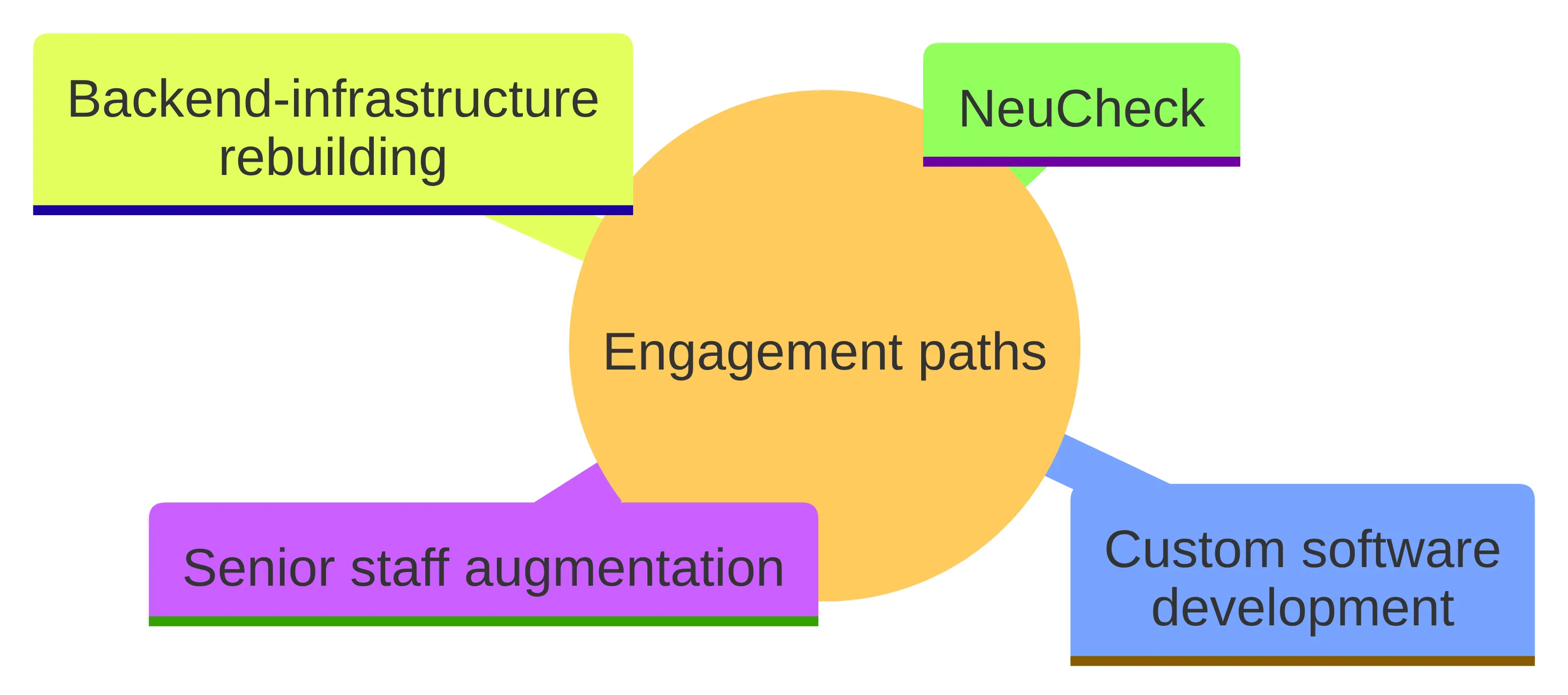
Choose the engagement path that matches the fund’s technology need
Your fund should choose an engagement path by starting with the work that must be owned, not with a general request for technical help. The following map keeps the options separate.
Engagement path
Use it as the starting question when you need
Define before moving forward
Senior staff augmentation
Additional software designers or developers to augment an existing product or development team
Roles, decision rights, reporting line, start conditions, and expected duration
Custom software development
A defined software solution rather than additional seats inside an existing team
Functional boundary, technical deliverables, acceptance criteria, and ownership
Backend-infrastructure rebuilding
A rebuild of backend infrastructure for an existing client environment
Current constraints, migration boundaries, system dependencies, and operating responsibility
NeuCheck
A service that you want to examine through the involvement of senior engineering oversight
What the service covers, the inputs required, the written outputs, and the decisions it is intended to support
NeuCheck is overseen by our most senior engineers. Those are distinct offerings; the descriptions do not establish that any one path is appropriate for your architecture or operating model.
Use the work product to distinguish the paths:
If your internal team retains roadmap and delivery ownership, staffing augmentation may be the relevant starting point.
If you need a defined result with agreed acceptance conditions, custom development may be more appropriate than adding individual contributors.
If the assignment concerns a difficult or aging backend, isolate infrastructure boundaries before deciding whether the work is a rebuild or a narrower intervention.
If the immediate question is technical condition or direction, ask what NeuCheck examines and what decisions its output is meant to support.
If you cannot describe the assignment in one sentence, start with a discovery brief rather than a broad staffing request. State whether you need capacity, a defined build, infrastructure work, or technical examination. Then ask for the proposed responsibilities and deliverables for that path. A clear boundary is the first condition for a useful comparison.
Start by matching the fund’s work product to the engagement path.
Map Neutech’s stated capabilities to hedge-fund software and data work
Your hedge fund’s technology requirement should determine which capability you examine first. Hedge funds should identify software that aligns with their specific strategies and operational requirements. Use that principle to translate a broad technology concern into a bounded workstream.
Data integration: If your assignment involves bringing data from multiple systems into a usable workflow, define the sources, transformations, destinations, ownership, and operating responsibility. Automated data integration is described as fundamental for hedge fund managers, while implementation challenges remain part of the decision. Ask us to explain which part of that assignment we would own and what would remain with your team.
Backend infrastructure: If an existing backend limits a system change, ask whether the proposed work is a rebuild, a contained alteration, or an assessment before any implementation begins. We undertake backend-infrastructure rebuilding for clients, but that statement does not define the boundaries of your environment.
Custom application work: If you have a defined product or workflow to build, compare the proposed scope with our custom software development offering. Ask for the expected deliverables, dependencies, acceptance criteria, and handoff responsibilities rather than relying on a service label.
Additional engineering capacity: If your internal product or development team owns the roadmap and needs additional contributors, evaluate senior staff augmentation. We provide senior software designers and developers to augment product and development teams.
A data assignment should also identify the point at which engineering work becomes an operating responsibility. For example, specify whether the external team is expected to build an integration, monitor it, investigate failures, maintain data mappings, or hand the system to your internal operations group. Each responsibility changes the required access, documentation, escalation path, and acceptance conditions.
This mapping helps you test fit without assuming that a general capability covers every technical layer. We may be relevant to the category of work while still requiring a separate discussion about your data model, system access, production responsibility, documentation, and control requirements. Keep those questions attached to the assignment they affect.
Evaluate capacity, embedding, and commercial flexibility
Our stated capacity and commercial structure should be evaluated as separate questions. We offer month-to-month staffing-augmentation plans, allowing clients to scale up or down with 30 days’ notice. We can also provide two senior-level resources embedded in a client’s team within one week.
Those are stated staffing and commercial terms, not a commitment that the proposed resources, timing, or structure will match your assignment. Ask for the conditions behind the proposed start date and for the practical meaning of scaling up or down. Your diligence brief should cover:
The roles and experience required for the assignment.
The number of resources needed and the expected allocation.
The work that must be completed before a resource can begin.
The person who directs day-to-day work and the person who approves deliverables.
The notice mechanics, transition expectations, and consequences of changing capacity.
The information that must be available for the proposed start date.
The one-week statement should be connected to a specific staffing request. Ask whether it assumes completed role definitions, available access, an identified internal manager, or other conditions. Ask separately whether the two resources would have the same skills, allocation, and responsibilities that your assignment requires. A stated time frame is useful for planning only when its conditions are visible.
A month-to-month structure may reduce the duration of a commitment, but it does not define the quality of delivery, the suitability of a resource, or the controls required for your environment. Ask us to attach each commercial term to the specific assignment you are considering.
Do not fill gaps with assumptions about price, savings, availability, or delivery speed. Put those items into the commercial discussion and record the answer alongside the scope. If capacity can change with notice, document how open work, credentials, documentation, production responsibilities, and knowledge transfer will be handled when the team changes.
Define how an external team would operate inside the fund
Your operating model should describe how outside engineers work with your team, not merely where they sit on an organization chart. We use Scrum and agile planning for project management. We also describe senior-level resources as embedded in a client’s team and provide senior software designers and developers to augment product and development teams.
Before work begins, write down the following operating conditions:
Work ownership: Identify who owns the roadmap, technical decisions, prioritization, approvals, and production responsibility.
Communication: Specify meeting cadence, escalation routes, written records, and the time zone or working-hour overlap your team requires.
Repository and environment access: List the systems, repositories, data environments, credentials, and approval steps involved. Grant only the access needed for the defined assignment.
Delivery evidence: State what must be delivered at each checkpoint, including code, configuration, documentation, test records, or decision notes where applicable to the assignment.
Change control: Explain how scope changes, blocked work, defects, and urgent production matters are recorded and approved.
Handoff: Define who receives the work, what knowledge must be transferred, and which responsibilities remain after the engagement changes or ends.
Your internal team should also decide which ceremonies are mandatory and which decisions cannot be delegated. Scrum and agile planning describe an approach to project management; they do not determine who approves a production release, who accepts a control change, or who responds when a dependency blocks delivery. Put those decisions in the engagement brief.
Ask us to translate the proposed working model into named responsibilities and concrete outputs. If an external engineer attends your planning meetings, specify whether that person may prioritize work, approve a design, merge code, deploy changes, or only provide recommendations. If accountability remains unclear after that discussion, pause the evaluation rather than treating team integration as automatic.
Assess technical oversight through specific diligence questions
NeuCheck is a service we offer, and NeuCheck is overseen by our most senior engineers. That description gives you a useful subject for diligence, but it does not define the service’s scope or establish what decision your fund should make from it.
Ask specific questions before treating technical oversight as part of your engagement:
What problem or decision is NeuCheck intended to address?
What materials, repositories, environments, or system information must you provide?
What written output will you receive, and who is responsible for acting on it?
Does the engagement examine architecture, implementation, or another defined subject?
Which findings require remediation, a design decision, or further investigation?
How are access, confidentiality, data handling, and ownership addressed for the materials reviewed?
Does the service create any implementation work, or must that work be scoped separately?
Connect each question to a decision your fund must make. An architecture review may inform whether to rebuild a backend, while an implementation review may identify work inside an existing codebase. Those are different activities with different inputs and outputs. Do not accept a general description of oversight as a substitute for naming the technical subject under review.
Use the answers to separate oversight from delivery. Senior involvement may be relevant to your evaluation, but the right test is whether the proposed activity produces the information your technology, risk, and compliance stakeholders need for the decision at hand. Ask for the scope in writing and connect each expected output to a named decision-maker.
If the proposed service cannot be described through inputs, activities, outputs, and responsibilities, keep it outside the approved assignment until those boundaries are clear.
Make third-party risk evidence part of the partner decision
Your third-party review should be part of partner selection, not an activity left until after technical work is approved. Implementing a Standardized Information Gathering questionnaire can help organizations navigate third-party relationships, safeguard operations, and reinforce trust with clients and regulators.
Use a questionnaire or equivalent diligence brief to request evidence relevant to your engagement. Include:
The services and environments covered by the proposed work.
The categories of data the external team may access, process, store, or transmit.
Access approval, authentication, least-privilege expectations, and credential handling.
Incident notification responsibilities and the route for escalating a material issue.
Subcontractor involvement, location of work, and responsibility for their actions.
Business continuity, recovery expectations, and dependencies that could affect your operations.
Secure development, change management, testing, and release responsibilities where they apply to the assignment.
Data retention, deletion, return, confidentiality, intellectual property, and termination terms.
Separate the evidence request into three layers. First, identify what the proposed team will do and which environments it will touch. Second, identify the control or contractual requirement that applies to that activity. Third, specify the document, answer, owner, or approval needed to close the question. This structure makes an open issue easier to assign than a broad request for assurance.
A completed questionnaire is evidence for a diligence discussion; it is not a substitute for your own approval process or a conclusion that every control requirement has been met. If your fund has named contractual, legal, regulatory, or client obligations, write those obligations into the brief and ask for the specific evidence needed to assess them. Do not infer a certification, compliance status, or production control from a service description.
Move forward only when the answers identify who owns each control and what documentation supports the answer. Keep unresolved issues visible in the approval record, including the person responsible for resolving each one and the point at which the issue must be closed.
Separate stated capabilities from evidence still requiring verification
Our stated capabilities include senior software designers and developers for product and development-team augmentation; custom software development; month-to-month staffing-augmentation plans with scale changes on 30 days’ notice; two senior-level resources embedded in a client’s team within one week; Scrum and agile planning; NeuCheck overseen by our most senior engineers; and backend-infrastructure rebuilding for clients.
Those statements answer what we offer. They do not answer whether a proposed engagement fits your fund. Verify the items that depend on your assignment and operating environment:
Current resource availability, named skills, seniority, and relevant experience.
The exact work the proposed team will own and the work your internal team will retain.
Access requirements for systems, repositories, data, environments, and production operations.
Security, confidentiality, continuity, incident response, and subcontractor arrangements.
Evidence relevant to your contractual, legal, regulatory, and client obligations.
Expected checkpoints, acceptance criteria, documentation, handoff, and post-delivery responsibility.
Fees, notice mechanics, capacity changes, expenses, and termination consequences.
Use a simple distinction in your approval record: stated capability, assignment-specific proposal, supporting documentation, open question, and decision owner. That structure keeps a broad service description from being mistaken for a commitment or control conclusion. Ask us to answer open questions against the exact scope rather than accepting general assurances.
The distinction also helps your stakeholders ask different questions of the same proposal. Your engineering lead can test architecture, skills, dependencies, and delivery ownership. Your risk or compliance function can assess access, data handling, continuity, and third-party obligations. Procurement can evaluate fees, notice, termination, and responsibility for changes. A proposal is easier to approve when each reviewer can see the question that belongs to them.
Prepare a bounded quote request for a defined assignment
Your project brief should give a potential partner enough information to respond to the assignment rather than to a vague category of need. Keep the document short, specific, and usable by technical, risk, procurement, and business stakeholders.
Include these sections:
Business purpose: State the operational problem, the users or internal teams affected, and the decision the work should support.
Scope: Describe the systems, workflows, integrations, or infrastructure included. List explicit exclusions so an initial response does not assume unlimited responsibility.
Required skills: Identify the engineering disciplines, platform knowledge, data experience, and domain context required for the assignment.
Technical environment: Name the relevant applications, repositories, interfaces, data stores, deployment environments, dependencies, and constraints.
Data and access: Describe data categories, access levels, approval steps, handling restrictions, credentials, and environments the team may use.
Delivery expectations: Set checkpoints, acceptance criteria, documentation needs, testing responsibilities, handoff requirements, and any uptime or operational expectations that apply.
Accountability: Name the internal sponsor, technical owner, risk or compliance participants, approver, escalation contact, and decision rights.
Commercial structure: State the expected resource model, timing assumptions, duration, capacity changes, notice requirements, and information you need in the commercial response.
Ask for a response that mirrors this structure. Then compare the proposed work, people, timing, controls, outputs, and terms against your brief. If a response leaves ownership or access conditions open, record the gap and resolve it before approval. A bounded assignment gives you a basis for evaluating fit without treating a general capability statement as a project commitment.
Before sending the brief, remove questions that your own team has not decided. Identify whether the request is for staff augmentation, a defined build, backend work, or technical examination. Mark assumptions about system access, timing, data, and internal availability as assumptions rather than commitments. This makes the response easier to compare and reduces the risk that a supplier fills an undefined boundary with its own interpretation.
For the commercial response, request the proposed team structure, allocation, start conditions, notice mechanics, and responsibilities alongside any price information. For the technical response, request scope, deliverables, dependencies, acceptance conditions, and handoff. Keep those responses connected so that a staffing proposal cannot be evaluated separately from the work it is expected to perform.
Structured follow-up is appropriate when the assignment and proposed responsibilities can be documented.
The decision should turn those stated capabilities into an assignment-specific proposal. Require clear scope, named ownership, access conditions, technical outputs, third-party evidence, commercial terms, and a handoff plan. If those points remain unresolved, keep the evaluation open rather than treating a general service description as approval.
Use your brief to decide what happens next: request a scoped response when the assignment and decision owner are clear; resolve diligence questions when access or control responsibilities remain open; or pause when the proposed path does not match the work your fund needs. That sequence keeps a contact conversation separate from an approval decision.
A qualified professional responsible for your fund’s technology, risk, legal, or compliance obligations should decide individual suitability and required controls. With that boundary in place, use your defined assignment and diligence questions to determine whether further discussion is warranted.
What should a hedge fund verify before requesting a project quote?
What services does Neutech provide for hedge funds?
Neutech offers senior software designers and developers for staff augmentation, custom software development, backend-infrastructure rebuilding, and a service called NeuCheck overseen by senior engineers.
What is the flexibility of Neutech's staffing plans?
Neutech offers month-to-month staffing-augmentation plans, allowing clients to scale up or down with 30 days’ notice.
What should hedge funds consider when evaluating Neutech as a partner?
Hedge funds should define their specific technology needs, assess Neutech’s capabilities against those needs, and clarify roles, responsibilities, and access conditions before proceeding.
What are the key factors for hedge funds when assessing third-party software providers like Neutech?
Hedge funds should evaluate third-party providers based on their ability to meet specific operational requirements, compliance standards, data security measures, and the clarity of their service offerings.
How can hedge funds prepare a project brief for Neutech?
A project brief should include the business purpose, scope, required skills, technical environment, data access, delivery expectations, accountability, and commercial structure.