Iteration revisits work; increments add to what is built
Agile software development can be understood through two related ideas: iteration and increment. Iteration revisits or refines work; an increment adds to what has been built. Agile emphasizes how you and your team respond to changing understanding of the work, rather than requiring every project to follow the same fixed recipe.
That distinction matters when you encounter labels such as Scrum or Kanban. A team can use Agile principles without treating one framework as the definition of Agile itself. The approach emphasizes people, customer feedback, and working solutions over rigid processes and documentation; it does not make every process or record unnecessary. The useful question is what helps you collaborate, learn, and adapt while building the software.
The Agile Manifesto emerged from a February 11–13, 2001 meeting in Utah, where 17 people sought common ground on software development. That origin is consistent with treating Agile as a set of shared principles rather than a single implementation manual.
For your project, use the term to describe an orientation toward collaboration, feedback, and adaptable work. Then look at the actual practices your team proposes. Their names alone do not tell you how decisions get made, how feedback reaches the work, or what kind of software is delivered.
Feedback guides the next cycle of design and development
Agile project management is an iterative development process that continuously gathers feedback from users and stakeholders to create the right user experience. This makes feedback part of the way work proceeds, not simply a final reaction after everything has been built. The approach connects repeated work on a product or service with opportunities to learn from the people involved.
A practical way to picture the cycle is to:
Identify a question or part of the work that needs attention.
Design or develop a response.
Put the resulting work in front of the relevant users or stakeholders when appropriate.
Consider what their feedback means for the next cycle.
This is a thinking aid, not a required Agile ceremony or a universal schedule. The useful feature is the connection between doing work and using feedback to guide what happens next.
Feedback informs decisions; it does not automatically decide them. You still need to interpret what you hear, relate it to the purpose of the software, and decide what should change or continue. A request, observation, or concern may point to a useful adjustment, but your team has to make that judgment in the context of the work.
This also explains why iteration is more than dividing a project into short periods. A recurring schedule without a way to consider feedback may repeat activity without changing what the team understands. Conversely, feedback that arrives but never affects a later decision is not doing the work described by an iterative approach. The connection matters: each cycle gives you another chance to reconsider the design or build based on what you have learned.
If you are assessing a proposed process, ask where feedback enters the work and how it can shape a subsequent decision. You do not need a particular meeting name to ask that question. The answer should make the path from feedback to later work understandable.
Iteration revisits work; increments add to what is built
Iteration and increment describe related but distinct aspects of development. Iteration means returning to design or development work to reconsider or refine it. An increment means adding a portion to what has been built. Agile frameworks such as Scrum are built on iterative and incremental development.
You can keep the distinction clear with two questions: What did you revisit or adjust? What new portion did you add? The first question focuses on learning and refinement across cycles. The second focuses on how the product or service grows in pieces. A cycle can include both, but you do not have to treat every revision as a new addition or every addition as proof that earlier assumptions have been reconsidered.
For example, suppose your team is developing a user-facing feature. Adding a small part of that feature is an increment. Showing the work to users or stakeholders and then changing its design in response is iterative work. The example separates the two ideas without prescribing a particular feature, release pattern, or method for your project.
The distinction helps you describe what a plan actually accomplishes. If a plan emphasizes iterations, ask how the work can be revisited as understanding changes. If it emphasizes increments, ask what portions are expected to be added over time. If it uses both ideas, ask how feedback and additions relate: does an increment create something the team can learn from, and can that learning shape later work?
These questions help you talk about delivery with more precision than the word “Agile” alone provides. They also keep progress from being reduced to a single measure: work may be refined, expanded, or both, and those are different kinds of movement.
Agile is broader than Scrum or any single method
Agile is the broader approach; Scrum, extreme programming, Lean, and Kanban are among the methods used to carry out an Agile process. Naming a method tells you more about the chosen structure, but it does not by itself explain how your team will apply it.
The available methods include:
Scrum
Extreme programming
Lean
Kanban
These examples are not an exhaustive menu or a ranking. They show why it is useful to separate the principle from the method: Agile describes an orientation toward adaptable, collaborative work, while a method provides a way to organize practices.
Teams can tailor Agile practices to their needs and may blend frameworks such as Scrum and Kanban. Tactics for using Scrum also vary with context. Together, these points argue against choosing practices by label alone: the same framework name does not describe every detail of how work is handled.
When you examine an approach, look for the practical arrangement behind its name. How does work move from an idea to design and development? Where can users or stakeholders offer feedback? How does your team decide what to revisit and what to add? These questions let you assess whether the described practices support the work you need to do, without assuming that a particular method automatically fits every project.
You can also treat a method as something to examine and adjust rather than as a complete answer. The approach is adaptable, but that does not mean practices should change without a reason. Make the purpose of a practice clear, then consider whether it helps your team collaborate, use feedback, and work toward useful software.
Agile describes an approach; methods provide ways to organize practices.
Working solutions do not remove documentation needs
Agile’s preference for working solutions over rigid processes and documentation is a statement about emphasis, not a rule that documentation has no place. Working software and useful records answer different questions. Software shows what has been built; records can help make decisions and work understandable. The Agile principle does not, by itself, determine what records your project needs.
That distinction is especially worth keeping in view when you work on fintech or healthcare software. Do not use the word “Agile” as a reason to set aside documentation or evidence that your project’s obligations call for. At the same time, a preference for working solutions does not require you to turn every activity into a rigid paperwork process. The practical task is to understand what matters for your project and fit that work into the way development proceeds.
Use questions like these to make the boundary concrete:
What records or evidence does your project need to maintain?
Which work, decisions, or changes should those records make understandable?
Who will keep the relevant information connected to the work as it develops?
How will your team tell whether its approach to documentation still fits the project?
These are prompts for discussion, not a universal checklist of required records. Their purpose is to keep two concerns visible at once: the team needs working solutions, and it needs to understand the documentation expectations that apply to its own work. Agile describes an approach to organizing development; it does not settle that project-specific question for you.
Regulated teams must assess security and evidence separately
For fintech and healthcare software, Agile can describe how your team organizes work, receives feedback, and adapts. It does not establish that the resulting software meets applicable regulatory or security obligations. Those are separate questions for your project. An iterative schedule or a set of working increments should not be mistaken for proof of compliance, security, or project success.
Keep the distinction visible when planning. Your delivery approach answers questions about collaboration and the progression of design and development. Your project’s applicable security, traceability, risk, and evidence needs require their own consideration. Agile alone does not tell you which obligations apply, what evidence is needed, or whether a particular product meets them.
A security-focused example appears in the April 2024 initial public draft of NIST SP 800-218A. That draft recommended reusing existing, well-secured software when feasible to lower development costs, expedite development, and decrease the likelihood of introducing additional security vulnerabilities. It described reuse as particularly important for software that implements security functionality, including cryptographic modules and protocols.
The recommendation is bounded: it concerns existing software that is well-secured, and it says to reuse it when feasible. It is not a reason to assume that any existing component is suitable or that reuse settles your project’s security considerations. For your planning, it can prompt a focused question: where security functionality is involved, is there existing, well-secured software that is feasible to reuse?
This keeps Agile’s potential usefulness and its limits in the same frame. Feedback and iteration can help your team adapt its design and development work. They do not replace attention to security choices or the evidence your project needs. Reuse, where feasible and appropriate to the project, is one consideration from a security-development recommendation; it is not a complete security process.
If you are working in financial services or healthcare, make the relationship between delivery practices and project obligations explicit. Ask which concerns need attention alongside the next development cycle, who is responsible for addressing them, and how the team will understand whether its approach remains appropriate. Those questions do not turn Agile into a compliance method. They help you avoid confusing a way of organizing work with a conclusion about compliance or security.
Choose practices that fit the project’s constraints
Choose Agile practices by looking at the work they need to support, not by assuming that a framework name settles the decision. Teams can tailor practices or blend frameworks such as Scrum and Kanban, and tactics vary with context. A useful starting point is to name the feedback your team needs, the work it expects to revisit, and the portions it expects to add.
You can then review the proposed approach with a few practical questions:
How will collaboration and feedback fit into design and development?
What will your team revisit, and what will it add as an increment?
What documentation, security, traceability, risk, or evidence considerations need separate attention for this project?
How will you tell whether the selected practices remain useful as the work proceeds?
Experimenting with practices and reviewing their effectiveness is a way to consider whether they support collaboration and continuous improvement. Keep the review tied to your project’s aims and constraints; a framework is a structure to work with, not a guarantee of compliance, security, or success.
If your team is evaluating a regulated fintech or healthcare software project, bring its delivery goals, feedback needs, and constraints into the planning conversation. A qualified professional should determine how particular regulatory obligations apply to your work.
What should regulated teams clarify about Agile?
How should a team handle stakeholder feedback that conflicts with project constraints?
Treat feedback as input to a decision, not an automatic instruction. Consider it alongside the software’s purpose and the project’s constraints, then decide whether it should change the design or later work.
Does a working increment demonstrate that regulated software is compliant?
No. An increment shows a portion of what has been built; it does not establish that the software meets applicable regulatory or security obligations. Consider those requirements and any needed evidence separately.
Does software agile development require managers to direct every task?
No particular management behavior follows from the Agile label alone. Agile emphasizes collaboration, feedback, and adaptability, but the team’s actual practices determine how work is directed. Assess the working arrangements rather than assuming a framework name specifies them.
Agile is a delivery approach, not a product or tool
Agile software development is an iterative, incremental way to manage design and build work while gathering feedback from users and stakeholders. Instead of treating the full product as a single handoff, you organize delivery into smaller pieces, inspect what those pieces reveal, and adjust the next part of the work.
That definition describes a delivery approach, not a software product, vendor, certification, or tool. Tools can help you plan, communicate, test, or document work, but a tool does not make the delivery approach agile. The defining question is how your team makes progress, receives feedback, and changes direction.
Regulated software delivery adds a governing condition: adaptability must operate inside requirements for security, quality, review, documentation, and evidence. Agile does not automatically satisfy SOC 2, HIPAA, PCI, or another obligation. Your team has to identify the applicable requirements and place them into the delivery system at the points where they matter.
A useful test is therefore not whether agile sounds flexible. Ask whether each increment can produce controlled, testable, reviewable, and auditable progress without leaving material obligations until the end.
The governing loop is small work, working feedback, and adaptation
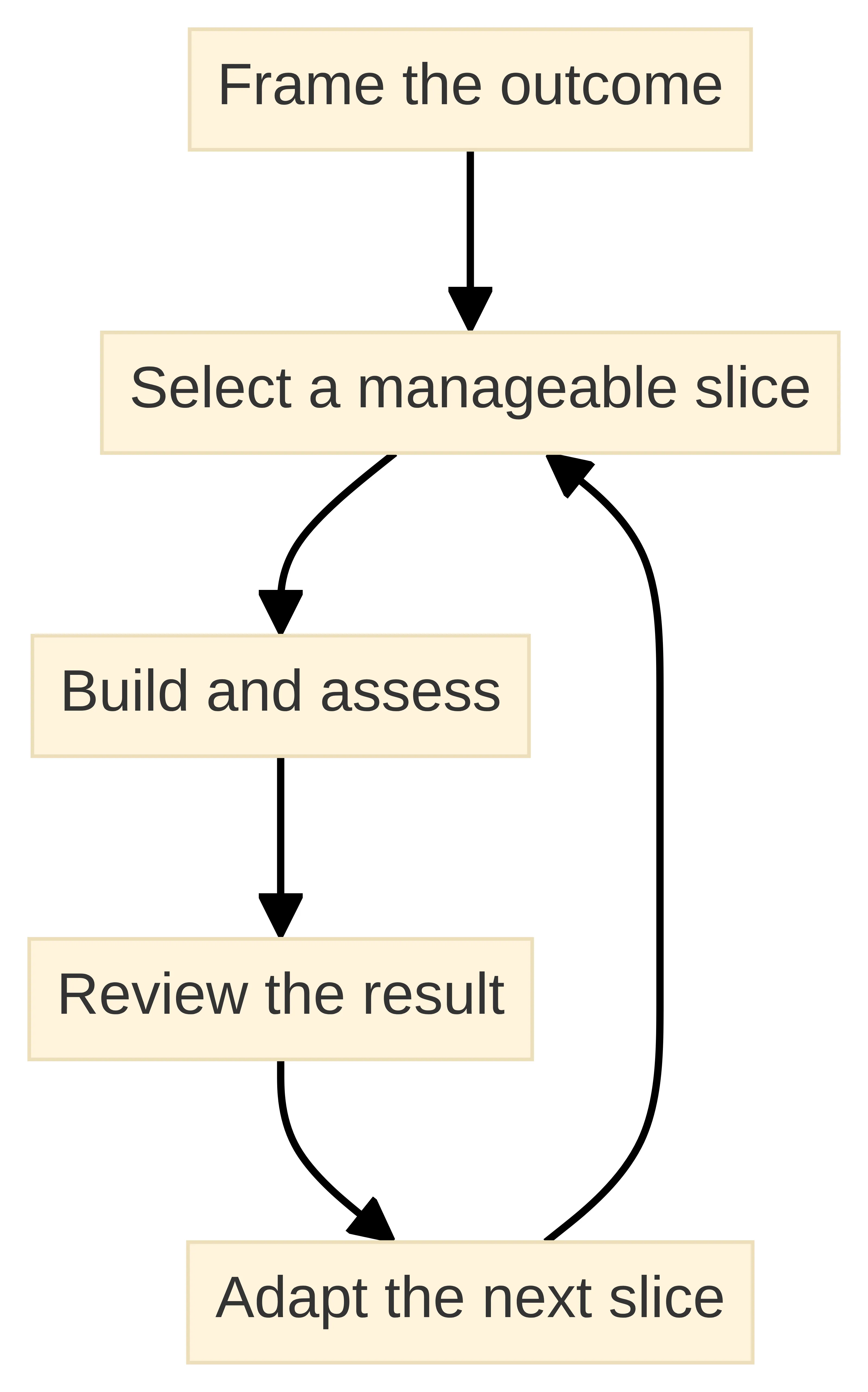
The agile delivery loop connects a limited piece of work with feedback and a decision about what happens next. Agile software development uses iteration and continuous feedback from users and stakeholders, while agile project management applies an iterative and incremental approach to design and build activities.
A practical loop looks like this:
Frame the outcome. State the user, business, technical, security, and control conditions that the work must satisfy.
Select a manageable slice. Choose a part of the outcome that the team can build and evaluate without pretending that the entire solution is finished.
Build and assess. Produce the slice and apply the appropriate engineering, quality, and security activities.
Review the result. Use stakeholder or user feedback, observed behavior, and unresolved risks to examine what the increment means.
Adapt the next slice. Continue, revise, reorder, or stop work based on what the review established.
Feedback is useful only when it can change a decision. If your review produces comments that never affect requirements, priorities, risk treatment, or acceptance, the team is collecting information without completing the governing loop.
Requirement volatility means that software requirements are uncertain or change during development. A qualitative study of 12 people with agile-project experience identified six primary causes of requirement volatility and three agile practices that helped mitigate it. The study provides a useful warning, not a universal prediction: iteration can expose change earlier, but it does not remove the need to control and communicate that change.
The loop turns each increment into feedback that shapes what happens next.
Frameworks implement agile; they do not define it
Agile frameworks and methods provide ways to organize the broader approach. Scrum, extreme programming, lean, and Kanban are examples used within agile processes. Scrum is one agile framework for maintaining and continuously developing projects; agile itself is broader than Scrum.
That distinction matters during evaluation. If a proposal says that a team uses Scrum, you still need to understand how the team handles product decisions, engineering quality, security, stakeholder feedback, documentation, and acceptance. A framework name does not answer those questions.
A framework gives your team a working structure, but the structure still needs a defined responsibility boundary. In the USDS agile example, the government retains responsibility for the product vision, contractual requirements, acceptance criteria, iteration plans, and revisions to the overall plan. The example illustrates a broader operating principle: the team performing delivery does not automatically own every product or acceptance decision.
Before selecting a framework, write down who can define the outcome, prioritize work, approve an increment, accept a result, and revise the plan. Then choose the practices that make those responsibilities visible.
Agile and predictive delivery answer different planning questions
Agile and predictive delivery organize planning around different assumptions. Neither label settles the fit for your project. The relevant question is which planning pattern can handle your uncertainty, controls, dependencies, and decision rights.
Planning criterion
Agile delivery
Predictive delivery
Primary planning question
What useful, reviewable increment should you develop and assess next?
What defined sequence and target should the plan execute?
Response to changing requirements
Revisit priorities and adapt later increments as new information appears.
Assess the effect of a change against an established plan, scope, and dependency structure.
Feedback timing
Invite feedback throughout incremental delivery.
Concentrate more feedback at planned review or acceptance points.
Main operating demand
Maintain disciplined prioritization, dedicated participation, and repeated review.
Maintain a reliable baseline, controlled change process, and dependency coordination.
This distinction prevents two common misreadings. Agile still requires planning: the plan is revisited as evidence and feedback change what the team knows. Predictive delivery still requires change control: a baseline does not make new information disappear. The difference is where the process places the decision. Agile expects more decisions about the next increment and its acceptance; predictive delivery expects more decisions about whether a requested change should alter an established sequence, scope, or dependency. For a regulated initiative, compare both patterns against the consequences of late discovery and uncontrolled change. If late discovery could affect controls or system boundaries, earlier review may be valuable. If a dependency or approval must remain stable, that part of the work may need a more fixed plan. Compare the approaches at the level of a workstream or control boundary rather than assigning one label to the entire initiative.
The trade-off is not simply speed versus caution. Iteration can help you expose uncertain requirements and gather feedback earlier, but it creates a recurring planning and coordination burden. Work must be selected, completed, reviewed, and documented repeatedly.
Small tasks do not solve a resourcing problem by themselves. Evidence from iterative audit work shows that scheduled activities can be delayed when the organization does not dedicate resources, and incomplete work can affect the schedule. For your software initiative, ask whether product, engineering, security, compliance, and operational participants can give the work attention at the required points. If they cannot, a nominally agile process may create unfinished increments rather than useful control.
Regulated delivery puts governance inside each increment
Regulated software delivery needs compliance and risk decisions to appear during the lifecycle, not only during a final review. A regulated development process should ensure that organizational and procedural compliance requirements are fulfilled by the required point in the product or service lifecycle.
Requirement: Which business, security, privacy, contractual, or regulatory condition applies?
Risk: What could fail, and what product-specific quality risk does that create?
Control activity: What review, test, approval, restriction, or operating step addresses the risk?
Acceptance: What observable result allows the increment to be accepted or sent back for further work?
Evidence: What record demonstrates the decision and the result?
Agile does not turn a delivery process into a compliance program by itself. Your team must map the obligations that apply to the product and decide when each one has to be satisfied. Some requirements may be addressed early; others may depend on a later system boundary, operational condition, or formal approval.
Product-specific quality risks can be handled through structured identification, transparent risk management, and defined mitigation actions. That gives your team a way to adapt without treating every change as harmless. A changed requirement should trigger a review of affected controls, tests, documentation, dependencies, and acceptance conditions.
Secure-development practices need shared ownership
NIST’s Secure Software Development Framework provides common language for describing fundamental secure software practices and is intended for use with modern development models such as agile and DevOps.
Use that shared language to make security part of ordinary delivery decisions. A business owner can clarify the protected outcome and acceptable conditions. Product and engineering roles can turn those conditions into work and acceptance criteria. Cybersecurity and operations roles can identify relevant risks and operating expectations. Acquisition roles can express required supplier practices when outside delivery capacity is involved.
A secure delivery arrangement needs explicit participation rather than a late security checkpoint. Define who contributes to risk identification, who reviews proposed controls, who evaluates evidence, and who can accept unresolved risk. Keep those decisions visible as the work changes.
This approach does not prescribe a particular tool or framework. It establishes a working boundary: every increment should have the security and quality questions needed for its scope, along with a clear route for resolving issues that the increment exposes.
Documentation and evidence are part of delivery
Documentation and audit evidence need deliberate planning when work is delivered incrementally. In iterative audit work, activities and findings are produced in stages, so teams must plan for evidence collection and documentation while the work is performed.
The same operational concern applies to your software delivery records: if you postpone all explanation until the end, the people who performed, reviewed, or approved earlier work may no longer have the necessary context. Iteration therefore requires a small, repeatable record for each meaningful increment rather than a large documentation exercise after delivery.
An increment record can contain the following items:
the requirement, risk, or decision the increment addresses;
the change that was made and the relevant system or data boundary;
the tests, reviews, or other control activities performed;
the result, approval, exception, or unresolved issue; and
the evidence location and the owner of the next action.
This is a practical record structure, not a universal compliance checklist. Your applicable obligations determine what must be retained, who must approve it, and how long it must remain available. The record is useful when it lets you reconstruct what changed, why it changed, what was assessed, and what still requires action.
Use change, risk, and control demands to test fit
Project fit depends on whether your organization can support the governing loop, not on whether agile is fashionable or familiar. Test the initiative against five questions:
How uncertain are the requirements? If user needs or system behavior are likely to change, incremental feedback may help you learn before the full solution is fixed. You still need a method for assessing the effect of each change.
How specific are the control deadlines? Identify when compliance, security, quality, or approval requirements must be fulfilled. An iterative approach needs enough planning to meet those points.
Who can participate repeatedly? Product, engineering, security, compliance, operations, and stakeholder roles need time to perform their assigned activities. Undedicated resources can leave scheduled work incomplete.
Can you make progress observable? Each increment should have a defined result, appropriate evaluation, and an evidence record that supports the relevant decision.
What happens when a risk remains open? Establish who can accept, mitigate, defer, or reject the risk before the team encounters it.
Use an iterative approach when you can provide recurring stakeholder feedback, dedicate the roles needed for each increment, and place control work inside the delivery cycle. Begin with a bounded slice and define its acceptance and evidence conditions before expanding the scope.
Use a predictive or mixed delivery pattern when fixed dependencies, formal approvals, or control deadlines require a stable sequence for part of the initiative. You can still use feedback and incremental work inside that boundary, but do not describe the whole initiative as adaptable if a material portion cannot change without a formal decision.
The decision should be recorded as a set of conditions rather than a permanent label. Revisit it when requirements, system boundaries, risks, resources, or applicable obligations change.
Choose the delivery approach your controls can support
The delivery approach for regulated software should connect adaptability with governance. Agile can help you work incrementally and use stakeholder feedback, but its fit depends on whether your team can make each increment controlled, testable, reviewable, and supported by appropriate evidence.
Before you commit, capture four decisions:
the outcome and system boundary;
the requirements, risks, and control deadlines that apply;
the roles responsible for building, reviewing, accepting, and documenting each increment; and
the conditions that would cause you to change the delivery pattern.
A qualified professional must decide whether a particular approach fits your initiative, obligations, and operating environment. This guide gives you a structure for that discussion; it does not determine individual compliance or legal suitability.
For a regulated fintech or healthcare initiative, prepare the project scope, delivery constraints, security and compliance expectations, stakeholder responsibilities, and evidence requirements before discussing capacity. A bounded brief makes the delivery question concrete and gives you a basis for evaluating whether the proposed team can support the controls your initiative requires.